A V8-swapped Land Cruiser does not have one universal overheating diagnosis or pressure specification. The radiator, cap, thermostat, hoses, fan system, ECU and bleeding method may come from different vehicles. Start by identifying the Land Cruiser generation, donor engine and every cooling-system component actually installed. Then verify the temperature reading, inspect the complete heat-rejection path, check coolant circulation and perform a donor-specific pressure test. Do not open a hot system or continue driving while the temperature is still rising.
Why a V8 swap changes the diagnosis
A factory Land Cruiser cooling system is engineered as a matched assembly. A conversion may combine a donor V8 with the original chassis radiator, an aftermarket radiator, custom hoses, a different pressure cap, electric fans and a controller from yet another application. The dashboard gauge may still use the chassis sender, while the engine ECU reads a donor sensor. Those systems can disagree.
As an Amazon Associate I earn from qualifying purchases.
Before selecting a thermostat, cap, coolant, fan or replacement radiator, write down:
Free tools Windows power users keep installed
One-click scans. No signup required.
- Land Cruiser generation and model year.
- Donor engine family, exact displacement and donor year.
- Radiator make and dimensions, pressure-cap rating and overflow-reservoir arrangement.
- Thermostat part number, opening direction and whether a bypass passage is present.
- Fan type: belt-driven clutch fan, donor electric fans or custom electric fans.
- ECU and fan-controller identity, including whether the donor ECU was retained.
- Coolant hose routing, heater-core connections and any bleed screws or surge tanks.
Without those details, a factory specification from one V8 can be unsafe to apply to another.
#1 Best Overall
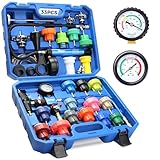
- 🔧【COMPLETE 33-PIECE MASTER KIT】This all-in-one coolant pressure tester and vacuum refill kit includes 23 radiator adapters (22 specific + 1 universal), a vacuum pump, a vacuum purge & refill tool, a probe thermometer, a wrench, EU & US air intake joints, O-rings, and hoses. Everything you need to diagnose cooling system leaks and refill without air pockets—all in one rugged carrying case.
- 🚗【WIDE COMPATIBILITY – 23 ADAPTERS FOR MOST CARS】With 23 different radiator adapters, this cooling system pressure tester works on most passenger vehicles, including Japanese, German, American, Korean, and European makes. Covers sedans, SUVs, trucks, and many light-duty vehicles. No more guessing which adapter fits—we‘ve got you covered.
- 🔍【DUAL FUNCTION: PRESSURE TESTING & VACUUM REFILL】Identify leaks quickly with the pressure testing function—check header tanks, expansion tanks, head gaskets, radiator cores, heater matrix, water pumps, and pipes. Then use the vacuum refill tool to purge air and refill coolant without any trapped air pockets. This two-in-one system saves time and prevents engine overheating.
- 📦【EASY ORGANIZATION & QUICK IDENTIFICATION】Color-coded adapters and molded size markings let you grab the right adapter instantly. The custom-molded carrying case keeps every component securely in its place, so you never lose a part. Hassle-free storage and transport for professional mechanics and DIYers alike.
- 💪【BUILT FOR DAILY USE – DURABLE MATERIALS】Constructed with quality aluminum alloy, nylon, rubber, and brass, this coolant pressure tester is engineered to withstand frequent use in busy workshops. The robust build ensures consistent performance and long-term reliability—year after year.
Safety before any inspection
Never remove a radiator cap, surge-tank cap or hose from a hot, pressurized system. Toyota warns that escaping coolant or steam can cause serious burns. Switch the engine off, keep people clear of the fan, and wait until the system is fully cold. If coolant is being expelled, the temperature continues to climb, or the warning system indicates coolant loss, stop driving and arrange a tow; continued operation can damage head gaskets, cylinder heads or the engine block.
There is no universal “safe temperature” for every swapped engine. Use the donor engine’s service information and the actual sensor data for your installation rather than guessing from a dashboard needle position.
Establish exactly when and how it overheats
Record the conditions each time the temperature rises. Ask whether it happens while idling in traffic, at steady cruising speed, on a hill, while towing, with the air conditioner operating, or in all of those situations. “Overheating only on the highway” is an owner description, not a diagnosis; road speed, engine load, airflow and coolant flow all need to be checked.
The Tool Desk
Outbyte PC Repair FREERepair Windows errors before they cause bigger problemsFix Now →Outbyte Driver Updater FREEScan for outdated or missing drivers - takes under a minuteDriver Scan →Confirm the source of the temperature information before replacing parts. Determine whether the reading comes from the original dashboard sender, the donor ECU, an aftermarket gauge or an independent infrared or data-logging instrument. Conversion wiring can give a stable-looking gauge an incorrect signal, and a generic scan tool may not communicate with a donor ECU that was not retained.
Rank #2

- 【TROUBLESHOOTING & SAVING MONEY】28pcs universal radiator pressure tester and vacuum refill kit with functions of leak detection, temperature measurement, liquid filling, etc. If you use the coolant pressure tester, the tester can quickly and easily solve any problems related to radiator pressure, making your job easier and faster.Note: Please select the corresponding adapter according to the user manual; otherwise, leakage may occur. If a suitable adapter is not available, please use a universal adapter, which is suitable for all vehicle models.
- 【ALL-IN-ONE TOOL KIT】1 x Radiator manual pressure tester(0-35psi/0-2.5 bar); 1 x Pneumatic vacuum coolant refiller(-30 to 0inHg/ -76 to 0cmHg); 1 x 19" Rubber nylon resin hose; 1 x Thermometer(32 - 400 ℉); 3 x Radiator cap test adapters; 1 x Universal tapered rubber adapter; 17 x Adapters; 1 x Adapter handle; 2 x Connectors; 1 x Storage case.
- 【TOP QUALITY MATERIAL】Radiator manual pump pressure detector adopts a premium aluminum cylinder and accurate shock-proof gauge design. A vacuum-type coolant refiller uses reliable brass and plastic material—a rubber hose with brass parts, anti-corrosive and waterproof. American & European style air plugs are provided for various air hoses.
- 【KEY EASE-OF-USE FEATURES】Color-coded caps help you quickly choose the right adapter without confusion.All-in-one design eliminates need for multiple separate tools.Clear instructions guide you through pressure testing and vacuum filling.Quality gauge provides accurate, easy-to-read pressure measurements,that even if you're new to cooling system work, the comprehensive kit and straightforward process make it accessible for DIY mechanics.
- 【APPLICATION】The kit includes 3 radiator cap test adapters for common cap styles.Look at your expansion tank: Most adapters are designed for expansion tank necks.Color-coded system: Each adapter has a colored cap to help you quickly identify the right fit.Universal tapered adapter: Included as a backup option for unusual fittings.Compatible with: Mercedes-Benz, BMW, Audi, VW, Ford, GM, Toyota, Honda, Nissan, Mazda, Subaru, and many more brands.The comprehensive adapter selection means you'll likely have the right fit, and if one doesn't work perfectly, you can try others in the set.
| Observed pattern | First inspection priority | What the pattern does not prove |
|---|---|---|
| Idle or slow traffic | Fan operation, fan-control trigger, shroud fit, radiator and condenser airflow | It does not by itself prove the radiator is undersized. |
| Highway cruising | Coolant level, circulation, thermostat, hose collapse, radiator restriction and temperature measurement | It does not prove the fan is irrelevant or that the thermostat is faulty. |
| Hills, towing or sustained load | Full heat-rejection capacity, ignition and fueling condition, coolant flow and airflow under load | It does not establish an internal engine leak without testing. |
| A/C on changes the result | Condenser blockage, fan staging and controller logic, plus added engine load | It does not identify a single failed component. |
| All conditions | Coolant loss, air trapped in the system, pump or thermostat operation, radiator restriction and engine condition | It does not justify removing the thermostat. |
Start cold: level, leaks and coolant condition
- With the engine completely cold, check the reservoir level against the mark used by your installation. If the system has a separate fill neck or surge tank, inspect it only when cold and only according to that system’s design.
- Look for dried or crusted coolant around the cap, radiator seams, hose joints, water pump, thermostat housing, heater hoses and custom adapters. Wetness may appear only when the system is hot, so residue is useful evidence even when no drip is visible.
- Inspect every hose for swelling, soft sections, kinks, collapse marks and contact with belts, pulleys, exhaust parts or sharp brackets. Check that clamps are positioned on sound hose, not on a damaged or flared section.
- Examine the coolant for oil film, unusual discoloration, rust or scale. Note whether the mixture is contaminated or repeatedly diluted with plain water.
- Inspect the pressure cap seal and neck for damage. Use the cap specification for the installed radiator or surge tank, not automatically the chassis specification.
Toyota factory technical documentation for named Land Cruiser and Prado applications specifies Toyota Genuine Super Long Life Coolant, or a similar ethylene-glycol coolant with non-silicate, non-amine, non-nitrite and non-borate chemistry using long-life hybrid organic-acid technology. That formulation should not be prescribed to an unidentified donor engine without checking the donor manufacturer’s compatibility requirements.
Check the radiator, condenser and fan system
Radiator and condenser airflow
Inspect the entire radiator face and the condenser in front of it. Mud, bent fins, plastic bags, auxiliary coolers and tightly packed accessories can block airflow. From the engine side, verify that air is being pulled or pushed in the intended direction. A fan that spins the wrong way after a wiring change can move air while providing little cooling.
Identify the fan architecture
Do not assume a swapped V8 uses the original Land Cruiser fan arrangement. A factory 2UZ-FE Land Cruiser arrangement includes a fluid-coupling fan, shroud, radiator and reservoir. Toyota’s 3UZ-FE material describes electric fans controlled through the engine-management system. A conversion may retain either design or use a custom controller.
- For a belt-driven clutch fan, inspect the blades, hub and surrounding area for damage or fluid leakage. Confirm that the shroud is present, intact and positioned close enough to draw air through the full radiator core.
- For electric fans, verify fuse and relay condition, wiring grounds, controller commands and both low- and high-speed operation where applicable. Check that the fans start at the intended temperature or A/C request, not merely when power is applied manually.
- For custom fans, confirm that the controller’s temperature input matches the sensor actually installed and that the fan’s current demand is within the wiring and alternator capacity.
A fan that works on a bench but not under the controller’s normal trigger is still a fault. Observe operation with the engine warm and the A/C switched on, while keeping hands, clothing and tools away from moving blades.
Rank #3

- MULTIFUNCTION: The 14 pcs radiator pressure tester kit allows detecting for leakage in radiator system, especially head gasket failure detection, and help you to change coolant more efficiently.
- WELL MADE KIT: The adapters are made of high quality aluminum, and treated with rust and corrosion protection. High tenacity rubber and high-impact plastic for longer service life.
- COLOR CODED SET : Color coded radiator adapters are convenient to select the suitable one according to different colors without messy. 124pcs radiator adapters are perfect to test cooling systems on most vehicles.
- EASY TO CARRY: The thickened carrying case keeps all accessories in place and protects the gauges during storage and transportation.
- 100% Satisfaction: We are responsible for every product. If you have any problems with our products or services, please contact us immediately and we will provide you with exceptional responses to your every concern.
Verify hoses, bypasses and coolant circulation
Trace every hose from the engine to the radiator, heater core, reservoir and any auxiliary circuit. Compare the installed routing with the donor engine’s coolant-flow diagram and the radiator layout. Look for a heater hose bypassed incorrectly, a surge-tank line connected to the wrong port, a hose routed uphill where it traps air, or a section that flattens as the engine cools.
The thermostat is a flow-control component, not a plug. Toyota’s 2008 Land Cruiser 3UR-FE thermostat procedure states: “Even if the engine tends to overheat, do not remove the thermostat.” Removing it can reduce cooling efficiency because the thermostat and bypass circuit help control the coolant’s path and residence time.
Confirm that the thermostat is the correct specification for the donor engine, installed in the intended orientation, and seated without sealant obstructing the bypass. Check the water pump for the donor’s required rotation and drive arrangement, and inspect for bearing noise, shaft play or leakage. A pump can appear intact while its impeller is damaged or slipping.
Do these 3 things before closing this tab:
1Repair Windows errors before they cause bigger problems2Scan for outdated or missing drivers - takes under a minute3Clear out junk files and repair common Windows errorsBleed the system using the donor-specific procedure. Toyota’s 1UZ-FE documentation describes a pressurized forced-circulation system, a thermostat with a bypass valve and an engine-specific bleed-plug procedure. That procedure is not automatically correct for a 3UZ-FE, 3UR-FE or a custom surge-tank conversion. Air trapped near the thermostat or cylinder heads can cause unstable readings and localized boiling.
Rank #4

- Radiator Leak down Tester Kit: The radiator pressure tester kit helps you change coolant and test for leaks in your vehicle's cooling system, including the radiator, heater core and radiator cap, in a simple and straightforward manner. Self-locking quick coupler for easy adapter installation, and thumb-operated relief valve allows for repeated pressure tests and pressure release while testing the cooling system. Stainless steel thermometer(0-200℃ / 32-400℉) measures coolant temperature.
- Build to Last: Our coolant pressure tester kit is made of high-quality materials, which is sturdy, durable, high strength, good toughness and has a long service life.
- Easy to Operate: First,remove the original radiator cap, choose an available radiator cap from the test kit and install it on radiator opening. Then,work the handpump till the pressure up to 10-15psi (Avoid up to 35psi). Check the gauge reading, if the reading drops automatically, it means that the leakage might occur in radiator. Please inspect the radiator system and repair it if necessary. Normally, it takes around 10mins to test leak, very easy and fast to operate.
- Various Water Tank Adapters: You will receive 13pcs dedicated radiator adapters with quick plugs, used to replace the original radiator opening cap with any suitable one of them for radiator airtightness test, and there is a black adapter assembly tool for labor-saving adapter installation and removal. Each color-coded radiator adapter has its own number mark for quick vehicle model reference and right position placement in the case.
- Package Content: 1 x Pressure testing pump with gauge, 1 x Thermometer, 3 x Chromed Steel Cap Adapters,10 x Anodized Cap Adapters; 2 x Connector;1 x Adapter Handle;1 x Carrying Case
Pressure-test the installed system
A cooling-system pressure tester is useful only when its adapter fits the actual cap or fill neck and the test pressure matches the installed system’s specification. Do not use a number simply because it appears in a manual for a different V8.
- Begin with the engine cold. Remove only the cap that the system design identifies as the pressure boundary.
- Fit the correct tester adapter and inspect the tool, adapter and cap for a secure seal.
- Apply the pressure specified for the donor engine and cap. As a scoped example, Toyota’s 2008 Land Cruiser 3UR-FE procedure uses 123 kPa (1.3 kgf/cm², 17.8 psi).
- Watch for a pressure drop and inspect hoses, radiator, water pump, thermostat housing, cap, heater connections and custom fittings for external leakage.
- If pressure falls without an external leak, follow the engine-specific procedure for the heater core and internal leakage through the block or cylinder heads. Use appropriate combustion-gas, compression or leak-down tests as directed by the donor service information.
The 123 kPa figure is a pressure-test setting for that 2008 3UR-FE application. It is not an overheating threshold and is not a universal specification for a swapped Land Cruiser.
Independent reader supportYour contribution helps us test, update, and keep practical guides available for everyone.Separate external coolant loss from internal leakage
| Evidence | Next action |
|---|---|
| Wet joint, crusted residue or visible spray | Repair the leaking hose, fitting, radiator, pump or cap, then refill and bleed with the correct procedure. |
| Pressure drops and no external leak appears | Inspect the heater core and follow donor-specific checks for block, head or combustion-gas leakage. |
| Coolant level falls but pressure test is stable cold | Check for leaks that occur only hot, cap operation, overflow routing and trapped air; repeat testing after the system reaches operating temperature only with suitable equipment and precautions. |
| Oil appears in coolant or coolant appears in oil | Stop operating the engine and perform internal-engine tests before further driving. |
Use the donor ECU and scan data carefully
An OBD-II scan tool can help only if it supports the donor ECU and the conversion retained the relevant sensors and communication network. Toyota’s 3UZ-FE documentation describes ECM-controlled electric fans and a thermostat-related diagnostic code, but that information does not make every generic scanner compatible with every swap. Compare coolant-temperature data with an independent measurement and verify that the ECU’s fan commands reach the installed controller.
Recommended Free Tools
If the dashboard gauge rises while ECU data remains normal, investigate the sender, wiring, grounding and gauge integration. If both independent measurement and ECU data show excessive temperature, continue with the physical cooling-system checks rather than assuming an instrument fault.
Best Value

- A comprehensive coolant system pressure test & refill kit locates system leaks from header and expansion tanks and fittings, head gasket, radiator core, heater matrix, water pump, hoses and pipes, and is designed for refilling radiators with coolant without introducing air pockets.
- The hand operated pressure pump and vacuum refiller is fitted with an accurate and easy to read gauge marked in both psi and bar. A add on thermometer is designed to aid diagnostics and also ensure the system is cool before removing the cap.
- Features a upgraded metal valve, offering much better durability and performance over traditional rubber valves. This innovative design ensures a quick, efficient refill process, preventing engine overheating and maximizing vehicle performance.
- The different colors on each test cap will help operators working much more efficiently to choose suitable cap and work.
- 17 Pieces color coded test caps are designed for testing cooling systems on most domestic and import vehicles. Is compatible with Mercedes-Benz, GM, Jeep, Peugeot, Subaru, Chrysler, Acura, Mitsubishi, Nissan, Mazda, Toyota, Infiniti, Geo, Suzuki, Isuzu, Honda, Lexus, Volvo, Saab, Citroen, Renault, Fiat, Alfa, Mini Cooper, VW, BMW, Ford, Opel, Porsche, Audi, etc.
Diagnostic branches for common swap scenarios
Overheats in traffic but stabilizes at speed
Prioritize fan engagement, controller thresholds, shroud gaps, condenser blockage and radiator-face obstruction. Confirm that the fan moves air in the correct direction and that high-speed operation occurs when commanded. Do not conclude that a larger radiator is required until airflow and control have been verified.
Overheats during highway cruising or long climbs
Check coolant level and pressure loss, thermostat operation, hose collapse, pump function, radiator restriction and the accuracy of the temperature reading. Sustained load can expose inadequate circulation or heat rejection even when a fan appears to work at idle.
Temperature rises after recent cooling-system work
Recheck hose routing, thermostat orientation, cap fit, fan wiring and the bleeding procedure. Look for an unused bypass or heater connection that was capped during the swap. Air introduced during service is a common reason for an unstable gauge, but confirm it rather than replacing parts at random.
PC Slower Than It Used to Be?
A free scan shows the junk files, broken settings and background clutter dragging Windows down - then fixes them in one click.Free scan · Windows 10 & 11Crashes, No Sound, or Screen Glitches?
Random freezes, missing sound and display glitches usually trace back to one bad driver. Find and replace yours safely.Free scan · under a minuteCoolant is pushed out of the reservoir
Stop driving, let the system cool and inspect for a failed cap, trapped air, external leak or internal combustion leak. Pressure-test the system at the donor specification and escalate to internal-engine testing if pressure loss has no visible source.
Choose repairs only after the fault is identified
Replacement categories may include a thermostat, water pump, radiator or cap, hoses, fan, clutch or controller. Fitment depends on the donor engine and the chassis modifications; there is no evidence-based universal “upgrade” part for all V8-swapped Land Cruisers. Match each replacement to the installed engine, pressure boundary, electrical control strategy and hose layout.
After repairs, refill with compatible coolant, bleed according to the donor-specific method and verify operation in the condition that originally produced the overheating. Monitor independent temperature data, reservoir level and fan behavior. If the temperature rises again, shut down rather than repeatedly testing the vehicle on the road.
Information to collect before asking for a precise diagnosis
- Land Cruiser generation and year.
- Exact V8 engine code and donor year.
- Radiator, cap, thermostat, water-pump and fan part numbers, if known.
- Photographs or a diagram of hose routing, shroud and fan placement.
- ECU and fan-controller details.
- Temperature readings from the dashboard, scan data and any independent gauge.
- Whether coolant is lost, expelled or contaminated.
- The conditions that trigger overheating and what happens after the engine is shut off.
Those details let a mechanic apply the correct donor specification instead of transferring assumptions from a different factory configuration.
Quick Recap
Product prices and availability are accurate as of the date/time indicated and are subject to change. Any price and availability information displayed on Amazon at the time of purchase will apply.




