What’s actually slowing this PC down?
Pick the symptom - the matching free tool is one click away.
Before buying a used electric car in the United States, get the complete 17-character VIN, check it for unrepaired safety recalls, pay for an independent inspection that includes the friction brakes and high-voltage systems, and verify every remaining warranty term in writing. Regenerative braking can reduce brake-pad wear, but it does not make the conventional brakes optional. A clean recall result or vehicle-history report is useful evidence, not proof that the car is mechanically sound.
Use this order when evaluating a used EV
Work through the checks in this sequence before leaving a deposit or signing a purchase contract. It separates safety defects, mechanical condition, and contract coverage—three different questions that sellers and advertisements often blur together.
As an Amazon Associate I earn from qualifying purchases.
- Obtain the full VIN. Ask for the 17-character vehicle identification number from the car, title, or seller’s paperwork. Do not rely on a stock listing photo or a partial number.
- Run the VIN through the National Highway Traffic Safety Administration (NHTSA) recall lookup. Record every unrepaired recall shown for that specific vehicle.
- Confirm each recall remedy with an authorized manufacturer service department. Ask whether the repair is complete, parts are available, and any interim safety instruction still applies.
- Arrange an independent pre-purchase inspection. Use a technician who can evaluate the model’s high-voltage equipment, charging system, brakes, tires, suspension, and collision or flood damage.
- Review warranty documents against the VIN. Establish what remains, when it expires, what mileage limit applies, whether it transfers, and what paperwork or maintenance is required.
- Compare the car with alternatives on the same dimensions. Use documented condition and cost exposure, not mileage or a “certified” label alone.
Check for recalls by VIN before you negotiate
What a VIN lookup can tell you
NHTSA’s vehicle and license-plate lookup is intended to identify unrepaired safety recalls associated with a particular vehicle. A make-and-model search can reveal recalls or investigations that affect a broader group, but only the VIN search can connect an unrepaired recall record to the individual car you are considering. Save or print the result with the date you checked it.
Quick wins for a faster PC:
Repair Windows errors before they cause bigger problemsFix Now →Scan for outdated or missing drivers - takes under a minuteDriver Scan →If the lookup returns an open recall, ask the seller for the recall notice and any repair invoice. Then contact an authorized service department for that manufacturer and have staff confirm the status using the VIN. A recall remedy should be completed by the manufacturer’s dealer at no charge under NHTSA’s safety-recall guidance. Parts may not be immediately available, so ask what you are supposed to do while waiting and follow any interim warning in the notice.
#1 Best Overall

- 1.Accurate and Efficient: Different colors on the bar represents different scopes, the red range on bar: 0 - 3/ 32; Yellow range on bar: 3/ 32 - 6/ 32; Green range on bar: 6/ 32 - 32/ 32, allowing you easy and fast to read and calibrated
- 2.Reusable:Tire tread gauge is made of sturdy material, reusable and long lasting, which is an efficient tool to moenitor tire tread levels, make driving safer
- 3.Convenient:Tire tread Depth gauge measures approx 3.35 x 1.06 inch, small size, also features a pocket clip for easy carrying, you can clip it on your pocket, ideal for quick and convenient getting and using
- 4.Simple to use :Place the black flat edge of the tire tread gauge on both sides of the tire tread, press down the color bar until it reaches the bottom of the tread groove, and read the depth measurement on the indicator bar.
- 5.Easy to read: There are 3 different color codes of areas on the bar that add simplicity and convenience, which show you a clear result of your tyre condition, really easy to read, giving you a fast and accurate measurement to tread depth, smart, high efficiency
What a “no open recalls” result does not mean
- It does not certify the car as safe or mechanically sound.
- It does not identify every service campaign, software update, or non-safety bulletin.
- It does not reveal wear, corrosion, poor repairs, flood damage, or a failing battery that is not covered by a recall.
- It does not replace an independent inspection or a review of the title and service history.
Use the recall result as a safety gate: an unresolved safety recall should be explained and remedied before purchase, or reflected in a decision to walk away. It is not a substitute for condition testing.
Why regenerative braking does not let you skip a brake inspection
How the two braking systems work together
When an EV decelerates, its traction motor can operate as a generator. That regenerative braking converts some of the car’s motion into electrical energy and sends it back to the battery. The car also has conventional friction brakes—rotors, pads or shoes, calipers, hydraulic lines, and a brake-control system.
NHTSA describes the limitation plainly: “The vehicle still utilizes conventional brakes to slow the vehicle during some braking events, such as emergency braking or when the battery is fully charged.” Friction braking can also be required when the driver demands more stopping force than regeneration can provide, when traction conditions call for it, or when the control system blends the two systems.
The Tool Desk
Outbyte Driver Updater FREEScan for outdated or missing drivers - takes under a minuteDriver Scan →Outbyte PC Repair FREERepair Windows errors before they cause bigger problemsFix Now →Why an EV can have low mileage but troublesome brakes
Regeneration generally means the friction brakes are used less often than on a comparable gasoline vehicle. The Department of Energy’s Alternative Fuels Data Center therefore says EV brake systems generally last longer. That is a population-level maintenance pattern, not a diagnosis of the particular car in front of you.
Less use can allow moisture-related corrosion or surface rust to persist, especially if the car is parked for long periods or operated in a wet, salty climate. A vehicle can also have seized caliper hardware, uneven pad wear, damaged rotors, a sticking parking brake, or a hydraulic fault even when its brake pads appear thick. Ask the inspector to remove wheels or use the manufacturer’s approved inspection method when a visual check cannot establish condition.
Brake checks during the inspection and road test
Arrange a supervised road test on a safe route and ask the technician to document observations. These are practical prompts, not universal pass/fail thresholds:
Rank #2

- Accurate and precise tire tread depth readings in 1/32 inch increments (1/128 inch resolution)
- Durable dial type gauge with easy-to-read 32nds scale (max. tread depth 14/32 inch)
- Color coded scale shows true tire health - safe range (green), showing wear (yellow), or needs replacement (red)
- Calibrated to meet or exceed industry standards for precise accuracy of tire tread depth (+/- 0.25%)
- Rugged, convenient, and compact design for easy storage with included leather pouch
- Does the pedal feel firm and consistent, or unusually soft, hard, or pulsating?
- Does the car stop straight without pulling?
- Is there grinding, scraping, squealing, clunking, or vibration under light or firm braking?
- Do warning lamps appear at startup or during the drive?
- Are pads, rotors, calipers, lines, and shields worn, cracked, leaking, or heavily corroded?
- Does the parking brake hold and release correctly?
- Is there an unexplained change between regenerative deceleration and friction-brake engagement?
Have the written report distinguish normal cosmetic surface rust from corrosion or wear that requires repair. Ask for an itemized estimate so you can compare the cost with the seller’s price.
Make the independent inspection EV-specific
Choose a qualified inspector
The Federal Trade Commission recommends an independent mechanical inspection for a used car, even when a dealer says the vehicle was inspected or certified. Its guidance states: “A vehicle history report is not a substitute for an independent vehicle inspection.” It also says, “That’s why it’s always a good idea to pay for an independent mechanic to conduct a mechanical inspection of a used car.”
Before booking, ask whether the shop has the diagnostic equipment, training, and safety procedures for the exact EV model. If the shop cannot work safely around high-voltage components, use a manufacturer dealer or another EV-qualified technician. An inspector should never remove covers or disconnect high-voltage parts without the model’s required procedures and personal-protective equipment.
Request a written report
Give the inspector the VIN and request a report that identifies the make, model, and vehicle inspected. Require three separate categories:
- Immediate safety concerns: defects that make driving or charging unsafe.
- Necessary repairs: work needed now or within a defined interval, with parts and labor estimates.
- Monitoring items: wear or diagnostic findings that do not yet require repair but should be tracked.
A dealer’s inspection, a “certified pre-owned” designation, and a history report can provide useful information, but none is independent evidence of current mechanical condition. You are entitled to pay for your own evaluation before final commitment.
Ask for EV-system checks without demanding an invented battery score
There is no single federal pass/fail battery test prescribed for every used EV. Ask the technician what the manufacturer’s diagnostic system can document for that model, such as stored fault codes, charging behavior, thermal-management faults, isolation faults, and evidence of impact or water intrusion. Ask for the method and limitations in writing rather than accepting an unexplained “battery health percentage.”
Rank #3

- 1. Accurately measures tire tread depth gauge, Calibrated from 0 to 1 inch in 1/32 inch
- 2. Color coded tire tread depth gauge clearly indicates the tire different phase by colors
- 3. Tire tread depth gauge of Red range on bar: 0-3/32; Yellow Range on bar: 3/32 - 6/32; 5. Green Range on bar: 6/32-32/32
- 4. Comes with a pocket clip, easy to carry a tire tread depth gauge
- 5. Tire tread depth gauge reads in 32nds Suitable for trucks, motorcycles, automobiles and any passenger vehicle
Have the inspection cover the charge port and cable fit, onboard charging, high-voltage warning messages, 12-volt battery, cooling circuits, underbody shields, suspension, steering, tires, lighting, climate control, and driver-assistance systems. A battery diagnostic cannot substitute for these checks, and a good scan cannot prove that hidden collision or flood damage is absent.
Verify warranty coverage for the exact VIN
Start with the Buyers Guide and factory warranty booklet
For a dealer sale in the United States, read the completed FTC Buyers Guide before signing. It indicates whether the dealer is offering a warranty or selling the vehicle “as is,” subject to applicable state law. Obtain the manufacturer’s current warranty booklet and ask the dealer or manufacturer to verify the remaining coverage using the VIN.
Write down the answer to each of these questions:
- Which systems are covered—basic vehicle components, power electronics, motor, charging equipment, corrosion, emissions-related parts where applicable, and traction battery?
- What is the expiration date and what mileage limit applies?
- When did the coverage start: the original delivery date, in-service date, or another date?
- Does the warranty transfer automatically to a second owner, require registration, or change after transfer?
- Is there a deductible, approved repair network, preauthorization rule, or towing requirement?
- What maintenance records, inspections, or software updates must be documented?
- Are commercial use, salvage or rebuilt titles, flood damage, modifications, racing, or failure to follow charging instructions excluded?
Do not treat a salesperson’s verbal summary as the contract. Ask for the answer by email or on the purchase documents, and retain the VIN-specific confirmation.
Understand the commonly cited battery warranty figure
The U.S. Department of Energy says many manufacturers offer an eight-year or 100,000-mile warranty for an EV battery. That is a broad description of a common offering, not a universal federal benefit and not a promise that every used EV has that much coverage remaining.
For the car you are considering, identify the battery warranty’s actual start date, time and mileage limits, capacity or performance threshold, exclusions, diagnostic process, and transfer rules. A battery warranty may cover a manufacturing defect but use different terms for gradual capacity loss. Only the manufacturer’s written warranty controls.
Do not confuse a service contract with a manufacturer warranty
A dealer or third party may offer an “extended warranty.” The FTC explains that an auto service contract is a separate contract, not a manufacturer warranty under federal law. Read it as an insurance-like repair agreement with its own limits.
Rank #4
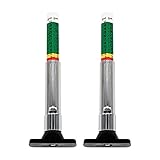
- Accurate measures tire tread depth gauge tool
- Calibrated from 0 to 1 inch in 1/ 32 inch
- Red range on bar: 0-3/32; Yellow Range on bar: 3/32 - 6/32; 5. Green Range on bar: 6/32-32/32
- Pocket-sized gauge, easy handy
- 2 pack
| Document or promise | What to verify | Why it matters for an EV |
|---|---|---|
| Manufacturer warranty | Covered systems, start date, time and mileage limits, transfer rules, exclusions, and required records | Coverage may differ between the traction battery, drive unit, power electronics, and the rest of the vehicle |
| Dealer warranty on the Buyers Guide | Whether a dealer warranty applies, its duration, and any stated limitations | It may overlap with or supplement factory coverage, or the car may be sold as-is where permitted |
| Optional service contract | Administrator, covered components, exclusions, deductible, repair network, authorization process, start date, and cancellation terms | “Bumper-to-bumper” marketing does not prove that high-voltage parts or battery capacity are included |
Compare the contract’s start date with any unexpired factory warranty so you do not pay for duplicate coverage. Check who approves repairs and whether you must use a particular facility. Keep every contract, inspection report, and receipt with the vehicle records.
Compare two or more candidate EVs on evidence, not labels
When several cars meet your range and price needs, put the same information in a side-by-side worksheet. A low odometer reading can be attractive, but it does not establish battery condition, brake condition, or accident-free history.
| Comparison area | Evidence to record | Decision question |
|---|---|---|
| Recall status | VIN lookup date, open recalls, repair invoices, dealer confirmation | Are all safety remedies complete, and can any parts delay delivery? |
| Independent inspection | Brake and tire measurements or observations, diagnostic findings, written estimates | What must be repaired immediately, and what will it cost? |
| Battery and vehicle warranty | Remaining time and mileage, capacity threshold, transfer rules, exclusions | How much documented protection remains for the systems most expensive to replace? |
| Service history | Maintenance invoices, software or recall records, charging-system work | Is the history coherent and supported by paperwork? |
| Damage and title history | Title branding, disclosed collision or flood events, repair documentation | Could hidden structural, corrosion, or high-voltage damage remain? |
| Near-term ownership cost | Inspection estimates, tire condition, brake work, charging equipment needs | Does the purchase price still make sense after known repairs? |
A vehicle-history report can reveal reported events, but unreported damage will not necessarily appear. Treat it as one input alongside the physical inspection, title review, and service records.
Independent reader supportYour contribution helps us test, update, and keep practical guides available for everyone.Warning signs that justify pausing or walking away
- The seller will not provide the VIN before requesting a deposit.
- An open safety recall is minimized, or the seller refuses to let you confirm the remedy with the manufacturer.
- You are pressured to use only the seller’s inspection shop.
- The shop cannot safely inspect the high-voltage system, yet the seller presents its report as a complete EV evaluation.
- The brake pedal, warning lamps, charging behavior, or tire condition raises a concern that the seller will not document or repair.
- The title is branded, the car shows flood or collision evidence, and there is no credible repair record.
- Warranty answers are verbal, contradictory, or not tied to the VIN.
- The seller describes an optional service contract as if it were the original manufacturer warranty.
Do not let a favorable price turn an unresolved safety issue into your problem. Pause the transaction until the record, inspection, and contract terms are clear.
What buyers can and cannot conclude from common evidence
| Evidence | Reasonable conclusion | Unreasonable conclusion |
|---|---|---|
| No unrepaired recall appears in the VIN search | No open safety recall is listed for that VIN at the time checked | The car is defect-free or safe in every respect |
| Thick-looking brake pads | Pad material may remain | Rotors, calipers, hydraulics, or emergency braking performance are proven good |
| Regenerative braking feels strong | The motor is contributing to deceleration | Friction brakes never need service |
| Clean vehicle-history report | No reported event appears in that report | No unreported damage, flood exposure, or mechanical fault exists |
| “Battery health” percentage from a seller | A measurement was supplied | The number is a universal, manufacturer-approved pass/fail standard |
| Eight-year/100,000-mile battery language in an advertisement | It may describe a common industry warranty pattern | This VIN definitely has that coverage or a guaranteed capacity replacement |
Keep a buyer’s file before signing
Save the dated VIN recall result, recall notices, dealer confirmation, independent inspection report, repair estimates, vehicle-history report, title documents, Buyers Guide, warranty booklet, written VIN-specific coverage confirmation, and any service contract. Record the odometer reading and take photographs of warning messages, tires, charge-port condition, and visible damage. This file helps you make a price decision and gives you evidence if a promised repair or coverage term is later disputed.
Do these 3 things before closing this tab:
1Fix the driver behind crashes, sound loss and screen glitches2Clear out junk files and repair common Windows errors3Scan for outdated or missing drivers - takes under a minuteLimits that depend on state and vehicle
This guidance is U.S.-focused. Whether a dealer may sell a car “as is,” what implied-warranty rights apply, and what disclosures are required can vary by state. The exact vehicle model, model year, VIN, mileage, title status, warranty booklet, service history, and seller type can change the answer. Confirm state-law rights with the relevant state agency or a qualified attorney when the transaction involves unusual title, warranty, or disclosure issues.
Best Value

- 1. Accurately measures tire tread depth gauge tool, Calibrated from 0 to 1 inch in 1/32 inch
- 2. Color coded tire tread depth gauge tool clearly indicates the tire different phase by colors
- 3. Tire tread depth gauge of Red range on bar: 0-3/32; Yellow Range on bar: 3/32 - 6/32; 5. Green Range on bar: 6/32-32/32
- 4. Comes with a pocket clip, easy to carry a tire tread depth gauge tool
- 5. Tire tread depth gauge tool reads in 32nds Suitable for trucks, motorcycles, automobiles and any passenger vehicle
Official guidance does not establish a universal statistic for how much longer every EV’s brakes last, nor a universal battery-failure rate. Use the general maintenance advantage of regenerative braking as a reason to inspect carefully—not as a reason to skip inspection.
Frequently Asked Questions
How do I check an EV for recalls by VIN?
Obtain the complete 17-character VIN and enter it in NHTSA’s vehicle recall lookup. Save the result, then have an authorized manufacturer service department confirm whether every listed remedy is complete. A VIN search identifies listed unrepaired safety recalls; it does not certify the car’s overall condition.
Does regenerative braking mean I do not need to check the brakes?
No. Regeneration usually reduces friction-brake use, but conventional brakes still operate during events such as emergency braking and when the battery is fully charged. Have an independent inspector assess pads, rotors, calipers, hydraulics, parking brake operation, corrosion, warning lights, and road-test behavior.
Is an eight-year/100,000-mile EV battery warranty guaranteed on a used car?
No. The Department of Energy describes that as a common warranty offering from many manufacturers. Check the specific vehicle’s warranty start date, remaining time and mileage, capacity threshold, exclusions, and transfer rules in the written warranty and through the manufacturer using the VIN.
Can a vehicle-history report replace a pre-purchase inspection?
No. The FTC says a vehicle-history report is not a substitute for an independent vehicle inspection. A history report may omit unreported damage or current mechanical faults, so obtain a written inspection and repair estimate.
Quick Recap
Product prices and availability are accurate as of the date/time indicated and are subject to change. Any price and availability information displayed on Amazon at the time of purchase will apply.




