The safest way to buy a used manual Alfa Romeo is to identify the exact model, year, engine, market and VIN first, then compare the car with its correct handbook and records. Inspect the body and underside, verify time-sensitive servicing, measure tires and brakes, and test every gear only after a cold start. Because “Alfa Romeo” covers very different cars and powertrains, there is no single brand-wide fault list or timing-belt interval. An independent inspection by a mechanic experienced with that precise model is the final decision point.
Start with the exact car, not the badge
Before applying any buying advice, write down the VIN, model, model year, engine, transmission and the market in which the car was sold. A manual Giulietta, a 4C and a Giulia do not share the same maintenance plan, construction or diagnostic requirements. Even cars with the same model name can have different engines, equipment and service intervals by year and region.
As an Amazon Associate I earn from qualifying purchases.
Alfa Romeo’s owner-manual catalogues are organised by model and year. The Canadian owner-manual portal says its coverage runs from 2015 through the current model year, while the US catalogue lists documents for cars such as the Giulia and 4C. Select the market-appropriate manual, then match the engine and version shown on the vehicle identification plate or VIN record. A US manual may not describe a European car correctly, and an older manual may not apply to a later revision.
The Tool Desk
Outbyte PC Repair FREEClear out junk files and repair common Windows errorsFree Scan →Outbyte Driver Updater FREEFix the driver behind crashes, sound loss and screen glitchesFind Drivers →Do not treat enthusiast forum anecdotes as a failure-rate study. The available evidence does not provide a reliable percentage for gearbox failures, repair costs or the proportion of used manual Alfa Romeos needing major work.
#1 Best Overall

- 1.Accurate and Efficient: Different colors on the bar represents different scopes, the red range on bar: 0 - 3/ 32; Yellow range on bar: 3/ 32 - 6/ 32; Green range on bar: 6/ 32 - 32/ 32, allowing you easy and fast to read and calibrated
- 2.Reusable:Tire tread gauge is made of sturdy material, reusable and long lasting, which is an efficient tool to moenitor tire tread levels, make driving safer
- 3.Convenient:Tire tread Depth gauge measures approx 3.35 x 1.06 inch, small size, also features a pocket clip for easy carrying, you can clip it on your pocket, ideal for quick and convenient getting and using
- 4.Simple to use :Place the black flat edge of the tire tread gauge on both sides of the tire tread, press down the color bar until it reaches the bottom of the tread groove, and read the depth measurement on the indicator bar.
- 5.Easy to read: There are 3 different color codes of areas on the bar that add simplicity and convenience, which show you a clear result of your tyre condition, really easy to read, giving you a fast and accurate measurement to tread depth, smart, high efficiency
What to request before you travel to see the car
Ask for evidence, not reassurance
- VIN, exact mileage and registration details.
- Dates and invoices for routine servicing, repairs, tires, brakes and fluids.
- Repair orders, inspection certificates and evidence of recalls or campaigns where applicable.
- Number of owners and the seller’s explanation of any gaps, imported history or mileage changes.
- Confirmation of whether any timing-belt work due for that engine has been completed, supported by an invoice.
Compare the seller’s account with odometer and registration records available in your country. A vehicle-history report can reveal recorded crashes, title events or mileage entries, but it cannot prove that an undocumented service was done or that a structurally repaired car is safe. Use it as a cross-check alongside invoices and a physical inspection.
Download the matching service schedule
Copy the scheduled maintenance items into a simple checklist before viewing the car. Mark each item as documented, apparently due, or unknown. Include mileage-based and time-based work, not just oil changes. The handbook’s specified fluids, inspection procedures and warning-light meanings should govern your assessment.
Inspect the body and structure in daylight
View the car when it is dry and, if possible, before it has been warmed up or freshly washed. Mismatched reflections, overspray on seals, uneven panel gaps, paint texture that differs from adjacent panels and glass carrying different date markings can indicate repairs. Ask directly about collisions rather than accepting “no issues” as a substitute for documentation.
What’s actually slowing this PC down?
Pick the symptom - the matching free tool is one click away.
Check the structural areas
Alfa Romeo’s Certified Pre-Owned inspection form identifies the areas that deserve close attention. Use a torch and inspect:
- Inner fenders and shock towers.
- Front and rear chassis rails.
- A-, B- and C-pillars.
- Rocker or sill panels and their seams.
- Rear quarter panels and the tail panel.
- Axle mounting points, roof structure and floor pan.
- Spare-wheel well and trunk floor.
Look for rippled metal, fresh sealant, weld marks, missing fasteners, paint overspray, corrosion around repairs and parts that do not sit squarely. Check that doors, hood and trunk open, close and latch without lifting or forcing them. A clean-looking exterior does not establish that the underlying structure is straight.
Special case: the 4C
The 4C uses a carbon-fibre tub, so a suspected crash deserves specialist assessment of chassis straightness and repair quality. That advice is specific to the 4C’s construction; it should not be presented as a universal requirement for every Alfa Romeo. Do not rely on a routine visual inspection if the 4C has unexplained alignment, panel or history concerns.
Rank #2

- Accurate and precise tire tread depth readings in 1/32 inch increments (1/128 inch resolution)
- Durable dial type gauge with easy-to-read 32nds scale (max. tread depth 14/32 inch)
- Color coded scale shows true tire health - safe range (green), showing wear (yellow), or needs replacement (red)
- Calibrated to meet or exceed industry standards for precise accuracy of tire tread depth (+/- 0.25%)
- Rugged, convenient, and compact design for easy storage with included leather pouch
Look underneath before the road test
Ask the seller to allow a lift inspection. If the history is incomplete or you see damage, a qualified mechanic should inspect the car from below before you negotiate a price. Examine underbody protection, subframes, suspension arms, exhaust components, brake and fuel lines, hoses, rubber boots and bushes. Search for fresh underseal that may conceal repairs, severe corrosion, bent mounting points or impact marks.
Quick wins for a faster PC:
Clear out junk files and repair common Windows errorsFree Scan →Scan for outdated or missing drivers - takes under a minuteDriver Scan →Repair Windows errors before they cause bigger problemsFix Now →Identify leaks and their sources
Use a clean surface or inspection paper to distinguish an active leak from an old stain. Check around the engine, gearbox, differential where fitted, cooling system, brake system, fuel system, power-steering system on versions that use it, shock absorbers and air-conditioning components. Note the colour, smell and location of any fluid, but do not open a hot cooling system or reservoir.
Check fluid levels and visible condition only as the handbook permits. The correct fluid specification matters; topping up with an incompatible product can create a new fault. A dry driveway does not prove that seals are sound, because a leak may appear only at operating temperature or under load.
Measure tires, wheels and brakes
Tires
Inspect all four tires, including the inner shoulders that are easy to miss with the wheels fitted. Confirm that the size, load rating, speed rating and specification are appropriate for the exact car. Look for sidewall bulges, cuts, cracking, puncture repairs, exposed cords and uneven wear. Record the manufacturing date where available and compare the tires for mixed brands or substantially different ages.
Measure tread at the inner, centre and outer positions on each tire. A tread-depth gauge makes this repeatable, but it does not replace a mechanic’s inspection. The Alfa Romeo CPO checklist specifies at least 3 mm of tread above the wear indicator for certification. That is a CPO requirement, not a universal legal limit and not a guarantee that a tire with 3 mm is suitable for every weather condition.
Free tools Windows power users keep installed
One-click scans. No signup required.
Brakes and wheels
Look through the wheel openings for pad thickness, rotor scoring, a pronounced lip, cracks, corrosion and uneven contact. Ask for invoices for recent brake work and check whether pads and rotors were replaced as an axle set where appropriate. The same CPO checklist uses 5 mm of brake-friction material as a certification threshold. It is not a blanket safety rule; pad condition, rotor condition, caliper operation and the vehicle’s intended use all matter.
Rank #3

- 1. Accurately measures tire tread depth gauge, Calibrated from 0 to 1 inch in 1/32 inch
- 2. Color coded tire tread depth gauge clearly indicates the tire different phase by colors
- 3. Tire tread depth gauge of Red range on bar: 0-3/32; Yellow Range on bar: 3/32 - 6/32; 5. Green Range on bar: 6/32-32/32
- 4. Comes with a pocket clip, easy to carry a tire tread depth gauge
- 5. Tire tread depth gauge reads in 32nds Suitable for trucks, motorcycles, automobiles and any passenger vehicle
During the drive, braking should be straight and progressive. Pulsation, scraping, vibration, a soft pedal or a pull to one side requires diagnosis before purchase. Check wheel rims for cracks, bends and fresh impact marks, and confirm that the tire-pressure monitoring system reports normally.
Verify time-sensitive servicing with the right handbook
Timing-belt work is one of the most expensive surprises on a used car, and the interval is not shared across Alfa Romeo models. Ask for a dated invoice identifying the belt, tensioners and, where specified, the water pump. A verbal statement that “the belt was done” is not equivalent evidence.
4C figures are model-specific
A PistonHeads 4C used-buying guide, published approximately in 2021 for the UK market, reports general servicing every 12,000 miles or 12 months and cambelt and water-pump replacement every five years or 60,000 miles. Treat those figures as 4C-specific secondary guidance and verify them against the exact car’s handbook and records. Do not transfer either interval to a Giulietta, Giulia or another engine.
Giulietta and other models
The Giulietta handbook sets out distance-based servicing and, where applicable, time-based intervals. Its checklist includes lighting, fluids, emissions equipment, pipes and hoses, underbody protection, brakes and timing-belt checks; versions fitted with the TCT transmission have additional checks. The handbook copy reviewed is hosted by Manualzz, so match its edition and market to the vehicle and confirm details through the appropriate official manual.
Brake fluid and other calendar items
The Alfa Romeo CPO checklist records brake-fluid replacement every two years. That figure should be verified against the car’s market-specific handbook and service history. Also check age-sensitive coolant, auxiliary belts, batteries, tires and rubber components rather than assuming low mileage means low wear.
Cold-start procedure
Arrange to see the car with the engine cold. Ask the seller not to start it before you arrive, and feel the engine or exhaust if you need to confirm that it has not just been warmed to mask a problem.
Rank #4
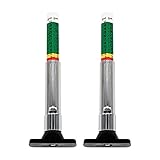
- Accurate measures tire tread depth gauge tool
- Calibrated from 0 to 1 inch in 1/ 32 inch
- Red range on bar: 0-3/32; Yellow Range on bar: 3/32 - 6/32; 5. Green Range on bar: 6/32-32/32
- Pocket-sized gauge, easy handy
- 2 pack
- Before starting, inspect the instrument panel and confirm that warning lamps illuminate as part of the self-test.
- Start the engine and watch which lamps extinguish. Persistent oil-pressure, charging, airbag, ABS, engine or transmission warnings require diagnosis.
- Listen for rattles, knocks, belt noise and uneven running. Observe exhaust smoke after the initial start and during gentle revs.
- Check idle stability and temperature rise. An engine that overheats, hunts, misfires or smells strongly of fuel or coolant should not be treated as a minor adjustment.
- After the drive, look again for fresh drips, coolant loss, oil mist or new smells.
Warning lights and stored faults should be scanned by a qualified technician with equipment appropriate to the car. A generic code reader may not access every manufacturer system, and compatibility cannot be assumed from the connector alone.
Test the clutch and manual gearbox methodically
There is no evidence supporting one universal manual-gearbox defect list for an unspecified Alfa Romeo. Evaluate the individual car’s behaviour and obtain model-specific diagnosis when symptoms appear.
- With the engine running, press and release the clutch several times. Note abnormal stiffness, a very high or low engagement point, vibration or noises that change when the pedal moves.
- Select reverse and every forward gear while stationary, without forcing the lever. Resistance, baulking or grinding should be investigated.
- On a safe, legal road, accelerate in a higher gear from low-to-moderate revs. Engine speed rising without matching road speed suggests clutch slip.
- Pull away gently and then under normal load. Chatter, shudder or an engagement that is difficult to control may indicate clutch, flywheel, mount or hydraulic problems.
- Repeat shifts when the car is warm. A gearbox that behaves when cold but grinds or refuses a gear hot still needs diagnosis.
- Listen for whining, rumbling or knocking that changes with gear, load, clutch position or road speed. Record when the noise occurs rather than guessing its source.
The 4C buying guide mentions possible gear-selection problems on some cars, including reports of software patches. That is UK-market, 4C-specific secondary reporting and is not proof of a conventional manual-gearbox fault across the Alfa Romeo range. Ask a specialist whether any software update, hydraulic adjustment or repair campaign applies to the VIN.
Independent reader supportYour contribution helps us test, update, and keep practical guides available for everyone.Assess steering, suspension, electronics and cooling
The car should track straight on a level road without constant correction. Check for steering play, wheel vibration, suspension knocks over uneven surfaces and a vehicle that sits lower on one corner. Test braking from different speeds only where safe and legal, and note whether the car remains straight.
Operate every control: headlights and indicators, brake lights, hazard lamps, wipers and washers, climate control, windows, mirrors, central locking, infotainment, parking sensors, cameras, heated seats and instrument displays. Check that the air-conditioning produces cold air and that the heater reaches normal temperature. Confirm that the engine reaches and holds its normal operating temperature without warning messages.
Inspect seat belts, airbags and dashboard trim for signs of deployment or removal. Missing trim, non-functioning warning lamps or a seller who refuses a scan should be treated as a serious concern rather than an electrical nuisance.
Best Value

- 1. Accurately measures tire tread depth gauge tool, Calibrated from 0 to 1 inch in 1/32 inch
- 2. Color coded tire tread depth gauge tool clearly indicates the tire different phase by colors
- 3. Tire tread depth gauge of Red range on bar: 0-3/32; Yellow Range on bar: 3/32 - 6/32; 5. Green Range on bar: 6/32-32/32
- 4. Comes with a pocket clip, easy to carry a tire tread depth gauge tool
- 5. Tire tread depth gauge tool reads in 32nds Suitable for trucks, motorcycles, automobiles and any passenger vehicle
Commission an independent pre-purchase inspection
Choose a mechanic who works on the exact model and engine, not merely any European car. Request a written report that includes:
- VIN and mileage verification.
- Lift inspection of structure, suspension, brakes, leaks and corrosion.
- Diagnostic scan using equipment suitable for the car’s manufacturer systems.
- Cold-start and road-test observations, including clutch and gear engagement.
- Confirmation of completed, overdue and soon-due scheduled work.
- Separate estimates for safety-critical repairs, reliability work and cosmetic items.
- An opinion on whether any structural repair is safe and properly documented.
For an unusual or high-performance variant, ask how many examples the shop services and whether it can obtain the required parts and specialist repairs. A low inspection fee is not useful if the examiner cannot interpret the car’s systems.
When to pause, renegotiate or walk away
Pause the purchase until a specialist has diagnosed any of the following:
Crashes, No Sound, or Screen Glitches?
Random freezes, missing sound and display glitches usually trace back to one bad driver. Find and replace yours safely.Free scan · under a minutePC Slower Than It Used to Be?
A free scan shows the junk files, broken settings and background clutter dragging Windows down - then fixes them in one click.Free scan · Windows 10 & 11- Unexplained structural repairs, bent mounting points or inconsistent accident history.
- Persistent warning lights or diagnostic faults that the seller will not explain.
- Unsafe or badly aged tires, damaged wheels or severely worn brakes.
- Active oil, coolant, fuel, brake or gearbox leaks.
- Clutch slip, repeated gear grinding, inability to select a gear or severe drivetrain noise.
- Missing evidence for a timing-belt service that is due or overdue.
- Overheating, misfiring, heavy smoke or unstable oil pressure.
- Records that conflict with the VIN, mileage or seller’s story.
Use the written inspection to price known work. Do not deduct only the cost of parts: include labour, diagnostic time, downtime and the possibility that one symptom has multiple causes. If the seller refuses a cold start, lift inspection or independent examination, the risk remains with you and should be treated accordingly.
Printable inspection sequence
- Record VIN, model, year, engine, transmission, market and mileage.
- Obtain invoices, repair orders, ownership history and any vehicle-history report.
- Download and read the matching owner’s handbook and maintenance schedule.
- Confirm timing-belt, water-pump, brake-fluid and other time-sensitive work.
- Inspect paint, panel gaps, glass and the structural zones listed above.
- Raise the car and inspect underbody protection, suspension, lines, boots, corrosion and leaks.
- Measure each tire at inner, centre and outer tread positions; inspect age and damage.
- Inspect pads, rotors, wheels and tire-pressure monitoring.
- Cold-start the engine and observe warning lamps, smoke, noise, idle and leaks.
- Drive safely through every gear and assess clutch take-up, slip, grinding, steering, braking, suspension and temperature.
- Operate all electrical and climate functions and scan for stored faults.
- Obtain a written report from an independent, model-experienced mechanic before agreeing the final price.
What the inspection can and cannot establish
A careful inspection can expose missing maintenance evidence, visible damage, current leaks, worn consumables, poor gear engagement and many warning signs. It cannot guarantee that an old car will have no future failures, nor can a vehicle-history report reconstruct every repair. The most defensible decision combines the exact handbook, dated records, a physical examination and a specialist’s written opinion.
Quick Recap
Product prices and availability are accurate as of the date/time indicated and are subject to change. Any price and availability information displayed on Amazon at the time of purchase will apply.




