Do these 3 things before closing this tab:
1Fix the driver behind crashes, sound loss and screen glitches2Clear out junk files and repair common Windows errors3Scan for outdated or missing drivers - takes under a minuteThe best adventure motorcycle for a long-distance trip is the one that matches your route, body, fuel stops, luggage, and total load—not simply the bike with the biggest tank or the most off-road branding. Start by checking usable fuel range, riding-position fit, wind protection, suspension adjustment, carrying capacity, and how manageable the motorcycle remains when loaded. Then verify the exact model year, market, payload limit, and service requirements.
Define “suitable” by the journey
Long-distance riding can mean a week on motorways, a multi-country trip with sparse fuel stations, or a mostly paved route that includes rough access roads. Those journeys reward different motorcycle characteristics. A road-focused itinerary generally places more weight on seat comfort, wind control, stable handling, and luggage. A route with gravel, washboard, broken pavement, or trails increases the importance of suspension travel, ground clearance, protection, tire choice, and low-speed manageability.
As an Amazon Associate I earn from qualifying purchases.
The word adventure does not guarantee that a motorcycle fits your trip. Compare candidates against the actual itinerary, your riding experience, whether a passenger is coming, and the combined weight of people and equipment.
What’s actually slowing this PC down?
Pick the symptom - the matching free tool is one click away.
1. Fuel range is a planning calculation, not a tank-size contest
Tank capacity is only one input to usable range. Real distance between fuel stops also depends on consumption, speed, wind, temperature, terrain, passenger and luggage weight, and how much reserve you are willing to keep. Fuel availability along the route can matter more than a nominally large tank.
#1 Best Overall
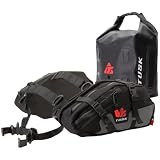
- Slim Rackless Luggage System for Side Storage Without a Dedicated Mounting Rack
- Includes Quick Harness System; Installs with or Without a Top Rack, No Additional Hardware Required
- Tapered Bag Profile Keeps Cargo Close to the Motorcycle; Compression Straps for Added Support
Use the specification as a starting point
Manufacturer pages illustrate the spread of tank sizes:
| Motorcycle and source | Published tank capacity | What the figure does—and does not—tell you |
|---|---|---|
| Honda Transalp, Honda Powersports feature page | 4.4 US gallons | A model specification; it is not an independently measured range. |
| BMW F 900 GS Adventure, BMW Motorrad USA | 6 US gallons | The larger tank may reduce fuel-stop frequency, but actual distance still depends on consumption and conditions. |
| Kawasaki KLE500 SE, Kawasaki UK 2026 page | 16 litres | Market- and model-specific capacity; no general range figure is established by the specification. |
| Honda Africa Twin Adventure Sports, Honda UK overview | 24.8 litres | A high-capacity touring specification, not a promise of a particular distance. |
For a route, list the longest gap between reliable fuel stations and add a safety margin. Use conservative consumption information from the exact model year and your expected load rather than assuming that the tank-size comparison predicts the winner. If the route includes remote sections, carry only fuel equipment that is approved for motorcycle use and secured away from heat and moving parts.
Check fuel access before choosing the motorcycle
- Mark fuel stations on every long or remote segment.
- Identify stations with uncertain opening hours or payment availability.
- Plan for detours, headwinds, slow off-road travel, and a reserve.
- Recalculate if adding a passenger, panniers, camping equipment, or substantial wind protection.
2. Fit and seat comfort determine whether you can ride the planned miles
A motorcycle can have touring equipment and still be wrong for your body. Sit on the exact bike, wearing the clothing and boots you will use. Check whether your hips, knees, wrists, and shoulders remain relaxed; whether you can reach the controls without stretching; and whether you can put a foot down confidently during stops and uneven surfaces.
Rank #2

- 🏍[WATERPROOF]: Seamless welded process and waterproof fabric, which could prevent rainwater penetration. The main material is a waterproof and tear-resistant tarpaulin, middle layer is a strong mesh cloth, and the two outer sides are pasted with a waterproof glue layer, which is wear-resistant and easy to clean. Shockproof and waterproof, with good storage space and strong durability.
- 🏍[STABILISE]: When cycling fast on bump roads, the bag has a cushioning function.3D 6-sided honeycomb shape, the bump height reaches 6mm,which can effectively cushion the shock and protect the items in the bag.
- 🏍[HIGH VOLUME]: The capacity of the single sided bag is about 24L, double sided bag is about 48L. The bag is designed with external straps and D-buckles in multiple positions, which can freely place the items that need to be carried.
- 🏍[CONVENIENT AND SIMPLICITY]: Roll up design, meets the need of your motorcycle travel touring.The straps used for fixing has the locking function after pressing button. After tightening the webbing, pressing the button can solve the problem of webbing loosening when bumping.
- 🏍[HIGH COMPATIBILITY]: The bag has shoulder straps that can be crossed, and the rear of the motorcycle is fixed after two sides are inserted. When used alone, it can be used as a shoulder bag or a messenger bag.Reflective logo printing for safe cycling at night.
Evaluate the contact points
- Seat shape: Look for pressure concentrated at the tailbone, inner thighs, or a narrow front section. A seat that feels acceptable for ten minutes may become a problem after several hours.
- Leg position: Excessive knee bend can become tiring on long pavement days, while a tall, open position may be preferable when standing on rough surfaces.
- Handlebar and controls: Check reach with elbows slightly bent and confirm that the clutch, brake, indicators, and switches are easy to operate with your gloves.
- Standing position: If unpaved riding is planned, test whether the foot controls and handlebar remain usable while standing.
- Passenger fit: Check passenger knee angle, grab points, foot-peg position, and whether luggage removes usable seating space.
Honda describes the Transalp seat as suitable for high mileage. Kawasaki says the KLE500’s standard seat is designed for long-ride comfort and offers multiple seat configurations as accessories. Those are manufacturer descriptions, not independent comfort tests. BMW lists a comfort seat for the F 900 GS Adventure. Treat each as a reason to arrange a proper fit check, not as proof that every rider will be comfortable.
3. Wind protection should match your speed and exposure
Wind protection affects fatigue, noise, temperature management, and how much effort is required to hold a line. A screen that works well at one rider’s height can create turbulence for another. Test the motorcycle at the speeds and in the riding position you expect, including with your helmet and jacket.
Look for controllable airflow
- Check whether the screen sends clean air over your helmet or creates buffeting at eye level.
- Assess airflow around your shoulders and chest in rain and crosswinds.
- Make sure the screen does not obstruct your view when standing or when riding slowly on rough ground.
- Confirm that an adjustable mechanism is easy to operate without compromising its lock or stability.
BMW lists an adjustable touring windscreen on the F 900 GS Adventure. BMW Group PressClub quoted Christof Lischka, Head of BMW Motorrad Development, describing the R 1300 GS Adventure as combining “seating comfort, ergonomics and wind and weather protection” with handling and suspension comfort. That sentence is a promotional statement, not an independent assessment, so your own height, helmet, and intended speed remain decisive.
Rank #3

- YKK Hardware, 252D Nylon Body, TPU Reinforcement Panels, Nylon Stitching
- 35L Capacity Per Bag; Roll-Top Design
- Replaceable Strap System
4. Suspension must handle both the road and the loaded motorcycle
Suspension suitability is about more than travel length. Spring rate, damping, adjustment range, ground clearance, wheel and tire choices, and protection underneath all influence how a motorcycle behaves when the surface changes. The correct setup also changes when you add a passenger or luggage.
The Tool Desk
Outbyte Driver Updater FREEScan for outdated or missing drivers - takes under a minuteDriver Scan →Outbyte PC Repair FREERepair Windows errors before they cause bigger problemsFix Now →Account for total operating weight
Add your riding gear, passenger, panniers, top case, tools, water, camping equipment, and any other cargo. Then compare that total with the motorcycle’s permitted payload in the owner’s manual. Do not infer payload from a marketing description or from engine size.
BMW specifically notes preload adjustment for riders carrying luggage or a passenger. That adjustment helps maintain the intended ride height as load changes, but it does not increase the motorcycle’s legal payload. Set sag and damping according to the manufacturer’s instructions for the actual load.
Rank #4

- [QUICK REMOVAL DESIGN] One second quick release, with original quick release mechanism design, you can easily remove your luggage with just one click
- [STURDY MATERIAL] The main material is 1680D encrypted and thickened oxford cloth + sub spandex, wear-resistant and tear-resistant. Fully waterproof inner bag can be removed and used as a handbag. Waterproof mesh material and seamless voltage technology are used to prevent rainwater intrusion safely. Back panel quick release adapter is made of reinforced nylon, the actual driving time on unpaved road is more than 5000 kilometers, and there is no deformation or breakage in many collisions
- [Internal support] Semi-rigid support, the body and bottom of the bag are supported by 3mm thick semi-rigid PE boards, which protects the contents of the bag from crushing damage caused by bumps and drops. The PE support panels in the middle and bottom are foldable and removable for easy transportation and storage
- [Large Capacity] Plenty of storage compartments. The single side bag has a capacity of approximately 35L when folded three times. the front, sides and bottom of the bag are designed with the molle system. The front, sides and bottom of the bag are designed with the molle system. In addition, with various D-shaped buckles and triangular hooks, the bag can be used for a variety of external items. Opening the front panel reveals an abundance of storage space. Exclusive repair tool pocket, electronics organizer and separate waterproof map pocket
- [Anti-theft design] The fixing position of the buckle helps to install anti-theft locks. It is suitable for locks with a rod diameter of 3 mm to 5 mm. Once locked, the entire mechanism switch will be locked and it will no longer be possible to remove the bag from the side shelf. (Note: locks are sold separately)
Interpret suspension specifications carefully
Kawasaki UK lists 210 mm of front suspension travel and 196 mm at the rear for the 2026 KLE500 SE. Those numbers describe available movement; they do not by themselves establish comfort, traction, or suitability for a particular trail. Honda and Kawasaki describe their respective models’ suspension as intended for on- and off-road use, but the practical result still depends on setup, tires, rider skill, and the surface.
5. Luggage has to fit the mounting system and the load limit
Decide what you must carry before selecting cases. A daily commuter load, two-up touring kit, and self-supported camping equipment require different volume and mounting solutions. Check whether the motorcycle includes racks, whether cases are optional, and how the load affects width, balance, and passenger access.
Verify compatibility before buying cases
- Confirm the exact model, model year, and market.
- Check whether a specific rack, mounting plate, or subframe reinforcement is required.
- Verify that pannier capacity and case weight stay within the motorcycle’s stated limits.
- Check exhaust clearance, suspension movement, indicator visibility, and passenger-peg access.
- Secure heavy items low and close to the motorcycle’s centerline.
Kawasaki describes a three-case-capable setup available as genuine accessories. Honda lists both hard and soft luggage among Transalp accessories. The existence of an accessory option does not establish universal fit: a rack or case for one model year may not fit another, and a market-specific accessory package may differ. Obtain the mounting instructions and load limits before committing to a purchase.
Best Value
- Slim Rackless Luggage System for Side Storage Without a Dedicated Mounting Rack
- Includes Quick Harness System; Installs with or Without a Top Rack, No Additional Hardware Required
- Tapered Bag Profile Keeps Cargo Close to the Motorcycle; Compression Straps for Added Support
6. Match the road/off-road balance to your route
| If most of the trip is… | Prioritize | Questions to ask |
|---|---|---|
| Paved highways and secondary roads | Seat support, wind control, stable road manners, fuel planning, and luggage capacity | Can I remain relaxed for a full day? Is the screen tolerable at my cruising speed? Does the loaded bike feel settled? |
| Mixed pavement and gravel | Manageable weight, usable suspension adjustment, suitable tires, ground clearance, and protection | Can I control it at walking pace? Can I adjust preload for luggage? Are vulnerable components protected? |
| Rough unpaved routes | Suspension travel, clearance, wheel and tire suitability, low-speed control, and recovery practicality | Can I pick it up or get help if it falls? Does the load remain secure? Are fuel and service options available? |
A heavier motorcycle can be stable and comfortable on pavement but demanding in sand, steep turns, or technical tracks. A lighter, more dirt-oriented machine may be easier off-road yet offer less wind protection or carrying capacity. Choose the compromise that matches the proportion of each surface on your itinerary, not the category label.
7. Manageability matters more after you add fuel and luggage
Test the motorcycle at low speed, on uneven ground, and while pushing it backward. Practice a full-lock turn, a controlled stop with one foot down, and moving it on a slope. Then repeat those checks with representative luggage. Seat height, center of gravity, handlebar leverage, and the ability to reach the ground can matter more than peak power during parking, fuel stops, and recovery from a mistake.
Ask a dealer to demonstrate the manufacturer’s maximum load and suspension-setting procedure. If you cannot confidently control the motorcycle when loaded, a nominally impressive tank or engine specification does not make it suitable for your trip.
Free tools Windows power users keep installed
One-click scans. No signup required.
8. Reliability and servicing require model-year evidence
The manufacturer feature pages considered here do not establish comparative reliability rankings, maintenance costs, or service intervals. Those are separate questions. For any candidate, read the owner’s manual and service schedule for the exact model year and market. Confirm what can be serviced on the route, whether parts are available where you will travel, and what roadside failures you could realistically repair.
Build a service and recovery plan
- Record the required service points before departure and start with fresh fluids, tires, and drive components where appropriate.
- Carry the tools and spare items that the manual and experienced owners identify as practical for your model.
- Check roadside assistance and recovery coverage in every country on the route.
- Use credible long-term ownership evidence when comparing durability, and separate repeated owner reports from isolated anecdotes.
A practical buying and trip-preparation procedure
- Map the route. Mark pavement, gravel, rough sections, elevation, weather exposure, and the longest fuel gaps.
- Set the load. Weigh rider gear, passenger gear, luggage, tools, water, and camping equipment. Compare the total with the manual’s payload limit.
- Shortlist by fit. Sit on each candidate in riding boots and test seat, reach, leg position, passenger space, and standing posture.
- Ride at intended speeds. Evaluate windscreen turbulence, helmet noise, stability, braking feel, and fatigue on the kinds of roads you will use.
- Load the motorcycle. Fit representative luggage, adjust preload as directed, and repeat low-speed, stop, and uneven-ground tests.
- Check equipment compatibility. Confirm racks, cases, screens, seats, protection, tires, and electrical accessories for the exact model year and market.
- Validate fuel planning. Use conservative, model-specific consumption information and include a reserve for weather, detours, and slow terrain.
- Confirm service support. Read the manual, schedule required maintenance, and identify dealers or recovery options along the route.
Common mistakes that make a motorcycle unsuitable
- Choosing by tank capacity alone: A large tank does not guarantee the longest practical range.
- Trusting “touring” language without a fit test: Comfort claims are not universal measurements.
- Ignoring payload: Passenger and luggage weight can change suspension behavior, braking, clearance, and legal compliance.
- Buying cases before checking the rack: Accessory compatibility varies by model year and market.
- Assuming adventure branding equals trail capability: Surface, tires, protection, weight, and rider skill determine what is realistic.
- Using another market’s specification: Equipment and capacities can differ by country and edition.
- Treating promotional claims as test results: Manufacturer descriptions identify intended features, not independent comfort, reliability, or range measurements.
Bottom line
An adventure motorcycle is suitable for long-distance riding when its real-world range and fuel access cover the route, its ergonomics and wind protection let you ride the planned days, its suspension remains controlled at the combined load, and its luggage system carries what you need within the manufacturer’s limits. Compare the same model year and market, test the loaded motorcycle at realistic speeds, and use the owner’s manual—not a category name or isolated specification—as the final authority.
Quick Recap
Product prices and availability are accurate as of the date/time indicated and are subject to change. Any price and availability information displayed on Amazon at the time of purchase will apply.




