Quick wins for a faster PC:
Repair Windows errors before they cause bigger problemsFix Now →Scan for outdated or missing drivers - takes under a minuteDriver Scan →A muscle car is a performance-focused American production car that combines a powerful engine—most often a V8—with a relatively ordinary, frequently intermediate-size body. The formula prioritizes strong straight-line acceleration without requiring an exotic or purpose-built chassis. It is a historical market category, not a class with a universally enforced technical definition, so some cars sit on a debated border.
The short definition: power in an ordinary American car
When enthusiasts call a car a muscle car, they usually mean an American-built production model that puts a substantially powerful engine into a mainstream body rather than an exotic, highly specialized sports-car platform. The result is a car intended to deliver conspicuous acceleration, usually in a package that can still serve as an ordinary coupe, sedan or convertible.

As an Amazon Associate I earn from qualifying purchases.
Three ideas matter more than any single specification:
Crashes, No Sound, or Screen Glitches?
Random freezes, missing sound and display glitches usually trace back to one bad driver. Find and replace yours safely.Free scan · under a minuteWindows Errors? Fix Them Before They Spread
Repair common Windows errors and clear accumulated junk for a smoother, more stable PC - no reinstall needed.Free scan · no reinstall- A large or powerful engine: V8 power is the recurring pattern, although displacement, induction and published output changed from one model year to another.
- A relatively ordinary platform: Classic examples were based on mainstream or intermediate-size cars instead of purpose-built racing machinery.
- Acceleration as the priority: The appeal is forceful straight-line performance and the ability to make a normal-looking production car unusually quick.
There is no standards-body checklist that determines whether every car is or is not a muscle car. Historians and enthusiasts disagree about some full-size cars, pony cars and specialized performance models. It is more accurate to describe the recurring formula and explain a car’s historical role than to apply an invented horsepower cutoff.
#1 Best Overall

- Authentically licensed product from Chevy
- A true American muscle car, this 1969 Chevy Corvette Stingray has been brought to you in a 1:24 die - cast model
- Crafted from durable materials such as 100% die - cast metal and premium rubber tires
- Our high - end casting method allows for feature rich details, such as an opening hood, doors, detailed interior, and trunk
- This premium die - cast model is a must have for any Chevy collection
What the muscle-car formula includes
A powerful engine, usually a V8
Muscle cars are associated with engines that were unusually large or powerful for the body carrying them. In the classic period, that normally meant a naturally aspirated V8, with multiple carburetors and other performance equipment available on some versions. The important point is the relationship between the engine and the vehicle: the car had more thrust than a routine version of the same kind of family-oriented production model.
Published horsepower is useful for identifying a version, but it must be read in context. Ratings changed with model year, equipment and measurement conventions, so an advertised figure from one car cannot automatically be treated as a laboratory comparison with another. For that reason, a muscle-car identification should consider engine size and specification alongside the car’s platform and purpose.
An intermediate or mainstream body
The classic recipe placed the engine in a relatively ordinary American production car, often an intermediate-size model. This made the performance surprising and commercially legible: buyers could order dramatic acceleration in a body that shared basic engineering and styling with less-expensive family cars.
That relationship separates the category from a specialized sports car. A purpose-built performance chassis can be fast, but the classic muscle-car idea depends on a powerful drivetrain being offered in a more conventional production package. The boundaries remain fuzzy because manufacturers also sold large luxury-performance cars, compact performance cars and later pony cars that overlap with the same audience.
Straight-line performance over an all-purpose track brief
Muscle-car identity is rooted in acceleration. Braking, cornering, road-course balance and racing capability can matter, but they are not the defining historical emphasis. A car that was marketed around explosive launches and high-output engine options fits the traditional idea more closely than one engineered primarily for lightweight cornering or endurance competition.
A production model or factory package
Many well-known muscle cars were not separate model lines at launch. They were option packages or high-performance versions of an existing car. That distinction matters because the package combined a familiar body with a larger engine, stronger transmission choices, exhaust upgrades or other equipment. The 1964 Pontiac GTO is the clearest early example: it began as an option package on the Tempest LeMans rather than as an independent model line.
Rank #2
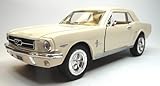
- Authentic 1:36 Scale: Meticulously crafted 1964 1/2 Ford Mustang model car with impressive 5-inch length.
- Realistic Details: Die-cast metal body with opening doors and eye-catching blue finish.
- Interactive Play: Engaging pull-back action for thrilling motion across smooth surfaces.
- Collectible Quality: Ideal for model car enthusiasts and collectors seeking miniature automotive replicas.
- Brand: KiNSMART, a trusted name in die-cast vehicle models and toys.
Why the “first muscle car” question has no single uncontested answer
The phrase “first muscle car” mixes two different historical questions. One asks which earlier cars anticipated the formula. The other asks when the recognizable mass-market muscle-car era began. Museum and manufacturer histories commonly separate those answers.
| Car | Historical role | Why it matters |
|---|---|---|
| 1949 Oldsmobile Rocket 88 | Often treated as a precursor | Audrain Auto Museum includes it in the late-1940s evolution toward the muscle-car era; the available historical material does not establish a universally accepted “first” verdict. Audrain Auto Museum’s overview |
| 1955 Chrysler 300 | Earlier performance landmark and bridge to the 1960s | Its inclusion in museum histories shows that powerful American production cars existed before the intermediate-car formula became commercially prominent. Audrain Auto Museum’s overview |
| 1964 Pontiac Tempest LeMans GTO | Commonly recognized launch of the classic muscle-car era | General Motors identifies the Tempest LeMans with the GTO option package as the car that started the era. GM Heritage Collection |
Calling the Rocket 88 or Chrysler 300 a “precursor” is more precise than declaring either the definitive first muscle car. Calling the GTO the commonly recognized starting point describes its historical impact without pretending that earlier performance cars did not exist.
How the 1964 Pontiac GTO made the definition concrete
The 1964 Pontiac Tempest LeMans GTO is the reference point because it combined the ingredients in a form buyers could order from a regular production car. General Motors describes the GTO option package as the beginning of the muscle-car era. The original car was therefore both a specific performance package and a template that other manufacturers quickly developed.
Engine and transmission choices
According to General Motors’ historical specification, the 1964 GTO used a 389-cubic-inch V8 rated at 325 horsepower, with dual exhausts. Buyers could choose an optional heavy-duty three-speed manual or a close-ratio four-speed manual. An available Tri-Power setup raised the published output to 348 horsepower. These are manufacturer-published historical specifications, not results from an independent modern road test. See the GM Heritage Collection specification.
| 1964 GTO detail | Published figure or description | Qualification |
|---|---|---|
| Engine | 389 CID V8 | General Motors historical specification |
| Standard published output | 325 horsepower | General Motors rating for the 1964 model-year GTO |
| Optional output | 348 horsepower | General Motors rating with the optional Tri-Power setup |
| Performance claim | 0–60 mph in 7.7 seconds | General Motors’ period performance figure, not an independent test result |
| 1964 sales | 32,450 Tempests sold with the GTO package | General Motors’ model-year total |
| Body and status | Tempest LeMans with GTO option package | It was a package on an existing model, not a standalone line at launch |
Why the package mattered
The GTO made the formula visible because its ordinary-looking Tempest LeMans body could be ordered with an engine and equipment associated with much more serious performance. It also gave buyers meaningful choices rather than a single fixed specification. The available transmissions and Tri-Power option let the customer decide how heavily to emphasize acceleration and driver involvement.
The Tool Desk
Outbyte PC Repair FREEClear out junk files and repair common Windows errorsFree Scan →Outbyte Driver Updater FREEScan for outdated or missing drivers - takes under a minuteDriver Scan →General Motors’ 2025 retrospective quotes the 1964 sales brochure: “Designed as a piece of performance machinery, its purpose in life is to permit you to make the most of your driving skill.” That is period advertising language, not a modern engineering definition, but it captures how the package was presented to buyers. Read GM’s 2025 retrospective.
Rank #3
Early examples and the development of the category
1949 Oldsmobile Rocket 88: an important antecedent
The Rocket 88 is frequently discussed because it brought a powerful overhead-valve V8 into a comparatively conventional Oldsmobile body at the end of the 1940s. In the historical sequence presented by the Audrain Auto Museum, it is an early step toward the later muscle-car idea. The available evidence supports “precursor,” not a universal declaration that it was the first muscle car. Audrain Auto Museum’s muscle-car history.
1955 Chrysler 300: performance before the classic boom
The Chrysler 300 represents another pre-1960s performance landmark. It demonstrates that American manufacturers were already combining substantial power with production-car comfort before the intermediate-size package formula became the dominant muscle-car story. Its historical role is best understood as a bridge rather than a perfect match for every later definition of muscle car.
1964 GTO: the segment-defining example
The GTO brought together the ingredients that became the category’s commercial shorthand: a familiar intermediate body, a large V8, factory performance equipment and a clear acceleration mission. General Motors’ heritage material calls it the start of the muscle-car era, while its package format showed other manufacturers how to adapt an existing model instead of creating an entirely new vehicle.
Later cars show the formula spreading across marques
Once the market accepted the idea, the formula appeared across several manufacturers. General Motors’ heritage overview names the Chevrolet Chevelle Malibu SS and Oldsmobile 4-4-2 alongside the GTO. The Gilmore Car Museum’s exhibit coverage also lists later examples such as the 1969 AMC AMX, 1970 Chevrolet Chevelle LS6 and 1970 Dodge Super Bee. These cars illustrate a multi-marque movement rather than a single company’s product line. GM Heritage’s overview and Gilmore Car Museum’s exhibit coverage.
Independent reader supportYour contribution helps us test, update, and keep practical guides available for everyone.How to decide whether a particular car fits
Use the following questions together rather than treating any one answer as decisive:
- Was it an American production car? The classic category is rooted in American manufacturers and their mass-market offerings.
- Did it offer unusually strong engine performance for its body? Look for a large or high-output engine, commonly a V8, and verify the model-year specification.
- Was the body relatively mainstream or intermediate? A familiar production platform supports the classic muscle-car interpretation more strongly than a specialized exotic chassis.
- Was acceleration a central purpose? Factory language, transmission choices and performance equipment can reveal whether straight-line speed was the selling point.
- Was it a factory version or package? An option package on an ordinary model can be more historically representative of the muscle-car formula than a separate, purpose-built sports car.
- Where does it fit in the timeline? Identify it as an early precursor, a segment-defining 1960s example or a later development instead of forcing every car into the same period label.
If the answers are mixed, describe the overlap openly. For example, a large luxury-performance car may share the engine-and-acceleration emphasis but not the intermediate-car relationship; a lightweight specialty model may be very fast without matching the mainstream-body formula. Historical labels are more useful when the reasoning is visible.
Rank #4

- Crafted from durable materials such as 100% die - cast metal and premium rubber tires
- ur high - end casting method allows for feature rich details, such as an opening hood, doors , detailed interior, and trunk
- Scale is 1:24
- Collect them all
- Suitable for ages 8+
Common misconceptions about muscle cars
“Every powerful American car is a muscle car”
Power alone is not enough. The category depends on the combination of power, body type, production context and historical purpose. A specialized performance car can be powerful yet fall outside the classic muscle-car pattern.
Free tools Windows power users keep installed
One-click scans. No signup required.
“There is one exact horsepower minimum”
No universally accepted threshold appears in the historical material. Horsepower ratings vary by model year and rating method, and the category predates modern uniform performance testing. Use the complete formula instead of an arbitrary number.
“The GTO was always a standalone model”
The 1964 car was a GTO option package on the Pontiac Tempest LeMans. That packaging decision is central to why it became such a powerful example of the category: buyers could turn a familiar intermediate into a performance car through factory equipment.
“The first car debate can be settled by naming one vehicle”
The evidence supports a two-part answer. The Rocket 88 and Chrysler 300 are credible precursors in the evolution, while the 1964 Tempest LeMans GTO is commonly regarded as the launch of the classic muscle-car era. Those statements are compatible, and they are more accurate than treating “first” as a single uncontested fact.
A practical comparison framework
When comparing two candidate muscle cars, record the same information for each one:
What’s actually slowing this PC down?
Pick the symptom - the matching free tool is one click away.
- Engine: type, displacement, induction and the published output for that model year.
- Platform: intermediate or mainstream body, larger car, compact car or specialized chassis.
- Body and package: coupe, sedan or convertible; standalone model or factory option package.
- Performance purpose: acceleration-focused marketing and equipment versus broader road-course or luxury aims.
- Historical role: precursor, early segment-defining example or later muscle-car-era development.
Keep the source and rating context attached to every number. A 325-horsepower figure for the 1964 GTO and a figure from a later car are not directly comparable unless the model year and rating method are understood. The historical record currently provides manufacturer specifications and museum context, not a single independent test that ranks all of these cars against one another.
Quick Recap
Product prices and availability are accurate as of the date/time indicated and are subject to change. Any price and availability information displayed on Amazon at the time of purchase will apply.




