What’s actually slowing this PC down?
Pick the symptom - the matching free tool is one click away.
A supercharger is an air compressor that forces more air into an internal-combustion engine. With more oxygen available, the engine can burn more fuel and potentially produce more power. In common automotive usage, a supercharger is driven mechanically by the engine; a turbocharger uses energy from the exhaust to drive its compressor.
What does a supercharger do?
A supercharger raises the pressure of the air entering an engine, either by compressing it or moving more air into the intake. That added air can support more fuel combustion and greater engine output. The actual power gain depends on the engine and the complete system, so there is no single increase that applies to every supercharged vehicle.

A mechanically driven supercharger is connected to the engine, commonly by a belt or gears. The engine must supply energy to turn the compressor, which means some of its output goes toward operating the supercharger. The net result depends on the specific design and operating conditions.
How does a supercharger work?
- The compressor draws in air. Its rotating parts move incoming air toward the engine.
- The compressor raises intake pressure. The way it does this depends on the design: some units move a set volume of air, while others accelerate air with an impeller.
- The engine receives more air. The additional oxygen can allow the engine to burn more fuel and potentially make more power.
Because a conventional supercharger is driven by the engine, its operation is mechanically linked to the engine rather than powered by exhaust flow. The resulting response and output depend on the compressor, engine, controls, and operating point—not just on the word “supercharger.”
#1 Best Overall
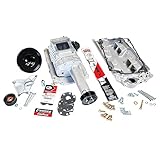
- Conventional Cylinder Head Compatibility
- Edelbrock 122 System Type
- Carbureted
- Eaton H122 Rotor Type
- 6-Rib 3. 75 in. Pulley
What are the main types of superchargers?
Roots/TVS and twin-screw designs are positive-displacement compressors: their rotors move air through the unit. A centrifugal supercharger instead uses an impeller to accelerate air. These are distinct designs, not interchangeable names.
Roots and TVS
A Roots-style unit moves air using rotating lobes. Eaton describes its TVS technology as a positive-displacement design. Its R-Series has four lobes and is intended for peak-power applications; its V-Series has three lobes and is aimed at efficiency at low engine speeds and compound-boosting applications. These descriptions apply to Eaton’s product families, not to every Roots-type supercharger. Eaton’s TVS overview describes the technology and its product families.
Rank #2

- [ADDS 45-55% HORSEPOWER] Complete 6-71 Roots-style supercharger kit pumps streetable, instant-throttle boost into your Small Block Chevy - case, double-pinned 3-lobe rotors, factory-timed for consistent boost.
- [FITS ALL SBC BLOCKS] Bolts to standard-deck 265/283/305/307/327/350/383/400. Carb adapter accepts dual 4-barrel square-bore ( 600-850 cfm typical). Verify rotating assembly for sustained race use.
- [COMPLETE BOLT-ON KIT] Includes supercharger, intake manifold, snout, 50T/55T Gilmer pulleys, idler with bracket, 3in belt, V-belt crank pulley, dual-carb adapter, and all gaskets. Carbs/dist/fuel sold separately.
- [BUILT TO SURVIVE BOOST] Heavy-duty front/rear bearing plates handle sustained PSI. Double-pinned rotors prevent slip under detonation. Pop-off valve relocated to rear. 12-month warranty.
- [DIAL IN YOUR BOOST] Ships with 50T/55T pulleys for popular street range. 48T, 60T, 65T sold separately to adjust overdrive for race or street. Intended for racing - verify local emissions.
Twin-screw
A twin-screw supercharger uses two intermeshing, screw-shaped rotors to move and compress air. It is also a positive-displacement design, but its rotor arrangement differs from a Roots unit. The performance of a particular system depends on the unit and its installation.
Centrifugal
A centrifugal supercharger uses an impeller to accelerate air, making it a dynamic-compressor design rather than a Roots-style displacement pump. Its output behavior varies with the specific compressor, engine, and installation; the design label alone does not establish how a particular vehicle will perform.
Rank #3
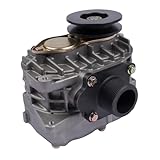
- 【Universal Fit】: The AMR500 turbocharger is designed for easy adaptation to a wide range of vehicle models. It can be installed on any engine with a displacement of 1.6-2.4L, provided sufficient installation space is available
- 【Wide Compatibility】: Experience more powerful acceleration and turbo boost across various driving conditions. Engine output increases by over 30% while fuel consumption decreases by 3-10%. Additionally, this technology helps reduce pollutant emissions
- 【Efficient Airflow Design】: Engineered for optimal airflow, this supercharger improves power output and engine responsiveness for a superior driving experience
- 【Durable & Reliable】: Built to last, this high-quality Supercharger ensures consistent performance, whether for racing, off-roading, or recreational use
- 【Easy Installation】: Designed for straightforward integration into various applications, helping you take your automotive projects to the next level with minimal hassle
Supercharger vs. turbocharger: what is the difference?
The key distinction is the source of energy that drives the compressor. A conventional supercharger draws drive power from the engine, usually through a mechanical connection. A turbocharger uses exhaust energy to spin a turbine connected to the compressor. Magnuson’s supercharger FAQ explains this mechanical-drive versus exhaust-drive distinction; Eaton describes its TVS airflow as not relying on exhaust energy.
| Comparison | Supercharger | Turbocharger |
|---|---|---|
| Drive source | Mechanical drive from the engine | Exhaust energy spins a turbine connected to the compressor |
| Compressor designs | May use positive-displacement Roots/TVS or twin-screw designs, or a centrifugal design | Uses a compressor connected to the exhaust-driven turbine |
| Response and efficiency | Depend on the design, engine, controls, and operating conditions | Depend on the design, engine, controls, and operating conditions |
| Power, heat, packaging, and complexity | Require comparison of a specified system on a specified engine | Require comparison of a specified system on a specified engine |
A mechanical supercharger provides boost through an engine-linked drive, while a turbocharger uses exhaust energy. Neither is universally faster, more powerful, less expensive, or more fuel-efficient: a fair comparison requires the exact systems and engine.
Rank #4

- 【Part Number】AMR300 14408KA051.The supercharger is built to exact specifications for direct replacement, ensuring enhanced performance and efficiency
- 【Application】Replacement for cars and snowmobiles and ATVs with engine sizes of 0.8-2.0L.This supercharger works seamlessly with V4 V5 and V6 engines and is compatible with various automotive applications
- 【Ensure Fitment】Please confirm the part number and vehicle model to ensure the product fits your needs. If can't confirm it, please check the nameplate or the part number of the old supercharger
- 【Easy Installation】The supercharger is designed for straightforward integration into various applications, helping you take your automotive projects to the next level with minimal hassle
- 【Material 】Constructed from high-quality materials including aluminum, iron, plastic, and alloy. The closed assembly method ensures performance. The supercharger is designed to withstand high operating temperatures and pressures, ensuring long-lasting performance
Does a supercharger always make the same boost or power?
No. Boost, response, efficiency, and net power depend on the compressor design, sizing, engine, controls, and operating conditions. A technology name does not establish a universal boost pressure, power increase, or fuel-economy effect.
Eaton states that its TVS technology offers “up to a 12% efficiency improvement” in comparison with an earlier-generation context. That is Eaton’s claim for its technology, not a general efficiency gain for all superchargers. Eaton’s overview does not state a publication year for the claim.
Do these 3 things before closing this tab:
1Scan for outdated or missing drivers - takes under a minute2Clear out junk files and repair common Windows errors3Fix the driver behind crashes, sound loss and screen glitchesDoes “Supercharger” mean Tesla charging?
It can. Tesla Supercharger can refer to the company’s electric-vehicle fast-charging option, which is separate from the engine compressor described here. The U.S. Department of Energy’s Alternative Fuels Data Center discusses Tesla Supercharger in the context of EV charging and separately explains charging equipment and connector types: Electric Vehicle Charging Infrastructure.
Quick Recap
Product prices and availability are accurate as of the date/time indicated and are subject to change. Any price and availability information displayed on Amazon at the time of purchase will apply.




