A solar farm does not automatically become a waste site when its panels reach the end of a typical 20-to-30-year performance period. The owner may keep operating it, refurbish equipment, repower with newer technology, or fully decommission the project. If the site is retired, panels and other equipment are disconnected, removed, and routed for reuse, recycling, or disposal, while the land is restored or converted to another agreed use. The result depends on equipment condition, project contracts, permits, local law, recycling capacity, and economics.
What “end of life” means for a utility-scale solar farm
The U.S. Department of Energy’s Federal Energy Management Program states: “The typical performance period for a photovoltaic system is 20 to 30 years.” That figure describes a common operating period, not an automatic shutdown date. A well-maintained project can continue producing electricity after that point, although output, reliability, and repair costs may change.
As an Amazon Associate I earn from qualifying purchases.
A project can reach an end-of-life decision for reasons other than age. DOE identifies several possible triggers:
Do these 3 things before closing this tab:
1Repair Windows errors before they cause bigger problems2Fix the driver behind crashes, sound loss and screen glitches3Clear out junk files and repair common Windows errors- An underlying land-use agreement, power-purchase agreement, interconnection agreement, or permit expires.
- Severe weather, fire, flooding, or another event causes damage that is uneconomic to repair.
- Energy production has degraded while operation and maintenance costs have risen.
- Replacement parts are no longer available, making repairs slow or expensive.
- The owner decides that a new project, a different land use, or a sale is financially preferable.
Because these factors differ from project to project, “end of life” is best understood as a decision point rather than a single date.
#1 Best Overall

- [Strong Adaptability] ECO-WORTHY Mounting Bracket is 118"Lx39"W In. the front and rear pillars are 5.9 in higher, the front column is 13.78 in, and the rear column is 28.53 in,Which can better support large Solar Panels. Width per panel < 38.6 in for 3×300W panels and < 27.5 in for 4×200W panels. Suitable for home, farms, cabin and off-grid
- [Upgraded stability] When install the bracket, the distance between parallel vertical columns should be 59 in, and an upgraded support rod should be installed in the middle,It can bear 160lbs, solving the sagging or collapse problem in the middle of the solar panel
- [ 30% Efficiency Improvement ] ECO-WORTHY mounting system features adjustable hole positions. It can be set between 30 and 60 degrees, which allows the solar panel to absorb the sun's rays efficiently and make the best use of the sun's resources
- [ Beginner-Friendly Installation ] Our upgraded mounting system includes a detailed step-by-step manual, and a full installation video is available on our product page. Whether you're a DIY beginner or a pro, setting up your solar panel bracket is easy
- [ 15 years Durability ] Upgraded Galvanized Steel construction, endure harsh weather conditions,up to 15 years. You can put battery, controller, inverter at backside of the mounting system. It can save lots of room and use solar power system easier
The four paths an owner can choose
DOE lifecycle guidance describes four broad outcomes. The right choice depends on expected production, operating costs, available parts, remaining site infrastructure, contract status, permits, and the cost of eventual removal.
| Path | What happens | When it can make sense | Main constraints |
|---|---|---|---|
| Continue operating | The existing array and balance-of-system equipment remain in service. | Production remains adequate and leases, permits, interconnection rights, and power contracts can continue. | Older equipment may become less reliable and more expensive to maintain. |
| Refurbish | Selected components are repaired or replaced while much of the project stays in place. | Targeted work can restore performance more cheaply than a complete rebuild. | Local rules may limit repair or reuse of older systems; replacement parts may be unavailable. |
| Repower | Some or all major generation equipment is replaced with newer modules, inverters, racking, or related equipment. | Existing roads, electrical collection, fencing, foundations, or grid access still have value. | New equipment must meet current codes, permits, interconnection terms, and site limits. |
| Decommission | The array and balance-of-system equipment are removed, then materials and land are managed under the project’s obligations. | Continued operation or repowering no longer works technically, legally, or financially. | Removal, transportation, waste handling, restoration, and financial-assurance costs can be substantial. |
Reusing existing infrastructure can sometimes cost less than removing everything and starting elsewhere. That is not a universal result: an older design may be difficult to repair, and a permit or local ordinance may require removal even when some equipment could still produce power.
What decommissioning removes
Decommissioning is larger than taking modules off the racks. A typical scope includes disconnecting the project from the grid, making equipment safe, dismantling the photovoltaic array, and removing balance-of-system components. Depending on the design, that can include:
- PV modules and their wiring;
- racking, trackers, piles, and other foundations;
- inverters, transformers, switchgear, and enclosures;
- collection cables and communication equipment;
- fences, gates, security equipment, and monitoring hardware;
- storage batteries and their containers, where the project has energy storage;
- access roads, drainage features, concrete pads, and other site improvements when the agreement or permit requires removal.
Crews normally separate equipment before shipment. Components that can be reused may go to another project or a refurbishment channel. Materials that can be recovered are sent to a recycler, and residual material is handled as waste under applicable federal and state rules. Damaged equipment may require different packaging, transport, or testing from intact equipment.
Rank #2
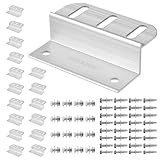
- Durable & Wind-Resistant Build: Crafted from corrosion-resistant aluminum alloy, these heavy-duty Z brackets provide long-lasting, stable performance and withstand high winds for outdoor solar installations.
- Adjustable Multi-Slot Design: The multi-slot structure allows flexible positioning and precise alignment during installation, making setup straightforward and hassle-free.
- Complete 16-Pack Kit with All Hardware: Includes 16 Z brackets, all necessary mounting hardware, and clear installation guidance for quick, secure mounting right out of the box.
- Versatile Application: Suitable for solar panel installations on RVs, boats, roofs, and off-grid systems, offering universal compatibility for diverse outdoor setups.
- Reliable Hold-Down Performance: Sturdy construction ensures your solar panels stay securely mounted in various conditions, giving you peace of mind for long-term use.
What can happen to the panels?
Direct reuse or refurbishment
A retired module can sometimes be installed elsewhere or refurbished so it generates electricity at a second location. The U.S. Environmental Protection Agency (EPA) notes that the U.S. secondary market has not yet gained broad traction. A module that still produces power may nevertheless fail the requirements of a new project.
Before reuse, an owner or buyer must consider electrical, building, fire, and grid-interconnection codes, along with the module’s condition, documented performance, warranty status, and transport risk. Off-grid applications may have fewer interconnection requirements, but that does not make every used panel suitable or safe. Reuse should be based on testing and the receiving site’s rules, not simply on the panel’s age.
Recycling crystalline-silicon modules
EPA identifies glass, aluminum, copper, polymer layers, silicon cells, and other materials in common crystalline-silicon panels. Recycling processes can recover substantial amounts of glass, aluminum, and copper. The exact recovery rate and economics depend on the module design, contamination, damage, transport distance, and the facility’s process.
Free tools Windows power users keep installed
One-click scans. No signup required.
Recycling thin-film modules
Thin-film cadmium-telluride modules require a different process from crystalline-silicon panels. EPA reports that at least one U.S. manufacturer operates dedicated facilities that recover semiconductor material as well as glass and copper. A recycler therefore needs to know the panel technology and model before accepting a shipment.
Rank #3

- Reliable & Multi-Functional: Torsion-resistant and corrosion-resistant, these solar panel mounting brackets provide high stability and precise manufacturing, making them ideal for secure attachment of photovoltaic and solar modules. The tilt angle can be adjusted from 0-90° without tools
- Sturdy & Versatile: Crafted from high-strength aluminum rails and sold in packs of 4, our solar panel mounting kit ensures fast, easy, and secure installation for balcony power plants, mini PV systems, and off-grid solar setups
- Wide Application Range: The 45 inch long solar panel mounting rails are suitable for modules up to approximately 115 cm and 100-400 watts. Panels can be attached horizontally or vertically, and for solar panels, two can be installed horizontally
- Universal Use: Quickly and easily mount your PV or solar system on flat roofs, garage roofs, balconies, balcony railings, walls, facades, boats, campers, and caravans. They can also be placed on the ground in gardens, balconies, and terraces
- Package Includes: 8 x 1140mm/45in Aluminum Mounting Rails, 4 x rails for angle adjustment, 12 x knurled screws and wing nuts, 8 x M6 hex screws and nuts, 12 x self-tapping screws
Disposal and hazardous-waste screening
Under federal rules, a discarded panel is solid waste. It may also be hazardous waste if it exhibits the toxicity characteristic. EPA explains that lead or cadmium can be present in forms that may leach; some tested panels pass the toxicity test and others fail. It is incorrect to label every panel hazardous, but it is equally unsafe to assume that no panel is hazardous.
Generators must evaluate the actual material and follow applicable federal and state requirements. State adoption of federal recycling exclusions and additional state rules can change how panels are stored, transported, recycled, or disposed of. Damaged, broken, or contaminated modules may need special handling even when an intact module from the same project would not.
What happens to the land?
A decommissioning plan normally addresses equipment removal, grading or other site work, erosion control, and vegetation. The land may be returned as nearly as practicable to its pre-project condition, or it may be adapted for another use agreed by the landowner and project owner. The controlling documents are usually the lease, permit conditions, local ordinances, and any state requirements; there is no single nationwide restoration standard for every solar farm.
The Tool Desk
Outbyte Driver Updater FREEScan for outdated or missing drivers - takes under a minuteDriver Scan →Outbyte PC Repair FREERepair Windows errors before they cause bigger problemsFix Now →Restoration can involve removing foundations and buried equipment, filling or stabilizing holes, repairing drainage, replacing topsoil where required, and establishing vegetation. Whether roads, fencing, and other improvements remain depends on the agreed future use. A landowner who wants agricultural, grazing, conservation, or development use should have that outcome described in writing rather than relying on a general promise to “restore” the property.
Rank #4

- Practical Design & Easy to Install: End clamps and T-shaped middle clamps ensure a secure and easy grip during the solar panel installation. It also reduces the impact of the weight of the PV system on the suction of the roof covering. The grooved strips of the rails allow for a more secure connection to the solar panels
- Premium Material, Durable and Long-lasting: Anbte solar panel brackets are made of aluminum alloy, lightweight, high load capacity and corrosion resistance, suitable for various outdoor environments. Stainless steel screws have the advantages of rust and corrosion resistance. And the rubber mat made of EPDM material has good waterproof performance
- Innovative Two-hole End Clamp: Anbte solar panel end clamp is divided into long end and short end, and 2 fixing holes are pre-drilled. Choose the shorter side of the end clip for mounting solar panels with 30 mm/1.18" frame, and choose the longer side of the end clip for mounting solar panels with 35 mm/1.38" frame
- Wide Applications: Suitable for most home, RV and marine solar panel installations, you can install solar panels on flat and pitched roofs made of tiles, asphalt shingles, ceramic tiles, slab shingles and standing seam boards. Provides toughness to withstand extreme weather conditions
- Complete Kit: 10pcs 4.72n rails + 4pcs end clamps +6pcs middle clamps, including complete accessories for mounting (fixing screws and rubber pad). Ideal for mounting 4 solar panels
North Carolina as a specific state example
North Carolina’s 2023 Session Law 2023-58 (House Bill 130) illustrates how detailed state requirements can be. For covered projects, the law calls for disconnecting from the grid, removing equipment, shipping equipment for reuse, recycling components practicably capable of recycling, and properly disposing of residual components. Its equipment list includes modules, racking, cables, fencing, transformers, inverters, and storage batteries.
The law requires restoration as nearly as practicable to the pre-project condition, or to a different condition agreed in writing by the landowner and project owner, subject to applicable laws and local ordinances. Land cleared of trees may be revegetated or reforested with seedlings. The owner must notify the state Department within 30 days after operations cease and complete decommissioning and restoration within one year after cessation. Financial assurance must remain in place until the work is complete; permitted mechanisms include insurance, guarantees, letters of credit, trusts, and surety bonds.
Those deadlines and assurance mechanisms are North Carolina requirements, not a rule for every state. A project in another jurisdiction may have different notice periods, restoration standards, bonding rules, or no comparable statewide statute.
Crashes, No Sound, or Screen Glitches?
Random freezes, missing sound and display glitches usually trace back to one bad driver. Find and replace yours safely.Free scan · under a minuteWindows Errors? Fix Them Before They Spread
Repair common Windows errors and clear accumulated junk for a smoother, more stable PC - no reinstall needed.Free scan · no reinstallWhy recycling does not always win on cost
Recycling capacity exists in the United States, but EPA says it is not yet operating at large scale. DOE also reports that total U.S. recycling cost is generally greater than landfill disposal. Transportation, sorting, labor, panel chemistry, contamination, and local capacity all affect the result. A distant recycler may recover more material but cost more than a nearby disposal facility; a damaged shipment may require additional packaging and compliance work.
Best Value

- 【SUPERIOR QUALITY】 Anodized Aluminum Z brackets, Stainless Steel Hex Bolts and Screws, service life up to 25 years, perfectly supporting solar panels in off-grid installations.
- 【MULTIPLE APPLICABILITY】 Z Brackets are ideally designed to install single solar panels from 50w~150w on RVs, Trailers, Boats, Motorhome,Yachts, Wall, Cabins, Sheds, Garages and Other Off Gird Roofs.
- 【EACH SET CONTAINS】 16 units per set, each set includes 16pcs Z brackets, 16pcs Bolts, 16pcs Flange Nuts, 32pcs Self-Tapping screws.
- 【HIGH PERFORMANCE】 Light weight in quality construction, rust free and excellent corrosion resistance performance. We ensure our Z brackets performs well in all weather conditions!.
- 【CONSIDERATE AFTER-SALES SERVICE】 If you have any questions about product itself or about installation, please feel free to contact with us, we will have our professional technical team to help.
That cost comparison does not eliminate recycling as an option. Contract terms, state rules, customer requirements, corporate commitments, available take-back programs, and the value of recovered materials can change the decision. Project owners should obtain current, written acceptance terms rather than assume a facility takes every module type.
How large could the waste stream become?
DOE’s Solar Energy Technologies Office projected in its October 2023 Photovoltaics End-of-Life Action Plan that U.S. PV module waste could reach 0.8 to 1.5 million metric tonnes in 2050. DOE characterized that range as roughly 0.1% of total U.S. waste generated in 2018 and said PV end-of-life volume could be about 12% of U.S. annual municipal electronic-waste volume in 2050. These are projections, not measurements of future waste.
There is also potential value in recovered materials. The International Renewable Energy Agency, as reported by EPA, estimated that recoverable raw materials from end-of-life panels globally could have a cumulative value of about $450 million by 2030, equivalent to the raw-material cost currently needed to produce about 60 million new panels. That is an estimate of potential raw-material value, not guaranteed recycling revenue or a forecast price paid to every project owner.
A practical end-of-life decision process
- Review the controlling documents. Check the land lease, power-purchase agreement, interconnection agreement, permits, decommissioning plan, local ordinances, and any financial-assurance terms. Identify the event that counts as cessation and the notice deadlines.
- Measure the remaining system value. Document production, degradation, outage history, operation and maintenance costs, insurance issues, and the condition of modules, inverters, transformers, racking, foundations, and batteries.
- Compare continued operation, refurbishment, repowering, and removal. Include expected energy output, replacement-part availability, permitting and interconnection work, construction costs, removal costs, and the value of existing roads and electrical infrastructure.
- Classify equipment before moving it. Identify crystalline-silicon versus thin-film modules, intact versus damaged units, and any components that require hazardous-waste evaluation. Keep records of quantities, serial numbers, condition, and destination.
- Obtain written reuse and recycling terms. Confirm accepted technologies, minimum quantities, testing requirements, packaging, transport responsibilities, fees, certificates, and what happens to non-recyclable residue. EPA directories can help locate options, but EPA does not endorse listed organizations.
- Plan the site work with the future land use in mind. Mark equipment to remove, buried infrastructure to address, drainage repairs, grading, topsoil needs, vegetation or reforestation, and any improvements the parties agree to leave in place.
- Close out the project. Complete required notices, inspections, waste records, restoration documentation, and release of financial assurance only after the responsible authority and landowner accept the completed work.
Common mistakes to avoid
- Treating 20 to 30 years as a mandatory retirement date. It is a typical performance period, not an automatic legal or technical expiration.
- Planning only for modules. Racks, foundations, cables, inverters, transformers, fencing, and batteries can be part of the removal obligation.
- Assuming all panels follow the same waste rule. Material composition and toxicity testing determine classification.
- Promising “full restoration” without defining it. Specify grading, buried equipment, roads, drainage, vegetation, tree replacement, and the intended post-project condition.
- Assuming a recycler accepts every shipment. Technology, model, damage, volume, geography, and current capacity matter.
- Generalizing one state’s law. North Carolina’s deadlines and financial-assurance provisions should not be presented as nationwide requirements.
What landowners and communities should ask
Before a project is built or transferred, ask who is responsible for decommissioning, when financial assurance is posted and updated, how its amount is calculated, and who controls it if the project owner becomes insolvent. Ask what “remove” includes, whether buried cables and foundations must come out, how damaged panels will be classified, where materials may be sent, and what evidence proves recycling or disposal.
For the land itself, ask whether the default is pre-project condition or an alternative use, who pays for soil and drainage work, how trees and vegetation will be replaced, what happens to access roads and fencing, and which agency signs off. Put the answers in the lease and permit documents; a verbal understanding may not survive a sale of the project.
The bottom line for a retiring solar farm
At the end of a solar farm’s operating period, the panels are only one part of the decision. The owner may extend, refurbish, repower, or retire the project. Retirement usually means disconnecting the array, removing the modules and balance-of-system equipment, separating reusable and recyclable materials from residual waste, and restoring or adapting the land under the applicable contract and law. Recycling is technically available but generally costs more than landfill disposal in the United States and is not yet large-scale. The final outcome is determined by the project’s documents, local requirements, equipment condition, panel technology, and the economics at the time of closure.
Quick Recap
Product prices and availability are accurate as of the date/time indicated and are subject to change. Any price and availability information displayed on Amazon at the time of purchase will apply.




