If coolant gets into engine oil, it can contaminate the oil and compromise the cooling system. Continued overheating or running with contaminated oil can lead to serious engine damage. A failed head gasket is one possible cause, but an oil cooler fault can also mix fluids. Milky sludge under the oil-filler cap is a clue—not proof—because short trips can leave harmless condensation there.
What happens when coolant and engine oil mix?
Engine oil lubricates moving parts, while coolant carries heat away from the engine. When the fluids cross-contaminate, the oil may no longer protect engine components as intended, and the cooling system may not function properly. If the problem leads to overheating and the engine continues to run, damage can become severe. The outcome depends on how much fluid has mixed, where it entered, and how long the engine has been operated in that condition.
Mixing usually means a leak has opened between a coolant passage and an oil passage. A head gasket can fail at that boundary, but it is not the only component that can allow fluids to cross.
What can cause coolant to get into the oil?
Head-gasket failure
The head gasket sits between the cylinder head and engine block. It seals coolant passages, oil passages, and cylinder compression. If it fails between a coolant passage and an oil gallery, coolant and oil can mix. A failure elsewhere can instead let coolant enter a cylinder, combustion gases enter the cooling system, or fluid leak externally; symptoms therefore vary with the failure location. Haynes explains the gasket’s sealing role in its guide to ways a head gasket can fail.
What’s actually slowing this PC down?
Pick the symptom - the matching free tool is one click away.
#1 Best Overall

- NOT FOR USE ON AIRCRAFT - Look for our Aircraft specific testing kits on Amazon.
- MONITOR EQUIPMENT HEALTH - Professional laboratory oil analysis helps identify wear metals, contamination, and lubricant condition before small issues become expensive repairs. Trending results over time provides valuable insight into the health of your equipment.
- FOR GASOLINE & DIESEL EQUIPMENT - Designed for automobiles, diesel pickups, heavy-duty trucks, construction equipment, agricultural equipment, generators, marine engines, motorcycles, ATVs, UTVs, and other gasoline or diesel-powered equipment.
- COMPLETE TEST KIT INCLUDED - Everything needed to collect and submit your sample is included: sample bottle with leak-resistant cap, information card, resealable sample bag, prepaid return mailer, and easy-to-follow collection instructions.
- SIMPLE SAMPLE COLLECTION - Collect your sample from the engine, transmission, or differential, complete the information card, seal everything in the included prepaid mailer, and drop it in the mail. We'll take care of the laboratory testing from there.
Overheating and its underlying causes
Haynes identifies overheating as the most common cause of a faulty head gasket in its head-gasket guide. Low coolant from a leak, a faulty thermostat or electric cooling fan, or blocked coolant passages can contribute to overheating. A gasket failure can also cause coolant loss and further overheating, so the relationship can run in either direction. Wear or a design-specific weakness may also be involved; the cause should be diagnosed rather than assumed.
Engine oil cooler or transmission oil cooler fault
A leaking engine oil cooler or transmission oil cooler can also account for oily or milky residue in coolant. These are alternatives to a head-gasket failure, and appearance alone cannot identify which component is leaking. A technician needs to locate the actual leak path.
Rank #2

- FUNCTION: The engine oil pressure tester kit is used to diagnose and test the engine oil pressure value, to check whether it is normal. The measured value can be used to judge the operation of fuel system components such as electric gasoline pump and oil pressure regulator. And with this best in class oil pressure test tools, you can get a definite pressure value well without relying on the dashboard light.
- INCLUDING: This oil pressure test tool kit contains a wide assortment of durable adapters designed to fit mot import/domestic engines. The 10 adapters are marked with number, you can choose the right one very easy. 4FT long hose is made of rubber nylon resin, working pressure 300 PSI. This is a great kit for DIY auto tools, to test engine oil pressure value quickly and accurately.
- DURABLE AND SAFE: The material of the engine oil pressure tester kit consists of Copper, Rubber, ABS Plastic, Iron, and Aluminum; And the gauge is equipped with a shockproof cover, which is under great protect and convenient maneuverability; Whole oil pressure tester kit packed in a molded case making it easy to store and organize the equipment.
- PARAMETER: The oil pressure gauge use 3" big dial with clear dual scale range 0 to 140 PSI and 0 to 10 Bar. Compare to a large range, this oil pressure gauge is easy to read about 1-2 Bar with a short range. There are a straight quick coupler and a elbow one in the case, you can choose it according to the location of the engine oil pressure test port.
- QUALITY ASSURANCE: 100% brand newengine oil pressure test tool kit, To guarantee 100% customers' satisfaction, we accept unconditional return service and 180 days warranty for all parts. Please contact with us if there's any quality or other problem.
Symptoms to look for—and what they do and do not prove
- Milky or sludgy oil: Coolant or water contamination can make oil look milky. But mayonnaise-like residue only under the filler cap is often condensation after frequent short trips, when the oil does not stay hot long enough to evaporate moisture. Check the broader pattern, not just the cap.
- Oily residue in the coolant expansion tank: This can result from a head-gasket leak, but an engine oil cooler or transmission oil cooler fault is another possibility.
- Coolant loss or overheating: Loss can come from an internal or external leak. A gasket failure may cause coolant loss and overheating, while overheating may also damage the gasket.
- White exhaust steam, misfires, or rough running: These may occur if coolant enters a cylinder or compression is lost. They are not universal symptoms of a leak that mixes coolant and oil.
None of these signs alone identifies the failed part. A recent overheating episode, changing fluid levels, visible residue, and changes in how the engine runs are more useful considered together.
How a mechanic can investigate the leak
Diagnosis should establish both whether there is a leak and where the fluids are crossing. A visual clue or one test result may not answer both questions.
PC Slower Than It Used to Be?
A free scan shows the junk files, broken settings and background clutter dragging Windows down - then fixes them in one click.Free scan · Windows 10 & 11Outdated Drivers Are Slowing You Down
One free scan finds every outdated or missing driver and matches the right update for your exact hardware.Free scan · exact hardware matchRank #3

- 【Engine Oil Quality Test】After prolonged use, engine oil gradually darkens, becomes more viscous, contains more impurities, and becomes dirtier. This engine oil tester determines the degree of oil aging by testing its light transmittance (0%~100%), helping you assess whether your engine oil needs to be changed. The older the oil, the lower its light transmittance. This engine oil tester is ideal for automotive maintenance and DIY enthusiasts.
- 【High-Precision Probe & Fast Response】The oil analysis kit probe utilizes optical sensing technology, offering higher measurement accuracy and sensitivity. It can quickly output stable results within seconds of contact with the engine oil, providing immediate and reliable data, avoiding lengthy testing procedures. The operating temperature range is -10℃ to 60℃.
- 【Compatible with Various Engine Oil Types】This engine oil tester supports testing for both gasoline and diesel engine oils, and is compatible with the majority of lubricants on the market. It enables rapid dipstick-tube testing and offline sample testing, allowing you to choose the appropriate testing method based on different scenarios.
- 【Oil Temperature Test】This oil test kit can display the actual oil temperature and supports one-touch switching between temperature units (℃/℉). You can select different temperature units according to your needs.
- 【50.4In Extra-Long Probe Hose】The engine oil tester comes with an extended 1280mm (50.4in) flexible hose, longer than traditional ones on the market, making it suitable for various vehicle types including large vehicles. Data is clearly readable, and test results are displayed as bar graphs and percentages for more intuitive result viewing.
| Diagnostic approach | What it checks | What it cannot establish by itself |
|---|---|---|
| Combustion-gas test of coolant | Whether combustion gases are present in the coolant; Haynes describes using a gas analyser to test for hydrocarbons. | A negative result does not guarantee a healthy head gasket. It also does not rule out an oil cooler fault or every other oil-coolant leak path. |
| Leak-down test | Pressure loss when the engine is pressurized through a spark-plug hole, as described by Haynes. | It does not, by itself, prove that a head gasket—rather than an oil cooler or another component—caused the fluid contamination. |
These tests look for different failure patterns; neither is a universal test for every oil-and-coolant leak. A technician may need vehicle-specific checks to identify the source. Follow the vehicle maker’s instructions, and never open a hot, pressurized cooling system.
What to do if you suspect coolant in the oil
- Do not treat one patch of cap sludge as a diagnosis. Look for other signs, such as changing coolant or oil levels, overheating, residue in the expansion tank, or abnormal exhaust and engine behavior.
- Avoid continuing to operate an overheating engine. Overheating can contribute to gasket failure and further engine damage. If you are unsure whether the vehicle can be driven safely, arrange professional advice or recovery; there is no reliable universal safe distance.
- Arrange diagnosis of the leak path. Ask the technician to consider the head gasket as well as the engine oil cooler or transmission oil cooler where applicable. Tests should be interpreted in light of the symptoms and the vehicle’s design.
How the repair is determined
If a failed head gasket is confirmed, the repair involves engine disassembly and gasket replacement. Overheating may distort the cylinder head, so it needs inspection appropriate to the vehicle and the damage found. The exact procedure varies by engine; Haynes discusses diagnosis and repair in its head-gasket symptoms and repair guide.
Rank #4
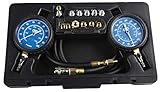
- OTC’s 5610 Transmission/Engine Oil Pressure Testing Kit is designed for static and/or on road testing and can be used on both domestic and import applications
- Included high (0-400 psi/0-2800 kPa) and low (0-100 psi/0-700 kPa) pressure gauges allow for testing on both transmissions and engines
- Large 3-1/2 inch diameter gauges feature chrome bezels, rugged protective outer boots, and hooks for easy hanging out of the way
- Gauges and hose assembly incorporate quick couplers; Kit includes 13 adapters to fit most applications and a detailed instruction manual
- Blow molded hard case with removable lid included to keep kit components contained and organized when not in use
If an oil cooler or another component is responsible, the repair must address that component and the resulting contamination. The evidence here does not establish a generic repair price or time-to-failure. Oil and coolant specifications also vary by vehicle, so use the manufacturer’s recommended fluids; AAA provides general fluid guidance.
Quick Recap
Best Value

- Comprehensive Tool Set: Orion Motor Tech's 19 pcs coolant pressure tester kit makes detecting internal & external pressure leaks in your vehicle's cooling system easy, including 15 adapters, a manual vacuum pump, a probe thermometer, a wrench, and O-rings
- 15 Adapters for Most Cars: With 15 different radiator adapters, this coolant pressure tester kit is compatible with numerous vehicle makes and models such as BMW, Ford, Fiat, VW, Porsche, Mercedes-Benz, Nissan, Peugeot, Chrysler, and more
- Accurate Readings: This cooling system pressure tester kit features a 2.5 in. (6.4 cm) easy-to-read pressure gauge with protective rubber coating, ideal for testing automotive pressurized cooling systems up to 35 psi (2.5 bar)
- Hassle-Free Organization: The color-coated adapters and molded size markings make it easy to quick identify the appropriate tool for the job. The custom molded carrying case keeps everything organized and ready for transport
- Built to Withstand Everyday Use: Constructed with quality aluminum alloy, nylon, rubber, and brass, this coolant system pressure tester kit is designed for enhanced strength and consistent performance for years to come
Product prices and availability are accurate as of the date/time indicated and are subject to change. Any price and availability information displayed on Amazon at the time of purchase will apply.