Recommended Free Tools
For vehicle-to-home (V2H) backup, you need more than an electric vehicle and a normal wall charger. A workable installation combines a V2H-capable EV, a matching bidirectional EVSE, DC-to-AC conversion, equipment that safely disconnects the house from the utility during an outage, adequate panel and wiring capacity, and any manufacturer-specific modules, controls and software. A permitted installation by a qualified electrician is part of the equipment plan because the system can energize household wiring while the grid is down.
These functions may be integrated into one ecosystem or divided among several boxes. The exact vehicle trim, model year, connector, software, charger, backup hardware and local electrical rules must all line up.
As an Amazon Associate I earn from qualifying purchases.
What a complete V2H system must contain
Bidirectional charging means electricity can move into the vehicle and back out to the home. GM Energy defines it as energy flowing in two directions. Each part below performs a different safety or power-conversion job; omitting one can leave you with ordinary charging rather than usable home backup.
1. An EV that is approved to discharge to a home
Start with the exact vehicle, not merely the battery size or charging connector. The manufacturer must support vehicle-to-home discharge for that model year and trim, and the car must contain the required hardware and software. An EV that accepts AC or DC charging is not automatically able to export energy.
#1 Best Overall
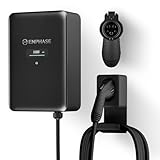
- 9× FASTER CHARGING: Get faster, smarter EV charging up to 11.5 kW (up to 46 miles/hour). Perfect for overnight charging or quick top-ups.
- REVENUE GRADE METER: Eligible for utility rebate programs with accurate, compliant energy monitoring.
- SOLAR CHARGING: Seamlessly connects with your home solar system so you can use more of your own clean energy.
- 5-YEAR WARRANTY: Backed by an industry-leading 5-year warranty for peace of mind.
- SECURE ACCESS: Prevent unauthorized use with app-based control or RFID card access for added safety.
Eligibility can change by model year, market, software release and installed equipment. GM, for example, says some otherwise eligible vehicles require a software update. Check the manufacturer’s current compatibility list using the vehicle identification details before buying any charger. Confirm the connector and communication protocol as well; a physical plug that fits does not prove that the vehicle and charger can negotiate bidirectional power.
2. A vehicle-matched bidirectional EVSE or charger
The bidirectional EVSE is the controlled electrical interface between the vehicle and the house. It manages charging into the battery and discharge back toward the home’s electrical system, while communicating with the vehicle and the backup controller. A conventional one-way home charger cannot be made bidirectional with an adapter or a software setting.
Compatibility is system-specific. The charger may be sold as a package with a backup gateway, or it may require separately purchased modules. Verify the supported vehicle list, connector, maximum continuous and surge output, indoor or outdoor rating, communications requirements and whether commissioning requires a manufacturer account or app.
Quick wins for a faster PC:
Repair Windows errors before they cause bigger problemsFix Now →Scan for outdated or missing drivers - takes under a minuteDriver Scan →Clear out junk files and repair common Windows errorsFree Scan →3. DC-to-AC inverter capability
An EV battery stores direct-current (DC) electricity, while household branch circuits use alternating current (AC). A V2H installation therefore needs an inverter. Depending on the architecture, the inverter is inside the vehicle, inside the bidirectional charger, or in a separate power-conversion unit. The manufacturer’s wiring diagram should identify its location and its rated output.
Do not assume that a charger advertised as “bidirectional” includes every other box. Ask whether the quoted equipment includes the inverter, how much continuous and surge power it can deliver, and what loads it can support simultaneously.
Rank #2

- AI-POWERED SMART CHARGING & APP CONTROL – This ev charger level 2 uses Autel’s AI-integrated smart app to schedule charging around time-of-use utility rates, helping lower your monthly bill while boosting station utilization. Start or stop sessions remotely, adjust current from low to high amps, view real-time energy data, and get alerts if anything looks off.
- ULTRAFAST 80A PERFORMANCE FOR HOME – Delivering up to 19.2 kW / 80A, this charger adds about 70 miles of range per hour and powers your EV up to 14x faster than a standard Level 1 outlet, so you can fully recharge overnight or between customer visits. This 80 amp ev charger is a high-power level 2 ev charger that future-proofs your setup for larger-battery EVs and busy households.
- BUILT FOR 24/7 RELIABILITY & THEFT PROTECTION – Engineered for a 10-year lifespan with internal temperature monitoring and a flame-retardant enclosure. Dual-network Wi-Fi + Wi-SUN keep your charger online with >99.9% uptime, so drivers always find a live station. Custom tamper-resistant screws plus remote locking provide double theft protection for both residential and commercial installs.
- FAST INSTALL & FLEXIBLE STATION MANAGEMENT – Hardwired design for maximum power and reliability (100A circuit recommended for full 80A output; professional electrician install suggested). One-click configuration lets installers set up a charging station in about 10 minutes, then you can easily manage pricing, access, and usage in the app.
- CSA CERTIFIED, REBATE READY & UNIVERSAL J1772 – UL certified by CSA and eligible for many U.S. rebates, incentives, and tax credits to help reduce your installation cost. The 25 ft SAE J1772 cable works with all EVs and PHEVs in North America and with Tesla vehicles when used with a NACS adapter (not included). Backed by a 5-year warranty, 24/7 expert support, and Autel’s proven EV charger technology for long-term peace of mind.
4. Grid-isolation and islanding equipment
When utility power fails, the system must open the connection between the home and the utility before the vehicle energizes the home’s wiring. A transfer switch, gateway, backup controller or islanding device performs that isolation and prevents dangerous back-feeding onto utility lines. The controller also reconnects the home only when utility power is stable and the reconnection sequence is permitted.
This is not optional backup “automation.” It is a life-safety function. Never attempt to back-feed a panel through a receptacle, improvised cord or manual breaker arrangement.
Do these 3 things before closing this tab:
1Fix the driver behind crashes, sound loss and screen glitches2Repair Windows errors before they cause bigger problems3Scan for outdated or missing drivers - takes under a minute5. Panel, service and dedicated-circuit hardware
The charger and isolation equipment need correctly sized conductors, overcurrent protection, disconnects and a hardwired circuit where the manufacturer specifies one. Whether your service can support the equipment depends on the main service rating, existing loads, the charger’s input current, the inverter’s output and local code. A smaller service panel may require an upgrade, load-management controls or a revised backup-load design.
Some installations back up the entire main panel; others feed a dedicated backup panel containing selected circuits. Your installer should calculate fault current, conductor ampacity, voltage drop, grounding and bonding, and available capacity rather than copying a breaker size from another system.
6. Manufacturer-specific backup modules and controls
Many ecosystems use a coordinated set of modules: a backup box or gateway, a power module, a transfer device, metering hardware, communications equipment and an app or cloud account. These parts may be required for automatic outage detection, load control, firmware updates and warranty support.
Rank #3

- Charge with Confidence: ChargePoint builds reliable, flexible EV charging stations for home, business, and fleets. Get 24/7 support and access to hundreds of thousands of North American charging locations.
- Charge Smart: With the user-friendly ChargePoint Mobile App, you can control your electric car charger, manage reminders, connect to smart home devices, find stations, get data and charging info, and access the latest features. Note: WiFi is needed for certain functionalities and troubleshooting steps if connectivity issues arise.
- Vast Network: Wherever you go, ChargePoint’s network includes 274k+ stations across North America and Europe and 565k+ roaming partner stations.
- Safe & Durable: Rely on this UL-certified EV charger for safe home charging. It can be installed indoors or outdoors by an electrician and includes a cold-resistant cable.
- Fast & Powerful: This EV charger charges 9× faster than a 120V outlet, delivering up to 45 mi/hr., dependent upon your vehicle. It features a J1772 connector for all non-Tesla EVs and requires a 20A or 80A circuit. For Tesla EVs, this will require an adapter.
Treat the manufacturer’s complete system bill of materials as a package. An unrelated inverter, battery gateway or smart charger may not communicate correctly, may lack the required isolation certification, or may void the vehicle or equipment warranty.
Crashes, No Sound, or Screen Glitches?
Random freezes, missing sound and display glitches usually trace back to one bad driver. Find and replace yours safely.Free scan · under a minuteWindows Errors? Fix Them Before They Spread
Repair common Windows errors and clear accumulated junk for a smoother, more stable PC - no reinstall needed.Free scan · no reinstall7. Professional installation and approvals
Plan for a site assessment by an electrician or installer experienced with energy-storage and backup systems. The work can require an electrical permit, inspection, utility notification or interconnection approval. Local rules differ, and some jurisdictions restrict certain configurations or require a panel permit even when the charger itself is listed.
Use certified electrical installation where the manufacturer requires it. Approval from the utility or permitting authority is separate from the vehicle maker’s statement that a model is technically capable.
How the power flows during normal operation and an outage
Normal operation
- The EVSE communicates with the vehicle and supplies AC power, or manages the appropriate DC path, to charge the battery.
- The system monitors vehicle state of charge, temperature, charging limits and the home’s electrical demand.
- When discharge is requested, the vehicle and charger authorize reverse power flow under their specified limits.
- The inverter converts battery DC to synchronized AC for the home’s permitted circuits.
Utility outage
- The gateway or backup controller detects loss or unacceptable quality of utility power.
- It opens the grid connection, creating an electrically isolated home “island.”
- After isolation is verified, the inverter establishes the AC supply for the backed-up circuits.
- Loads are limited to the system’s continuous and surge ratings. Large motor starts, electric heating and other high-demand appliances may be shed or excluded.
- When utility service returns, the controller follows its approved resynchronization and reconnection sequence.
The exact switching time, supported loads and restart behavior vary by system. Ask the installer which circuits remain energized during the transition and whether sensitive equipment needs its own uninterruptible-power solution.
Published system examples: different ecosystems, different parts
The following examples illustrate why parts cannot be mixed casually. They are manufacturer-specific configurations, not interchangeable shopping lists.
Rank #4
- 7× FASTER CHARGING: Get fast, reliable EV charging up to 9.6 kW (38 miles/hour) in a compact, flexible design that’s easy to use anywhere.
- REVENUE GRADE METER: Eligible for utility rebate programs with accurate, compliant energy monitoring.
- SOLAR CHARGING: Seamlessly connects with your home solar system so you can use more of your own clean energy.
- 5-YEAR WARRANTY: Backed by an industry-leading 5-year warranty for peace of mind.
- SECURE ACCESS: Prevent unauthorized use with app-based control or RFID card access for added safety.
| System example | Published equipment and compatibility notes |
|---|---|
| GM Energy | A compatible V2H-capable GM EV, the PowerShift Charger and a separate V2H Enablement Kit. GM lists eligible models by year and notes that hardware and software eligibility, including updates on some vehicles, must be confirmed. |
| BMW USA | A compatible EV, Wallbox Professional, Home Backup System Professional, Power Module Professional and Gateway Module Professional. BMW specifies certified-electrician installation and applicable permitting, inspection and utility requirements. |
| Kia with Wallbox | The Quasar 2 bidirectional charger plus additional equipment sold separately. Kia identifies certain EV9 and EV6 model years as supported or anticipated. Its page states that the blackout recovery unit is currently unavailable, so a technically supported vehicle may not yet have an installable backup package in every market. |
| Tesla Powershare | Compatible vehicles and Powershare equipment that support bidirectional transfer and home backup. Vehicle- and system-specific documentation determines the required home equipment. |
Before ordering, obtain the current parts list for your exact market and vehicle. Product names, eligible trims, firmware requirements and availability can change.
How to size the installation for the loads you actually need
Choose backed-up circuits
List the circuits that matter during an outage: refrigeration, heating controls, medical equipment, lighting, communications and a few receptacles are common priorities. Decide whether you need the whole panel or a separate critical-loads panel. Whole-home backup can require substantially more service and inverter capacity than a selected-circuit design.
Check continuous and surge demand
Compare the system’s continuous output with the simultaneous wattage of the selected loads. Then account for starting surges from refrigerators, pumps, furnaces, well equipment and other motors. A system can have enough energy in the battery yet still trip if the instantaneous power or motor-start surge exceeds its inverter rating.
Understand runtime without relying on a promise
Runtime is determined by usable battery energy, the vehicle’s state of charge, household consumption, inverter losses, weather, temperature controls and any load-shedding rules. Manufacturer examples that divide assumed battery capacity by assumed household demand are illustrations, not a guaranteed number of hours. Set a reserve level so the vehicle retains enough energy for driving and configure automatic discharge limits accordingly.
What’s actually slowing this PC down?
Pick the symptom - the matching free tool is one click away.
Purchase and installation process
- Identify the exact vehicle. Record model year, trim, connector, installed charging hardware, software version and country or utility territory.
- Obtain the vehicle maker’s current V2H compatibility statement. Ask whether an update, subscription, account or activation is required and whether discharge is supported in your region.
- Match the charger and all companion modules. Request the complete equipment list, wiring diagram, ratings, environmental limits and warranty conditions. Confirm what is included versus separately purchased.
- Have an installer survey the home. Review the main service, panel space, grounding, meter location, cable route, mounting surface, Wi-Fi or other communications and the circuits you want backed up.
- Complete load and protection calculations. The installer should size conductors, breakers, disconnects, transfer or isolation equipment and backup-panel capacity to the chosen system and local code.
- Check approvals before work begins. Confirm permit, inspection and utility requirements, including any interconnection or export restrictions.
- Install and commission the system. The qualified installer should verify isolation, anti-islanding behavior, firmware, communications, transfer operation, load limits and emergency shutdown procedures.
- Test an outage scenario. With the installer, confirm which circuits remain powered, how large loads are handled, how the vehicle resumes charging, and how the system reconnects after utility power returns.
Safety, maintenance and operating limits
- Use only listed, manufacturer-approved equipment and the specified cable, connector and mounting method.
- Keep the charger and gateway within their stated temperature, moisture and clearance limits.
- Do not open energized equipment or bypass interlocks; service belongs to qualified personnel.
- Install firmware and software updates only through the manufacturer’s supported process, and recheck compatibility after an update.
- Maintain a written list of backed-up circuits, shutdown steps and installer or utility contacts.
- Expect the system to restrict discharge when the battery is too cold or hot, the state of charge is below its reserve, communications fail, or an electrical fault is detected.
Common mistakes and how to avoid them
Buying a normal home charger
One-way EVSE hardware charges the vehicle but has no approved reverse-power path, inverter coordination or islanding control. Select a system explicitly documented for V2H.
Best Value

- Dual Charging on a Single Circuit: Charge two EVs simultaneously with the HCS-D40’s dual-port design, delivering 32 Amps to one vehicle or 16 Amps to two vehicles, minimizing the need for costly electrical upgrades.
- Commercial-Grade Durability with Rugged Connector: Designed for heavy-duty use, the HCS-D40 features a rugged connector that withstands drops, rollovers, and harsh environments, perfect for high-traffic or commercial settings.
- Reliable Performance in All Weather Conditions: The HCS-D40 includes a NEMA 4-rated enclosure and a flexible cable that remains operational even in extreme cold, ensuring reliable charging in any climate.
- Fast and Efficient Charging for Two EVs: Charge one vehicle at 32 Amps or two vehicles at 16 Amps each, providing up to 31 miles of range per hour, ideal for EVs with up to 7.7kW acceptance rates.
- Safe, Long-Lasting Installation for High-Traffic Use: The HCS-D40 hardwired station offers a robust installation for homes and businesses, with safety certification to UL 2594 standards and a 5-year limited warranty for long-term reliability.
Assuming vehicle capability from the connector
Connector type and fast-charging capability do not establish discharge eligibility. Verify model year, trim, software and region together.
Leaving out the backup kit
A charger may be only one part of the system. A required enablement kit, gateway, power module or blackout-recovery unit can determine whether backup works at all. Confirm availability before paying for installation.
Ignoring service capacity
Existing household loads, panel space and conductor limits can force a service upgrade or a smaller critical-loads panel. Resolve this during the site survey, not after equipment arrives.
Expecting every appliance to run
Heating elements, air-conditioning compressors, pumps and other large or motor-driven loads may exceed continuous or surge limits. Have the installer label excluded circuits and configure load management.
Skipping permits or utility coordination
Unapproved work can delay operation, complicate insurance or violate anti-islanding rules. Requirements depend on location, so verify them before installation.
Questions to confirm before signing an order
- Is my exact vehicle model year and trim listed as V2H-capable in my country?
- Which software update, account or activation is required?
- Where is the inverter, and what are its continuous and surge output ratings?
- What equipment performs grid isolation, and is it included in the quoted package?
- Which modules, gateways, meters and cables are purchased separately?
- Will the design back up the whole panel or a dedicated critical-loads panel?
- Which circuits and motor loads can run simultaneously?
- What panel, service, grounding or communications work is required?
- Which permits, inspections and utility approvals apply?
- What is the current availability of every component, especially any blackout-recovery or enablement unit?
- How are reserve state of charge, discharge limits, firmware updates and emergency shutdown handled?
Bottom line
A home V2H installation is a coordinated energy system: a manufacturer-approved bidirectional EV, a matching EVSE, DC-to-AC conversion, certified grid-isolation equipment, correctly sized wiring and panel hardware, required backup modules, and permitted professional installation. Confirm the complete vehicle-and-home combination before purchase, because eligibility, software, component availability and local approvals are all subject to change.
Quick Recap
Product prices and availability are accurate as of the date/time indicated and are subject to change. Any price and availability information displayed on Amazon at the time of purchase will apply.




