The Tool Desk
Outbyte PC Repair FREEClear out junk files and repair common Windows errorsFree Scan →Outbyte Driver Updater FREEFix the driver behind crashes, sound loss and screen glitchesFind Drivers →Jeep “death wobble” is a violent, rapid oscillation of the front axle and steering wheel. It usually begins after the Jeep hits a pothole, bridge joint, rut, or other bump at road speed, and it normally continues until the vehicle slows substantially.
It is most common on solid-front-axle Jeeps such as the Wrangler TJ, JK, and JL, as well as the Gladiator JT. It is not a normal characteristic of these vehicles. The usual pattern is looseness or incorrect geometry plus a bump that triggers the oscillation. Finding the actual source of that looseness—not simply installing a new steering damper—is the key to a lasting repair.
As an Amazon Associate I earn from qualifying purchases.
What causes death wobble?
Death wobble rarely has one universal cause. Several components work together to locate and steer the solid front axle. Wear in any one of them can let the axle or steering linkage move; a tire or road impact can then start a self-sustaining oscillation.
Recommended Free Tools
The areas that deserve inspection are:
- Front track bar and its mounting brackets
- Tie rod and drag link
- Ball joints
- Control arms and bushings
- Wheel bearings or hub assemblies
- Tires, wheels, and lug nuts
- Alignment and suspension geometry
- Steering damper
A Jeep can have more than one fault. Replacing the first visibly worn part may reduce the symptom while leaving another source of play untouched.
#1 Best Overall

- Easy bolt-on installation
- Made of forged solid steel for unsurpassed strength and durability. Massive 1.25in outside diameter
- TECHNICAL NOTES: Requires 2.5 - 6in suspension lift, Models with a drop pitman arm installed require a track bar drop bracket (# 1118). Available Below.
- FITS: 07-17 4WD Jeep JK Wrangler/JK Wrangler Unlimited; 07-17 2WD Jeep JK Wrangler Unlimited
- Installation Time: 1-2 hours
Start with the front track bar
The front track bar locates the axle from side to side. One end attaches to the frame and the other to the axle. If a bushing, joint, bolt, bracket, or mounting hole allows movement, the axle can shift laterally beneath the Jeep. That movement is one of the most common contributors to death wobble.
Inspect the track bar for:
- A loose or incorrectly torqued mounting bolt
- Torn or compressed bushings
- Play in a ball-and-socket or adjustable joint
- Elongated (“wallowed-out”) bolt holes
- Cracked welds or a separating bracket
- A bent bar
- Incorrect length or relocation after a suspension lift
A useful preliminary check can be performed with the Jeep sitting on level ground on its tires. Have an assistant move the steering wheel slightly left and right while you watch both ends of the track bar and its brackets. The bar should not visibly shift independently of its mounts. If a bolt, bushing, joint, bracket, or hole moves, tightening the bolt alone will not solve the problem.
Use the exact torque specification for the Jeep’s year and component. Do not guess based on a similar Wrangler or substitute a generic torque value.
Inspect the steering linkage
Check the complete tie-rod and drag-link assemblies, including every tapered end and the connections at the steering knuckles and pitman arm. Look for:
Rank #2
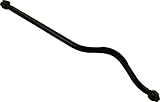
- COMPATIBILITY – Fits 2007-2017 Jeep Wrangler
- Supports Suspension Geometry: Designed as a key suspension component, MOOG control arms help maintain proper wheel alignment and supports stable vehicle handling
- Durable Construction: Manufactured to withstand road stress and everyday driving conditions, this suspension component is built to promote strength, durability, and reliable performance over time
- Helps Restore Ride Quality: Ideal for replacing worn suspension parts, the MOOG control arms supports improved steering response and consistent vehicle stability for confident driving
- About DRiV: We are driven to deliver the automotive products and services our global customers want
- Movement at a tie-rod or drag-link end
- Damaged dust boots
- A bent tie rod or drag link
- Loose tapered studs
- Play at the pitman-arm connection
A bent or loose steering link can cause poor directional control, bump steer, uneven tire wear, and wobble. Do not judge a joint only by whether its boot looks intact; have the linkage loaded and observe the actual joint while the steering is moved.
Check ball joints, bearings, and control arms
Ball joints
Worn ball joints allow the steering knuckle to move relative to the axle housing. Check them using the inspection method and allowable play specified for that Jeep. A generic visual inspection is not a substitute for the manufacturer’s measurement procedure.
Wheel bearings and hubs
Excessive hub or wheel-bearing play can contribute to steering instability. Check for looseness and roughness using the model-specific service procedure. A bearing that is quiet is not automatically free of excessive play.
What’s actually slowing this PC down?
Pick the symptom - the matching free tool is one click away.
Control arms and bushings
Cracked, deteriorated, or loose control-arm bushings can let the axle move in an unwanted direction. Pay particular attention after a lift, hard off-road impact, or control-arm replacement. Hardware may need to be tightened with the suspension loaded, depending on the Jeep and the service instructions.
Rank #3

- The Package Height of the Product is 92.71 centimeters
- The Package Length of the Product is 11.43 centimeters
- The Package Width of the Product is 11.43 centimeters
- Package Weight: 6.622 kilograms
Do not overlook the tires and wheels
A tire or wheel problem can trigger or amplify an existing suspension fault. Check for:
- Unequal or incorrect tire pressures
- Cupped or uneven tread wear
- A damaged, separated, or out-of-round tire
- A bent wheel
- Missing wheel weights
- Excessive tire or wheel runout
- Loose lug nuts
- Mismatched tires or substantially different tread depths
Set pressure according to the Jeep’s door-jamb certification label and the vehicle’s load. Do not automatically inflate to the maximum pressure molded into the tire sidewall.
Have suspicious tires checked for balance, runout, and internal damage. Tire balancing may remove a vibration or reduce a trigger, but it cannot repair a loose track bar, worn ball joint, or damaged bracket.
Alignment matters, but it is not the complete fix
Incorrect toe, caster, or other suspension geometry can make a Jeep unstable. Alignment is especially important after installing a lift, changing control arms, relocating the track bar or drag link, replacing steering parts, damaging suspension components, or changing wheel and tire size.
Rank #4

- Fitment: for 2007-2018 Jeep Wrangler JK JKU 2 Door 4 Door with 0-6" Lift
- Adjustable Design: Perfectly center your car's front axle after adding lift leveling kits. This front track rod is fully adjustable for vehicles at stock height and with up to 6" of suspension lifts
- Strong Construction: Features strong steel material for high strength with 38mm(1.49") outer diameter. Powder coat surface prevents rust, chips, and corrosion. This JK track bar ensures high performance on rough roads
- Package Includes: 1 x Front adjustable track bar. An installation video is available for viewing on the product page.
- 24/7 Customer Support: maXpeedingrods offers lifetime technical support and 1-year limited warranty for quality-related issues since the date of purchase. Feel free to contact us if you have any questions
However, an alignment cannot remove mechanical play. If a track bar, ball joint, tie-rod end, bearing, bushing, or bracket moves, that component must be repaired or replaced first. An alignment performed over loose parts may not hold and can make the Jeep seem fixed only temporarily.
Lifted Jeeps need correctly matched geometry. Track-bar length and angle, drag-link position, control-arm length, caster, toe, wheel offset, and tire clearance all matter. Adding heavy-duty parts at random can create new geometry problems instead of solving the original one.
Is the steering damper the fix?
Usually, no. The steering damper—also called a steering stabilizer—absorbs some steering movement and kickback. A damaged damper should be replaced, but it generally cannot repair looseness in the track bar, steering linkage, ball joints, wheel bearings, or mounting brackets.
A new damper can mask symptoms while the worn component continues to deteriorate. Treat it as one part of the diagnosis, not as a substitute for inspecting the front axle.
Best Value
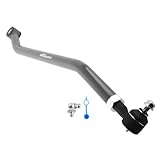
- Fitment: for Jeep Cherokee XJ 1984-2001, for Jeep Wrangler TJ 1997-2006
- Suit 1.5-4.5" Lift: This front track rod can be adjusted from 32.28" to 33.46", for Jeeps installed with 1.5 to 4.5 inches of suspension lifts to help keep the axle centered
- Solve Wobble Issue: Replace your vehicle's worn track bar can help to solve steering wander, death wobble, and alignment issues. Improve off-road capability, allows you to install larger tires while properly setting your track
- Strong Steel: Front trac bar has 1.25" O.D. and 0.24" wall tubing, the tubular steel design and anti-rust powder coating ensure high strength and durability. Rubber bushings are preinstalled to absorb noise and vibrations, providing a more comfortable ride
- 24/7 Tech Support: maXpeedingrods offers lifetime technical support and 1-year limited warranty for quality-related issues from the date of purchase. Feel free to contact us if you have any questions
Some Jeeps have model-specific recalls, customer-satisfaction campaigns, or technical bulletins involving the track-bar bracket or steering damper. For example, certain 2018–2019 Wrangler JL vehicles were covered by recall 18V-675/UA5 for a possible front track-bar-bracket weld problem. Campaign V41 addressed the damper on certain 2018–2019 Wrangler JL vehicles, and FCA bulletin 19-002-24 Revision A discussed air trapped in the damper on certain JL, JK, and JT vehicles. Check the Jeep’s VIN with a dealer or NHTSA before paying for a repair that may be covered.
Independent reader supportYour contribution helps us test, update, and keep practical guides available for everyone.How to diagnose death wobble in the right order
- Record the symptoms. Note the speed, triggering bump, whether braking is involved, outside temperature, tire pressure, recent suspension work, lift height, tire size, wheel offset, and any off-road impact.
- Check the wheels and tires. Verify pressures and lug-nut tightness. Inspect for damage and uneven wear, then check balance and runout if necessary.
- Inspect the track bar under load. With an assistant moving the steering slightly, watch both ends, the bolts, bushings or joints, brackets, welds, and mounting holes.
- Inspect the steering linkage. Check the tie rod, drag link, pitman-arm connection, steering knuckles, and tapered joints for play or bending.
- Check ball joints, hubs, and control arms. Use the service-manual limits for the specific model rather than relying on a generic test.
- Review modifications. Verify track-bar and drag-link geometry, control-arm length, caster, toe, bracket strength, wheel offset, tire clearance, and the torque of all altered hardware.
- Repair before aligning. Replace or repair every failed component, correct damaged brackets or holes, torque everything to the correct specification, then align and road-test the Jeep carefully.
What to do if death wobble starts while driving
- Hold the steering wheel firmly with both hands.
- Keep the Jeep pointed straight as far as practical.
- Do not sharply yank the steering wheel or make a sudden lane change.
- Smoothly reduce speed. Avoid an abrupt panic-braking maneuver if conditions allow.
- Pull over at the first safe opportunity.
- Do not continue highway-speed driving until the cause has been inspected.
A severe wobble can make the Jeep difficult to control and can worsen quickly if a worn joint, loose fastener, or damaged bracket fails.
Common death-wobble myths
| Claim | What is actually true |
|---|---|
| “Every death wobble is caused by the steering damper.” | The damper may reduce movement, but it cannot repair worn or loose suspension and steering parts. |
| “An alignment always fixes it.” | Alignment cannot remove play from a track bar, ball joint, bearing, tie-rod end, bushing, or bracket. |
| “Tire balance cannot be involved.” | Balance, tire damage, pressure, and wheel runout can trigger or amplify instability, even when they are not the root cause. |
| “Only lifted Jeeps get death wobble.” | Lifted and oversized-tire Jeeps face changed loads and geometry, but stock Jeeps can also develop worn or damaged components. |
| “Death wobble is normal on a Wrangler.” | The solid axle makes the condition possible; a severe oscillation still indicates a problem requiring inspection. |
FAQ
Can a bad steering stabilizer cause death wobble?
A damaged stabilizer can reduce damping and may worsen a shimmy, but it is usually not the underlying cause. Inspect the track bar, steering linkage, ball joints, bearings, brackets, tires, and alignment before replacing the damper.
Is death wobble caused by an alignment problem?
Incorrect toe, caster, or suspension geometry can contribute, especially after a lift or steering modification. Alignment will not fix looseness or damage, so mechanical faults must be repaired first.
Can a stock Jeep get death wobble?
Yes. Lifts, oversized tires, and altered geometry increase the risk, but stock Jeeps can develop worn joints, loose bolts, damaged brackets, bad bearings, tire problems, or other faults.
Can I keep driving a Jeep with death wobble?
Avoid highway-speed driving until it is diagnosed. If wobble starts, hold the wheel firmly, keep the Jeep straight, smoothly reduce speed, and pull over safely. A severe oscillation can make the vehicle difficult to control.
The Bottom Line
The lasting fix for Jeep death wobble is a complete inspection—not an automatic steering-damper replacement. Start with the front track bar and its mounts, then check the steering linkage, ball joints, control arms, wheel bearings, tires, wheels, and suspension geometry. Repair every source of excessive movement, use model-specific torque specifications, and perform the alignment only after the parts are sound.
Quick Recap
Product prices and availability are accurate as of the date/time indicated and are subject to change. Any price and availability information displayed on Amazon at the time of purchase will apply.




