What’s actually slowing this PC down?
Pick the symptom - the matching free tool is one click away.
VTEC stands for Variable Valve Timing and Lift Electronic Control. It lets an engine use one valve-opening strategy for smooth, efficient low-speed driving and another, higher-lift strategy for breathing at high rpm. Engine electronics select the change, while oil pressure locks rocker arms onto a different cam profile. The result is a broader useful powerband than a fixed camshaft can normally provide.
What VTEC means
A four-stroke engine breathes through intake and exhaust valves. A camshaft determines when those valves open, how far they open (lift), and how long they stay open (duration). Those settings involve a compromise: mild valve action helps idle quality, low-speed torque, starting and economy, while more lift, duration and overlap can move more air at high engine speed.
VTEC addresses that compromise with multiple cam profiles and switchable rocker-arm operation. At lower engine speeds, the valves follow a conservative profile. When the engine needs more airflow, electronically controlled hydraulic pins lock the rocker arms together so a more aggressive lobe controls the valves.
Honda describes the goal as usable power throughout the rpm range, with throttle response in everyday driving and stronger breathing near the top of the rev range. The exact hardware, control strategy and benefits differ by engine family.
Recommended Free Tools
#1 Best Overall
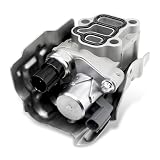
- Compatible: Compatible with Honda Accord 2003-2007 L4 2.4L, Civic 2002-2004 L4 2.0L(Si & SiR Submodel), Civic 2005 L4 2.0L(Si Submodel), CR-V 2002-2009 L4 2.4L, Element 2003-2011 L4 2.4L; Compatible with Acura RSX 2002-2006 L4 2.0L
- Reference Number: 15810-PNE-G01, 15810-PPA-A01, 15810-RAA-A01, 15810-RAA-A02, 15810-RAA-A03, VTS1189, VVT144, 917-224, 917224, Please enter your vehicle information in the top left corner of listing.
- Specifications: Plug/Connector Type: Plug and Socket; Housing Material: Plastic; Terminal Quantity: 2 Pins; Solenoid Activation Type: Electromagnetic
- Exceptional Performance: Made of high quality materials, aluminum valve body, solenoids precision engineered for durability, compatibility and abrasion resistance for long life
- Customer Support: We stand by our product with a one-year quality warranty. If you encounter any issues, our dedicated customer service team is ready to provide a quicker and easier solution to ensure your satisfaction.
Why an engine needs two valve strategies
Low-speed priorities
At low rpm, an engine has little time-related need for very large valve openings. A smaller-lift, shorter-duration profile can maintain stable combustion, useful cylinder filling and smooth idle behavior. It also supports easy starting and tractable torque in normal traffic.
High-speed priorities
As rpm rises, each intake and exhaust event happens more quickly. The engine may need the valves open farther and for longer to overcome flow restrictions. More overlap—the period when intake and exhaust valves are open together—can help draw in the next charge and clear exhaust gas, but too much overlap at low rpm can hurt idle quality and drivability.
VTEC allows one engine to use both approaches instead of choosing a single compromise cam profile.
Rank #2

- Ideal replacement - this VVT solenoid is professionally engineered to match the function and performance of the stock part on specific vehicle applications
- Durable construction - this part is made from quality materials to ensure a long service life
- Century of experience - for over 100 years, Dorman Products has provided quality automotive replacement parts to its customers
- Vehicle tested - has undergone on-vehicle testing to ensure proper fit and performance
- Ensure fit - Input your vehicle into the garage tool and check Confirmed Fit bar at the top of the page. If there is an “i” in a blue circle, additional verification is needed. Please hover over the "i" to verify fitment notes match your vehicle.
How the VTEC mechanism works
- Low-rpm operation: Separate rocker arms follow the low-speed cam lobes. The high-lift rocker and its lobe do not yet control the valves.
- Electronic decision: The engine control unit evaluates operating conditions. Honda’s B16A technical description identifies engine speed, engine load and vehicle speed as inputs; other engines use their own calibration and additional safeguards.
- Hydraulic actuation: When the programmed conditions are met, engine-oil pressure moves locking pins inside the rocker-arm assembly.
- High-rpm operation: The pins join the rocker arms, allowing the larger cam lobe to dictate valve lift and duration. The resulting airflow and overlap are better suited to high-speed power.
- Return to the mild profile: When conditions fall below the calibration threshold, hydraulic pressure releases the pins and the low-speed rocker arrangement resumes.
This is a mechanical change commanded by electronics, not a separate turbocharger or a switch that creates power by itself. The cam profiles, oil-control hardware and software calibration determine how noticeable and effective the transition is.
Do these 3 things before closing this tab:
1Scan for outdated or missing drivers - takes under a minute2Clear out junk files and repair common Windows errors3Fix the driver behind crashes, sound loss and screen glitchesWhen does VTEC kick in?
There is no single VTEC engagement rpm for every Honda. The threshold depends on the engine, cam profiles, transmission, load, vehicle speed, oil pressure and other operating conditions. A tachometer number from one model should not be treated as a universal VTEC specification.
Honda’s documented B16A description gives a switching range of approximately 4,800–5,200 rpm. That range belongs to the described B16A configuration; it is not a specification for all VTEC engines. Depending on calibration, the system may engage later under light load, engage differently under heavy load, or avoid changing profiles until operating conditions are suitable.
Rank #3

- OEM FIT: This VTEC actuator has undergone a rigorous testing to ensure proper operating parameters to factory specification, exactly OEM design to replace your defective solenoid valve. Give you full control to accelerate the car beyond 3000 RPM with no hesitation
- PREMIUM QUALITY: The vtec camshaft solenoid utilizes aluminum valve bodies that are surface-treated to create micro finished surfaces for increased wear resistance, means you will get a fairly reliable solenoid assembly to perform excellently under all engine operating conditions
- FITS: 2003-2007 Honda Accord 2 Door Coupe, 03-07 Accord 4 Door Sedan, 2002 2003 2004 2005 Honda Civic Si Models, 2002-2009 Honda CR-V, 2003-2011 Honda Element, 02 03 04 05 06 Acura RSX Base L Models. Comes with oil pressure switch, gasket and heat shield installed
- REPLACE OEM PART NUMBER: 15810-RAA-A03, 15810-PNE-G01, 15810-PPA-A01, 15810-RAA-A01, 15810-RAA-A02, 15815-RAA-A02, 37250-PNE-G01. Robust spool valve filter screen design for greater resistance to leakage, improved durability and compatibility with a wide range of fuels
- 24-MONTH WARRANTY: Oil flow rate, pressure and leakage are tested on every unit for years of effective performance. If the spool valve solenoid fails, stops working or any other problems, you can rely on our service of carefree REPLACEMENT or REFUND
On a healthy engine, a transition can feel like a change in pull as the high-lift profile comes in. The sensation varies with gearing, throttle position, exhaust and intake hardware, sound insulation and the particular VTEC design. A dramatic “kick” is characteristic of some older performance calibrations, not a requirement of the technology.
VTEC versus i-VTEC
i-VTEC combines VTEC’s switchable valve-lift strategy with Variable Timing Control (VTC) on applicable engines. VTC changes the phase of the intake camshaft relative to the crankshaft, allowing the engine to advance or retard valve timing as conditions change. VTEC changes which lift and duration profile operates; VTC changes cam timing. Working together, they give the control system more ways to balance torque, emissions, economy and high-rpm power.
Free tools Windows power users keep installed
One-click scans. No signup required.
| Feature | VTEC | i-VTEC on applicable engines |
|---|---|---|
| Valve-lift strategy | Switches between cam profiles or rocker-arm operating modes | Retains the VTEC lift strategy |
| Cam timing | May be fixed unless another timing system is fitted | Adds intake-cam timing control through VTC |
| Control inputs | Engine-specific electronic and hydraulic calibration | VTEC and VTC are coordinated by the engine control system |
| Main engineering aim | Reconcile low-speed manners with high-speed airflow | Broaden control over torque, efficiency, emissions and power |
| Applicability | Varies by engine family and model | Not every engine marketed as i-VTEC uses identical hardware or maps |
The “i” does not mean that every i-VTEC engine has the same cam profiles, engagement point or driving character. Model-specific service information is necessary to identify the actual system.
Rank #4

- Part Number: 15810-RAA-A03, 15810RAAA03, 15810-PNE-G01, 15810PNEG01, 15810-PPA-A01, 15810PPAA01, 15810-RAA-A01, 917-224, 917224, 2T1147, VTS1189, R53013, VVT144, 024-1953
- Fitment: 2002-2006 Acura RSX L4 2.0L, 2003-2007 Honda Accord L4 2.4L, 2002-2004 Honda Civic L4 2.0L Si & SiR Submodel only, 2005 Honda Civic L4 2.0L Si Submodel only, 2002-2009 Honda CR-V L4 2.4L, 2003-2011 Honda Element L4 2.4L
- Package Includes: 1Pcs Engine Variable Timing Solenoid w/Oil Pressure Switch & Gasket
- High Quality: Made of high-quality aluminum alloy material and manufactured according to OE standards, it meets OE specifications and has excellent performance in high temperature resistance, corrosion resistance, and long service life
- Purchase with Confidence: AUCERAMIC offers 1 year warranty. If you have any vehicle installation or concerns, please contact us in time, we will solve your problem within 24 hours to give you a satisfactory answer
Does VTEC increase horsepower?
It can increase an engine’s potential horsepower by allowing more air into and out of the cylinders at high rpm. More airflow can support more fuel burning and greater power, provided the rest of the engine is designed and calibrated for it. VTEC also preserves a milder profile for usable low- and mid-range behavior, so the engine does not have to be tuned solely for peak output.
Honda’s B16A is a clear documented example. Honda Global describes that naturally aspirated 1.6-liter DOHC four-cylinder as achieving 100 PS per liter, with a stated 160 PS maximum output and an 8,000-rpm redline in the configuration discussed in its technical article published September 30, 2025. Those figures demonstrate what that engine achieved; they are not ratings that apply to VTEC as a brand or to every Honda engine carrying the name.
Independent reader supportYour contribution helps us test, update, and keep practical guides available for everyone.Does VTEC improve fuel economy?
VTEC can support fuel economy because the engine can use valve behavior suited to low-load, low-speed operation instead of running a high-rpm performance profile everywhere. Better cylinder filling and more precise valve control can also reduce pumping and combustion losses in some operating ranges. Honda’s later VTEC developments addressed fuel efficiency and emissions as well as performance.
Best Value

- VTEC SOLENOID SPOOL VALVE - Also known as variable valve timing solenoid, allows the engine to have multiple camshafts, the engine gets the best features of low-speed and high-speed camshafts in the same engine
- FIT THE FOLLOWING VEHICLES - VTEC solenoid compatible with 2.0L 2.4L Honda & Acura vehicles with K24 & K20 engine, including 2003-2007 Honda Accord 2.4L, 2002-2005 Honda Civic 2.0L, 2002-2009 Honda CR-V 2.4L, 2003-2011 Honda Element 2.4L, 2002-2006 Acura RSX 2.0L
- REPLACE PART NUMBER - Spool valve replace Honda 15810-RAA-A03, 15810-PNE-G01, 15810-PPA-A01, 15810-RAA-A01, 15810-RAA-A02, replace Dorman 917-224, replace SK917224, 2T1147, VTS1189, R53013, VV0122, 2VTS0143, VVS214, VVT144, 0241953. Commonly found on 2.0L 2.4L Honda Accord, CRV, Element, Civic, Acura RSX, model year 2002, 2003, 2004, 2005, 2006, 2007, 2008, 2009, 2010, 2011
- OEM DESIGN & DIRECT FIT - Quality materials & advanced technology used, meets or exceeds OEM standards. Even though this is not a genuine Honda or Acura spool valve, but it works even better and lasts longer. Save yourself times and money by replacing VTEC valve yourself
- WHAT YOU'LL GET - 1 * VTEC Valve & 12 Months Warranty. If you have any problem with our spool valve, feel free to contact us, we will sort things out together
Actual fuel consumption still depends on displacement, gearing, vehicle weight, calibration, driving conditions, emissions equipment and maintenance. A VTEC badge does not guarantee lower fuel use than a non-VTEC engine, and a performance-oriented VTEC tune may prioritize power over economy when driven hard.
Why Honda developed VTEC
Honda’s New Concept Engine program began in 1984 with the aim of improving torque at both low and high engine speeds while increasing horsepower per liter. Production DOHC/VTEC arrived in the 1989 Integra. Honda’s heritage account presents the combination as high-revving performance with smooth idle, easy starting, useful low-end behavior and improved fuel economy.
In a Honda News release dated May 16, 2024, Honda called VTEC the first commercially successful variable valve timing and lift technology used in a production car. The company says the late-1980s system helped extract more power from smaller naturally aspirated engines and later evolved for efficiency, emissions and turbocharged applications.
VTEC is a family of systems, not one universal specification
Honda has used VTEC-related strategies for different objectives. Some applications emphasize high-rpm power, while others use valve control to reduce fuel consumption, manage emissions or support cylinder deactivation. The number of cam profiles, which valves are switched, whether VTC is present, and the engagement calibration all depend on the engine and model.
The Tool Desk
Outbyte Driver Updater FREEFix the driver behind crashes, sound loss and screen glitchesFind Drivers →Outbyte PC Repair FREEClear out junk files and repair common Windows errorsFree Scan →For a meaningful comparison between two Honda engines, check these items:
- Whether the system switches valve lift, duration, timing, or a combination
- Whether intake-cam VTC is included
- The engine-speed and load conditions used for switching
- The balance between low-rpm torque and high-rpm power
- Whether the primary objective is performance, economy, emissions control or cylinder management
- The exact engine code, model year and market specification
What drivers should and should not expect
What a functioning system can provide
- Smoother low-speed operation than an always-aggressive cam profile
- Stronger airflow and power potential at higher engine speeds
- A wider useful operating range from one engine
- In some applications, improved efficiency and emissions performance
What VTEC does not guarantee
- A dramatic engagement surge in every Honda
- A fixed rpm threshold across all models
- More peak horsepower than every comparable non-VTEC engine
- Lower real-world fuel consumption regardless of vehicle or driving style
- Identical hardware simply because two engines carry the VTEC or i-VTEC name
In short, VTEC is Honda’s way of changing valve operation to suit changing engine conditions. Its value lies in managing the low-speed/high-speed trade-off; the final result comes from the complete engine design and its calibration.
Quick Recap
Product prices and availability are accurate as of the date/time indicated and are subject to change. Any price and availability information displayed on Amazon at the time of purchase will apply.




