Quick wins for a faster PC:
Clear out junk files and repair common Windows errorsFree Scan →Scan for outdated or missing drivers - takes under a minuteDriver Scan →Yes. Volkswagen ended production of the VR6, but the end came in two separate steps. In North America, the engine left the Atlas and Atlas Cross Sport with model year 2024, a change Volkswagen of America announced on February 10, 2023. The last VR6 was reportedly assembled on December 12, 2024, closing a run that Volkswagen spokesperson Andreas G. Schleith put at nearly 1.87 million engines over 34 years, as reported by Hagerty.
The model-year change and the global production stop are different events, and most confusion about the VR6 comes from treating them as one. The reporting behind this article dates from 2023 and 2024. It does not cover any production, service or sales changes after that.
When did the VR6 leave the Atlas?
The Atlas change came first. In its February 2023 launch material for the 2024 Atlas and Atlas Cross Sport, Volkswagen’s newsroom release confirmed that both models would use only a turbocharged 2.0-liter four-cylinder. The 2023 Atlas was therefore the last model year to offer the VR6 in North America, according to the reporting. The VR6 did not stop being built in 2023, though. Production continued elsewhere until late 2024.
Timeline of the VR6’s end
| Date | What happened | Source |
|---|---|---|
| 1991 | The VR6 debuts. | Hagerty |
| February 10, 2023 | Volkswagen of America announces the 2024 Atlas and Atlas Cross Sport with only the 2.0-liter turbo four. | Volkswagen newsroom |
| 2023 model year | Last Atlas model year with the VR6 in North America. | Hagerty |
| Before late 2024 | The VR6 has already left the European market. L’argus does not give an exact date for this exit. | L’argus |
| December 12, 2024 | Reported date of the final VR6 assembly. | Hagerty |
| December 21 to 23, 2024 | L’argus and Hagerty publish reports on the end of production. L’argus says production continued in North America and China until the final period. | L’argus; Hagerty |
When was the last VR6 built?
The reported final assembly date is December 12, 2024. Hagerty attributes the announcement to Volkswagen spokesperson Andreas G. Schleith, who posted the news on LinkedIn. The reporting describes this as the final build date, not as a date for the last engine sold or installed in a vehicle. Those dates may differ, and the sources do not give them.
#1 Best Overall
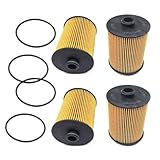
- Precision Vehicle Fitment: Engineered for Cayenne VR6 3.6L V6 (2012-2018), Volkswagen Atlas (2018-2023), CC (2013-2017), Passat (2012-2018), and Touareg (2012-2017).
- Direct Replacement Part Numbers: Replaces OE references: 03H115562, 95810722210, CH11242, PG6293EX, OX983D
- Advanced Filtration Technology: Features high-efficiency synthetic media, reinforced casing withstands 250+ PSI burst pressure, preventing oil leaks and engine damage.
- Optimal Engine Protection: Integrated silicone anti-drainback valve maintains oil pressure during cold starts. Precision-designed relief valve prevents flow restriction while filtering abrasive particles to extend engine life.
- Value 4-Pack & Easy Installation: Cost-effective bundle of 4 filters for multiple maintenance cycles. Includes durable sealing gasket and twist-on design for tool-free installation.
What replaced the VR6 in the Atlas?
The replacement is a 2.0-liter turbocharged direct-injection TSI four-cylinder. Volkswagen’s figures are below. Volkswagen made these claims in its own release, and no independent test of the Atlas with this engine was reviewed for this article. The VR6 column reflects the 3.6-liter North American Atlas unit, which L’argus identifies as one of the VR6’s later versions.
| Attribute | Outgoing VR6 (3.6-liter Atlas unit) | 2.0-liter TSI turbo four (Volkswagen figures) |
|---|---|---|
| Cylinders | Six, in a narrow-angle layout | Four, turbocharged with direct injection |
| Displacement | 3.6 liters | 2.0 liters |
| Power | Not stated in the reporting cited | 269 hp |
| Torque | Not stated in the reporting cited | 273 lb-ft, which Volkswagen says is available over a broader rev range |
| Fuel economy | Not stated in the reporting cited | Volkswagen anticipated an improvement. It gave no figure in the release. |
| Towing capacity | Volkswagen says 5,000 lb is unchanged | 5,000 lb |
The horsepower and torque figures come from Volkswagen’s release, which compares the new engine’s delivery with the outgoing unit only in general terms. Treat the comparison as a manufacturer’s claim, not a measured result.
Why the VR6 was built the way it was
Narrow-angle, shared-head packaging
The VR6’s appeal was packaging. Its cylinder banks are closely angled, and they share a cylinder head. That let Volkswagen fit six cylinders into engine bays that could not easily take a conventional inline-six or a wider V6. Hagerty describes this arrangement as the basis of the engine’s compact design. L’argus describes the original design as a 15-degree layout.
Rank #2

- please confirm this item fits for your vehicle (Check Fitment Data Above or see description below).
- All the Components are produced under strictly observed and meet or exceed OEM performance requirements in Manufacturing and Material
- Part Numbers: 071109513, 021109467, 021109509E, 021109503D, 021109507B, 02109469
- Utilizes the latest in design and material technology, ensuring quiet and maintenance-free experience, link-belt type timing chain for exceptional durability
- Local US friendly professional team to resolve your issues in time, solving any MOCA product related issues for you.
The sources do not describe one angle for every generation. Different displacements and versions used different arrangements, so a single angle should not be assumed for the whole engine family.
The Tool Desk
Outbyte PC Repair FREEClear out junk files and repair common Windows errorsFree Scan →Outbyte Driver Updater FREEScan for outdated or missing drivers - takes under a minuteDriver Scan →Displacements, valve counts and applications
Hagerty describes early 2.8-liter, 12-valve engines, followed by 2.9-, 3.2- and 3.6-liter versions. A 24-valve version appeared in 1999. L’argus gives the original 2.8-liter engine as producing 174 metric horsepower and 235 Nm. Metric horsepower is not identical to U.S. horsepower, so that figure should not be compared directly with the 269 hp rating for the new Atlas engine.
Hagerty’s selected applications include the Golf and R32, Corrado, Jetta, Touareg, New Beetle and Phaeton. It also notes VR6 use in the original Audi TT and the first-generation Porsche Cayenne. These are examples, not a complete list of models that used the engine.
Rank #3

- Genuine RKX PCV valve replacement diaphragm. New version 4.0 has been refined to be the most durable PCV valve ever!
- Listing is for PCV membrane only (valve cover not included)
- Designed to replace broken / ruptured PCV diaphragms Compatible with Volkswagen Audi 3.6L and 3.2L engine
- Diaphragm is made from our proprietary fluorocarbon rubberand designed to be more durable
- The dealership does not sell this as a spare part!
L’argus also reports a 2.5-liter turbo VR6 used in Chinese-market applications, which shows that the engine family did not end in one uniform form across markets.
What the “nearly 1.87 million” figure means
The production total comes from Schleith’s statement as reported by Hagerty. The exact sentence attributed to him is: “After 34 years and nearly 1.87 million units produced, the iconic VR6 engine says farewell.” The word “nearly” is part of the attribution. The figure is a rounded company total, not an audited production count, so it should be quoted with that qualifier.
Why “quietly” is the wrong word
The headline framing suggests the end was hidden. Hagerty’s account says the end of production was announced publicly, with a spokesperson posting the news on LinkedIn. Readers should treat it as an announcement, not a concealed change. The earlier Atlas change had its own formal press release, though its wording did not present itself as the end of the engine.
Rank #4

- Fits: please confirm this item fits for your vehicle (Check Fitment Data Above or see description below)
- All of our kits will be passed with specific Operation Card before delivery
- All the Components are produced under strictly observed and meet or exceed OEM performance requirements in Manufacturing and Material
- Utilizes the latest in design and material technology, ensuring quiet and maintenance-free experience, link-belt type timing chain for exceptional durability
- Local US friendly professional team to resolve your issues in time, solving any MOCA product related issues for you
The year 2023 also causes confusion. It marks the last model year for the VR6 in the North American Atlas. It is not the year the engine stopped being built, because production reportedly continued until December 2024.
Why the engine ended in Europe first
L’argus links the VR6’s exit from Europe to Euro 5 emissions rules. The reporting does not establish a single cause for the global production stop in December 2024. Euro 5 explains the European timing as reported by L’argus, but it is not the documented reason for the final global end.
The engine’s end was not a single event with one stated cause. It came through market-by-market withdrawals, with the North American and Chinese applications lasting longest according to L’argus.
What is not established
- No independent performance or fuel-economy test of the Atlas’s new 2.0-liter engine was reviewed. The 269 hp, 273 lb-ft and projected economy figures are Volkswagen’s.
- The exact date of the VR6’s European exit is not stated in the reporting.
- The dates for the last engine installed in a vehicle are not stated. Only the reported final assembly date is given.
- The reporting does not give a single cause for the global production stop.
For a VR6 owner or buyer, the practical point is that Volkswagen’s end-of-production announcement does not change the engine’s history. A VR6 built in the 1990s or 2000s is still a VR6, and the sources here do not address parts supply or service after production ended.
Full reporting is in L’argus’s account of the VR6’s end, which covers the European exit, the layout and regional applications.
Quick Recap
Product prices and availability are accurate as of the date/time indicated and are subject to change. Any price and availability information displayed on Amazon at the time of purchase will apply.




