Free tools Windows power users keep installed
One-click scans. No signup required.
A V6 engine is a compromise between a smaller four-cylinder and a larger V8: it uses two banks of three cylinders to deliver useful power, torque, refinement, and towing ability in a shorter package than an inline-six. The trade-offs are higher friction and fuel use than many four-cylinders, wider packaging, potentially harder service access, and balance characteristics that depend on the exact bank angle and crank design. Because “V6” describes only the cylinder layout, you must evaluate the specific vehicle, model year, engine code, transmission, and technology before predicting economy, reliability, or maintenance cost.
What is a V6 engine?
A V6 is an internal-combustion engine with six cylinders arranged in two banks of three. The banks meet at a V-shaped angle around a shared crankshaft. Splitting the cylinders into two rows makes the engine shorter front-to-back than a six-cylinder engine arranged in one straight row, which helps manufacturers fit six-cylinder power into transverse cars, crossovers, SUVs, and longitudinal trucks.
As an Amazon Associate I earn from qualifying purchases.
The V shape is a packaging and performance choice, not a single standardized specification. Displacement, turbocharging, hybrid assistance, cylinder deactivation, crankshaft design, firing order, and bank angle can make two V6 engines behave very differently.
Windows Errors? Fix Them Before They Spread
Repair common Windows errors and clear accumulated junk for a smoother, more stable PC - no reinstall needed.Free scan · no reinstallCrashes, No Sound, or Screen Glitches?
Random freezes, missing sound and display glitches usually trace back to one bad driver. Find and replace yours safely.Free scan · under a minuteAdvantages of a V6 engine
More power and torque than a typical four-cylinder
With six cylinders and often greater displacement, a V6 generally produces more peak power and low- and mid-range torque than a comparable naturally aspirated four-cylinder. That extra torque reduces the need for frequent downshifts when accelerating, climbing grades, carrying passengers, or merging onto a highway.
#1 Best Overall
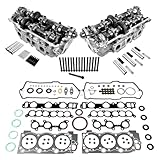
- 1995 1996 1997 1998 1999 2000 2001 2002 2003 2004 2005 Tacoma 4Runner T100 Tundra 3.4 Engine Cylinder Head Assembly w/ Gasket Set, Left & Right
- OE Part# 11101-69136, 11101-69135, 1110169136, 1110169135, 13502-62030, 13053-62050, 1350262030, 1305362050, 13054-62030, 1305462030, HS9227PT-1, ES72168
- Replacement for 1995-2004 Toyota Tacoma 3.4L; 1996-2002 4Runner 3.4L
- Replacement for 2000-2004 Toyota Tundra 3.4L; 1995-1998 T100 3.4L
- Engine: 3.4L 3378CC V6 GAS DOHC Naturally Aspirated (24 VALVE), ENG CODE "5VZFE" / 5VZ-FE
General Motors’ 4.3-liter V6 development program, described in a 1992 SAE paper, targeted strong low- and mid-range torque, relatively high specific power, smoothness, good driveability, and fuel-efficient performance. Those targets describe an engineering goal, not a guarantee for every V6.
Smoother operation than many four-cylinders
Six combustion events per cycle can make a V6 feel more refined than a four-cylinder, particularly under load. The actual result depends on bank angle, crankpin arrangement, firing order, balance shafts, engine mounts, and calibration. A V6 is not automatically as naturally balanced as an inline-six.
Shorter than an inline-six
Two banks of three cylinders reduce engine length compared with a single-row six-cylinder. That can leave more room for crash structures, transmissions, cooling hardware, or passenger space. The advantage is most useful when the engine must fit across the vehicle (transversely), although a V6 is also common in rear-wheel-drive layouts.
The Tool Desk
Outbyte Driver Updater FREEScan for outdated or missing drivers - takes under a minuteDriver Scan →Outbyte PC Repair FREERepair Windows errors before they cause bigger problemsFix Now →Useful towing and hauling capability
Torque is a major reason buyers choose V6-powered crossovers, SUVs, and trucks. A V6 can provide a practical middle ground: stronger pulling performance than many four-cylinders without the size and fuel demand of a comparable V8.
Rank #2
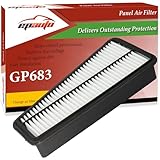
- Compatible with Toyota V6 Engines – Fits Tacoma V6 (2005–2015), 4Runner V6 (2003–2009), Tundra V6 (2005–2010), and FJ Cruiser (2007–2009)
- OEM Replacement Fit – Replaces 17801-0P010 and CA9683; built to match factory specifications for easy drop-in installation
- Protects Your Engine – Captures dirt, dust, and debris to prevent wear and ensure clean airflow
- Boosts Efficiency – Helps improve throttle response, fuel economy, and engine longevity
- Quick DIY Install – No tools required; easy to replace as part of routine vehicle maintenance
Engine configuration alone does not determine towing capacity. Check the vehicle’s certified tow rating, axle ratio, transmission, cooling package, brakes, payload, hitch equipment, and the specific model configuration.
Potentially better fuel economy than a V8
A smaller V6 typically uses less fuel per mile than a larger V8, but the result depends on vehicle weight, aerodynamics, gearing, calibration, driving conditions, and whether the V6 is turbocharged. A turbo V6 can deliver V8-like power while still using less fuel during light-load driving, but heavy acceleration or towing can erase that advantage.
Cylinder deactivation can reduce light-load consumption
Some V6 systems shut down one bank during lower-load cruising and reactivate all six cylinders when the driver requests full torque. Honda describes this approach as providing full power on demand while improving fuel economy. It adds hardware and control complexity, so the system’s service history matters when buying used.
Disadvantages of a V6 engine
More friction and fuel use than a smaller engine
A V6 has two additional cylinders, pistons, connecting rods, valve trains, and combustion chambers compared with an inline-four. The National Academies reported an EEA 1991 estimate that replacing an equivalent-displacement V6 with an inline-four could reduce friction by 15 percent and improve fuel economy by about 3 percent. That historical estimate illustrates the mechanical penalty; it is not a universal modern test result.
Rank #3

- 【Compatible Vehicles】The Cabin Air filter and the Engine Air Filter compatible with 2016-2023 Toyota Tacoma V6.
- 【200% Longer Life】 Compare with Standard air filter, we adopts advanced HV filter paper with higher filtering precision, to absorb 99.9% of impurities (hair,fines,dust and flocs etc.).For the service life, each engine air filters are engineered to last up to 20,000 miles, 200% longer than the standard performance, less replacement.
- 【2 Times Longer Life】Each package comes with two filters and can be used for 1-2 years.Each cabin air filters are engineered to last up to 20,000 miles, 30% longer than the standard performance of 12,000 miles.
- 【When to replaced】(1)Smell Musty, unpleasant inside your vehicle; (2)Excessive noise when A/C is running;(3)A/C is on but still hot,etc; (4)Strange engine noise; (5)Black smoke coming out of the exhaust; (6)Smell of fuel when starting the vehicle,etc.Having a good filter can protect your HVAC system well.
- 【Easy to Install】It is convenient for you to remove the panels and clips without damaging the original car. Please watch the instructional video before installation to help you install quickly and easily.
Real-world economy also depends on how much power the vehicle demands. A heavy SUV with a V6 may consume more fuel than a light car with a four-cylinder, while a downsized turbo V6 may outperform an older, larger naturally aspirated engine.
Wider and more complex packaging
Two cylinder banks increase engine width and create two exhaust sides, two cylinder heads, and additional routing for intake, exhaust, cooling, and accessories. Honda’s engineering discussion notes that a 120-degree bank angle provides ideal regular firing but is too wide for many transverse installations; a 60-degree layout is slimmer but taller, while a 90-degree layout can balance width and height differently.
Service access can be harder
The rear bank in a transverse installation may be close to the firewall. Spark plugs, ignition coils, exhaust components, oxygen sensors, and other parts can therefore take longer to reach than on a simple inline-four. Two cylinder heads and two banks also mean more components that may eventually require inspection or replacement. Labor and parts costs are vehicle-specific.
Do these 3 things before closing this tab:
1Fix the driver behind crashes, sound loss and screen glitches2Repair Windows errors before they cause bigger problems3Scan for outdated or missing drivers - takes under a minuteBalance and refinement vary by design
V6 vibration characteristics depend on the bank angle, crankshaft, crankpin phasing, firing order, and balance shafts. Some layouts require additional measures to control primary or secondary vibration. Judge refinement from the actual engine and vehicle rather than assuming every V6 is inherently smooth.
Rank #4

- Compatible with Toyota Camry V6 (2012-2017), Highlander Gas (2014-2019), Sienna (2011-2020), Avalon V6 (2013-2018), Tacoma (2024-2026), 4Runner (2025-2026)
- Compatible with Lexus RX350 (2010-2022), RX350L (2018-2022), ES350 (2013-2018), NX300 (2018-2021), NX200t (2015-2017)
- Compatible with Jeep Grand Cherokee 3.6L/5.7L/6.4L (2011-2021), Grand Cherokee WK (2022); Compatible with Dodge Durango 3.6L/5.7L/6.4L (2011-2026)
- Compatible with FRAM CA10755; Replacement Made for Toyota/Chrysler Genuine Part# 17801-0P050, 17801-0P051, 17801-31130, 17801-31131, 17801-YZZ11, 04861756AA, 4861756AA, 4861756AC
- Helps extend performance. Protect against dirt. Improve fuel mileage, Recommended replacement every 12,000 miles
Turbocharging and emissions hardware add failure points
Modern V6s may use turbochargers, direct injection, variable valve timing, particulate filters, exhaust gas recirculation, hybrid motors, or cylinder-deactivation hardware. These technologies can improve performance and economy, but they increase system complexity and can make diagnosis or repair more expensive. Reliability depends on the specific engine code and its service record.
V6 versus four-cylinder, inline-six, and V8
| Comparison | V6 | Inline-four | Inline-six | V8 |
|---|---|---|---|---|
| Power and torque | Usually a strong middle ground; turbo versions can be very powerful | Usually lowest, although turbocharging narrows the gap | Can be very smooth and powerful but is long | Usually highest, especially for heavy-duty work |
| Fuel use | Often below a comparable V8 and above a smaller four-cylinder | Usually best in lighter vehicles | Depends on displacement and vehicle; long layout limits packaging | Typically highest among these choices |
| Packaging | Shorter than an inline-six but wider than an inline-four | Narrow and simple | Long front-to-back | Wide and often larger overall |
| Refinement | Design-dependent; generally smoother than many four-cylinders | Can transmit more vibration under load | Naturally well balanced | Usually smooth, with greater size and weight |
| Service complexity | Two banks can make access and exhaust work difficult | Often simplest to access | One bank but a long engine | Two banks plus more cylinders and hardware |
| Best use case | Everyday vehicles needing extra performance or moderate towing | Low operating cost and light-duty use | High refinement where length is acceptable | Maximum towing, payload, or performance |
These are general tendencies, not guarantees. A turbocharged four-cylinder may outperform an older naturally aspirated V6, and a modern turbo V6 may match an older V8 while using less fuel. Compare the complete powertrain and the vehicle’s ratings.
Independent reader supportYour contribution helps us test, update, and keep practical guides available for everyone.How modern V6 technology changes the trade-offs
Direct injection
Direct injection can improve combustion control and power density. It may also bring additional maintenance considerations, such as intake-valve deposits in some applications, so the engine’s documented service requirements matter.
Variable valve timing
Variable valve timing broadens the useful torque range and can reduce pumping losses. Oil quality and correct service intervals are important because the system relies on clean oil and functioning control hardware.
Best Value

- Vehicle Compatibility: Fits for 2003-2007 Honda Accord V6 3.0L; Compatible with MT (manual) models; Please verify vehicle fitment before ordering
- OE-Fit Replacement: 19010RCAA02, 19010RCAA52, 19010RCAA53, 19010RCAAA52, HO3010191; Direct-fit radiator designed to OE standards for easy installation and reliable performance
- High-Efficiency Cooling: Built with high-density, multi-louvered fins and a 16mm-thick radiator core for improved heat dissipation and consistent engine protection in extreme temperatures
- Leakproof & Durable: The radiator is constructed with a sturdy aluminum core and high-grade plastic tanks for durability; Leak-tested for extended lifespan
- Complete Package: Includes 1 x new complete radiator and 1 x user manual; NOTE: Radiator cap is not included; Professional installation is recommended
Turbocharging
Turbochargers raise torque without requiring a proportionally larger displacement. They can make a V6 feel exceptionally strong at low and mid rpm, but add heat, plumbing, lubrication demands, and expensive components.
Hybrid assistance
An electric motor can provide launch torque, recover braking energy, and allow the gasoline engine to operate more efficiently. A hybrid V6 must be evaluated as an entire system, including battery warranty, cooling circuits, and transmission design.
Cylinder deactivation
Deactivation can reduce fuel use during steady cruising by running fewer cylinders, then restore all six for acceleration. Confirm whether the particular engine uses it and review owner documentation for any related maintenance requirements.
Recommended Free Tools
Is a V6 reliable?
There is no reliable answer based on cylinder count alone. Reliability is determined at the engine-code and vehicle level. Before buying, identify the exact model year, displacement, aspiration, transmission, and engine code, then check manufacturer service information, recalls, technical service bulletins, owner-maintained records, and failure patterns specific to that powertrain.
- Verify oil-change intervals and the correct oil specification.
- Check timing-chain or timing-belt requirements and replacement history.
- Inspect turbochargers, cooling systems, direct-injection components, and cylinder-deactivation hardware when fitted.
- Look for evidence of overheating, neglected transmission service, or repeated misfires.
- Obtain a professional pre-purchase inspection for a used vehicle.
How to choose the right V6 for towing or daily driving
- Define the load. Add trailer weight, cargo, passengers, and tongue weight; stay within the vehicle’s tow and payload ratings.
- Compare torque delivery. Low-rpm torque, transmission gearing, and axle ratio matter more for towing feel than peak horsepower alone.
- Check the complete tow package. Confirm cooling upgrades, brakes, hitch equipment, wiring, and manufacturer limits.
- Compare measured economy. Use the same vehicle class and driving conditions, and distinguish official ratings from owner-reported results.
- Price maintenance access. Ask for labor estimates on spark plugs, belts or chains, turbo components, and rear-bank repairs.
- Research the exact engine code. “V6” is not enough to establish reliability, fuel economy, or maintenance cost.
Bottom line
A V6 is usually the sensible middle choice when a four-cylinder lacks the desired torque or towing ability and a V8 would add unnecessary size and fuel consumption. Its advantages are compact length, strong performance, refinement, and broad availability in cars, crossovers, SUVs, and trucks. Its disadvantages are extra friction, wider and sometimes harder-to-service packaging, and design-dependent balance and complexity. Make the final decision using the complete vehicle and engine specification—not the V6 label by itself.
Quick Recap
Product prices and availability are accurate as of the date/time indicated and are subject to change. Any price and availability information displayed on Amazon at the time of purchase will apply.




