Crashes, No Sound, or Screen Glitches?
Random freezes, missing sound and display glitches usually trace back to one bad driver. Find and replace yours safely.Free scan · under a minuteWindows Errors? Fix Them Before They Spread
Repair common Windows errors and clear accumulated junk for a smoother, more stable PC - no reinstall needed.Free scan · no reinstallThe safest way to check a used Toyota Tundra engine is to identify the exact model year, engine configuration and VIN, verify recalls, review dated service records, inspect the truck cold, follow the correct oil and coolant procedures, complete a road test, and pay for an independent pre-purchase inspection. A quick look can find warning signs, but it cannot prove that an engine is healthy. Tundra engines, specifications, manuals and recall campaigns vary by year, so do not apply one generic checklist to every truck.
Start with the truck’s identity, not the engine bay
Before judging condition, write down the model year, engine and drivetrain configuration, current mileage, full vehicle identification number (VIN), and whether the truck is hybrid or non-hybrid. Use those details for every subsequent check. Toyota’s owner information and recall campaigns are vehicle-specific; a statement such as “this generation has a good engine” is not a substitute for checking the individual truck.

As an Amazon Associate I earn from qualifying purchases.
- Model year: Record the year shown on the title, registration and VIN decoder information.
- Engine and configuration: Note the engine designation, cab and drivetrain configuration, and whether the truck is equipped for heavy towing.
- VIN: Obtain the complete 17-character VIN and compare it with the windshield plate, door-jamb label, title and service invoices.
- Mileage and use: Ask how much of the mileage involved towing, commercial work, off-road driving, short trips or long periods of idling.
These details establish which maintenance instructions and recall notices apply. They also let you test whether the seller’s explanation matches the records and the truck’s physical condition.
Free tools Windows power users keep installed
One-click scans. No signup required.
Check recalls by VIN before negotiating
Search the VIN in Toyota’s official recall lookup for U.S. vehicles. The service accepts a VIN or license plate, but the VIN is the most precise way to identify a particular truck. Ask the seller or Toyota dealer for documentation showing whether every applicable campaign is open, completed or otherwise resolved. Do not rely on the model year alone or on a general assurance that “all recalls are done.” Campaign status can change as remedies are released, and it belongs to the specific vehicle.
#1 Best Overall

- Compatible with Toyota Tundra (2WD and 4WD) 2007-2019
- Compatible with Toyota Sequoia (2WD and 4WD) 2008-2019
- Paperback
2022–2023 Tundra engine recall
Toyota’s remedy notice for Recall 24TA07, NHTSA Recall 24V-381, says machining debris may remain in certain engines. The condition can lead to engine knocking, rough running, a no-start condition or loss of motive power. Toyota says authorized dealers replace the engine assembly at no charge for covered vehicles. A Toyota dealer planning FAQ dated November 15, 2024 listed approximately 98,600 vehicles built from early November 2021 through mid-February 2023. That figure is the approximate campaign population, not a failure rate.
Toyota’s December 2024 owner notice described the cause this way: “Machining debris may not have been cleared from the engine when it was produced.” Treat this as a recall-screening issue, not a diagnosis. The VIN lookup must determine whether a particular truck is included and whether the remedy has been recorded as complete.
Certain 2024 non-hybrid Tundra engines
On May 20, 2026, Toyota announced another recall covering approximately 44,000 vehicles in the United States. Toyota said machining debris may damage the number-one main bearing in certain 2024 non-hybrid Tundra engines, potentially causing knocking, rough running, a no-start condition or loss of motive power. Toyota said remedy preparations were underway and that owners would be contacted in phases as a remedy became available. The announcement also referred to related recalls announced in May 2024 and November 2025.
Because that dated announcement said remedy details were still being finalized, it does not establish the current status of any truck. Check the live VIN result and obtain the latest dealer record before buying. Toyota also stated that engines produced after those included in the recall were manufactured with an improved number-one main bearing “to help resist certain debris that might remain.” That is Toyota’s statement about its production change, not an independent reliability assessment.
Review records as a timeline
Ask for dated invoices, work orders, inspection reports and recall paperwork rather than a verbal summary. Organize the documents by mileage and look for a believable sequence of oil services, scheduled maintenance, repairs and parts replacement.
What a consistent history looks like
- Oil-service dates and mileages progress logically without unexplained gaps.
- Major repairs identify the symptom, diagnosis, parts installed and mileage at completion.
- Towing, commercial use or long idle periods are acknowledged rather than concealed.
- Recall work is documented with a campaign number or dealer repair record.
- Current mileage agrees across the title, inspection reports, invoices and vehicle history information.
How to interpret missing records
Missing records create uncertainty; they do not prove that the engine was neglected. A private seller may have performed work without keeping invoices, while a dealer may have incomplete access to an independent shop’s records. Ask what can be verified, contact the servicing shop when appropriate, and place more weight on an independent inspection when the history cannot be reconstructed.
Compare the seller’s explanation with physical evidence. A truck described as lightly used but showing extensive hitch wear, commercial decals, heavily worn pedals or repeated towing repairs deserves additional questions. None of those observations alone establishes an engine defect.
Inspect the engine before it is started
Arrange to see the Tundra before it has been started that day if possible. A fully warm engine can hide cold-start behavior and make fluid leaks harder to trace. Ask the seller not to preheat it, and note the ambient temperature and how long the truck has been sitting if that information is available.
Rank #2
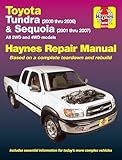
- Complete Repair Coverage: Step-by-step repair procedures specific to your vehicle — from routine maintenance like oil changes and air filter replacement to complex engine and transmission repairs
- 700+ Photos & Illustrations: Every procedure is visually supported with clear, close-up photography taken during an actual vehicle teardown and rebuild — no guesswork required
- Beginner to Advanced: Written in plain language so a DIY owner with basic tools can tackle most repairs confidently, while still serving as a valuable reference for experienced mechanics
- Full Troubleshooting Section: Quickly diagnose problems with dedicated troubleshooting guides for engine, electrical, brakes, and drivetrain systems
- Time-Saving Tips Throughout: Pro shortcuts and notes highlight common pitfalls, helping you avoid costly mistakes and get your vehicle back on the trail faster
Look for external warning signs
- Fresh oil, coolant or other fluid beneath the engine, transmission or radiator area.
- Wet seams, crusted residue, staining around hoses, the reservoir, radiator, water pump or drain areas.
- Damaged, swollen or visibly loose hoses and clamps.
- Electrical connectors, covers or fasteners that look recently disturbed without an accompanying repair invoice.
- Heavy degreasing or a recently washed engine bay that could make a leak difficult to locate.
Photograph anything unusual and ask for an explanation. A leak, loose part or cleaned engine bay is a reason for a qualified inspection, not proof of a failed engine.
Check oil using the exact year’s procedure
Do not treat a generic dipstick reading as definitive for every Tundra. Toyota’s 2023 Tundra Owner’s Manual instructs the owner to park on level ground, warm the engine, turn it off and wait about five minutes so oil can drain back before checking the dipstick. Follow the manual matched to the truck you are considering.
- Park on a level surface.
- Warm the engine according to the owner’s manual.
- Turn the engine off and wait approximately five minutes.
- Remove, wipe and reinsert the dipstick as directed, then read the level.
- Record whether the oil is below the indicated range, within it or above it, and look for an unexplained difference between the dipstick condition and the service records.
The 2023 manual identifies conditions that can increase oil consumption, including high engine speeds, heavy loads or towing, frequent acceleration and deceleration, and long idling. Ask how the truck was used before interpreting the level. A low reading warrants questions and a professional inspection; it does not, by itself, prove internal engine damage. Do not invent a universal oil-consumption limit when the applicable manual and service history do not provide one.
What’s actually slowing this PC down?
Pick the symptom - the matching free tool is one click away.
Look at the oil’s condition only as a screening observation. Unusual sludge, metallic glitter or a strong fuel smell should be reported to the inspector. Color alone is not a reliable pass/fail test because oil age, formulation and recent servicing affect its appearance.
Check coolant only when the engine is cold
Toyota’s 2023 Tundra manual says the coolant level is satisfactory when cold between the “F” and “L” marks on the reservoir. Do not remove a hot cooling-system cap. Observe the reservoir from a safe position and use the procedure and coolant specification for the exact truck.
- Between F and L when cold: Record the level and ask when it was last checked or replenished.
- Below L: Ask for service records and have the system inspected for leaks before purchase.
- Repeatedly falling level: Toyota advises visually checking the radiator, hoses, reservoir cap, drain cock and water pump; seek dealer help if the leak cannot be found.
- Signs of overheating: Treat an overheating history, temperature warning, coolant odor or visible residue as a reason to stop the evaluation and obtain professional diagnosis.
A low coolant level does not automatically mean a failed head gasket or engine. It does mean the truck’s cooling system needs an explanation and, when the cause is not documented, a proper inspection.
Listen to the cold start and idle
Have the seller start the truck while you stand where you can hear the engine and see the instrument panel. Observe the first seconds, the idle after it settles and the warning lights during the normal start-up sequence. Record the exact behavior rather than trying to diagnose it in the driveway.
Signals that require a professional diagnosis
- Persistent or pronounced knocking, tapping or other new mechanical noise.
- Rough running, shaking, misfiring or an idle that does not settle.
- A no-start event, repeated cranking or a history of intermittent starting problems.
- A malfunction indicator lamp or other warning light that remains illuminated.
- Blue, white or unusually heavy exhaust smoke after start-up.
- Overheating indications, coolant odor or a noticeable loss of power.
Toyota’s recall notices identify knocking, rough running, no-start and loss of motive power as possible symptoms of the specific machining-debris conditions described above. The same symptoms can have many other causes, so they do not establish that the truck has a recalled defect. If any appears, postpone the purchase decision until a qualified technician provides a diagnosis.
Complete a controlled road test
Drive only with the owner’s permission, valid insurance and a safe route. Begin gently, then include normal acceleration, steady cruising, turns, braking and, where legal and safe, a moderate load on an incline. Keep the radio off and note how the engine behaves rather than trying to reproduce an extreme condition.
- Does the engine start promptly after the cold start and again after the drive?
- Is acceleration smooth, or is there hesitation, surging, vibration or a loss of power?
- Do warning lights appear or flash under load?
- Does the temperature indication remain normal?
- Do noises change with engine speed, throttle position or load?
- After parking, do you see fresh fluid or smell coolant or burning oil?
Return the truck to the seller if it shows severe noise, overheating, smoke, a major warning light or a pronounced loss of power. A road test is a screening step, not a substitute for mechanical testing.
Use diagnostic scanning carefully
If the malfunction indicator lamp is illuminated, ask a qualified technician to scan the truck for diagnostic trouble codes. A code can identify a system or condition that needs investigation, but it does not by itself prove which part failed or what repair is required. Do not clear codes before the inspection; doing so can erase useful history and make the vehicle appear temporarily normal.
The most useful result is a written report that connects codes and observed symptoms to a diagnosis, recommended tests and repair urgency. A seller who offers only a recently cleared dashboard, without supporting records, has not demonstrated that the underlying problem is fixed.
Make the independent pre-purchase inspection a condition of sale
Arrange an inspection at a shop you choose, not only at a facility selected by the seller. Tell the technician the truck’s year, engine, mileage, towing history and any symptoms you observed. Ask for a written report that separates immediate safety concerns, engine or cooling-system defects, maintenance items and issues that require monitoring.
Give the inspector these questions
- Are there active or stored fault codes, and do they correspond to a verified problem?
- Are oil or coolant leaks present, and can their source be identified?
- Is there evidence of overheating, abnormal internal noise or low fluid pressure?
- Do the engine and drivetrain show signs of heavy towing, commercial use or accident repair?
- Does the VIN show an open recall or an incomplete remedy?
- Which findings require repair before driving, and which can be priced as routine maintenance?
No universal Tundra-specific inspection protocol or pass/fail score applies to every generation. The prudent process is to make your offer contingent on an independent inspection and use the technician’s findings, the VIN recall result and the documentary history together.
Independent reader supportYour contribution helps us test, update, and keep practical guides available for everyone.Compare candidate Tundras on evidence, not reputation
If you are choosing between several used Tundras, score each truck using the same evidence. Do not rank model years by reliability without vehicle-specific records and inspection results.
| Comparison point | What to document | Why it matters |
|---|---|---|
| Model year and engine | Year, engine/configuration, hybrid or non-hybrid status | Determines which manual instructions and recall notices apply |
| VIN and recall status | Open campaigns, completed remedies and dealer documentation | Recall applicability is vehicle-specific |
| Service history | Dated oil services, repairs, towing and mileage sequence | Shows how well the truck’s use can be verified |
| Observed behavior | Cold start, idle, warning lights, smoke and road-test response | Identifies symptoms requiring diagnosis |
| Fluids and leaks | Oil level, coolant level and leak locations | Reveals maintenance questions without pretending to diagnose failure |
| Mileage and workload | Total mileage, towing, idling, commercial or off-road use | Provides context for wear and service intervals |
| Independent inspection | Written findings, urgency and repair estimates | Supplies the strongest evidence about the individual truck’s condition |
Common seller explanations and sensible responses
“The noise is normal for this engine.”
Ask the inspector to identify the sound and determine whether it is within specification. Do not accept a general model-year explanation for a noise that appeared during your viewing.
Rank #4
“The recall is handled for every truck.”
Request the VIN lookup result and the completion record. A recall population number or a statement about other trucks does not prove that this vehicle’s remedy is complete.
“The low coolant is just because it was serviced.”
Ask for the service invoice and have the system checked for leaks. A recent refill explains an action, not necessarily why the level changed.
“The engine was washed, so there are no leaks.”
Recent cleaning can remove the evidence needed to locate a leak. Inspect again after the road test or have the shop check the engine under controlled conditions.
The Tool Desk
Outbyte PC Repair FREEClear out junk files and repair common Windows errorsFree Scan →Outbyte Driver Updater FREEFix the driver behind crashes, sound loss and screen glitchesFind Drivers →“You can skip the inspection because it runs well.”
Good running during a brief drive does not verify internal condition, recall status or maintenance quality. Keep the inspection contingency or walk away.
When to walk away or renegotiate
Pause the purchase until the issue is resolved when the seller refuses to provide the VIN, blocks a cold inspection, will not allow an independent shop visit, or cannot explain contradictory mileage and service records. A truck with an open engine recall is not automatically a bad purchase, but you need a clear remedy path, confirmation of eligibility and a price that reflects the time and uncertainty involved. If the recall remedy is unavailable, do not assume the dated announcement’s plan is the current status; verify with Toyota or an authorized dealer.
For a truck that passes inspection but needs routine maintenance, use the written findings to negotiate without confusing maintenance with an engine failure. For unexplained knocking, rough running, repeated no-starts, overheating, major fluid loss or loss of power, require diagnosis before committing to the purchase.
Keep the right reference material
Use a Toyota Tundra repair manual or year-specific Tundra repair information matched to the exact model year and configuration when you need torque specifications, inspection procedures or maintenance details. Toyota’s 2022 maintenance information recommends Toyota repair manuals. A manual is useful for understanding the truck and checking completed work, but it is not a substitute for an independent mechanic’s pre-purchase inspection.
Do these 3 things before closing this tab:
1Repair Windows errors before they cause bigger problems2Fix the driver behind crashes, sound loss and screen glitches3Clear out junk files and repair common Windows errorsA practical appointment checklist
- Get the VIN, year, engine/configuration, mileage and seller’s maintenance records.
- Run the VIN through Toyota’s official recall lookup and print or save the result.
- Schedule a viewing before the truck is started, if possible.
- Inspect for leaks, damaged hoses, disturbed parts and heavy cleaning.
- Check oil and coolant using the applicable owner’s manual procedure.
- Observe the cold start, idle, warning lights, exhaust and any abnormal noise.
- Take a controlled road test and note temperature, power, vibration and new warnings.
- Have an independent shop scan and inspect the truck before money changes hands.
- Compare the written inspection with the records and recall status.
- Make the final offer contingent on documented repairs and a completed inspection.
The central decision is not whether the engine looks clean or the truck drives quietly for ten minutes. It is whether the exact Tundra has a verifiable history, a known recall status, no unresolved symptoms and an independent inspection that supports the price.
Quick Recap
Product prices and availability are accurate as of the date/time indicated and are subject to change. Any price and availability information displayed on Amazon at the time of purchase will apply.




