Do these 3 things before closing this tab:
1Clear out junk files and repair common Windows errors2Scan for outdated or missing drivers - takes under a minute3Repair Windows errors before they cause bigger problemsUnderstanding motor regeneration means understanding how an electric motor can reverse its energy flow: wheels or another mechanical load drive the motor, the motor generates electricity, and power electronics send that energy to a battery, DC bus, storage system, or grid. The opposing electromagnetic torque provides controlled deceleration, but recovery is never complete.
The principle appears most visibly as regenerative braking in electric and hybrid vehicles, but the same reversible operation is used in industrial regenerative drives. The destination for recovered energy, control objective, operating limits, and safety provisions differ between automotive and industrial systems.
As an Amazon Associate I earn from qualifying purchases.
Key takeaways
- Motor regeneration reverses the normal energy flow so a mechanically driven electric motor operates as a generator.
- In an EV or hybrid, regenerative braking can slow the vehicle while sending some recovered electrical energy to the traction battery.
- According to the U.S. Department of Energy and U.S. Environmental Protection Agency (2024), a typical EV is 87%–91% efficient after regenerative braking is included, compared with about 30% for a conventional gasoline vehicle, depending on the drive cycle.
- According to the U.S. Department of Energy and U.S. Environmental Protection Agency (2024), net regenerative braking recovered about 22% on the EPA combined city/highway drive cycle; that is not a universal recovery rate for every EV.
- Battery state of charge, battery and motor temperature, vehicle speed, tire traction, inverter limits, and braking demand can all reduce available regeneration.
- Regeneration reduces friction-brake use but does not eliminate friction brakes or their maintenance and safety role.
What is motor regeneration?
Motor regeneration is the reversible operation of an electric motor in which a mechanical load drives the motor, causing it to generate electricity instead of consuming electricity to produce motion. The recovered power passes through power electronics to a battery, shared DC bus, electrical grid, or another energy-storage system. The generator’s opposing electromagnetic torque resists the load and can provide controlled deceleration.
Free tools Windows power users keep installed
One-click scans. No signup required.
Electric motors normally convert electrical power into rotational mechanical power. Under suitable control, the same electromechanical machine can operate in the opposite energy-conversion direction. A vehicle’s wheels, an elevator descending with a load, or another overhauling machine can drive the motor’s rotor. The motor then produces electrical power, while the inverter manages voltage, current, and torque.
#1 Best Overall

- Flex Level 1 EV Charger - The EVDANCE Level 1 electric car charger is compatible with J1772 electric vehicles and plug-in hybrid vehicles (North American Standard). *Tesla requires a SAE J1772 adapter.
- Convenient to Use - This charger has both NEMA 6-20 plug for 16A 240V charging (3.68kW, 10-12 mi/h) and a NEMA 6-20 to 5-15 plug adapter for 12A 120V charging (1.44kW, 2-5 mi/h). The included bag makes it easier to carry on the go. It also has a 25ft cable length, you can use it flexibly from anywhere in the garage or driveway.
- Check Your Outlet Type -This charger works with standard 120V NEMA 5-15/5-20 outlets (2-5 mph charging speed) and 240V NEMA 6-20 outlets (10-12 mph) . It's not compatible with NEMA 6-15/10-30/14-30/14-50/6-50 outlets – you'll need a NEMA 14-50/14-30/10-30/6-50 to 6-20 adapter (sold separately) to connect.
- Compatible EV Models -This EV charger works with most major electric vehicles, including Ford, Chevrolet, Hyundai, Audi, Nissan Ariya, Rivian R1S, Kia, and others. However, it's not compatible with Mini Cooper Electric Hardtop,Toyota Prus Prime/Z4X/RAV4Prime, Porsche Taycan Base/4S/Turbo/Turbo S or Tesla models (Tesla requires a J1772 to Tesla Adapter, sold separately). For a full list of compatible models, check out the Full Compatibility List on our product page.
- Indication Displays - LED display that can tell you the status as well as indicate errors while charging your electric vehicle.
The U.S. Department of Energy describes the vehicle version this way:
“In regenerative braking, the electric motor is reversed so that, instead of using electricity to turn the wheels, the rotating wheels turn the motor and create electricity.”
That statement describes reversed energy flow and torque operation; it does not mean that regeneration creates free energy. Energy is recovered from motion that already exists, and every motor, inverter, cable, and battery introduces losses.
How does regenerative braking work?
Regenerative braking works by commanding negative motor torque, allowing the vehicle’s wheels to drive the traction motor while the motor generates electrical power. The power electronics then direct usable energy toward the battery when the battery can accept it.
- The driver lifts off the accelerator or applies the brake. The vehicle control system interprets the requested deceleration.
- The controller requests negative motor torque. Instead of helping the wheels rotate, the traction motor resists their rotation through electromagnetic force.
- The wheels drive the motor. The vehicle’s kinetic energy is converted into mechanical rotation inside the motor.
- The motor generates electricity. The motor’s electrical output is sent to the inverter and related power electronics.
- The inverter conditions the power. The inverter controls the electrical flow and coordinates motor torque with battery and vehicle limits. The DOE’s power-electronics reference explains the central role of power electronics in controlling energy conversion in electric vehicles.
- The battery accepts eligible charging power. The battery receives some of the recovered energy if its state of charge, temperature, and charge-power limits permit.
- Friction brakes fill the gap. Conventional brakes provide additional stopping force whenever the requested deceleration exceeds the motor’s capability or regeneration must be reduced.
The electromagnetic resistance is the important physical effect: the motor does not merely produce electricity while allowing the vehicle to coast freely. Generating electrical power creates opposing torque, which slows the vehicle. The vehicle’s software blends that torque with hydraulic or electrically actuated friction braking to deliver the requested deceleration.
Does regenerative braking charge the battery?
Yes, regenerative braking can charge an EV or hybrid battery, but only the portion of recovered energy that the battery and powertrain can accept. In a battery-electric vehicle, the traction battery supplies the inverter and motor during acceleration, while regeneration sends some energy back through the inverter toward the battery during deceleration. The DOE also explains that hybrid vehicles use regenerative braking and, when necessary, the internal-combustion engine to charge their batteries; during regenerative recovery, the electric motor acts as a generator.
Rank #2
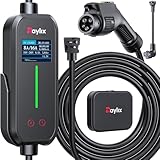
- [2026 INTELLIGENT CHARGING UPGRADE — PRECISION CONTROL MEETS SMART SCHEDULING] After surveying 100K+ U.S. EV owners, the Raylix R&D team found that nearly all drivers recognized the necessity of adjustable current and scheduled charging. Our upgraded J1772 charger features 4-level adjustable current (8A/10A/12A/16A) and a 1–12 hour smart delay timer. Whether you're charging overnight or during off-peak hours, enjoy smarter energy use, lower costs, and total convenience—on your schedule.
- [ONE CHARGER, ALL J1772 EVs/PHEVs READY!] Compatible with all SAE J1772 electric vehicles and plug-in hybrids—whether it’s Ford, GM, Nissan, Audi, BMW, Kia, Hyundai, Honda, Chevy, or more. Perfect for home or on-the-road charging, our 16A Level 1 & 2 charger ensures your EV is always powered and ready for any journey.
- [CHARGE 4× FASTER — NO MORE WAITING] In a rush? Our 16A Level 1 & 2 charger delivers charging speeds up to 4× faster than standard 8A Charger Level 1. Whether it's an early commute, a spontaneous trip, or last-minute errands, your EV will be ready when you are.
- [LEVEL 1 & 2 PORTABLE CHARGER — CHARGE ANYWHERE, ANYTIME] Designed for maximum flexibility, Raylix Level 1 & 2 EV charger features both 5-15 and 6-20 plug compatibility. Whether you're charging in your garage, at a friend's house, or at a roadside motel. NEMA 6-20 plug for Level 2 ev charging (240V, 16A, 3.68kW, 9-12 miles/hr) and a NEMA 5-15 adapter for Level 1 ev charging (120V, 12A, 1.44kW, 3-5 miles/hr) NOTE: In compliance with North American electrical safety standards, the charger automatically limits current to 12A when using a 5-15 outlet—protecting both your vehicle and your home’s electrical system.
- [AT-A-GLANCE CHARGING COMMAND: TOTAL CONTROL, INSTANTLY] While most ev chargers solutions confine vital data to in-car screens, the Raylix tesla charger breaks free with its enhanced TFT color display. This Raylix-exclusive feature delivers crystal-clear, real-time updates—voltage, current, power load, AND critical charging temperature—directly on the unit. Just one glance gives you complete charging insight. It’s not just information; it's the empowering peace of mind and satisfying control that transforms every charge into a masterfully managed experience.
Regeneration is therefore a form of opportunity charging, not a substitute for plugging in an EV. The DOE explanation of electricity basics for vehicles distinguishes energy supplied from the grid from energy recaptured during operation. A home EV charger replenishes the battery from the grid; regenerative braking recovers a limited portion of energy that would otherwise become heat during deceleration.
The Tool Desk
Outbyte Driver Updater FREEFix the driver behind crashes, sound loss and screen glitchesFind Drivers →Outbyte PC Repair FREEClear out junk files and repair common Windows errorsFree Scan →How much energy does regenerative braking recover?
There is no single recovery percentage that applies to every EV, journey, or braking event. Recovery depends on how often the vehicle slows, how hard it brakes, the terrain and traffic, vehicle mass and speed, battery condition, tire traction, and the control strategy.
According to the U.S. Department of Energy and U.S. Environmental Protection Agency (2024), “A typical EV is 87%–91% efficient (after taking regenerative braking into account) compared to about 30% for a conventional gasoline vehicle, depending on the drive cycle.” The same 2024 analysis reports that “net regenerative braking recovers about 22% on the EPA combined city/highway drive cycle.”
The 22% figure describes a particular EPA combined city/highway drive-cycle analysis. It does not mean that every EV returns 22% of all braking energy to its battery. A long, steady highway trip may involve relatively little braking, while dense urban traffic or hilly terrain may create more recovery opportunities. Even when the vehicle displays regenerative power, conversion losses mean that not all of the vehicle’s kinetic energy reaches the battery.
A 2022 SAE paper based on logged Chevrolet Bolt data found negative battery power associated with regenerative braking for 14% of total logged drive time. That observation belongs to that vehicle and data set, not to all EVs. The SAE International paper provides the underlying vehicle-data context.
| Claim or observation | Scope and source | What it does not mean |
|---|---|---|
| 87%–91% typical EV efficiency after regenerative braking | DOE and EPA, 2024; depends on the drive cycle | It is not the efficiency of every EV on every trip |
| About 22% net regenerative-braking recovery | DOE and EPA, 2024; EPA combined city/highway drive cycle | It is not a guaranteed share of all braking energy |
| 14% of logged drive time with negative battery power associated with regeneration | 2022 SAE Chevrolet Bolt data set | It is not a universal percentage of EV driving time |
Why does regenerative braking stop working or feel weaker?
Regenerative braking becomes weaker when the battery, motor, inverter, tires, or control system cannot safely accept or produce the requested braking torque. A vehicle may show reduced regeneration after a full charge, in cold or hot conditions, near a stop, on a slippery surface, or during a high-demand braking event.
Rank #3

- Universal J1772 Compatibility: Designed with a standard J1772 connector, this J1772 charger works with most J1772 electric vehicles and PHEVs, including BMW, Mercedes-Benz, Hyundai, Kia, Nissan, Rivian, Ford, Chevy, Volkswagen, Toyota and more. Note: Tesla vehicles require a J1772 to Tesla adapter (not included)
- Flexible Outlet Compatibility: This portable EV charger comes with a NEMA 6-20 plug and a NEMA 5-15/5-20 to 6-20 adapter. Supports Level 1 (8–12A) and Level 2 (16A). Max 12A (1.44kW) on 120V NEMA 5-15/5-20 outlets, and full 16A (3.84kW) with a 240V NEMA 6-20 outlet. One charger is designed to cover home, garage, and travel charging needs with reliable performance
- Adjustable Smart Charging Control: Customize charging safely with adjustable current settings (8A/10A/12A/16A) to match different circuits. The 0–12 hour delay timer helps schedule overnight charging during lower electricity rates. Integrated LCD display shows real-time voltage, current, power, and charging status for clear monitoring without apps. Note: Press 'A' or 'T' for 3s to set and confirm.
- Home Charging & Travel Backup: For daily home use while remaining fully portable for travel. This level 1 ev charger includes a durable 25FT ev charging cord, providing flexible reach for garage or driveway charging. Charge overnight to take advantage of lower utility rates—potentially saving up to $500 annually on electricity costs. The included carrying case makes storage easy and keeps a dependable backup charger available in your trunk for road trips or visiting friends
- Engineered For Safety & Durability: Built for dependable daily use, this electric car charger features an IP65 waterproof rating for all weather operation. Equipped with a UL-listed cable, fully rubberized connector, and advanced protection against overcurrent, overheating, and electrical faults. Designed to ensure safe, stable, and long-term charging performance in demanding environments
- High state of charge: A nearly full battery has little room for additional energy, so the control system may reduce battery charging power.
- Low battery temperature: A cold battery may have a restricted charge-power limit until it warms or is conditioned.
- High battery or motor temperature: Thermal protection can reduce regenerative power to protect components.
- Low vehicle speed: The motor may not provide enough smooth, useful regenerative torque as the vehicle approaches a stop.
- Traction limits: On wet, icy, or loose surfaces, the system must avoid asking the driven tires for more braking torque than they can transmit.
- Emergency or anti-lock braking: Maximum controllable stopping force and wheel control take priority over energy recovery.
- Braking demand: A hard stop may require more deceleration than the motor can provide, so friction brakes supplement regeneration.
- Component protection: Motor, inverter, battery, or brake-temperature limits can change the blend.
A 2024 SAE technical paper identifies battery state of charge as a major influence on regenerative-braking efficiency and discusses monitoring battery temperature, brake temperature, and motor temperature. The SAE regenerative-braking control-system paper provides the technical context. The owner’s manual for a particular vehicle controls for the exact dashboard message, regeneration level, and operating behavior.
Does regenerative braking replace brake pads?
No. Regenerative braking reduces friction-brake use during eligible deceleration, but it does not replace the vehicle’s friction brakes. Friction brakes remain necessary for emergency stops, low-speed stopping, traction management, parking, and situations in which the battery or motor cannot accept or supply enough regenerative braking.
Because regeneration handles part of the normal deceleration load, EV brake systems generally experience less friction material wear. The DOE guidance on EV maintenance and safety notes that EV brake systems generally last longer because regenerative braking reduces brake wear. Longer pad life is not the same as zero maintenance: brake components still require inspection, and corrosion or infrequent use can matter even when pad wear is low.
Windows Errors? Fix Them Before They Spread
Repair common Windows errors and clear accumulated junk for a smoother, more stable PC - no reinstall needed.Free scan · no reinstallCrashes, No Sound, or Screen Glitches?
Random freezes, missing sound and display glitches usually trace back to one bad driver. Find and replace yours safely.Free scan · under a minuteRegeneration also does not guarantee that one-pedal driving will bring every vehicle to a complete stop using motor torque alone. The exact blend varies by make, model, drive mode, speed, battery condition, road surface, and driver-selected setting. Some vehicles offer selectable regeneration levels; others blend regenerative and friction braking automatically.
What is the difference between regenerative braking and dynamic braking?
Regenerative braking returns electrical energy to a battery, DC bus, storage system, or grid-connected supply, while dynamic braking normally converts the motor’s recovered energy into heat through a braking resistor. Both methods can create opposing motor torque, but their energy destinations differ.
| Feature | Regenerative braking | Dynamic braking |
|---|---|---|
| Motor operation | Driven motor operates as a generator | Driven motor operates as a generator |
| Energy destination | Battery, shared DC bus, energy storage, or AC line | Braking resistor, where energy is dissipated as heat |
| Main benefit | Recovers usable electrical energy while controlling deceleration | Provides controlled deceleration without requiring an energy-accepting source |
| Typical limitation | Requires available battery, bus, storage, or grid capacity and has conversion limits | Resistor and thermal limits constrain how much energy can be dissipated |
| Vehicle or industrial role | EV and hybrid efficiency; industrial energy recovery | Industrial or vehicle-system braking when energy recovery is unavailable or insufficient |
Dynamic braking and regenerative braking can coexist in one system. If an industrial DC bus or battery cannot accept more energy, a braking resistor may absorb the excess. The terms should not be treated as interchangeable simply because both use a motor’s generating action.
Rank #4

- Road-Trip Ready & Apartment-Friendly: Comes with a 20ft heavy-duty cable that easily spans a standard parking space, plus a NEMA 5-15 adapter for plug and play convenience. Whether you're charging at home or hitting the highway, this portable EV Charger is your ultimate travel companion for weekend getaways and camping trips
- Delay Timer & Adjustable Current: Use the built-in timer to delay your start by 1-12 hours and easily harvest off-peak energy savings. Then pick from 6/8/10/12/16A (Level 2) to match your garage grid. It automatically locks in your favorite setting and never forces you to re-adjust. No complicated apps or Wi-Fi needed, just straightforward, reliable control
- Tactile Buttons & LED Screen: No glitchy smartphone apps or finicky touchscreens that lag, freeze, and misfire in winter. Our EV charger is engineered with a high-definition LED display that tracks critical real-time data, including live voltage and current. Tactile buttons deliver direct, satisfying click feedback that remains highly responsive even when wearing heavy winter gloves or operating in torrential downpours—conditions where standard touchscreens completely fail
- ETL Certified Safety & IP65 All-Weather Shield: ETL certified to meet US safety standards for charging. Engineered with a certified IP65 dust-and-waterproof enclosure and a heavy-duty TPE cable that operates reliably across a wide -22°F to 130°F range. An intelligent multi-protection defense system (GFCI, over-voltage, over-current, surge, short-circuit, and over-temp) keeps a 24/7 watch for 100% safe, unattended overnight charging in any weather
- J1772 Compatible + Dual-Level Charging: Works with all J1772 EVs (Tesla requires a separate J1772 adapter). Level 2: built-in NEMA 6-20 plug. Level 1: included NEMA 5-15 adapter fits any standard outlet. Please confirm your outlet is NEMA 6-20 or 5-15 before purchase
How is motor regeneration used in industrial drives?
Industrial motor regeneration controls overhauling loads and rapidly decelerating machinery by sending generated power to a shared DC bus, the AC utility line, or local energy storage. Examples include descending elevators, cranes, winders, test stands, conveyors with overhauling loads, and rotating equipment that must slow quickly.
In ordinary motoring operation, the drive supplies power to turn the motor in the load’s direction. During regeneration, the load drives the motor, and motor torque opposes the direction of rotation. Rockwell Automation describes regenerative drives as operating in two additional quadrants beyond ordinary motoring operation; those quadrants allow the drive to control an overhauling load and decelerate it faster than simply coasting. Its DC3R regenerative-drive manual documents this four-quadrant drive context.
The energy destination depends on the industrial architecture:
- A shared DC bus can send energy from one regenerating machine to another drive that is accelerating.
- A regenerative front end can convert DC-bus energy and return it to the AC utility line.
- A local storage system can retain energy for later use.
- A braking resistor can dissipate energy as heat when the system is using dynamic braking rather than energy recovery.
A DOE industrial case study describes AC motors operated by variable-frequency drives on a common 180-amp regenerative bus. The bidirectional bus supplied AC power to the motors and regenerated power back to the AC line. The DOE Power Regeneration System case study shows why industrial regeneration is a broader motor-control application rather than merely an automotive braking feature.
| Comparison axis | EV or hybrid | Industrial regenerative drive |
|---|---|---|
| Energy destination | Usually the traction battery | Shared DC bus, AC utility line, local storage, or another configured destination |
| Control objective | Efficient, predictable vehicle deceleration and energy recovery | Overhauling-load control, rapid deceleration, energy savings, and process control |
| Key limits | Battery state of charge and temperature, traction, speed, motor and inverter limits | Drive rating, DC-bus capacity, grid interface, load behavior, storage, and thermal limits |
| Safety provision | Friction brakes remain available and necessary | Application-specific braking, backup, resistor, and protective provisions remain necessary |
Want the engineering details?
Readers who want more than the operating principle can use an electric-vehicle regenerative-braking book or a broader vehicle-braking reference. The documented texts cover subjects such as electric machines, drives, power electronics, regenerative braking, brake-by-wire, and electronic braking systems. A technical book is optional background for students, engineers, and EV enthusiasts; it is not required to operate an EV safely, and a book cannot substitute for the owner’s manual or qualified service advice.
What motor regeneration does—and does not—promise
Motor regeneration is a reversible energy-flow principle, not a perpetual-energy system. When a vehicle or machine is already moving and the load drives the motor, electromagnetic torque can convert part of that mechanical energy into electricity. The amount recovered depends on whether a battery, DC bus, storage system, or grid connection can accept it and whether the motor, inverter, tires, and thermal system remain within their limits.
Best Value

- 【Delay Timer - Adjustable Current】Ev charger can adjust the current (8A/10A/12A/16A) through the physical button of level 1 ev charger. Charging power can reach up to 3.68KW (240V/16A). One-touch switch for ev charger operation. Built-in 2–8 hour delay timer for off-peak charging to save on electricity bills.
- 【NEMA 6-20 Plug & NEMA 5-15 Adapter】Nema 6-20 plug for 240V outlets and 5-15 adapter for standard 120V realize plug-and-charge (With 5-15 adapter, need to adjust the current to 12A or below, otherwise the charger may be demeged). Overall length of ev charger level 2 is 27FT, providing enough charging distance across garages at home or outdoor. Portable storage bag supports you take portable EV Charger during travel, business trip, electric vehicle charging stations anywhere.
- 【ETL/FCC and IP67 Safety】J1772 charger is equipped with advanced safety functions such as overvoltage, overheating, and short-circuit automatic shutdown. IP67 waterproof and dustproof, extreme temperature protection level for withstanding harsh weather conditions from -40°F to 131°F in sunny, rain, snow and sandstorm. Electric car charger has ETL certified, FCC listed, meets UL safety standards. Industrial-grade construction with high-strength TPU-coated cables and 99.95% oxygen-free copper cores.
- 【J1772 Connector】J1772 charger works for all J1772 standard electric vehicles, Ford, GM, Nissan, Audi, Kia, Honda, BMW, Hyundai, Gmc, Chevy, Mercedes, and all PHEV/BEV. [Not fits Tesla cars/Nacs connector]
- 【One-Touch Charging Operation】16A electric car charger supports plug-and-charge functionality and features one-touch scheduled charging and current adjustment. Its intuitive and user-friendly operation allows flexible customization of personalized charging plans. Level 1 ev charger automatically shuts off when your car is fully charged.
For drivers, the practical result is lower friction-brake use and improved overall efficiency, particularly in stop-and-go or descending conditions. For industrial operators, the same principle can control overhauling loads and return energy to a facility’s electrical system. In both settings, regeneration works alongside conventional braking and protection systems rather than making those systems unnecessary.
Frequently Asked Questions
Does regenerative braking charge the battery?
Regenerative braking can charge an EV or hybrid battery, but only when the battery has room and its temperature and charge-power limits permit. Regeneration recovers part of the vehicle’s existing kinetic energy; it does not replace energy supplied by grid charging.
Does regenerative braking replace brake pads?
Regenerative braking reduces friction-brake use but does not replace friction brakes. Friction brakes supplement motor braking during emergency stops, low-speed stopping, slippery-road events, high battery state of charge, temperature limits, and any deceleration demand greater than the motor can provide.
What’s actually slowing this PC down?
Pick the symptom - the matching free tool is one click away.
Why does regenerative braking stop working or feel weaker?
Regenerative braking can become weaker when the battery is full, cold, or hot; when vehicle speed is low; when tire traction is limited; or when motor, inverter, battery, or braking limits apply. The exact behavior depends on the vehicle’s control system and owner’s documentation.
What is the difference between regenerative braking and dynamic braking?
Regenerative braking sends generated electrical energy to a battery, DC bus, storage system, or grid-connected supply. Dynamic braking generally sends the energy to a braking resistor, where it is dissipated as heat. Both methods can create opposing motor torque, but they do not have the same energy destination.
The Bottom Line
Bottom line: Motor regeneration lets a driven electric motor act as a generator. EVs and hybrids use the resulting opposing torque for regenerative braking and may return some energy to the battery; industrial drives may return energy to a DC bus, storage system, or AC line. Recovery is valuable but limited, and friction or backup braking remains essential.
Quick Recap
Product prices and availability are accurate as of the date/time indicated and are subject to change. Any price and availability information displayed on Amazon at the time of purchase will apply.




