There is no universally best supercharger. Roots and twin-screw designs are positive-displacement blowers that typically deliver boost promptly at lower engine speeds; a centrifugal supercharger builds boost progressively as engine speed rises. The right choice depends on how you want the car to deliver power, plus the specific kit’s fitment, cooling, calibration, and intended use.
How the three supercharger types work
Roots: moves air into the intake
A Roots supercharger uses rotating lobes to trap and carry air from the inlet toward the outlet. In this description, the rotors move air rather than compressing it internally; pressure builds as the delivered air enters the intake manifold. Vortech describes Roots systems as providing boost through the RPM range and emphasizes their low-speed response, though its comparison is a manufacturer’s perspective. Vortech’s Roots-type explanation covers the mechanism and its claims.
Twin-screw: compresses air inside the blower
A twin-screw supercharger uses interlocking rotors to move and compress air internally before it reaches the intake manifold. That distinguishes it mechanically from a Roots blower, even though both are positive-displacement designs associated with prompt response. Whipple describes twin-screw systems as efficient and highlights their torque characteristics; those are the manufacturer’s claims, not a universal result for every engine and operating condition. Whipple’s FAQ presents its explanation.
Centrifugal: turns impeller speed into pressure
A centrifugal supercharger uses a mechanically driven, high-speed impeller to accelerate air outward. The compressor converts that air velocity into pressure. Because output rises with impeller speed, boost generally builds with engine RPM rather than arriving as a broadly flatter low-speed curve. ProCharger explains this mechanism and boost behavior in its supercharger overview.
#1 Best Overall

- Supercharger Cover And Intercooler Upgrade
- Camaro LSA Engines, 2009-14 CTS-V
How their power delivery compares
The most useful everyday distinction is the boost curve—not a claim that one type always makes more power. Positive-displacement Roots and twin-screw units are commonly selected for strong response lower in the rev range. A centrifugal unit tends to build boost as engine speed climbs, which favors power delivery that grows toward higher RPM. These are general design tendencies, not guarantees for a particular car.
| Type | How it moves or compresses air | Typical boost character | What to verify on a specific kit |
|---|---|---|---|
| Roots | Lobes carry air toward the outlet; pressure builds in the intake manifold. | Prompt response and boost across the RPM range are commonly described by manufacturers. | Exact engine fitment, system sizing, charge-air cooling, and calibration. |
| Twin-screw | Interlocking rotors move and internally compress air. | Positive-displacement response, typically associated with strong lower-RPM delivery. | Exact engine fitment, system sizing, charge-air cooling, and calibration; efficiency claims depend on conditions. |
| Centrifugal | A high-speed impeller accelerates air outward; the compressor turns velocity into pressure. | Boost generally rises with engine RPM. | Exact engine fitment, operating range, charge-air cooling, and calibration. |
Steeda’s three-way comparison is oriented toward Mustang applications, so its examples should not be treated as a universal fitment guide. Its overview is useful for comparing the broad design categories: Steeda’s comparison.
Rank #2
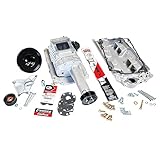
- Conventional Cylinder Head Compatibility
- Edelbrock 122 System Type
- Carbureted
- Eaton H122 Rotor Type
- 6-Rib 3. 75 in. Pulley
Heat and efficiency depend on the whole system
Twin-screw units compress air internally, whereas Roots blowers deliver air to the manifold, where pressure builds. Manufacturers and aftermarket explainers often describe twin-screw systems as more thermally efficient than Roots designs under some conditions. That comparison is not an independent, controlled ranking across all three supercharger types, and it does not establish the charge temperature of a particular vehicle.
Actual charge temperature depends on the complete setup, including the blower and its sizing, operating conditions, and charge-air cooling. The cited comparisons do not establish a same-engine test that holds boost target, calibration, temperature measurement, and conditions constant across Roots, twin-screw, and centrifugal designs. Do not use the design label alone to predict how cool a specific car will run.
Outdated Drivers Are Slowing You Down
One free scan finds every outdated or missing driver and matches the right update for your exact hardware.Free scan · exact hardware matchPC Slower Than It Used to Be?
A free scan shows the junk files, broken settings and background clutter dragging Windows down - then fixes them in one click.Free scan · Windows 10 & 11Rank #3

- 【Supercharger Kit】This is a universal supercharger, any model, 3.5 and below displacement, as long as there is space to install, Small size, it can be easily installed in various models
- 【Increased Power】engine power increased by more than 30%; 3-10% lower fuel consumption
- 【Reduce Pollutant Emissions】LCD, HC, NOXJ reduced by 30% or less
- 【Protect The Engine】reduce engine wear due to deposits
- 【Wide Application】For Cherokee TOYOTA Previa Buick GL8 HOVER So on. The Supercharger Can Be Mounted On Any Engine If There Is Enough Space.
Which type suits your use?
Choose by the power delivery you want
- Roots: Consider it when prompt low-speed response and broad boost delivery are priorities, provided a suitable kit exists for your vehicle.
- Twin-screw: Consider it when you want positive-displacement response and value internal compression as a design distinction. Do not assume that a claimed efficiency advantage will apply identically to every setup.
- Centrifugal: Consider it when you prefer boost that builds with engine RPM and your engine’s operating range and use make that curve desirable.
Match the curve to how the car is driven
Street driving may make low-speed response especially noticeable. Drag or roll-racing setups may favor different parts of the RPM range, while road-course use makes the overall power delivery, cooling, and control important to evaluate together. The boost curve is a useful starting point, not a prediction of traction or lap-time results.
Pulley ratio, engine characteristics, calibration, transmission, traction, and charge-air cooling all affect how a car behaves. A type-level comparison cannot tell you whether a particular vehicle will hook up, feel manageable, or make a specific horsepower figure.
Rank #4

- VMP Gen 6 3.0L Supercharger Kit: Boost your Mustang's power
- Stage 1 Kit: Entry-level performance upgrade
- Gain Over 300 RWHP: Unleash your engine's potential
- Complete Kit: Includes all essential components
- Stock-Like Driving Experience: Enjoy enhanced power without compromises
What to check before choosing a kit
- Confirm exact fitment: Match the kit to the vehicle’s make, model, year, and engine, and verify the exact kit configuration with its manufacturer or seller. Common packaging patterns—such as top-mounted positive-displacement layouts or front- and side-mounted centrifugal layouts—are not universal.
- Define the intended use and RPM range: Decide whether immediate low-speed response or boost that rises higher in the rev range better suits the way the car will be driven.
- Review the full system requirements: Check what the kit requires for charge-air cooling, fuel delivery, engine capability, tuning, and installation. Requirements vary by vehicle and configuration; there is no universal specification established by these comparisons.
- Check local compliance: Confirm emissions and other applicable rules for your jurisdiction and the exact vehicle and kit. Legality cannot be inferred from the supercharger type alone.
- Compare total cost and support: Include installation and supporting modifications, and confirm current pricing and availability for the exact configuration. No general price ranking among the three designs is established here.
Is one type more powerful or reliable?
The available comparisons do not establish that one design universally makes more horsepower, runs cooler, costs less, or lasts longer. Those outcomes depend on the specific supercharger, engine, boost target, supporting components, calibration, installation, and use. A meaningful head-to-head ranking would need controlled testing on the same engine under stated conditions; the cited sources do not provide that comparison.
Quick Recap
Best Value
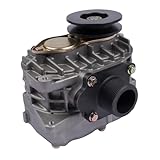
- 【Universal Fit】: The AMR500 turbocharger is designed for easy adaptation to a wide range of vehicle models. It can be installed on any engine with a displacement of 1.6-2.4L, provided sufficient installation space is available
- 【Wide Compatibility】: Experience more powerful acceleration and turbo boost across various driving conditions. Engine output increases by over 30% while fuel consumption decreases by 3-10%. Additionally, this technology helps reduce pollutant emissions
- 【Efficient Airflow Design】: Engineered for optimal airflow, this supercharger improves power output and engine responsiveness for a superior driving experience
- 【Durable & Reliable】: Built to last, this high-quality Supercharger ensures consistent performance, whether for racing, off-roading, or recreational use
- 【Easy Installation】: Designed for straightforward integration into various applications, helping you take your automotive projects to the next level with minimal hassle
Product prices and availability are accurate as of the date/time indicated and are subject to change. Any price and availability information displayed on Amazon at the time of purchase will apply.




