The Tool Desk
Outbyte PC Repair FREERepair Windows errors before they cause bigger problemsFix Now →Outbyte Driver Updater FREEScan for outdated or missing drivers - takes under a minuteDriver Scan →Boost threshold and turbo lag describe different things. Boost threshold is the engine-speed and load region where exhaust flow becomes sufficient to produce the defined amount of positive intake-manifold pressure. Turbo lag is the elapsed delay between a throttle change and the resulting boost or torque response when the engine is already operating above that threshold. A low-rpm hesitation can contain both effects, which is why the terms are often used interchangeably.
Turbo lag vs. boost threshold in one comparison
| Term | What it describes | What must be specified | Typical driver impression |
|---|---|---|---|
| Boost threshold | An operating condition: the engine speed and load at which a stated pressure criterion is reached. | Engine speed, load, boost criterion, gear and measurement reference. | “The engine does not make useful boost yet.” |
| Turbo lag | A time-dependent response: the delay in boost or torque after the throttle is opened above the threshold region. | Initial rpm and load, throttle change, elapsed time and the pressure or torque response being measured. | “The engine is in the boost-capable range, but response arrives late.” |
The distinction matters because a turbocharger can be rotating below threshold without producing positive manifold pressure, while a turbocharged engine can also experience a delay after it is already above the point where boost is available. Calling every low-rpm wait “lag” hides which problem is actually being observed.
As an Amazon Associate I earn from qualifying purchases.
What is boost threshold?
Boost threshold is commonly defined as the engine speed at which there is sufficient exhaust-gas flow to generate positive manifold pressure. In practice, it is better treated as a speed-and-load region rather than one universal rpm number. The threshold changes when the load, throttle position, gear, boost criterion or engine-and-turbo match changes.
Free tools Windows power users keep installed
One-click scans. No signup required.
Positive pressure is the criterion
A naturally aspirated engine can show manifold vacuum when the throttle is partly closed. A turbocharged engine may remain in vacuum or near atmospheric pressure at low speed and light load even though the compressor is turning. If the stated criterion is “positive manifold pressure,” the threshold is the operating point where manifold pressure crosses above atmospheric pressure under the chosen conditions.
#1 Best Overall
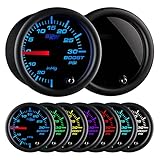
- GlowShift Tinted 7 Color Series 30 PSI Mechanical Boost/Vacuum Gauge is Designed to Monitor Boost Pressure & Vacuum Compression Levels of Your Car's Turbo or Supercharged Engine
- Mechanical Boost Readings from 0 to 30 PSI & Vacuum Readings from -30 to 0 inHg - 2-1/16" (52mm) Diameter Gauge with a Black Dial, Illuminated Red Needle, Tinted Lens, Matte Black Trim Ring & Aluminum Housing
- 7 Solid Color Modes & 2 Color Cycle Modes Allow You to Match Your Factory Dashboard Lights or Add a Custom Style to the Interior of Your Vehicle - Colors Include Blue, Red, Green, Teal, Purple, White & Yellow - Connecting the Dimmer Wire to the Headlight Switch Reduces Brightness of the Gauge by 30% When the Headlights are On
- Includes 6' Silicone Hose, 1/8" T-Fitting, 2 Hose Clamps, 2' Power Wire, Gauge Visor, Mounting Bracket, Mounting Bracket Hardware & Step-By-Step Instructions that Help Walk You Through the Installation Process
- Established Since 2004, GlowShift Has Always Been Committed to Customer Satisfaction by Offering a One-Year Limited Warranty, Free Lifetime Technical Support & 30 Day No Hassle Returns with Each Purchase
Some drivers use “threshold” to mean the point where a noticeable amount of boost appears, while an engineer may define it with a specific pressure value. Those are not identical measurements. A meaningful statement should name the pressure criterion and the conditions under which it was reached.
Why threshold is not a fixed specification
Exhaust flow depends on how much air and fuel the engine is processing, not rpm alone. At the same engine speed, a wide-open-throttle pull in a high gear can produce a different result from a light-throttle acceleration in a lower gear. The turbo, engine displacement, tuning, exhaust system and intake plumbing also determine how quickly the system reaches the selected pressure point.
For that reason, a claim such as “this turbo has a 2,500-rpm threshold” is incomplete unless it identifies the engine, load, boost definition and test method. It may be a useful observation for one combination, but it is not a transferable universal value.
Do these 3 things before closing this tab:
1Repair Windows errors before they cause bigger problems2Scan for outdated or missing drivers - takes under a minute3Clear out junk files and repair common Windows errorsWhat is turbo lag?
Turbo lag is the delay in boost response after the driver opens the throttle while the engine is already above the boost-threshold engine-speed region. In plain language, it is the time between the input and the delivery of boost-related torque. Garrett’s consumer-facing technical explanation uses the same basic idea: delayed response between throttle input and torque delivery.
Lag is measured over time
Unlike threshold, lag cannot be identified from a single rpm reading. You need a defined event, such as a repeatable throttle opening at a specified starting speed and load, and then measure how long it takes for manifold pressure or torque to reach a chosen response point. The result could be expressed as elapsed time, pressure rise versus time, or torque rise versus time.
Rank #2
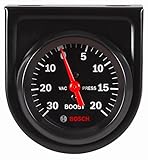
- Standard 2" black dial face for 2-1/16" openings
- 0-30 in. Hg Vacuum scale, 0-20 PSI Boost with 270 degree sweep
- Features a black bezel with removable black mounting panel
- 72" tubing and fittings included
- Includes mounting hardware and 12 volt internal back lighting
The throttle event must be described carefully. A small pedal movement, a full-throttle opening, a gear change and a change in engine load can produce different response traces. Without that context, two reported “lag times” may not be comparable.
Lag can exist above threshold
Suppose the engine is already operating in a range where the exhaust can produce positive manifold pressure. The driver opens the throttle further, but the turbine, compressor and intake system need time to accelerate and fill. That delay is lag even though the engine has passed the threshold region. This is the central reason the two terms should not be treated as synonyms.
Why a low-rpm wait can feel like both
During a low-speed acceleration, the engine may begin below the threshold, so there is initially no positive manifold pressure. As rpm and load rise, the system crosses into the boost-capable region. After the throttle change, the turbo and the rest of the intake and exhaust system may still require additional time to build the requested pressure and torque. The driver experiences one continuous hesitation, but it contains two distinct phases:
- Below threshold: the operating condition has not yet produced the defined positive pressure.
- After the threshold region is reached: the system is capable of boost, but pressure or torque is still developing after the throttle event.
A data trace with rpm, throttle position, manifold pressure and, where available, torque can separate these phases. A boost gauge watched without rpm or a repeatable throttle event cannot.
How turbo size and system design affect threshold and lag
Threshold and lag are properties of the matched engine-and-turbo system, not isolated labels attached to the compressor housing. The factors identified in technical explanations include turbo size relative to engine size, engine tuning, rotating-group inertia, turbine efficiency, intake-plumbing losses and exhaust backpressure.
Rank #3
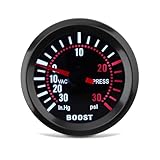
- - Turbo boost gauge is designed to provide accurate pressure measurements of vehicle's turbocharger system, with a clear 0 - 30 in.Hg / 0 - 30 PSI measurement range, monitoring engine performance more precisely
- - Offers a vibrant white LED backlight that remains highly visible in low-light or nighttime environments, allowing effortless real-time readings without glare or distractions
- - With clear and easy to read display, turbo boost gauge provides real time readings of turbocharger system pressure, allowing to make informed decisions about driving style and keep engine running at optimal performance
- - By monitoring turbocharger system pressure, allowing you to get the most out of engine performance and enjoy a smoother and more responsive driving experience
- - Made of sturdy materials, long lasting and easy to install, suitable for car / boat / truck / ATV
Turbo size relative to the engine
A turbo selected for high flow at high engine speed may require more exhaust energy before it produces the desired pressure. A smaller unit can respond earlier in some applications, but the correct choice depends on the engine’s displacement, airflow demand, target boost and usable operating range. “Spools sooner” is not a complete evaluation because it says nothing about whether the turbo can supply the required flow efficiently at higher speed.
Rotating-group inertia
The compressor and turbine assembly must accelerate when exhaust energy increases. More rotating inertia generally makes that acceleration more demanding, while the engine’s exhaust energy, turbine efficiency and calibration determine how much power reaches the rotating group. Inertia is therefore one contributor to transient delay, not a standalone definition of lag.
Turbine efficiency and exhaust backpressure
The turbine converts exhaust energy into shaft power. Its efficiency and the pressure required to drive it affect both response and the engine’s pumping conditions. Excessive exhaust backpressure can limit high-speed breathing and alter the energy available to the turbine. A turbo that responds quickly at one point may still be a poor match if it creates restrictive conditions elsewhere in the operating range.
Intake plumbing losses
Pressure losses in the intake path reduce the pressure delivered to the engine for a given compressor operating point. The volume and routing of the plumbing also influence how much air must be compressed before manifold pressure changes. These effects belong in a lag discussion, but they do not redefine the threshold: threshold remains the operating condition at which the chosen pressure criterion is reached.
Turbine A/R: the response-versus-flow tradeoff
Garrett’s turbine A/R guidance illustrates why turbo selection is a compromise. A smaller turbine A/R increases exhaust-gas velocity into the turbine and can increase turbine power at lower engine speeds, improving response. The same choice reduces ultimate turbine flow capacity compared with a larger A/R arrangement.
Rank #4

- High Quality: The boost gauge is made of high-quality ABS and metal material, which is wear-resistant and durable.
- Easy to Read: Numbers and pointing clearly show the turbo boost, the blue light on the dial for easy reading in the darkness.
- Application: Used to measure the turbo of automobile. Suitable for all 12V car models, which is a practical modification accessory. Measurement Range: 0~30in.Hg / 0~30PSI.
- Easy Installation: Compact and practical design makes it works more stable. Easy to install and operate, convenient to use.
- Package Included: 1 x Turbo Boost Gauge Meter, 1 x Sensor, 1 x Bolts Pack.
| Design direction | Potential benefit | Potential cost |
|---|---|---|
| Smaller turbine A/R | Higher exhaust-gas velocity and potentially stronger low-speed turbine power. | Less ultimate flow capacity, which can limit high-speed breathing or peak-power potential. |
| Larger turbine A/R | Greater flow capacity at high engine speed. | May provide less turbine drive at low speed and can reduce low-speed response in a given application. |
This is a design tradeoff, not a rule that smaller is always better. The appropriate A/R depends on the engine, target operating range, boost goal and required flow. Improving response at one part of the map can move the compromise elsewhere.
Why compressor maps matter more than a “spools sooner” claim
A compressor map describes an operating range using mass flow, pressure ratio, compressor efficiency and turbo speed, with limits such as surge and choke. Boost pressure is only one characteristic. Two turbochargers can show similar peak boost yet differ substantially in airflow, efficiency, operating margin and response under load.
When comparing setups, examine whether each turbo is matched to the engine’s required mass flow and pressure ratio. Also ask where the engine will spend its time: low-speed street operation, midrange acceleration, sustained high-speed use or a combination. A turbo that reaches a pressure target quickly but operates inefficiently or runs out of flow may not deliver the best usable performance.
- Pressure ratio: the compressor pressure increase required for the operating point.
- Mass flow: the amount of air the engine and compressor must process.
- Efficiency: how effectively compressor input power becomes useful pressure increase.
- Speed: the turbocharger shaft-speed condition associated with the point.
- Surge and choke: operating limits that constrain how far the compressor can be used safely and effectively.
These map characteristics explain why a single threshold rpm or peak-boost number cannot summarize a turbocharger’s behavior.
Crashes, No Sound, or Screen Glitches?
Random freezes, missing sound and display glitches usually trace back to one bad driver. Find and replace yours safely.Free scan · under a minutePC Slower Than It Used to Be?
A free scan shows the junk files, broken settings and background clutter dragging Windows down - then fixes them in one click.Free scan · Windows 10 & 11How to measure threshold and lag without mixing them up
Define the threshold test
- Identify the engine, turbocharger, calibration and fuel configuration.
- Choose a repeatable load condition, such as a specified gear and a full-throttle pull on the same road or dynamometer setting.
- Choose the pressure criterion: positive gauge pressure, or a stated manifold-pressure value.
- Log engine speed, throttle position and manifold pressure.
- Record the rpm and load region where the pressure criterion is first reached, rather than reporting one number without conditions.
Define the lag test
- Start above the selected threshold region at a specified rpm and load.
- Apply the same throttle change each time.
- Measure elapsed time to a stated pressure or torque response point.
- Repeat the event under the same gear, temperature and operating conditions.
- Report the starting state, throttle event, response criterion and measurement method with the result.
An automotive boost gauge can help observe manifold pressure while you note engine speed, but it is a measurement aid, not a cure for lag or a standalone diagnostic. A gauge reading without rpm, throttle position and load cannot distinguish threshold from transient response.
Best Value
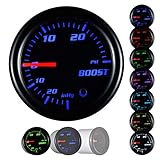
- 【Accurate Pressure Measurement】Turbo Boost Gauge is Designed to Provide Accurate Pressure Measurements of Vehicle's Turbocharger System, with a Range of up to 30PSI, Monitoring Engine Performance more Precisely.
- 【Easy-to-Read Display】With Clear and Easy-to-Read Display, Turbo Boost Gauge Provides Real-Time Readings of Turbocharger System Pressure, Allowing toMake Informed Decisions about Driving Style and Keep Engine Running at Optimal Performance.
- 【Improve Driving Experience】By Monitoring Turbocharger System Pressure, Allowing You to Get the most out of Engine Performance and Enjoy a Smoother and more Responsive Driving Experience.
- 【High-Quality Construction】Made from High-Quality Materials, Turbo Boost Gauge is Durable and Built to Withstand the Rigors of Daily Use, Ensuring Reliable Performance and Long-Lasting Durability.
- 【Easy to Install】With Simple Installation Process, Boost Gauge can be Installed easily and quickly, the Package includes Silicone Hose, T-Fitting, 2' of Power Harness, Gauge Visor, Gauge Swivel Dashboard Pod, Bottom, Mounting Hardware, Installation Instruction
Common mistakes when people describe turbo response
“The turbo is not spinning, so it has not reached threshold”
The turbo can be rotating below the threshold condition. Threshold concerns whether the engine has enough exhaust flow, under the chosen load, to generate the defined positive manifold pressure; it does not mean the turbo suddenly begins turning at one rpm.
“Boost starts at one rpm on every vehicle”
There is no broadly applicable rpm value. Engine size, turbo match, tuning, turbine geometry, plumbing, backpressure and load all change the result. Even the same vehicle can show different behavior in different gears or at different throttle positions.
“Peak boost tells me how much lag the system has”
Peak pressure does not provide a time measurement. Lag requires a defined throttle event and a response trace. A system can reach the same peak pressure as another while differing in how quickly it gets there and how much airflow it supplies along the way.
“A smaller turbo always eliminates lag”
Smaller turbine or compressor choices can improve response in a selected region, but they can also reduce high-speed flow capacity. The result depends on the complete match and the intended operating range.
“Any delay after pressing the pedal is turbo lag”
Below-threshold operation, throttle control, gear selection and other engine-response effects can all contribute to what the driver feels. Use “turbo lag” specifically for the time-dependent boost or torque delay after a throttle change above threshold.
A practical way to describe a turbo system accurately
Use a sentence that includes the operating condition and the event. For threshold, state: “At this engine speed and load, manifold pressure first reaches the chosen positive-pressure criterion.” For lag, state: “From this starting rpm and load, the defined throttle change takes this long to reach the selected pressure or torque response.”
This wording prevents three common errors: presenting a vehicle-specific observation as universal, confusing a pressure level with a time delay, and treating peak boost as a complete description of turbo performance.
Quick wins for a faster PC:
Repair Windows errors before they cause bigger problemsFix Now →Fix the driver behind crashes, sound loss and screen glitchesFind Drivers →Clear out junk files and repair common Windows errorsFree Scan →Quick Recap
What the driver should take away
- Boost threshold is about where the engine operates: the speed-and-load region where a stated boost criterion becomes available.
- Turbo lag is about when the response arrives: the delay after a throttle change above that region.
- A low-rpm hesitation can include both below-threshold behavior and above-threshold transient delay.
- Turbo sizing and turbine geometry trade low-speed response against high-speed flow capacity; neither “small” nor “large” is automatically best.
- A credible comparison identifies the engine, load, gear, throttle event, pressure or torque criterion and measurement context.
Product prices and availability are accurate as of the date/time indicated and are subject to change. Any price and availability information displayed on Amazon at the time of purchase will apply.




