The Tool Desk
Outbyte PC Repair FREERepair Windows errors before they cause bigger problemsFix Now →Outbyte Driver Updater FREEFix the driver behind crashes, sound loss and screen glitchesFind Drivers →Toyota to launch world’s first practical all-solid-state EV battery is a target, not a confirmed launch: Toyota says it aims to introduce BEVs using the technology in 2027–2028. Toyota has not announced the first model, price, countries, certified range, production volume, or customer-delivery date.
Toyota and Idemitsu Kosan are still developing sulfide solid-electrolyte materials, battery manufacturing methods, and BEV integration. Toyota’s published figures—a 20% cruising-range improvement and 10%–80% charging in 10 minutes or less—are development targets, not independently verified production-vehicle results.
As an Amazon Associate I earn from qualifying purchases.
Key takeaways
- Toyota’s official target is practical use or market introduction of all-solid-state batteries in battery-electric vehicles during 2027–2028, according to Toyota’s October 12, 2023 announcement.
- Toyota still describes the battery program as product development and mass-production-method development rather than completed high-volume production, according to Toyota’s 2025 Sustainability Data Book.
- Toyota and Idemitsu Kosan are focusing on sulfide solid electrolytes, whose softness and adhesiveness may help battery interfaces but do not remove the durability and manufacturing challenges.
- According to Toyota Motor Corporation’s 2023 technical disclosure, the development targets are a 20% cruising-range improvement over a referenced performance-version square battery and charging from 10% to 80% in 10 minutes or less.
- “World’s first practical use” is Toyota’s stated objective, not an independently established fact; the first model, launch country, price, certified range, production volume, and customer-delivery date remain unannounced.
Is Toyota really launching the world’s first practical all-solid-state EV battery?
Not yet. Toyota has stated that it aims to achieve the world’s first practical use of an all-solid-state battery in a battery-electric vehicle, but Toyota’s official materials describe a future target and an ongoing development program rather than a completed launch.
What’s actually slowing this PC down?
Pick the symptom - the matching free tool is one click away.
The phrase “world’s first” also depends on the definition of first. A laboratory cell, a working prototype, a limited-production vehicle, a semi-solid battery, a genuinely all-solid battery, and a practical mass-market BEV are different milestones. Toyota’s published announcements do not establish a universal industry test for the phrase or prove that no competitor will reach a qualifying milestone first.
#1 Best Overall

- 【Delay Timer - Adjustable Current】Ev charger can adjust the current (8A/10A/12A/16A) through the physical button of level 1 ev charger. Charging power can reach up to 3.68KW (240V/16A). One-touch switch for ev charger operation. Built-in 2–8 hour delay timer for off-peak charging to save on electricity bills.
- 【NEMA 6-20 Plug & NEMA 5-15 Adapter】Nema 6-20 plug for 240V outlets and 5-15 adapter for standard 120V realize plug-and-charge (With 5-15 adapter, need to adjust the current to 12A or below, otherwise the charger may be demeged). Overall length of ev charger level 2 is 27FT, providing enough charging distance across garages at home or outdoor. Portable storage bag supports you take portable EV Charger during travel, business trip, electric vehicle charging stations anywhere.
- 【ETL/FCC and IP67 Safety】J1772 charger is equipped with advanced safety functions such as overvoltage, overheating, and short-circuit automatic shutdown. IP67 waterproof and dustproof, extreme temperature protection level for withstanding harsh weather conditions from -40°F to 131°F in sunny, rain, snow and sandstorm. Electric car charger has ETL certified, FCC listed, meets UL safety standards. Industrial-grade construction with high-strength TPU-coated cables and 99.95% oxygen-free copper cores.
- 【J1772 Connector】J1772 charger works for all J1772 standard electric vehicles, Ford, GM, Nissan, Audi, Kia, Honda, BMW, Hyundai, Gmc, Chevy, Mercedes, and all PHEV/BEV. [Not fits Tesla cars/Nacs connector]
- 【One-Touch Charging Operation】16A electric car charger supports plug-and-charge functionality and features one-touch scheduled charging and current adjustment. Its intuitive and user-friendly operation allows flexible customization of personalized charging plans. Level 1 ev charger automatically shuts off when your car is fully charged.
Toyota President and CEO Koji Sato said in the company’s October 12, 2023 Toyota–Idemitsu announcement:
“First, between 2027 and 2028, we will start to produce solid-state batteries for use in battery electric vehicles.”
Toyota’s official announcement presents that statement as part of a cooperation plan aimed at mass-production technology. The statement does not identify a retail vehicle or guarantee that the 2027–2028 timetable cannot change.
| Claim | What Toyota has documented | What remains unproven |
|---|---|---|
| World’s first practical all-solid-state EV battery | Toyota and Idemitsu say they aim for the world’s first practical use in a BEV. | Toyota has not independently established that it will be first under a defined industry standard. |
| 2027–2028 launch | Toyota has repeatedly stated a target for practical use or market introduction during 2027–2028. | No exact production start date, vehicle, market, or customer-delivery date has been announced. |
| 10-minute charging and more range | Toyota has published development targets for 10%–80% charging in 10 minutes or less and a 20% range improvement. | No certified vehicle result, charging curve, pack capacity, or independent road test has been published in the reviewed sources. |
| Mass production | Toyota and Idemitsu are developing materials, pilot-scale production methods, battery integration, and a future full-scale manufacturing plan. | The reviewed sources do not prove that high-volume production has already been achieved. |
When will Toyota’s solid-state battery be available?
Toyota’s stated availability window is 2027–2028, but the available evidence supports a target for early practical use or market introduction rather than a confirmed customer-delivery date.
| Date | Announcement or disclosure | What the date means |
|---|---|---|
| June 13, 2023 | Toyota technical disclosure | Toyota described an all-solid-state BEV battery under development, with commercialization targeted for 2027–2028. |
| September 19, 2023 | Toyota manufacturing update | Toyota said product development and mass-production methods were still being developed, including high-speed, high-precision battery-layer stacking. |
| October 12, 2023 | Toyota–Idemitsu cooperation announcement | The companies announced cooperation on mass-production technology for all-solid-state batteries intended for BEVs and retained the 2027–2028 market-launch goal. |
| 2025 | Toyota Sustainability Data Book | Toyota said product development and establishment of mass-production methods were continuing, with practical use targeted for 2027 or 2028. |
| June 2, 2026 | Japan’s revised Battery and Power Industry Strategy | Japan’s wider strategy targeted full-scale commercialization of all-solid-state batteries around 2030 and a manufacturing base aligned with demand by the mid-2030s. |
The 2027–2028 Toyota target and Japan’s broader 2030 commercialization target are not necessarily contradictory. Toyota could begin limited or early commercialization before the wider industry reaches full-scale production. The government timeline describes an industrial ecosystem, not a cancellation of Toyota’s narrower company target.
Rank #2

- SAE J1772 Standard Charger: Compatible with all North American electric vehicles and plug-in hybrids, including Ford, Chevrolet, Nissan, BMW, Volkswagen, Hyundai, Kia, Audi, Mercedes-Benz, Rivian, Porsche, Toyota, Honda, Jeep, and GMC. Tesla vehicles can be charged with a separate SAE J1772 adapter (sold separately).
- Adjustable Current: Choose from 8A, 10A, 13A, or 16A to match your vehicle’s charging needs.Dual Plug Compatibility,NEMA 6-20 Plug (220/240V): Delivers up to 3.84 kW/h, providing approximately 15.36 MPH charging speed at 16A.NEMA 5-15 Plug (110/120V): Supports 10A charging at 120V, offering 1.2 kW/h (around 4.4 MPH). Customizable Charging: Easily adjust current to suit different charging scenarios, giving you maximum flexibility at home or on the go
- Hassle-Free Installation: Forget complicated setups—just plug in and go. Equipped with NEMA 5-15 and NEMA 6-20 (220V/240V) connectors, it works with any standard 110V–240V outlet. The 25-foot cable gives you the freedom to reach vehicles parked at a distance, making charging convenient anywhere.
- Intelligent Charging: Featuring a 2.8-inch touch display, you can easily select the charging current (8A / 10A / 13A / 16A) and schedule charging with a 1–12 hour delayed start. Perfect for maximizing off-peak hours and cutting electricity costs. (Example: Set a 2-hour delay, and charging begins automatically after 2 hours.)
- Comprehensive Safety: Designed to meet CE and FCC safety standards, this charger offers multiple layers of protection, including overvoltage, overload, short-circuit, grounding, and leakage safeguards. The durable IP65-rated waterproof housing and reinforced cable ensure reliable charging in all weather conditions, keeping your vehicle safe year-round.
What are Toyota and Idemitsu doing to reach production?
Toyota and Idemitsu’s program has three connected stages: improving the solid-electrolyte material, developing pilot-scale production, and studying full-scale manufacturing for commercialization.
- Materials development and pilot preparation: Idemitsu and Toyota are working to improve sulfide solid electrolytes while addressing quality, cost, and lead time.
- Pilot-scale production work: Idemitsu is developing production technology for solid electrolytes at a large pilot facility, while Toyota is developing the battery and the process for integrating the battery into a BEV.
- Future full-scale production: The companies plan to study full-scale mass production and commercialization based on the results of the earlier stages.
The structure matters because the announcement is not simply a claim about discovering a new material. Toyota and Idemitsu must make the material consistently, assemble durable cells, integrate those cells into a vehicle pack, control costs, and secure a supply chain before a practical retail launch can be considered established.
Do these 3 things before closing this tab:
1Clear out junk files and repair common Windows errors2Scan for outdated or missing drivers - takes under a minute3Repair Windows errors before they cause bigger problemsWhat does all-solid-state mean?
An all-solid-state battery replaces the liquid electrolyte used in a conventional lithium-ion battery with a solid electrolyte. Toyota and Idemitsu are focusing on sulfide solid electrolytes, which Toyota describes as promising because the material is soft and adhesive to other battery materials.
| Battery description | Electrolyte arrangement | How to interpret the label |
|---|---|---|
| Conventional lithium-ion battery | Uses a liquid electrolyte. | The established reference technology discussed in Toyota’s battery materials. |
| Semi-solid or hybrid battery | Uses a mixture or combination that is not wholly solid. | A semi-solid or hybrid vehicle should not automatically be counted as using a genuinely all-solid electrolyte. |
| Toyota’s all-solid-state program | Targets a solid electrolyte throughout the battery system’s electrolyte function, with Toyota and Idemitsu focusing on sulfide materials. | The program is intended for BEVs, but the reviewed sources do not document a finished production pack. |
The intended advantages are higher output, longer driving range, and shorter charging times. Those advantages are goals of the technology, not proof that every all-solid-state battery will deliver the same result.
Why is an all-solid-state battery difficult to make?
Durability at the interfaces between battery materials is the central challenge Toyota has identified. Repeated charging and discharging can create cracks between the cathode, anode, and solid electrolyte, degrading battery performance.
Rank #3

- 3-in-1 Smart Car Battery Charger: This 10A 12V car battery charger comes with a compact size and super fast charging, suitable for all 12V lead-acid batteries (including AGM, GEL, SLA, VRLA, etc.) and LiFePO4 lithium batteries. Charging, maintaining, and trickle charging modes for cars, motorcycles, trucks, boats, and more. Please note: this is a car battery charger and please connect it to a power source before use. (Please do not let the charger operating unattended for more than 12 hours.)
- Plug and Play Operation: Simply connect the clamps to your car battery. The LCD screen will light up and automatically display the battery voltage and ambient temperature. This automatic car battery charger gets to work the moment you plug the AC power cord into a 110-240V (50-60Hz) wall socket, it will automatically detect and charge. You can also manually select from 5 using modes with the press of the “MODE” button.(Input cable length: 102 cm; output cable length: 60 cm.)
- Smart Winter Battery Trickle Charger: This intelligent car battery charger features dual seasonal modes (Winter/Summer) that automatically adjust charging voltage based on ambient temperature, preventing undercharging in winter and overcharging in summer.
- LCD Display: Battery charger comes with a backlit LCD display, showing charging data including voltage, current, temperature, battery level, and seasonal modes (summer/winter), making it easy to stay updated on charging progress.
- 8-In-1 Protection Design: Built-in 8 layers of protection in a car battery charger, including reverse connection protection, short circuit protection, overcurrent protection, overheating protection, and more, ensure safe operation.
A liquid electrolyte can move through a cell as materials expand and contract. A solid electrolyte must maintain effective contact with the surrounding electrode materials over repeated cycles and across changing temperatures. The dossier does not provide a final cycle-life figure or independent durability result for Toyota’s battery, so claims about exceptional longevity would be premature.
PC Slower Than It Used to Be?
A free scan shows the junk files, broken settings and background clutter dragging Windows down - then fixes them in one click.Free scan · Windows 10 & 11Outdated Drivers Are Slowing You Down
One free scan finds every outdated or missing driver and matches the right update for your exact hardware.Free scan · exact hardware matchManufacturing precision is another obstacle. Toyota has identified high-speed, high-precision stacking of battery layers as part of the production challenge. A process that works for laboratory cells may not automatically deliver the consistency, yield, cost, and throughput required for vehicle production.
Toyota’s October 2023 cooperation announcement describes the program as covering quality, cost, lead time, production technology, and BEV integration. The combination of materials research and manufacturing development is why Toyota’s announcement should be read as an industrial scale-up plan rather than as evidence that a finished battery is already ready for mass production.
How much range and charging speed will Toyota’s battery provide?
Toyota has published development targets, not a final production-vehicle specification. According to Toyota Motor Corporation’s June 13, 2023 technical disclosure, the initial performance target is a 20% cruising-range improvement over Toyota’s referenced performance-version square battery and charging from 10% to 80% in 10 minutes or less.
| Metric | Toyota’s stated figure | Important qualification |
|---|---|---|
| Cruising-range improvement | 20% | According to Toyota Motor Corporation (2023), the figure is a development target compared with a specified performance-version square battery, not a certified range increase for every Toyota BEV. See Toyota’s technical battery disclosure. |
| Charging time | 10 minutes or less | According to Toyota Motor Corporation (2023), the target covers charging from 10% to 80%; Toyota has not published a final vehicle charging curve or independently verified production result. |
| Higher-level future range research | 50% | Toyota described the figure as a future specification under research compared with the referenced baseline, not as the initial 2027–2028 production target. |
Does Toyota’s battery really promise 1,200 kilometers and 10-minute charging?
No finalized Toyota production specification supports that complete claim in the authoritative material reviewed. Toyota’s official technical disclosure supports the more specific target of a 20% range improvement and 10%–80% charging in 10 minutes or less; the frequently repeated 1,200-kilometer figure should not be presented as a confirmed Toyota vehicle range.
Rank #4

- Charge with Confidence: ChargePoint builds reliable, flexible EV charging stations for home, business, and fleets. Get 24/7 support and access to hundreds of thousands of North American charging locations
- Charge Smart: With the user-friendly ChargePoint Mobile App, you can control your electric car charger, manage reminders, connect to smart home devices, find stations, get data and charging info, and access the latest features
- Vast Network: Wherever you go, ChargePoint’s network includes 274k+ stations across North America and Europe and 565k+ roaming partner stations
- Safe & Durable: Rely on this UL-certified EV charger for safe home charging. It can be installed indoors or outdoors by an electrician and includes a cold-resistant cable
- Fast & Powerful: This EV charger charges 9× faster than a 120V outlet, delivering up to 45 mi/hr., dependent upon your vehicle. It features a J1772 connector for all non-Tesla EVs and plugs into a 240V outlet with a 14-50 receptacle, requiring a 40A or 50A circuit. For Tesla EVs, this will require an adapter
A 20% improvement is also not the same as a fixed 1,200-kilometer range. The resulting distance would depend on the comparison vehicle, battery capacity, vehicle efficiency, software limits, temperature, speed, and the test cycle used. Toyota has not published a final pack capacity, certified EPA or WLTP range, or production charging curve for an all-solid-state BEV.
Independent reader supportYour contribution helps us test, update, and keep practical guides available for everyone.Which Toyota or Lexus model will get the battery first?
Toyota has not identified the first Toyota or Lexus model in the authoritative sources reviewed. Toyota has said the battery is intended for battery-electric vehicles, but the company has not published the model name, launch geography, customer order date, production volume, price, warranty, or certified range.
| Vehicle detail | Current documented position |
|---|---|
| First Toyota or Lexus model | Not announced. |
| Launch countries or regions | Not announced. |
| Customer-delivery date | Not announced; 2027–2028 remains the company’s practical-use or market-introduction target. |
| Battery capacity and certified range | Not published for a finished Toyota all-solid-state vehicle. |
| Price, warranty, and production volume | Not published in the reviewed authoritative material. |
That missing information makes it impossible to determine whether Toyota’s first vehicle would be a limited early-production model, a premium performance vehicle, or a higher-volume BEV. Toyota’s stated range and charging targets should therefore not be treated as specifications for a particular Toyota or Lexus currently available to order.
Is Toyota ready for mass production?
Toyota is preparing for mass production, but the reviewed disclosures do not show that Toyota has already reached high-volume production readiness. Toyota’s 2025 Sustainability Data Book says product development and the establishment of mass-production methods are continuing.
| Readiness signal | What the source supports | What the signal does not prove |
|---|---|---|
| Product development | Toyota continues developing the all-solid-state battery and the BEV into which the battery will be incorporated. | A completed, customer-ready vehicle. |
| Mass-production methods | Toyota is developing high-precision processes such as battery-layer stacking. | Stable high-volume yield, final cost, or a completed production line. |
| Idemitsu pilot work | Idemitsu is developing sulfide solid-electrolyte production technology at a large pilot facility. | Full-scale commercial supply for retail vehicles. |
| METI supply-assurance certification | Japan’s Ministry of Economy, Trade and Industry certified Toyota’s supply-assurance plan for next-generation BEV batteries and all-solid-state batteries, according to Toyota’s 2025 disclosure. | Proof that a retail vehicle is ready or that the 2027–2028 target cannot slip. |
“Mass production” can describe a development objective, a pilot line, or an established high-volume plant depending on the source. Toyota’s official wording is more cautious: the companies seek to ensure a 2027–2028 market launch and then proceed toward full-scale mass production.
Best Value
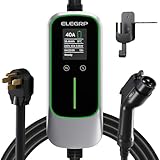
- Fast & Adjustable Charging: Up to 9.6 kW (37 mph), 7x faster than Level 1, with 5 current levels (16/20/24/32/40A) to match home capacity, plus 1–12H timing delay for off-peak charging, reducing costs and easing range anxiety
- Plug & Extended Reach: NEMA 14-50 plug fits 240V outlets for true plug-and-play use, while the 25FT cable offers flexible reach across garages and driveways, eliminating the need to reposition vehicles for easier daily charging
- ETL Certified & ELEGRP PBE Protection: Fully ETL certified, ELEGRP’s exclusive PBE technology combines full-link overheat protection with a triple-layer safety system, ensuring safer, more efficient charging. Includes a 2-year warranty
- All-Weather Indoor & Outdoor Use: IP67-rated for durability in rain, snow, and extreme temps (-21°F to 121°F), with a portable design that supports home, travel, and outdoor charging, delivering reliable performance anywhere
- Universal Compatibility: Works seamlessly with Mercedes, Chevy, Ford, Mustang Mach-E, Cadillac, Hyundai Ioniq, Kia EV6/EV9, Nissan Leaf, Chevy Bolt, Chrysler Pacifica Hybrid, and all PHEV/BEV. Tesla compatible with NACS adapter (sold separately)
How should competing solid-state battery claims be compared?
A meaningful comparison must examine more than the words “solid-state.” A competing battery program should be evaluated by its electrolyte, vehicle status, durability evidence, charging test, range basis, manufacturing stage, and actual delivery geography.
| Comparison axis | Question to ask | Why the answer matters |
|---|---|---|
| Electrolyte type | Is the battery liquid, semi-solid, hybrid, or genuinely all-solid? | Different electrolyte arrangements should not be treated as the same technology. |
| Vehicle status | Is the evidence a laboratory cell, prototype pack, test fleet, limited-production vehicle, or mass-market vehicle? | A cell result does not establish a customer-ready vehicle. |
| Durability | What cycle life, calendar life, temperature behavior, and resistance to cracking or interface degradation have been demonstrated? | Durability is one of Toyota’s stated engineering challenges. |
| Charging | What 10%–80% time, charging power, charging curve, and thermal-management requirements have been published? | A headline charging time without test conditions is difficult to compare. |
| Range basis | Is the number based on cell-level energy density or certified vehicle range under a named test cycle? | Cell performance and road-legal vehicle range are different measurements. |
| Manufacturing readiness | Is the process in a laboratory, pilot line, large pilot facility, certified production plan, or established high-volume plant? | Manufacturing scale determines whether a technology can reach ordinary buyers. |
| Geography and timing | Where will the first vehicle be approved and delivered, and when can customers actually buy it? | A prototype reveal is not the same as a market launch. |
What should EV buyers believe right now?
Buyers should treat Toyota’s all-solid-state battery as a significant development program with a 2027–2028 target, not as a currently orderable vehicle or a guaranteed specification.
- If you need an EV now: Toyota’s solid-state target does not provide a current model, price, range rating, or delivery date to use in a purchase decision.
- If you are considering waiting: Look for a named vehicle, a confirmed market, customer-delivery information, certified range, charging test conditions, warranty, and production-volume guidance before treating the launch as firm.
- If you are comparing battery announcements: Separate Toyota’s development targets from independent production-vehicle results and distinguish all-solid batteries from semi-solid or hybrid designs.
- If you want technical background: Readers can search for a solid-state battery book to learn about electrolyte chemistry and manufacturing. A technical book is educational background, not evidence that it is Toyota-authorized or that it predicts Toyota’s final battery specification.
Toyota’s program is more substantial than a simple laboratory claim because Toyota and Idemitsu are addressing materials, pilot production, vehicle integration, quality, cost, and supply. The program is still not the same as a completed mass-market launch.
Recommended Free Tools
The Bottom Line
Bottom line: Toyota is targeting practical use of all-solid-state batteries in BEVs during 2027–2028 and has published ambitious development targets of 20% more cruising range and 10%–80% charging in 10 minutes or less. Toyota has not yet documented the world’s first completed practical launch, a final vehicle, certified performance, price, or customer-delivery date.
Quick Recap
Product prices and availability are accurate as of the date/time indicated and are subject to change. Any price and availability information displayed on Amazon at the time of purchase will apply.




