The Tool Desk
Outbyte Driver Updater FREEFix the driver behind crashes, sound loss and screen glitchesFind Drivers →Outbyte PC Repair FREEClear out junk files and repair common Windows errorsFree Scan →The Toyota Celica SS-III was a Japanese-market, front-wheel-drive sixth-generation Celica with a naturally aspirated 2.0-liter 3S-GE engine. Toyota’s catalogs list 180 PS for a 1996 example and 200 PS for a 1999 entry. That makes the SS-III an interesting car to consider alongside the Integra Type R—but the available evidence does not establish a direct rivalry, a head-to-head result or a shared development target.
What the Celica SS-III is
Toyota identifies the SS-III as an E-ST202 three-door coupe in its Japanese-market catalog. The June 1996 entry lists five seats, front-wheel drive and a 1,998 cc 3S-GE engine. Toyota describes the engine as naturally aspirated; it is not the turbocharged GT-Four powertrain.
For a June 1996 SS-III, Toyota records 180 PS (132 kW) at 7,000 rpm and 191.2 N·m at 4,800 rpm. The catalog example weighs 1,210 kg and measures 4,435 × 1,750 × 1,305 mm, with a 2,535 mm wheelbase. It specifies 205/55R15 tires and premium unleaded gasoline. These are figures for that catalog entry, not a guarantee of the equipment or condition of a surviving car. Toyota’s June 1996 SS-III catalog entry.
Toyota’s January 1999 entry lists the same 1,998 cc engine and overall dimensions, but output rises to 200 PS (147 kW) at 7,000 rpm and 205.9 N·m at 6,000 rpm. Its listed curb weight is 1,240 kg. Keep these year-specific figures distinct rather than treating 180 PS and 200 PS as simultaneous specifications. Toyota’s January 1999 SS-III catalog entry.
#1 Best Overall

- An incredible, faithful reproduction of a classic supercar. The realism of this replica car is unmatched and no detail is overlooked. Feast your eyes on the sleek curves, line, angles and stance. You can almost feel teh power. Perfect to collect, display or simply play.
- Exceptional, accurate and vibrant paint finishes, Open the doors, bonnet and boot and admire the intricate details, working steering and suspension, performance rubber tyres.
- Precision manufacturing and craftmanship using heavy gauge Zinc alloy diecast metal and some ABS plastic components creates an authentic replica of this high performance, elegant, luxury vehicle
- It’s the perfect size to show off the details of this exotic machine, 1:24 scale 23cm x 11cm x 10cm, comes in a beautiful window box
- An excellent gift or present for any automotive, racing and street car enthusiast with a passion for te pinnacle of design, ages 3+
How it fits into the sixth-generation Celica range
Toyota presents SS-III as the highest grade alongside SS-I and SS-II, with the GT-Four listed separately. The catalog describes SS-I as the high mechanical-twin-cam grade, SS-II as the sporty twin-cam grade and SS-III as the top Celica grade in that lineup. Toyota’s 1996 listing includes both automatic and manual configurations, so the SS-III badge alone does not establish which transmission an individual car has. Check the specific vehicle’s records and equipment.
The GT-Four is a different proposition, not another name for the SS-III. Toyota’s lineage material identifies the ST205 GT-Four with a turbocharged 3S-GTE and full-time four-wheel drive. The SS-III catalog entries instead specify the naturally aspirated 3S-GE and front-wheel drive. Toyota’s sixth-generation Celica lineage record provides broader generation context, including the platform and body styles; it is not an SS-III-specific handling test.
Rank #2

- Detailed model kit in 1:24 scale.
- The high-quality kit from Tamiya must be assembled by yourself.
- The independent assembly is accompanied by step or illustrated assembly instructions (English language not guaranteed). The assembly instructions are included (English language not guaranteed).
- Based on the assembly instructions (English language not guaranteed), the exact individual parts must be joined together. A painting of the parts can be done according to your own ideas.
- Tools, glue and paints are not included with the plastic kit. These must be purchased optionally.
Why output figures vary by year
The different catalog figures are a useful reminder to identify the model year before quoting an SS-III’s output. Toyota’s lineage page gives 180 PS for a representative ST202 specification, while its dated SS-III entries show 180 PS in June 1996 and 200 PS in January 1999. The dated catalog entries are the relevant sources for those specific cars.
For period context, Toyota’s historical model-change announcement describes a 3S-GE revision with variable induction and stainless-steel exhaust manifolds, rated at 165 PS at 6,800 rpm. That is a development-era specification, not the output figure for the later SS-III entries above. Toyota’s historical Celica model-change announcement.
Rank #3

- Detailed model kit in scale 1:24.
- The high-quality kit from Tamiya must be mounted by yourself.
- Based on the assembly instructions, the exact parts must be assembled. A painting of the parts can be carried out according to your own ideas.
- Tool, glue and paints are not included in the box contents of the plastic kit. These must be purchased separately.
- International products have separate terms, are sold from abroad and may differ from local products, including fit, age ratings, and language of product, labeling or instructions.
Was the SS-III really an Integra Type R rival?
It is a reasonable editorial question, but the available Toyota material does not prove that Toyota developed the SS-III specifically to compete with the Integra Type R. It also supplies no matched comparison of prices, equipment, acceleration, lap times or period road-test results. Calling the Celica a “forgotten rival” works as a prompt for comparison, not as an established historical verdict.
A fair comparison would need to match model years and markets and account for engine output and units, curb weight, drivetrain, transmission, suspension and brakes, original price and availability, plus period tests or competition results. Without that evidence, a precise performance ranking would be speculation.
Rank #4
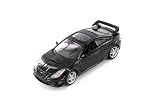
- 2004 Celica GT-S - 38237BK Showcasts Model Vehicle
- 1/24 Scale Collectible Model Sports Car
- This is a 7"L x 3"W x 2.25"H Diecast Metal model with some plastic parts
- Freewheeling, Opening Hood And Doors
- Comes in a window box
What to check when identifying an SS-III
- Chassis and grade: Toyota’s cited SS-III entries identify the car as E-ST202. Confirm the vehicle’s registration and identification details rather than relying on badges.
- Engine and drivetrain: The cited SS-III catalog entries specify a 1,998 cc naturally aspirated 3S-GE and front-wheel drive. A turbocharged, full-time 4WD GT-Four is a distinct grade.
- Year-specific output: Toyota lists 180 PS for June 1996 and 200 PS for January 1999. Verify the year and exact specification before using either figure.
- Transmission and condition: Toyota listed automatic and manual configurations in the relevant 1996 lineup. Confirm the individual car’s transmission and inspect its condition; catalog specifications do not establish that a used example remains original.
The SS-III in Toyota’s own account
Toyota’s institutional lineage page says: “The sixth-generation Celica Liftback adopted a newly designed platform with improved rigidity and reduced weight, further enhancing its sporty driving performance.” This is Toyota’s generation-level description, not a measured comparison with an Integra Type R or a claim about the SS-III alone.
Quick Recap
Best Value
![Matchbox 1993 Toyota Celica [Red] 12/125, 1:64 Scale Diecast Toy Vehicle](https://m.media-amazon.com/images/I/515UMfw-BrL._SL160_.jpg)
- 1993 Toyota Celica in a Striking Red Finish!
- Number 12/125 in the Overall Series!
- Ships in a Protector!
- 1:64 Scale Diecast Toy Car
Product prices and availability are accurate as of the date/time indicated and are subject to change. Any price and availability information displayed on Amazon at the time of purchase will apply.




