Quick wins for a faster PC:
Scan for outdated or missing drivers - takes under a minuteDriver Scan →Clear out junk files and repair common Windows errorsFree Scan →Choose the 1ZZ-FE for its lower-rpm, ordinary-road character; choose the 2ZZ-GE for higher-rpm performance and its VVTL-i variable-lift system. Neither engine can be declared universally more reliable from the available evidence. The condition, maintenance history, exact vehicle specification, and a careful inspection matter more than the engine code alone.
1ZZ-FE and 2ZZ-GE at a glance
Both engines are naturally aspirated, chain-driven, double-overhead-camshaft (DOHC) four-cylinders in Toyota’s 1.8-litre ZZ family. The 2ZZ-GE was developed from the 1ZZ-FE as a higher-speed-performance engine while retaining useful low-speed flexibility, according to Toyota engineers. Their similar displacement can hide substantial differences in geometry, compression, valve control, and intended operating range.
As an Amazon Associate I earn from qualifying purchases.
| Specification | 1ZZ-FE | 2ZZ-GE |
|---|---|---|
| Displacement | 1,794 cc | 1,795 cc |
| Bore × stroke | 79 × 91.5 mm | 82 × 85 mm |
| Compression ratio | 10:1 | 11.5:1 |
| Valve-control system | VVT-i (variable valve timing) | VVTL-i (variable valve timing and lift) |
| Block description | Aluminum block with cast-iron liner | Aluminum block with metal-matrix-composite reinforcement |
| Toyota UK Corolla rating cited | 133 bhp at 6,000 rpm; 170 Nm at 4,200 rpm | 189 bhp at 7,800 rpm; 180 Nm at 6,800 rpm |
| Toyota WiLL VS representative grade | 100 kW (136 PS) at 6,000 rpm | 140 kW (190 PS) at 7,600 rpm |
The output figures are application-specific, not universal ratings for every car carrying the engine code. Toyota’s Corolla figures are from a particular market and trim, while the WiLL VS figures are representative net ratings for that vehicle line. Model year, calibration, emissions equipment, transmission, and market can change the published result.
What the design differences mean
Long stroke versus oversquare geometry
The 1ZZ-FE’s 79 mm bore and 91.5 mm stroke make it the long-stroke design. A longer stroke generally supports useful torque at lower engine speeds and suits relaxed road driving. The 2ZZ-GE reverses that emphasis with an 82 mm bore and 85 mm stroke. Its larger bore and shorter stroke leave more room for high-flow valve areas and reduce piston speed for a given rpm, characteristics consistent with its high-speed-performance brief.
#1 Best Overall
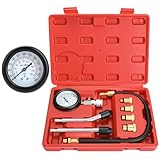
- Checking Compression On Petrol Engine Quickly And Accurately
- Easy Pressure Release Button On Side Of Tester
- 3" Gauge Features Dual Color Scale for easy reading. Pressure Range: 0-300psi, 0-20bar
- Kits Includes 2 Rubber Cones Ends for quick check. (no need to thread into head)
- Includes 17.7" extension hose with 4 sizes (10mm, 12mm, 14mm, 18mm) selectable adapters, suitable for petrol engines on motorcycles, cars, trucks, ATVs and more
Displacement is almost identical—only 1 cc separates the published figures—so the difference in character does not come from a larger engine. It comes from how each engine breathes and where its torque and power are produced.
Compression ratio
The 1ZZ-FE is listed at 10:1 compression, while the 2ZZ-GE is 11.5:1. The higher 2ZZ-GE ratio helps support its greater specific output, but compression ratio is only one part of the complete calibration. Fuel requirements, ignition mapping, cooling, and the exact vehicle application must be checked in the service information for the car you are considering rather than inferred from the engine code.
VVT-i versus VVTL-i
VVT-i varies cam timing to improve the compromise between response, efficiency, emissions, and power across the rev range. The 2ZZ-GE’s VVTL-i adds a variable-lift function: at the operating conditions defined by its control system, the engine changes to a higher-lift cam profile as well as adjusting timing. That extra lift is central to the 2ZZ-GE’s ability to continue making power at high rpm.
VVTL-i does not make every 2ZZ-GE application identical, nor does it mean the engine produces maximum power at all times. The Toyota Corolla figure places peak power at 7,800 rpm and peak torque at 6,800 rpm, so the driver must use substantially more engine speed to access the engine’s headline performance than with the 1ZZ-FE.
Block construction
Toyota describes the 1ZZ-FE as using an aluminum block with a cast-iron liner. The 2ZZ-GE uses an aluminum block with metal-matrix-composite reinforcement. These are meaningful engineering differences, but they are not, by themselves, a reliability ranking. Block material does not tell you how a particular used engine was maintained, overheated, modified, or repaired.
Rank #2

- FOR GASOLINE ENGINES ONLY: Designed for cars, trucks, ATVs, and small engines - please note this kit is not suitable for diesel or crude oil engines
- HIGH-VISIBILITY FLUORESCENT GAUGE: Features a triple-scale reading from 0-300 PSI, 0-20 Bar, and 0-21 kg/cm² for precise measurements and clear visibility in low-light conditions
- COMPREHENSIVE 13-PIECE KIT: Comes with five durable metal adapters (M10-M18), two spark plug testers, extension hose, and a protective case for a complete diagnostic solution
- QUICK-RELEASE SAFETY VALVE: Allows for safe and easy one-handed pressure release after testing to prevent accidental bursts
- PROFESSIONAL DIAGNOSTIC ACCURACY: Delivers reliable peak pressure readings to accurately assess engine health, identify worn piston rings, and detect valve issues
Power, torque, and real-world driving
Where the 1ZZ-FE makes its strength
In the cited Corolla specification, the 1ZZ-FE reaches 170 Nm at 4,200 rpm and 133 bhp at 6,000 rpm. That lower torque peak suits traffic, hills, and normal overtaking without requiring the driver to keep the engine near its upper rev limit. The long-stroke layout and VVT-i timing strategy support an easygoing road character, although gearing and vehicle weight can change how that feels in practice.
Where the 2ZZ-GE makes its strength
The Corolla 2ZZ-GE rating is 189 bhp at 7,800 rpm and 180 Nm at 6,800 rpm. The WiLL VS representative grade is rated at 140 kW (190 PS) at 7,600 rpm. In both examples, the larger power number arrives at a much higher engine speed than the 1ZZ-FE’s 6,000-rpm peak. A 2ZZ-GE car can therefore feel ordinary at low revs and become markedly stronger as revs rise and its high-lift operating range is reached.
Do these 3 things before closing this tab:
1Clear out junk files and repair common Windows errors2Scan for outdated or missing drivers - takes under a minute3Repair Windows errors before they cause bigger problemsThe 2ZZ-GE’s 10 Nm advantage in the Corolla table is modest at the peak and occurs at a higher rpm. Do not read the 2ZZ-GE’s greater horsepower as proof that it is stronger everywhere in the rev range. For a road car, the engine’s gearing, final drive, vehicle mass, and throttle calibration are as important as the catalogue peak.
Why published numbers vary
Toyota’s own figures show the variation: 2ZZ-GE output is listed as 189 bhp at 7,800 rpm for the cited Corolla and 140 kW (190 PS) at 7,600 rpm for a representative WiLL VS grade. The 1ZZ-FE appears as 133 bhp at 6,000 rpm in the Corolla and 100 kW (136 PS) in the WiLL VS. These differences can reflect market rating conventions, vehicle calibration, and grade specification. Compare engines only within the same vehicle, market, and model-year context.
Which engine is more reliable?
The available technical material does not establish a universal reliability winner. It contains no comparable fleet-failure rates, controlled longevity study, defensible expected lifespan, or mileage threshold that can be applied to every 1ZZ-FE and 2ZZ-GE. It would be inaccurate to turn the engines’ design differences into a claim that one is always dependable and the other is always troublesome.
Rank #3
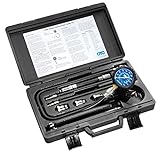
- OTC's Deluxe Compression Tester Kit offers a complete package for compression testing on gasoline engines and comes with commonly used standard and specialty adapters
- Kit includes the deep well connector used on recessed plug well style heads and the new Ford Triton engine adapter using 16 mm thread plugs
- Adapters work on both flat and tapered seat plugs; corrosion resistant nickel plated finish protects metal components
- Easy to read 2-1/2 inch gauge features a chrome bezel and rugged protective outer boot; Dual scale gauge reads 0-300 psi and 0-2100 kPa
- Extra long 25 inch flex hose gauge assembly with quick coupler allows easy viewing out of cluttered engine compartments
Reliability is best judged at the vehicle level. A well-maintained example with documented servicing can be a better purchase than a neglected car carrying the engine that has the better reputation in enthusiast discussions. Conversely, a clean-looking car with missing records, unexplained oil use, warning lights, leaks, or previous internal-engine work deserves caution regardless of engine code.
Recommended Free Tools
Questions to ask the seller
- Is there continuous service documentation, and does it identify the exact engine and vehicle specification?
- What is known about oil level checks and oil consumption over time?
- Have any warning lights, overheating events, unusual noises, or oil and coolant leaks occurred?
- Has the engine been rebuilt, replaced, modified, or opened for valve-train or bottom-end work?
- Do the service records match the market and model year of the car, rather than a different ZZ-family application?
What the engine code cannot tell you
An engine code does not guarantee identical sensors, wiring, emissions equipment, intake and exhaust parts, ECU calibration, transmission pairing, or output across all markets. It also cannot reveal neglected maintenance or damage from a previous owner. Verify the vehicle identification number, factory specification, and parts information before ordering components or planning a conversion.
How to inspect a used 1ZZ-FE or 2ZZ-GE
Start with the complete car, not a reputation
- Record the exact model, model year, market, trim, transmission, and engine code.
- Review invoices and scheduled-maintenance records. Look for consistent dates, mileage, fluids, and documented repairs rather than a single recent service.
- Check the oil level and ask for documented oil-consumption history. Look for external oil or coolant leaks and signs of previous overheating.
- Scan for warning lights and confirm that the instrument cluster behaves normally during a cold start and road test.
- Listen for abnormal mechanical noise at start-up, idle, and under load. A specialist should investigate any noise before purchase.
- Arrange an independent inspection when records are incomplete or the seller will not permit adequate testing.
Compression testing: useful, but limited
A compression check can add information about cylinder sealing and engine performance. Toyota service information for a 2001 Celica GT-S provides engine-specific reference material for a 2ZZ-GE application. That procedure and its interpretation belong to that vehicle context; they should not be copied as universal specifications for every 2ZZ-GE or any 1ZZ-FE.
Use a tester only as one part of an inspection, with the correct procedure and reference values for the exact vehicle. A single compression result does not establish overall engine health, prove reliability, or replace checks for oil pressure, cooling-system condition, valve-train operation, leaks, electronics, and transmission behavior. If readings are uneven or outside the applicable service information, have a qualified technician diagnose the cause before you make an offer.
Match the inspection to the application
A Corolla, Celica, and WiLL VS can use different ancillary systems, calibrations, and packaging even when the basic engine family is related. The same warning symptom can have different diagnostic priorities depending on the vehicle. Use the factory or market-specific service information for that car, and make sure a technician has access to the correct data.
Windows Errors? Fix Them Before They Spread
Repair common Windows errors and clear accumulated junk for a smoother, more stable PC - no reinstall needed.Free scan · no reinstallOutdated Drivers Are Slowing You Down
One free scan finds every outdated or missing driver and matches the right update for your exact hardware.Free scan · exact hardware matchRank #4

- Application: Suitable for testing various petrol engines, including motorcycles, automobiles, and most engine cylinder (excluding vehicles such as trucks, pickup trucks). However, due to its operating range of 0-300 PSI, it is not suitable for most diesel engines or engines with six or more cylinders engine, please confirm whether the engine has fewer than 6 cylinders. Note: Decrease the risk of petrol injection by releasing pressure before disconnecting
- Dual Color Scale Gauge: The engine compression tester kit equipped with a 3-inch dual scale gauge, this engine compression tester can read 0-300 psi and 0-20 Bar. the dual color scale makes pressure readings easy to identify and provides fast, accurate measurements for precise evaluations;please repeat the measurement at least twice to ensure data accuracy
- Reliable and Stable: Our compression tester is made of premium quality materials and specially treated to make sure longer service life and endurance, making it a reliable tool in your automotive toolbox
- Complete Set: The petrol pressure tester kit includes 1*double scale gauge, 2*rubber tapers (straight rubber taper end fittings and curved rubber taper end fittings) 4*brass fittings (M10, M12, M14, M18) and 14 inches long flexible extension hose to meet your practical needs
- Easy to Carry: This compression tester comes with a portable storage box to keep your compression test kit organized and unstuck. The hard-shell box ensures a secure storage and portability so you can stay on top of your compression testing needs
Which one should you choose?
Choose a 1ZZ-FE application when
- Your priority is ordinary road use with torque delivered at lower engine speeds.
- You prefer a less rev-dependent driving style and do not need the 2ZZ-GE’s high-rpm power objective.
- The available 1ZZ-FE car has stronger maintenance records, better inspection results, or more suitable local parts and service support than the 2ZZ-GE alternatives.
This is a use-case recommendation, not a claim that every 1ZZ-FE is more economical, longer-lived, or cheaper to repair. Confirm the individual car’s condition and specification.
Choose a 2ZZ-GE application when
- High-rpm performance is a primary reason for the purchase.
- You specifically want the VVTL-i variable-lift system and accept that peak published output occurs at higher engine speed.
- The car’s cooling, lubrication, valve-train, electronics, and service history withstand a professional inspection.
The 2ZZ-GE’s headline power is most relevant when the driver is willing and able to use the rev range where Toyota rated that power. If most driving is low-speed commuting, its high-rpm advantage may be less useful than the 1ZZ-FE’s lower-rpm torque delivery.
When condition should override preference
Walk away from a poor example of your preferred engine when a sound example of the other is available. A documented, unmodified car with no unresolved warning lights, leaks, overheating history, or unexplained engine work is the stronger starting point. Have the exact vehicle inspected before treating an engine-code preference as decisive.
Independent reader supportYour contribution helps us test, update, and keep practical guides available for everyone.Swaps, parts, and compatibility cautions
The engines share a family and displacement class, but that does not make them plug-and-play replacements. Differences in block construction, valve control, sensors, ECU calibration, wiring, intake and exhaust systems, mounts, cooling, emissions equipment, and transmission pairing can affect a conversion. Parts that fit one Toyota application may not fit another market or model year.
Before buying a replacement engine or planning a swap, document the donor and recipient vehicle identification numbers, market, model year, transmission, emissions standard, and complete engine code. Confirm every component against a parts catalogue or service source for those exact applications. Budget for control-system integration, legal inspection, emissions compliance, and troubleshooting; the bare long block is not the whole project.
Best Value

- FOR GASOLINE ENGINES ONLY: Designed for accurate compression testing on cars, trucks, ATVs, and small gas engines – please note this kit is not suitable for diesel or crude oil engines
- HIGH-PRECISION TRIPLE-SCALE GAUGE: Features an easy-read dial with three measurement scales (0-300 PSI, 0-20 BAR, 0-21 kg/cm²) for reliable peak pressure readings to assess engine health, identify worn piston rings, and detect valve issues
- PROFESSIONAL 8-PIECE COMPLETE KIT: Includes four durable metal adapters (M10, M12, M14, M18), straight and curved rubber cone adapters, and an extension hose for a comprehensive diagnostic solution
- QUICK-RELEASE SAFETY VALVE: Integrated one-handed pressure release valve allows for safe and controlled depressurization after testing, preventing sudden bursts and enhancing user safety
- COMPACT & PORTABLE GRAY CASE: The shock-resistant and organized storage case keeps all components protected and ready for easy transport to any job site or home garage
For ordinary repairs, order by the vehicle’s exact application rather than by “1ZZ” or “2ZZ” alone. Ask the supplier to verify fitment for the engine code, model year, market, and transmission. This avoids assuming that a shared family name means interchangeable sensors, gaskets, electronics, or accessories.
A practical decision framework
| Your priority | Better starting point | What to verify before purchase |
|---|---|---|
| Relaxed road response and lower-rpm torque | 1ZZ-FE application | Vehicle condition, maintenance records, oil history, and exact output specification |
| High-rpm performance and variable valve lift | 2ZZ-GE application | VVTL-i system condition, service history, cooling and lubrication condition, and transmission pairing |
| Lowest purchase risk | Whichever inspected car is healthier | Independent inspection, warning-light scan, leak check, and vehicle-specific service data |
| Engine replacement or conversion | Exact application match | Market, model year, ECU, wiring, emissions requirements, mounts, accessories, and legal compliance |
Use the table as a screening tool, not a substitute for inspection. Toyota’s stated design targets support the driving-use distinctions, while the final buying decision must account for the individual vehicle.
Bottom line: 2ZZ-GE or 1ZZ-FE?
The 1ZZ-FE is the sensible choice when lower-rpm torque and normal-road usability fit your brief. The 2ZZ-GE is the enthusiast choice when you value a higher-revving engine, VVTL-i, and substantially higher published peak power in the cited applications. Neither choice comes with a proven universal reliability advantage. Select the exact car with the better records, inspection results, specification match, and local service support.
Free tools Windows power users keep installed
One-click scans. No signup required.
Frequently Asked Questions
Are the 1ZZ-FE and 2ZZ-GE the same displacement?
They are nearly the same: Toyota’s cited specifications list 1,794 cc for the 1ZZ-FE and 1,795 cc for the 2ZZ-GE. Their bore, stroke, compression, block reinforcement, and valve-control systems differ substantially.
Does a 2ZZ-GE always make 189 bhp?
No. The 189 bhp at 7,800 rpm figure is from a Toyota UK Corolla specification. Toyota’s WiLL VS representative grade is listed at 140 kW (190 PS) at 7,600 rpm, illustrating that output depends on vehicle, market, trim, and calibration.
Can a compression test prove that either engine is reliable?
No. Compression testing can provide information about cylinder sealing when performed and interpreted for the exact vehicle, but it is only one diagnostic check and cannot establish overall reliability.
Quick Recap
Product prices and availability are accurate as of the date/time indicated and are subject to change. Any price and availability information displayed on Amazon at the time of purchase will apply.




