The best car GPS antenna for most compatible aftermarket equipment is an active magnetic-mount model with an SMA male connector—but only when the receiver accepts SMA and supplies the required bias voltage. A factory-antenna adapter may be a better solution, and some vehicles need no replacement at all.
If your car’s GPS takes too long to lock, loses position, or sits behind a heat-reflective windshield or metal obstruction, the right external antenna can help—but only if it matches the receiver. The best all-around category for many compatible aftermarket receivers is an active GPS antenna with a magnetic mount and SMA male connector. It is not a universal replacement: you must verify the connector, antenna type, required bias voltage, cable length, and receiver compatibility first.
In some vehicles, the better solution is not a new antenna at all. A vehicle-specific adapter may let an aftermarket head unit reuse the factory GPS antenna. And if the supplied antenna already has a clear view of the sky, relocating or reconnecting it may solve the problem without another purchase.
This is a research-based buying guide, not a hands-on test. The categories below are selected for compatibility and use case; they are not ranked from independently measured strongest to weakest signal.
What’s actually slowing this PC down?
Pick the symptom - the matching free tool is one click away.
#1 Best Overall

- GPS Antenna SMA Plug Connector GPS Active Aerial with 3M Antenna Extension Cable
- Working Frequency: GPS 1575.42MHz ±3 MHz; LNA Gain: 28dB; Cable Length: 3m; Connector: SMA Male Connector
- Power Supply DC Voltage: 3V to 5V; Power Supply DC Current: 10mA Max; Feature: Magnetic Mounting, Adhesive Mount
- Application: GPS Antenna Widely Used for Vehicle Telematics; 4G LTE GPS Tracker Locator; Vehicle Real Time Tracking Mobile DVR Video Recorder; Bus Truck RV Van Security Alarm System; Vehicle Amateur Radio Mobile Radio
- GPS Antenna SMA Plug Connector GPS Active Aerial Compatiable with Automotive Navigation, Personal Positioning, Fleet Management, Marine Navigation
Quick comparison: the five best car GPS antenna types
| Best for | Antenna type | What to know |
|---|---|---|
| Most compatible aftermarket equipment | active magnetic-mount GPS antenna with SMA male connector | Good general-purpose option when the receiver accepts SMA and supplies the required antenna power |
| A known Garmin installation | Garmin remote or magnetic GPS antenna | Choose only when your exact Garmin model is listed as compatible |
| Keeping the factory antenna | Vehicle-specific factory GPS antenna adapter | Can provide the cleanest installation, but fitment depends on both vehicle and receiver |
| Special glass or obstructed dashboards | Vehicle-installation external GPS antenna | Useful when an interior location cannot see the sky clearly; exterior mounting adds weather and routing concerns |
| Fleet, overland, or technical equipment | Active multi-band GNSS magnetic-mount antenna | Offers broader technical specifications and rugged options, but can be unnecessary for a basic car stereo |
1. Best general-purpose replacement: active magnetic-mount GPS antenna with SMA male connector
This is the most useful starting category for a compatible aftermarket navigation receiver, GPS tracker, development module, or other device with an SMA antenna port. A typical unit combines a GPS patch element, low-noise amplifier, coaxial cable, and magnetic base. Some are designed for dashboard use, while others are weather-resistant enough for exterior mounting; those characteristics vary by model.
Specialist antenna documentation shows that active L1 GPS patch antennas are available with magnetic mounting and SMA male termination. For example, an active magnetic-mount GPS antenna specification describes this exact product category.
Why it is a good default: the magnetic base makes temporary positioning easy, a remote antenna can move away from a blocked head-unit location, and SMA is common on some aftermarket and technical equipment.
Critical limitations: SMA is not the same as RP-SMA, SMB, MCX, MMCX, FAKRA, or a proprietary automotive connector. The antenna also needs the correct electrical supply for its internal amplifier. Do not buy solely because a listing says “GPS antenna” or because the plug appears similar.
Free tools Windows power users keep installed
One-click scans. No signup required.
When shopping, compare the receiver manual with the product specifications for connector gender, frequency, active or passive design, required voltage, cable length, and indoor or outdoor rating. Treat an advertised gain number as a specification—not proof that the antenna will deliver a stronger signal in your vehicle.
2. Best for a known Garmin-compatible installation: Garmin remote or magnetic antenna
Garmin offers several external antenna styles, including low-profile remote antennas, magnetic-mount accessories, and GPS/GLONASS products. Its antenna catalog is a better starting point than a generic marketplace search when you know the exact Garmin model: Garmin’s antenna catalog.
Garmin also sells a magnetic external passive GPS/Iridium antenna with an adapter cable for specified Montana devices. The product page lists the compatible device family, so it should be treated as a model-specific accessory rather than a universal car-stereo antenna: Garmin external passive GPS/Iridium antenna.
This is the right direction when you want a manufacturer-supported accessory and can confirm compatibility by model number. It is not automatically the right replacement for the antenna supplied with an aftermarket stereo. Garmin guidance says an external antenna is mainly needed when the device is mounted where its internal antenna cannot acquire GPS signal, such as behind a hard or thick top: Garmin’s external-antenna guidance.
Rank #2
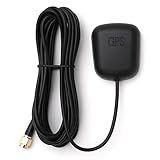
- Waterproof Active GPS antenna with SMA male connector
- Magnetic base allows you to conveniently attach it to to the roof of your car.
- 28 dB of gain with its built in LNA
- Cable length: 3 meters
- DC Voltage: 3V to 5V
3. Best for reusing the factory antenna: vehicle-specific GPS antenna adapter
Before buying a universal antenna, check whether your vehicle’s original GPS antenna can be connected to the new head unit. A vehicle-specific adapter can preserve the factory antenna location, reduce dashboard clutter, and avoid routing another cable.
Compatibility is the difficult part. For example, Crutchfield documents the iDatalink ACC-NAV4 for connecting a factory GPS antenna to selected Alpine receivers. A separate iDatalink ACC-SAT-TO2 is documented for selected Toyota applications and can allow compatible aftermarket navigation and satellite-radio equipment to use the factory GPS and satellite-radio antenna.
These examples do not establish universal fitment. Check the exact vehicle year, trim, factory radio or antenna system, replacement receiver, and adapter compatibility list. If the fitment tool does not list your combination, do not assume that a plug adapter or a chain of adapters will work electrically or mechanically.
4. Best for difficult glass or exterior mounting: a vehicle-installation external GPS antenna
Some windshields contain heat-reflective, heat-absorbing, or metallic treatments that can interfere with high-frequency signals. Sony identifies heated or heat-reflective glass as a reason an optional external antenna may be required for certain navigation devices: Sony’s navigation antenna guidance. Alpine similarly advises trying an exterior location when special glass interrupts reception: Alpine’s receiver installation manual.
Do these 3 things before closing this tab:
1Clear out junk files and repair common Windows errors2Fix the driver behind crashes, sound loss and screen glitches3Repair Windows errors before they cause bigger problemsAn exterior location can expose the antenna to more of the sky, but it is not automatically better in every installation. You must protect the paint from grit under a magnetic base, confirm the housing and cable entry are suitable for outdoor exposure, and consider theft. A magnetic mount is convenient on a steel roof, but do not assume every magnetic antenna is waterproof or safe for permanent highway-speed use.
For dashboard mounting, choose a level, unobstructed position away from metal. For roof or other exterior mounting, route the cable through an existing protected entry where possible. Avoid pinching it in a door, hatch, or sunroof seal, and do not leave a loose cable where it can contact hot, sharp, or moving parts.
5. Best for technical, fleet, or overland users: active multi-band GNSS magnetic-mount antenna
Professional GNSS antennas are appropriate when the equipment supports multiple satellite constellations or bands, or when you need documented electrical characteristics, rugged construction, a longer cable, or a defined environmental rating.
Taoglas documents an active, multi-band GNSS magnetic-mount antenna with SMA male termination: Taoglas Comet all-band GNSS antenna. Mobile Mark also documents a magnetic active GPS antenna with GPS operation at 1575.42 MHz, 3–5 V bias, and an SMA male configuration: Mobile Mark MAG-1575 specifications.
Rank #3

- Frequency: GPS 1575.42MHz; LNA Gain: 28dB; Power Supply DC Voltage: 3V to 5V; Power Supply DC Current: 10mA Max; Feature: Magnetic Mounting, Adhesive Mount;
- Cable Length: 3m; Connector: SMA Male Connector;
- Package List: 1 x Antenna, 1 x Double-sided Adhesive Piece (As the Picture Shown)
- Compatible with: Vehicle Telematics; 4G LTE GPS Tracker Locator; Vehicle Real Time Tracking Mobile DVR Video Recorder; Bus Truck RV Van Security Alarm System; Vehicle Amateur Radio Mobile Radio;
- Compatible with: Internet Of Things IOT; Machine-to-Machine M2M; 4G LTE Industrial Gateway Modular Modem Mobile Router; 4G LTE Cellular RTU DTU Terminal; Trail Camera;
Multi-band capability does not automatically improve every car stereo. The receiver must support the relevant bands and constellations, and the installation still needs a clear view of the sky. For a basic aftermarket head unit that expects a simple supplied GPS antenna, a professional multi-band model may add cost and complexity without providing a practical benefit.
How to choose the right car GPS antenna
1. Identify the receiver before looking at products
Find the exact head-unit, navigation module, tracker, or Garmin model number. Then read its installation manual—not just the marketplace listing. Some manufacturers require the supplied antenna. Kenwood, for example, says to use the supplied GPS antenna and warns that a different antenna may reduce positioning accuracy: Kenwood GPS antenna installation guidance.
Photograph the receiver port if necessary, but do not identify a connector by appearance alone. Confirm:
- Connector family and gender
- Whether the input expects an active or passive antenna
- Required voltage and current for an active antenna
- Supported GPS, GLONASS, Galileo, BeiDou, or multi-band frequencies
- Whether the manufacturer permits a replacement antenna
2. Understand active versus passive antennas
A passive antenna has no amplifier and does not require antenna power. An active antenna includes an amplifier and needs bias voltage from the receiver or from an appropriate external source. The voltage and current must match the receiver’s output and the antenna’s specification.
For comparison, the Mobile Mark specification identifies active amplification and a 3–5 V bias requirement. That is useful evidence for that product, not a universal requirement for every active GPS antenna. Never connect an active antenna to a port that cannot supply the specified power, and do not add an improvised power injector without confirming the signal path and electrical requirements.
3. Prioritize placement over headline gain
GPS antennas generally work best when mounted horizontally with a clear, unobstructed view of the sky. Kenwood specifies horizontal placement and warns that some vehicles may not receive GPS signals with an inside installation. Garmin’s installation instructions likewise emphasize a clear sky view and separation from electromagnetic-interference sources: Garmin GNSS antenna installation instructions.
A remote antenna is not a magic signal booster. It relocates the receiving element to a better position. Reception can still be poor because of a damaged cable, incorrect power, an incompatible connector, a defective receiver, severe obstruction, or radio-frequency interference.
4. Keep it away from transmitters and the head unit
Follow the exact receiver instructions, but use sensible separation as a general rule. Kenwood advises keeping the GPS antenna at least 30 cm from cellular phones and other transmitting antennas. Alpine warns that placing the GPS antenna too close to the unit or bundling the cable at the rear of the unit can degrade reception.
Windows Errors? Fix Them Before They Spread
Repair common Windows errors and clear accumulated junk for a smoother, more stable PC - no reinstall needed.Free scan · no reinstallCrashes, No Sound, or Screen Glitches?
Random freezes, missing sound and display glitches usually trace back to one bad driver. Find and replace yours safely.Free scan · under a minuteRank #4

- GPS Antenna SMA Plug Connector GPS Active Aerial with 3M Antenna Extension Cable
- Working Frequency: GPS 1575.42MHz ±3 MHz; LNA Gain: 28dB; Cable Length: 3m; Connector: SMA Male Connector
- Power Supply DC Voltage: 3V to 5V; Power Supply DC Current: 10mA Max; Feature: Magnetic Mounting, Adhesive Mount
- Cable is double-shielded, low-loss and very flexible. The cable-type is equivalent or better than LMR-100: Coax with black jacket has the same or better signal-loss-per-meter and flexibility as LMR100, and less attenuation (signal loss) than RG174. The higher quality of the cable of this antenna translates into lower loss/better performance. These antenna cables are rated for outdoor use and are also suitable for indoor use. Recommended tightest continuous bend radius is 1.1 inch (28mm)
- Application: GPS Antenna Widely Used for Vehicle Telematics; 4G LTE GPS Tracker Locator; Vehicle Real Time Tracking Mobile DVR Video Recorder; Bus Truck RV Van Security Alarm System; Vehicle Amateur Radio Mobile Radio,GPS Antenna SMA Plug Connector GPS Active Aerial Compatiable with Automotive Navigation, Personal Positioning, Fleet Management, Marine Navigation
Do not bury the antenna directly behind a metal bracket or bundle its cable tightly against a cluster of power or RF cables. Keep it away from transmitting antennas where the installation manual recommends, while also avoiding airbag zones and locations that obstruct the driver’s view.
5. Measure the cable route before ordering
Measure from the receiver to the intended mounting position along the actual trim route. Allow modest service slack, but avoid unnecessary excess. The cable must not interfere with pedals, airbags, moving seat rails, door or hatch hinges, sharp trim edges, or hot engine components. A cable that is too short can force a poor antenna location; an unnecessarily long or badly routed cable creates its own failure points.
Independent reader supportYour contribution helps us test, update, and keep practical guides available for everyone.Installation checklist
- Verify the receiver model and connector. Confirm the connector family, gender, and electrical requirements.
- Check whether the original antenna is required. Some receivers specify use of the supplied antenna.
- Test before buying. If possible, test the existing system outdoors in an open area. This helps distinguish a placement problem from a receiver, cable, or configuration fault.
- Choose a horizontal location. Give the antenna as much unobstructed sky view as the vehicle allows.
- Avoid metal and transmitters. Keep the antenna away from large metal obstructions and obvious RF-noise sources.
- Protect occupants. Do not place it in an airbag deployment zone or where it blocks the driver’s view.
- Prepare an exterior mount properly. Clean trapped dirt from beneath a magnetic base, protect the finish, and confirm the antenna’s environmental rating.
- Route the cable safely. Avoid sharp bends, pinch points, hinges, pedals, airbags, hot surfaces, and loose loops.
- Allow time for acquisition. After installation, let the receiver search for satellites in an open area and compare its status screen with the previous setup.
- Recheck rather than guess. If it does not work, verify the connector, active-antenna bias voltage, cable condition, antenna orientation, and receiver settings before declaring the antenna defective.
Common buying mistakes
- Buying an SMA antenna for a non-SMA receiver: similar-looking automotive connectors are not interchangeable.
- Confusing SMA and RP-SMA: the gender and center-pin arrangement differ.
- Assuming every receiver powers an active antenna: an active model can fail if its bias requirements are not met.
- Choosing by gain alone: gain does not guarantee better navigation in a particular car.
- Assuming magnetic means weatherproof: check the actual environmental rating before exterior use.
- Ignoring the factory antenna: a vehicle-specific adapter may be cleaner and more reliable than adding a new antenna.
- Putting the antenna under metal or special glass: relocation only helps when the new position is genuinely better.
- Using an adapter chain without checking specifications: each extra connection adds mechanical and electrical uncertainty.
Which one should you buy?
Choose an active magnetic-mount GPS antenna with SMA male connector when your receiver explicitly accepts SMA, requires an active antenna, and supplies the specified bias voltage. This is the most broadly useful product category—not a universal recommendation.
Choose a Garmin-specific antenna when your exact Garmin model is listed as compatible. Choose a factory GPS antenna adapter when your vehicle and aftermarket receiver are both listed in the adapter’s fitment information. Choose an external vehicle-installation antenna when special glass or an obstructed dashboard prevents a good interior position. Choose a multi-band professional GNSS antenna only when the receiver and use case justify its added capabilities.
The Tool Desk
Outbyte PC Repair FREEClear out junk files and repair common Windows errorsFree Scan →Outbyte Driver Updater FREEScan for outdated or missing drivers - takes under a minuteDriver Scan →The practical order is simple: compatibility first, placement second, antenna features third. If the existing antenna works in a clear dashboard location, buying another one may accomplish nothing.
Frequently Asked Questions
Will an external GPS antenna improve my car’s signal?
An external antenna can help when the receiver is hidden behind metal, installed under obstructive glass, or otherwise cannot acquire satellites. It relocates the receiving element to a clearer position; it is not automatically a signal booster. If the supplied antenna already has a clear view of the sky, replacement may not help.
Are all SMA GPS antennas compatible with aftermarket car stereos?
No. SMA, RP-SMA, SMB, MCX, MMCX, FAKRA, and proprietary automotive connectors are different families. Confirm the exact receiver port, connector gender, and the manufacturer’s approved antenna type before ordering.
What is the difference between an active and passive GPS antenna?
An active antenna contains an amplifier and needs the correct bias voltage from the receiver or an approved power source. A passive antenna does not use an amplifier. Use the type and voltage specified by the receiver manufacturer.
Can I reuse my car’s factory GPS antenna?
Possibly. Vehicle-specific adapters can connect the factory GPS antenna to selected aftermarket receivers. Fitment depends on the vehicle and replacement receiver, so verify both in the adapter manufacturer’s compatibility information.
The Bottom Line
The best car GPS antenna is not necessarily the one with the highest advertised gain. Match the antenna to the receiver’s connector and electrical requirements, then place it horizontally where it has the clearest practical view of the sky. Check for a vehicle-specific factory-antenna adapter before installing a universal replacement.
Quick Recap
Product prices and availability are accurate as of the date/time indicated and are subject to change. Any price and availability information displayed on Amazon at the time of purchase will apply.




