The Tool Desk
Outbyte PC Repair FREEClear out junk files and repair common Windows errorsFree Scan →Outbyte Driver Updater FREEScan for outdated or missing drivers - takes under a minuteDriver Scan →Short answer: Vehicle-mounted tire-particle collectors try to intercept wear debris beside the wheel, while conventional “tire filters” usually mean catch-basin inserts, roadway filters, or bioretention that treat contaminated stormwater after particles leave the tire. Neither category has a broadly validated, size-specific on-road capture rate. Xu and coauthors reported a study-specific maximum of 48.5% for an airflow-channel setup; an electrostatic prototype has reported the size and composition of what it collected, not the percentage of all emissions it captured.
What the comparison actually covers
The phrase “tire filter” can describe two very different interventions. A near-wheel collector is fitted to a vehicle and attempts to remove particles before they spread into roadside air, settle on pavement, or wash into drains. A conventional stormwater filter is installed in the drainage pathway: a catch-basin insert, roadway treatment unit, filter media, or bioretention area intercepts pollution after runoff has mobilized it.
As an Amazon Associate I earn from qualifying purchases.
Those systems should not be judged by one headline percentage. They operate at different points in the particle pathway, face different maintenance problems, and have different kinds of evidence. A prototype that collects material in a controlled test is not equivalent to a deployed drainage product with validated tire-specific removal data. A sampling device that counts particles is not a pollution-control product.
Why tire-wear particles are difficult to capture
Tire wear is generated in a turbulent, moving contact zone. Particles can be thrown from the tread, lifted by the wheel wake, deposited on the road, or transported later by rain. The UK Department for Transport’s technical review notes a fundamental engineering difference from brake-dust control: a tire cannot simply be enclosed. Any device must work around steering movement, suspension travel, wheel rotation, heat, water, mud, stones, and the need to service the tire safely.
#1 Best Overall

- The particle filter keeps dust and particles such as pollen, diesel soot or tire dust away from the interior of the vehicle
- Optimum ventilation inside the vehicle through low flow resistance
- Consistent filtration performance throughout the entire service interval
- Exact fit and seal
- Greatest filtration efficiency through a combination of mechanical and electrostatic attraction
Particle size also complicates the design. Large fragments may settle close to the vehicle, while fine particles can follow airflow or remain suspended. A collector that performs well for one size fraction may perform poorly for another. Therefore, “collected particle size” and “capture efficiency by size” are separate measurements.
How near-wheel capture systems work
Electrostatic plates
The Tyre Collective system described in the UK review places electrostatically charged collector plates behind a vehicle wheel. The plates attract particles, which can then be removed by suction or brushing. The review says a configuration could be installed behind all four wheels, use passive airflow around the wheel, and supply electrical power to charge the plates.
In the reported collection, particles ranged from 0.3 to 130 micrometres. Sixty-eight percent of the particles by number were below PM10, and 88% of the collected mass was identified as tire and road wear particles. These are observations about the material recovered by the system. They do not show that 68% of all emitted particles were captured, nor that 88% of total tire mass was removed. The review also says the company was still developing a method to quantify capture efficiency for tire-emitted PM2.5.
Rank #2

- Cabin air filters with activated carbon from MANN-FILTER stop nearly 100% of even the tiniest particles from entering the vehicle ensuring soot, tire abrasion dust and even particulate matter does not enter the car through the ventilation system
- The premium activated carbon layer captures harmful gases and eliminates unpleasant odors
- Easy to install - so you're on your way to cleaner, fresher air inside.
- Replace every 12 months for optimum performance - or more frequently in harsh or dusty environments.
- Confirm fitment using amazonconfirmedfit to ensure this is the correct part for your application
The stated commercial target at the time of the review was commercial vehicle fleets, with other vehicle types and integration approaches still under consideration. No current US retail route, purchase price, maintenance interval, or validated fleet-wide performance is established by these sources.
Charged surfaces and filter concepts
Patent concepts described by the review from the Postech Academy-Industry Foundation and IBM use variations on charged collection surfaces. The IBM concept links tire motion with triboelectric charge generation, directs particles toward a charged conductive surface and filters, and uses a photodetector to monitor loading.
These are early-stage concepts, not evidence of a commercially available product. The review says implementation feasibility, maintenance requirements, and costs could not be determined. A patent description demonstrates a proposed mechanism; it does not establish durability, safety, capture efficiency, or suitability for a production vehicle.
Rank #3

- ✅ ELIMINATES DIRT, BROWNING, AND BRAKE DUST - Which part of your car takes the biggest beating? Your wheels & Tires! Between the heat, elements, and constant brake contaminants your wheels are almost immediately dirty. Adam’s Wheel & Tire Cleaner is a specifically formulated chemical designed to target heavy brake dust and restore your tires back to factory color.
- ✅ SAFE ON MANY FINISHES - Safe on clear-coated, powder-coated, chrome, alloy, and painted wheels. Most wheel cleaners can be harmful to your wheel finish and dissolve more than what you wanted to clean off! Adam’s Polishes Wheel & Tire Cleaner gets to work fast and dissolves stubborn metallic contamination.
- ✅ GET RID OF BROWN TIRES - If you’re happy with brown, old and decrepit tires, look away! If you’re wanting to thoroughly clean your vehicle’s shoes and make them look like new again, then look no further! Adam's Wheel & Tire Cleaner contains a blend of alkaline-concentrated solvents and surfactants to create a high sudsing formula and removes silicones, greases, wax build-up, polymers, and any previously applied dressings to leave your tires and wheels looking new.
- ✅ EXTEND YOUR TIRE DRESSINGS LIFE - Adam’s Wheel & Tire Cleaner is a detailing essential for any user, from rookie to professional. When investing in premium protective options, high foaming soaps, and ultra-premium microfiber towels, your vehicle's shoes need to be kept clean to not take away from the rest of the vehicle. If you choose not to clean your tires, your tire dressings have no chance of sticking around. Clean your tires before with Wheel & Tire Cleaner to maximize your tire shine.
- ✅ 110% SATISFACTION GUARANTEE - At Adam’s, we strive to bring the BEST waxes, sealants, ceramic coatings, microfiber towels, wash mitts, garage tools, accessories, detailing kits, sponges, applicators and other high-quality car cleaning products to our customers. If you don’t agree & are not satisfied, let us know and we’ll do everything we can to make it right!
Airflow channels and tunnels
Xu and coauthors proposed a principal channel and an auxiliary channel in a peer-reviewed Powder Technology article. The abstract reports a highest capture ratio of 48.5% within the tested setup, with the principal channel collecting about two to three times as many particles as the auxiliary channel.
What’s actually slowing this PC down?
Pick the symptom - the matching free tool is one click away.
That 48.5% figure must remain attached to its conditions. The UK government review discusses the work alongside scaled tunnel tests and cautions that modelling and scaled experiments do not establish performance on a full-size vehicle in real traffic. The result is useful evidence that airflow shaping can concentrate particles; it is not a guaranteed efficiency for a commercial collector.
How conventional stormwater filters differ
Catch-basin inserts
Inserts sit inside or below a road drain and intercept sediment and other solids as runoff enters the drainage network. They can be practical where drains are accessible and maintenance crews already remove accumulated material. Their limitation is timing: particles that remain airborne, settle outside the capture area, or are carried past an overflowing or bypassed inlet are not treated by the insert.
Rank #4

- DAILY WHEEL CARE: Helps loosen brake dust, road grime and buildup from rims and tire sidewalls during regular car washes
- SPRAY AND WIPE USE: Apply to cool exterior surfaces, wait briefly, then wipe with a cloth or soft brush and rinse as needed
- FOR MULTIPLE VEHICLES: Designed for cars, trucks, SUVs, RVs and motorcycles as a quick garage or trunk touch-up spray
- FOR COMMON FINISHES: For most sealed aluminum, chrome, alloy and painted rim areas; test a small spot before full use
- COMPACT 3.38 FL OZ SIZE: Small bottle is easy to store for routine wheel care, weekend washes and on-the-go detailing
Roadway filters and media systems
Roadway treatment units use screens, cartridges, engineered media, or settling zones to remove pollutants from runoff. Their performance depends on flow rate, bypass conditions, particle size, media loading, and how often the unit is serviced. The US Environmental Protection Agency’s stakeholder roundtable summary identifies limited tire-particle efficacy data as an unresolved issue; it does not provide a validated capture rate for a specific tire-wear filter product.
Bioretention
Bioretention areas route runoff through vegetation, soil, and drainage layers. They can address several roadway pollutants at once, but they require suitable land, hydraulic design, and long-term upkeep. The EPA summary lists land availability and feasibility among the challenges and says tire-particle effectiveness needs further examination. A bioretention cell should therefore be described as a potential downstream control, not as a proven tire-particle solution with a universal removal percentage.
Free tools Windows power users keep installed
One-click scans. No signup required.
Evidence strength: what each result proves
| Approach | Where it captures | Evidence described | What can safely be claimed | What remains unproven |
|---|---|---|---|---|
| Electrostatic wheel collector | Behind the wheel, on the vehicle | Prototype collection described in the UK Department for Transport/Ricardo review (2025) | It recovered particles from 0.3–130 μm; 68% by number were below PM10; 88% of collected weight was tire and road wear material | Overall and PM2.5 capture efficiency, durability, production-vehicle integration, maintenance cost, and broad availability |
| Charged-surface patent concepts | Near wheel, with conductive surfaces and filters | Patent-stage descriptions | They propose electrostatic and monitoring mechanisms | Implementation feasibility, service intervals, cost, safety, and field performance |
| Airflow channel/tunnel | Near wheel or in a controlled channel | Xu et al., Powder Technology (2024); modelling and experimental setup | Maximum reported capture ratio of 48.5% in that setup; principal channel collected roughly two to three times the auxiliary channel | Full-size, real-road efficiency and performance across vehicles, speeds, weather, and particle sizes |
| Catch-basin or roadway filter | Downstream in stormwater | EPA stakeholder summary of potential methods | These are plausible runoff controls that may intercept tire particles | Tire-specific validated removal rate, bypass performance, land requirements, and comparative cost |
| Bioretention | Downstream in planted soil/media | EPA stakeholder summary | Potential to treat roadway runoff containing tire particles | Consistent tire-particle effectiveness and feasibility at different sites |
| SAMPLE measurement system | Near tires for sampling | Michelin description of a research system | It captures, sorts, counts, and characterizes particles for measurement | Use as a marketed consumer filter or proof of production-vehicle mitigation |
How to interpret the key numbers
- 0.3–130 μm: the range of particles collected by the electrostatic prototype described in the 2025 UK review. It is not a claim that every size in that range is captured equally.
- 68% below PM10 by number: a count-based description of the recovered sample. “By number” is different from mass percentage.
- 88% tire and road wear particles by collected weight: a composition result for the collected material. It is not the fraction of all roadway emissions removed.
- 48.5% maximum capture ratio: the highest value reported for Xu and coauthors’ tested channel setup. It should not be converted into an expected on-road vehicle result.
For a meaningful product claim, ask for efficiency curves by particle-size fraction, test conditions, flow or vehicle speed, repeatability, and the denominator used. “Captured particles” could mean a count, a mass, or a fraction of material entering a test apparatus; those measures are not interchangeable.
Best Value
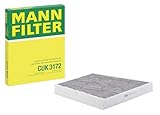
- AUTOMOTIVE CARBON CABIN AIR FILTER: Filters tiny particulates, odors, and harmful gases, so you can enjoy clean, healthier air inside the car; Provides a feel-good climate in the passenger compartment and helps support your air conditioning system
- FILTERS GASES, ODORS, & DUST: MANN-FILTER carbon cabin air filters trap harmful gases, such as ozone, nitrogen oxides & sulphur dioxide and eliminates almost 90% of odors; Offers effective filtering of pollutants, diesel soot and tire abrasion
- SUPPORTS AIR CONDITIONING SYSTEMS: Replacement filter limits the build-up of dirt inside the air conditioning system and prolongs its lifespan; Exact OEM fit and tightness ensures constant filtration performance during the full service interval
- EASY INSTALL & REPLACEMENT: Simple installation instructions provides guidance for a perfect fit; To optimize the clean air inside your car or truck and improve the driving experience, check your cabin air filter annually
- FITS A VARIETY OF MODELS: Compatible with: Mercedes Benz: 2007-2009 E350, 2003-2009 E320, 2007-2011 CLS550 and more; Verify exact fitment using Amazon Confirmed Fit
Operational requirements and trade-offs
Vehicle-mounted systems
- Installation must preserve wheel clearance, steering and suspension movement, tire changes, braking access, and crash safety.
- Collector plates or filters require a defined cleaning or replacement procedure. The electrostatic prototype uses suction or brushing to remove deposits.
- Electrical systems need a power source and must tolerate water, salt, vibration, and road debris.
- Captured material needs containment and disposal so it does not simply become airborne during servicing.
- The UK Department for Transport/Ricardo review does not provide sufficiently current, comparable operating costs for the tire-capture concepts.
Stormwater systems
- Maintenance crews must remove accumulated sediment or replace loaded media before clogging causes bypass.
- Design must account for intense storms, high sediment loads, and flows that exceed the treatment capacity.
- Site selection determines whether there is enough space for a filter vault, insert access, or bioretention area.
- Collected solids and spent media still require controlled handling and disposal.
Which approach fits which use case?
| Goal | Most relevant approach | Reasoning | Evidence caution |
|---|---|---|---|
| Study what leaves a tire during driving | Dedicated measurement equipment such as SAMPLE | Designed to capture, sort, count, and characterize particles | Sampling output is not mitigation performance |
| Explore source control on fleet vehicles | Vehicle-mounted electrostatic or airflow development systems | Acts close to the emission point and may reduce dispersion before runoff | Confirm vehicle integration, size-specific efficiency, service, and disposal data |
| Treat pollution from an existing road drainage area | Catch-basin inserts, roadway filters, or bioretention | Can be added to established runoff infrastructure | Tire-specific efficacy and bypass performance remain incompletely established |
| Make a procurement decision today | Only a system with independently documented deployment data | Requires evidence beyond a prototype, patent, or laboratory sampler | No broadly available, validated commercial tire-capture product is established by the cited sources |
Where the field stood through 2025
The Department for Transport publication history helps separate measurement progress from pollution-control availability. Phase 1, released in May 2023, developed a prototype for measuring tire particles in real driving conditions. Phase 2, added in November 2025, tested prototypes in laboratories and on the road. Those phases show that real-world measurement is advancing; they do not establish that a production mitigation device is commercially available or effective at a particular percentage.
The strongest potential audience identified in the technical review was commercial fleets, where vehicles can be instrumented, serviced, and monitored under a common maintenance program. That target does not prove that a fleet-ready product is currently offered in every market or for every vehicle type.
Health and environmental claims need separate evidence
Capturing particles is an engineering outcome. Demonstrating a reduction in human exposure, aquatic toxicity, or ecological harm is a separate chain of evidence requiring exposure and outcome studies. The EPA’s 2023 stakeholder report states, “Many questions remain regarding the ecological risks of exposure to tire wear particles.” Until those questions and consistent measurement methods are resolved, avoid claims that any collector has proven health benefits or a quantified reduction in ecological risk.
A buyer’s and fleet manager’s verification checklist
- Identify the capture location: wheel-mounted, roadway surface, catch basin, treatment vault, or bioretention.
- Request independent test details, including vehicle type, speed, road surface, weather, duration, particle-size bins, and whether results are by number or mass.
- Separate a collection sample’s composition from total-emission capture efficiency.
- Ask whether the result comes from a laboratory rig, simulation, scaled model, controlled vehicle test, or repeated real-road deployment.
- Verify how plates, filters, or media are cleaned; how often service is required; and how contaminated material is packaged and disposed of.
- Check whether steering, suspension, tire replacement, braking access, electrical load, and water or salt exposure were addressed.
- For stormwater projects, obtain hydraulic bypass data, site-area requirements, maintenance records, and tire-specific removal testing.
- Do not accept a patent, demonstration video, or measurement sampler as proof of a validated mitigation product.
Bottom line
Near-wheel collectors address tire wear at its source and could be valuable for monitored fleet applications, but the public evidence remains development-stage. Electrostatic prototypes have demonstrated collection and reported particle characteristics; airflow-channel research has reached 48.5% in a defined experimental setup. Conventional stormwater filters and bioretention remain practical downstream options, yet tire-specific effectiveness and bypass behavior need more validation. The defensible comparison is therefore about location, mechanism, evidence quality, and maintenance—not a single universal capture percentage.
Quick Recap
Product prices and availability are accurate as of the date/time indicated and are subject to change. Any price and availability information displayed on Amazon at the time of purchase will apply.




