Nissan’s VQ engine family was shaped by decades of engineering iteration, not one isolated breakthrough. Its design brief emphasized smooth, responsive revving while addressing weight, friction, airflow, fuel efficiency, and emissions. The VQ35HR shows how those priorities translated into hardware; the later VQ37VHR added continuously variable intake-valve lift.
What Nissan set out to achieve with the VQ
Nissan described the VQ’s design identity as an engine that “revs smooth and agile.” In a 2006 technical presentation, the company traced that aim to a 1988 “FEATHER” concept and said the original approach emphasized reducing weight and reconsidering basic engine structure. That is Nissan’s stated design brief, not an independent measure of how the engine compares with every rival.
The family’s development was incremental. Nissan’s timeline records successive changes to valve timing control:
| Year | Change Nissan identified |
|---|---|
| 1994 | Two-step VTC |
| 1999 | Continuously variable timing control |
| 2001 | Electromagnetic VTC |
| 2005 | CVTC on both intake and exhaust sides |
Nissan said VQ production began in 1994 and that cumulative production reached 5.5 million engines by March 31, 2006, the end of its fiscal year. The scale is evidence of a long-running engine family, while the timing-control timeline shows how its engineering changed over time. Nissan’s 2006 announcement and technical presentation document those milestones.
#1 Best Overall
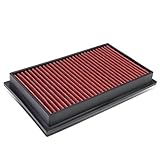
- ▶️ Designed to Boost Horsepower and Rate of Acceleration
- ▶️ Can be Cleaned and Used Again; High Air Flow with Exceptional Filtration
- ▶️ Lasts up to 50,000 Miles Before Ceaning is Required Depending on Driving Conditions
- ▶️ Works with Original Equipment Manufacturer Vehicle Electronics; Emissions Legal in All 50 US States
- ▶️ Will NOT Void Vehicle Warranty; Does NOT Require Filter to be Re-Oiled
What changed in the VQ35HR?
In August 2006, Nissan announced the 3.5-liter VQ35HR and 2.5-liter VQ25HR for front-engine, rear-wheel-drive vehicles. Initial applications included the Skyline in Japan and the Infiniti G35 in the United States. Nissan said “HR” stood for “high revolution” and “high response.” The company identified a 7,500-rpm maximum engine speed for the HR engines; this is a Nissan-published specification, not a result from an independent test.
Reducing friction and mechanical loads
Nissan described an asymmetric piston skirt intended to reduce piston weight and friction. It also used a longer connecting rod, which Nissan said reduced the force of the piston against the cylinder wall, and a revised cylinder block with greater structural rigidity. These changes address different parts of the same engineering problem: reducing mechanical losses while supporting high engine speeds.
Rank #2

- 【OE PART NUMBER】 Specifically designed to replace OE# 13028-JK20A, this High-Performance Timing Chain Kit for the VQ37VHR 3.7L engine provides the exact fit and factory-level precision needed to unleash smooth, powerful operation in your Nissan or Infiniti sports car.
- 【COMPATIBLE MODELS】 Engineered for the high-revving VQ37VHR, this kit fits 2009-2013 Nissan 370Z, 2008-2013 Infiniti G37 models, the 2013 FX37, and 2014 QX70. Ensure your 3.7L performance engine gets the precise timing chain components it requires.
- 【GRADE DURABILITY】 This premium timing chain kit features components built for high-RPM durability. The new tensioner and guide rails are key to eliminating the common startup rattle and ensuring smooth, quiet, and reliable power delivery from your VQ engine.
- 【PACKING LIST】 Your complete VQ37VHR timing chain kit arrives with: 1x 200-link chain, 2x 66-link chains, 3x tensioners (part#s 130701MR0A, 13070JK21C, 13070JK21B), and 3x guide rails (13085AL505, 13091AL502, plus one more) for a comprehensive service.
- 【FIWARY QUALITY ASSURANCE】 We stand behind the quality and fit of every kit. Your FIWARY timing chain kit comes with assurance, giving you peace of mind for your Nissan 370Z or Infiniti G37 performance engine repair or maintenance project.
The company also attributed a 40% reduction in cam-and-valve-lifter friction to a hydrogen-free diamond-like-carbon coating. That percentage is Nissan’s 2006 claim; the cited material does not provide an independent test protocol for it.
Improving airflow and valve control
The HR used a symmetrical twin-intake arrangement, straight intake ports, and an equal-length exhaust manifold. Nissan said the straight intake port reduced intake resistance by 18%. The figure is the manufacturer’s engineering claim, rather than an independently measured comparison.
Rank #3

- VEHICLE COMPATIBILITY: Replacement For NISSAN 1995-1999 Maxima VQ30DE VQ 1996-1997
- HEAVY DUTY MATERIAL: Full 4.5mm Thickness.Made of High Quality 83-Ply Nylon Silicone for Strong Reinforcement.
- EXCELLENT PERFORMANCE:Withstands Operating Temperatures from -65F to 500F Degrees Fahrenheit.Working pressure 85 PSI / Burst pressure 325 PSI.
- PROFESSIONALISM & RICH PRODUCT LINES: We have professional design teams and factory. We have a wide range of automotive products, we can meet the compatible needs of different vehicle models.
- EASY INSTALLATION: No modification Requires. Vehicle tested. Direct replacement. Any question pls feel free to contact.
Valve timing was controlled on both sides: Nissan specified hydraulic continuously variable timing control (CVTC) on the intake and electromagnetic e-VTC on the exhaust. The release also identified iridium spark plugs and emissions-control changes. Together, these measures show that Nissan’s account of the HR was not limited to peak revs: it connected breathing, timing, friction, ignition, and emissions in a single redesign.
Nissan further claimed a 10% fuel-efficiency improvement for the announced HR engines versus vehicles with the existing VQ engine. The published comparison does not state a standalone test protocol, so the percentage should be read as Nissan’s claim for that comparison—not a universal result across every vehicle or driving condition. The company’s design details and figures appear in its 2006 HR announcement and technical presentation.
Rank #4

- construction withstands extreme engine conditions for use.
- Compatible with 350Z, G35, M35, and FX35 models for effortless installation.
- Improves engine function by regulating airflow and pressure effectively.
- Designed for easy installation, saving you time and hassle during setup.
- Enhances fuel efficiency by maintaining engine ventilation and function.
How VVEL changed the VQ37VHR
The later VQ37VHR built on the VQ35HR and added Nissan’s Variable Valve Event and Lift (VVEL) system on the intake side. Where valve timing changes when a valve opens and closes, VVEL also changes how far the intake valve lifts. Nissan’s 2007 presentation describes a mechanical system of cams, links, and a control shaft that continuously varies lift between minimum and maximum.
That gives the engine another way to control incoming air. Nissan presented the VQ37VHR as a further development aimed at performance, fuel efficiency, and emissions, and said approximately 35% of its parts were newly developed. The figure describes Nissan’s accounting of the redesign; it does not mean that 35% of the engine’s performance came from new parts. Details are in Nissan’s 2007 VVEL presentation.
Do these 3 things before closing this tab:
1Fix the driver behind crashes, sound loss and screen glitches2Repair Windows errors before they cause bigger problems3Scan for outdated or missing drivers - takes under a minuteBest Value

- Ignition Module 22433-30P01 22433-30P00 22448 30P02 Ignition Coil For VG30DE For VG30DETT For GZ32 For GCZ32 VQ For Fairlady Z J30 3.0L V6 Ignition Coils(6 piece)
- 🔹Made with robust and sturdy materials, offering excellent durability and meeting the demands of extended use.
- 🔹Features an original vehicle-aligned design, perfectly matching existing vehicle mounting points, simplifying installation and making it easy for both beginners and experienced mechanics to install.
- 🔹The ignition coil ensures stable ignition performance, optimizes ignition consistency, and reduces ignition anomalies.
- 🔹Please verify the original vehicle part model before ordering to ensure compatibility.
What the award record does—and does not—show
Nissan’s award counts differ by publication date and scope, so they should not be combined into one undated total. Its 2006 presentation said the VQ had appeared on Ward’s 10 Best Engines list for 12 consecutive years. A 2007 VVEL presentation described the VQ35HR as having received the award for 13 consecutive years. Nissan’s current awards page reports 16 appearances for the combined VQ/VR series, including 14 consecutive years from 1995 through 2008.
These are manufacturer-reported award histories, not a reliability study. In a December 2002 release about the VQ’s ninth consecutive award, Nissan powertrain and emissions engineering director Motohiro Matsumura called the recognition “proof of the engineering flexibility and durability that we’ve built into this great engine.” That quote records his view at the time; it does not establish a measured failure rate or prove long-term reliability for every VQ variant. The historical statement appears in Nissan’s 2002 release, and the updated combined-series count is on Nissan USA’s awards page.
Why the VQ’s engineering story matters
The VQ’s significance is clearest in the continuity of its design work: Nissan kept pursuing responsive, smooth revving while revising valve timing, reducing friction, strengthening structure, and refining airflow. The VQ35HR makes those priorities concrete through its piston, rod, block, intake, exhaust, and timing changes; the VQ37VHR extended airflow control with variable intake-valve lift. The evidence supports a story of sustained development—not the idea that one feature alone made the VQ exceptional.
Quick Recap
Product prices and availability are accurate as of the date/time indicated and are subject to change. Any price and availability information displayed on Amazon at the time of purchase will apply.




