The 1980 Firebird with a turbocharged V8 was not a separate trim called “Turbo.” It was a Firebird Formula or Trans Am equipped with Pontiac’s LU8 301 Turbo option. The engine helped keep a V8 performance model in the lineup after the larger Pontiac 400 and Oldsmobile 403 were dropped, but its output figures and production totals vary by source.
Which 1980 Firebird came with the turbo V8?
Pontiac offered its Turbo 4.9-liter (301-cubic-inch) V8 in the Firebird Formula and Trans Am. The factory brochure identifies the engine, while Pontiac specialist Rocky Rotella’s review of factory references details the option’s applications and equipment. The 1980 Pontiac sales brochure and Rotella’s equipment overview are useful starting points.
That distinction matters: “Firebird,” “Formula,” and “Trans Am” are not interchangeable descriptions of the turbo specification. The turbo was an engine option for the Formula and Trans Am; a car’s appearance alone does not establish that it left the factory with the LU8 engine.
How Pontiac turbocharged the 301
With the 400 and Oldsmobile 403 out of the 1980 Firebird range, Pontiac turned to its smaller 301 V8 for a turbocharged performance option. The turbo system used exhaust gases to drive a Garrett AiResearch TBO-305 unit. Ate Up With Motor’s technical account describes a draw-through arrangement, in which the carburetor fed the turbo, along with lower compression, carburetor revisions, and ignition-retard measures. Its history of the 1980–1981 Trans Am Turbo provides more detail.
Recommended Free Tools
#1 Best Overall
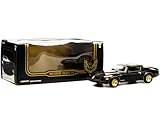
- Limited edition. Brand new box. Chrome accents. Real rubber tires. True-to-scale detail. Has opening doors. Detailed interior, exterior. Officially licensed product. Manufacturer's original unopened packaging. Made of diecast metal with some plastic parts. Dimensions approximately L-8.25, W-3, H-2 inches.
This was a period-specific solution to changing emissions and fuel-economy pressures, not simply a larger engine with a turbo bolted on. The combination gave Pontiac a way to retain a performance-oriented V8 after its bigger engines left the Firebird lineup.
Why do horsepower figures differ?
Published output depends on the source: Car and Driver’s October 1979 road test described the turbo Firebird at 205 horsepower, while Hagerty’s 2023 valuation report and Ate Up With Motor state 210 horsepower or bhp. The figures should be attributed rather than treated as a single uncontested rating.
Rank #2

- Skill 2, paint and cement required
- Big 1/16 scale
- Big 1/16 scale
- Authentic detail
- Opening doors and hood
Car and Driver’s period test, written by Don Sherman, called Pontiac’s turbocharged V8 “the biggest of its kind ever to see large-scale production.” That is the magazine’s contemporary characterization, not a current, independently verified comparison of every production turbo engine.
What came with the LU8 option?
According to Rocky Rotella’s review of factory literature, the 1980 turbo package required air conditioning, a Turbo-350 automatic transmission, and a 3.08:1 axle ratio. The option did not require WS6 suspension or J65 brakes. Standard suspension, rear drum brakes, and Rally II wheels were possible, so a turbo car did not necessarily have the more conspicuous performance equipment some enthusiasts associate with Trans Ams.
Free tools Windows power users keep installed
One-click scans. No signup required.
Rank #3
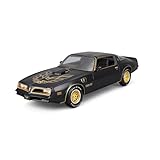
- Large Approx. 9.5” replicas
- Die-cast metal body with plastic parts, with opening doors and engine compartment on some models
- Full functioning steering Four- wheel suspension Adjustable seat backs on some models Detailed chassis with separate exhaust system
- Mounted on display stand for collectors
- Detailed die-cast precision model
Do not apply 1981 ordering restrictions to a 1980 car. For identification or restoration, check the engine code and vehicle records alongside the configuration; exterior trim or wheels by themselves are not proof of an original LU8 car.
Formula, Trans Am, and Indy Pace Car: what sets them apart?
Turbo Formula
The Formula paired the turbo option with a less showy Firebird body treatment than the Trans Am. Hot Rod’s 2007 feature reports 1,245 turbo Formulas, making them an especially interesting version for readers looking beyond the familiar Trans Am. Hot Rod’s 1980 Firebird Turbo feature gives that figure.
Rank #4

- Revell Model Kit #14535, Skill Level 5, Contains 144-Parts, Recommended for ages 13 and up
- Detailed 5.7-liter V-8 engine with tuned-port fuel injection. Positional front wheels.
- T-Top body with removable clear roof panels. All-new and expanded decal sheet.
- Molded in white and clear with soft black tires.
- Illustrated assembly instructions. Requires paint and glue. (not included)
Turbo Trans Am
The Trans Am was the more recognizable performance trim, but trim alone does not authenticate a turbo car. Hagerty’s 2023 valuation report gives a combined total of 23,422 turbo-equipped Trans Ams and Formulas. Hot Rod reports 16,476 Trans Ams in its breakdown. Those are source-specific production figures, and the publications’ category totals do not reconcile exactly.
Indy Pace Car
The 1980 Indy Pace Car was the most visually distinctive turbo Firebird, with white-over-gray trim and special decals. Hot Rod reports 5,700 pace cars; Hagerty gives the original price as $11,194. That is a historical price, not a present-day valuation. The reported pace-car count should not be casually added to other totals because the sources’ category accounting is not fully clear.
The Tool Desk
Outbyte Driver Updater FREEScan for outdated or missing drivers - takes under a minuteDriver Scan →Outbyte PC Repair FREEClear out junk files and repair common Windows errorsFree Scan →Best Value

- Pre-lettered Goodyear GT Radial tires
- 3 Firebird hood and color stripe options
- 1/25 scale, skill 2, paint and cement required
- Molded in pearl blue
- T-top roof
How quick was the turbo Firebird?
Ate Up With Motor summarizes period test results at roughly eight seconds from zero to 60 mph, quarter-mile times in the mid-16-second range, and a top speed of 116 mph. These are compiled test results, not guaranteed performance for every car; the account also notes inconsistent results and reports of detonation. Condition, tuning, and the particular test matter when comparing surviving examples.
How to assess an example today
- Confirm the engine: Look for documentation supporting the original LU8 301 Turbo rather than relying on decals, hood treatment, or trim.
- Check the equipment in context: A Turbo-350 automatic and 3.08:1 axle are part of the reported 1980 specification; WS6, J65 brakes, and four-wheel discs were not mandatory.
- Separate the trim from the powertrain: A Formula, Trans Am, or Pace Car appearance tells you which version it resembles, not by itself whether it is an original turbo car.
- Compare production claims carefully: Hagerty and Hot Rod report totals that do not line up cleanly. No survival count is established by those figures, so production numbers alone do not prove how many remain today.
For owners researching repairs or originality, check that a service manual or replacement component explicitly covers the 1980 Firebird and the LU8 turbo configuration; year, engine, and part fitment matter.
Quick Recap
Product prices and availability are accurate as of the date/time indicated and are subject to change. Any price and availability information displayed on Amazon at the time of purchase will apply.




