If you mean engines for cars, this is not a comprehensive automotive forecast: the strongest publicly documented programmes covered here are in aviation and aerospace. They range from hydrogen fuel-cell and hybrid-electric aircraft propulsion to open-fan and geared ducted-fan demonstrators, combat-aircraft power systems and rocket engines. Their milestones are not all alike: a planned joint venture, design milestone or ground test does not mean an engine is entering service.
The performance figures below are manufacturers’ targets with different comparison baselines, not results from a common independent test. Read them as signals of what each programme is trying to achieve, not as a reliable cross-programme ranking.
How to read the programmes
These projects span several kinds of propulsion and several stages of development. Some are intended to mature technologies for future aircraft; others are collaborations or demonstrators with no stated service-entry date. The table separates the announced milestone from any planned schedule and gives performance claims only where the programme has stated one.
| Programme | Mission and architecture | Current milestone and stated schedule | Stated performance |
|---|---|---|---|
| Airbus–MTU hydrogen fuel-cell propulsion | Fully electric hydrogen fuel-cell engine for aviation | Proposed joint venture expected to start operations in 2027, subject to approvals and social processes; this is not a commercial service date | No quantified performance target stated |
| Rolls-Royce UltraFan 30 and 80 | Geared ducted-fan demonstrators for future narrowbody and widebody aircraft | UltraFan 30 ground testing planned for 2028; UltraFan 80 completed a first test phase in 2023, with a second build’s re-testing planned for later in 2026 | UltraFan 30: company target of 20% lower fuel burn than current in-service engines. UltraFan 80: targets 25% greater efficiency than first-generation Trent engines and 10% over Trent XWB |
| CFM RISE | Technology programme spanning open-fan, compact-core and hybrid-electric systems for commercial aviation | As of Safran’s 18 July 2026 announcement, the programme reported about 500 test campaigns and more than 3,000 endurance cycles; full-scale open-fan front-module testing was being prepared | CFM targets more than 20% better fuel burn than commercial engines in service today |
| Pratt & Whitney Valox 1500 | Military/aerospace engine intended for semi-autonomous collaborative platforms | RTX reported a key design milestone on 21 July 2026; follow-on ground testing remains ahead | No quantified performance target stated |
| GCAP engine demonstrator | Power-and-propulsion system for the future Global Combat Air Programme aircraft | Rolls-Royce, Avio Aero and IHI reported progress toward ground testing a demonstrator; no service-entry date stated | No quantified engine-performance target stated |
| Lockheed Martin–Venus rotating detonation rocket engine | Rocket technology being evaluated for possible long-range precision-fires applications | Technology-development agreement announced on 21 July 2026 to evaluate and mature the technology; operational deployment is not established | Companies say the architecture may improve efficiency; no demonstrated operational advantage or quantified target stated |
| Airbus LEIA | Aircraft-level hybrid-electric systems integration, not a standalone engine | Ground demonstration planned by 2027; work covers the aircraft electrical architecture | No standalone engine-performance target stated |
Hydrogen fuel-cell aviation: Airbus and MTU
On 7 July 2026, Airbus and MTU Aero Engines announced their intention to establish a joint venture to develop and commercialise a fully electric hydrogen fuel-cell engine for aviation. The venture was expected to begin operations in 2027, subject to standard regulatory approvals and social processes.
Recommended Free Tools
#1 Best Overall
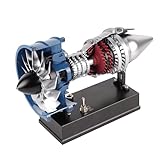
- Realistic & Authentic: The lifelike & visually stunning model provides a realistic depiction of a full-sized engine with main components including a first-stage fan, high-pressure rotor assembly, combustion chamber, high-pressure turbine assembly, low-pressure turbine assembly, and exhaust nozzle.
- High-Quality Construction: Made of high-quality metal, the meticulous model, full of detail and features, undergoes precision casting and CNC machining, along with sandblasting and anodized coloring treatment on the surface, ensuring durability and accuracy the same as the real model.
- Dynamic Display: Featuring a semi-transparent magnetic casing, this model offers a clear view of the engine's internal mechanics in motion when powered by the electric motor. The quick-release magnetic cover allows for effortless assembly and disassembly, making it ideal for demonstrations while protecting delicate components. Equipped with a sturdy mounting bracket and throttle control lever, this kit delivers an immersive hands-on experience with aviation engineering.
- DIY Assembly: Consists of 170+PCS (including screws & nuts) and comes with tools and paper-based English instructions. You will personally experience the entire assembly process, from small parts to the final completed model, constructing an awe-inspiring turbofan engine model.
- STEM Education: As an educational tool, this model unravels the internal workings of a turbofan engine, imparts knowledge about aerospace engineering, and stimulates interest, creativity, and awe for industrial technological achievements
That 2027 milestone is about setting up the organisation, not delivering an engine or putting an aircraft into commercial service. The announcement describes a development and commercialisation effort; it does not state a service date or quantify the engine’s performance. MTU Engineering and Technology SVP Dr. Stefan Weber described the ambition as paving the way for a “safe, reliable and economical propulsion system” that could contribute to climate-neutral aviation.
Rolls-Royce UltraFan: two demonstrators, different targets
UltraFan is a suite of technologies for future narrowbody and widebody engines, represented by two demonstrators: UltraFan 30 for the narrowbody market and UltraFan 80 for widebody applications. The programme’s headline efficiency numbers refer to different engines and comparison baselines, so they should not be treated as a direct comparison between the two demonstrators.
UltraFan 30
Rolls-Royce plans to begin ground testing UltraFan 30 in 2028. The company targets 20% lower fuel burn than current in-service engines. This is a manufacturer target; the planned ground test is a development milestone, not evidence that a production engine will enter service in 2028.
Rank #2

- Design: This jet engine model imitates the J35 turbine engine
- Rotatable design: The jet engine model can be rotated to show the working principle of the turbojet engine
- Size: H 5.11 IN, L 10.62 IN, W 2.55 IN
- Material: 3D printed plastic
- Fun: Assembling design, more playable
UltraFan 80
Rolls-Royce reports that the first UltraFan 80 test phase took place in 2023 using 100% sustainable aviation fuel. It targets a 25% efficiency improvement over first-generation Trent engines and a 10% gain over Trent XWB. The company planned to re-test a second build later in 2026. Those two percentages use separate baselines and are not independent, in-service results.
Free tools Windows power users keep installed
One-click scans. No signup required.
CFM RISE: open fan and a broader technology programme
CFM International, the 50/50 GE Aerospace–Safran joint company, describes RISE as a technology-demonstration programme, not an engine product for sale. Its scope includes an open fan, a compact core and hybrid-electric systems. That breadth matters: RISE is not simply a single engine design with one announced entry-into-service date.
As of Safran’s 18 July 2026 announcement, CFM reported approximately 500 test campaigns and more than 3,000 endurance cycles. The programme was preparing to test a full-scale open-fan front module in a new 8-metre test cell at Villaroche, while also conducting hybrid-electric demonstrator work. CFM targets more than 20% better fuel burn than commercial engines in service today. Both the activity figures and the fuel-burn claim are programme-reported; the target is not an independently measured result in commercial operation.
Rank #3

- 3D-Printed TR900 Replica: Precision 3D-printed Aero Engine Model of the iconic TR900 Turbofan.This highly accurate 9.3-inch replica showcases complex internal mechanics,offering a true-to-life visual of turbofan engineering for enthusiasts and collectors
- DIY Toyan Engine Kit: A rewarding DIY project for adult or teen 14+ hobbyists. This Engine building Kit provides hands-on assembly,deepening understanding of mechanical science.The completed model serves as a striking desktop display
- Transparent Educational Design: Features a clear casing that reveals the operational blade structure and dual-flow system. An insightful mechanical science educational gift, perfect for visualizing and learning fundamental aerospace principles
- Functional Science Gift: More than a model,it's an engaging educational tool.Ideal for students and aviation fans to interactively explore aerospace engine mechanics, making it a memorable gift for learning and discovery(Battery not included)
- Premium Desktop Art: A sophisticated 23cm collectible art piece. Its exquisite design makes it a perfect desktop decoration and a conversation-starting gift for adult hobbyists,combining aesthetic appeal with engineering intrigue
Valox 1500: a design milestone, not a service announcement
RTX said on 21 July 2026 that Pratt & Whitney’s Valox 1500 had completed a key design milestone. The engine is intended for semi-autonomous collaborative platforms, making it a military/aerospace programme rather than a passenger-aircraft engine. Follow-on ground testing remains ahead, and the announced design milestone does not establish when or whether the engine will enter operational service.
GCAP: an engine that must also manage aircraft power and heat
Rolls-Royce, Avio Aero and IHI are working toward ground testing an engine demonstrator for the Global Combat Air Programme (GCAP). The stated purpose is to mature technology and an integrated architecture, as well as test and refine development processes for a future combat aircraft.
For this programme, propulsion is not only about thrust. Rolls-Royce Director of Future Programmes, Defence, Phil Townley called the system a “flying power station,” saying it must manage the substantial electrical and thermal loads associated with next-generation sensors and weapon systems. The consortium described the programme as sustaining more than 9,000 highly skilled aerospace roles worldwide; that is an employment statement, not a measure of engine performance. No service-entry date or quantified performance target is stated.
Rank #4

- DETAILED TWIN-SPOOL ARCHITECTURE: This 1:10 scale model recreates the layered structure of an aerospace turbofan engine, including a single-stage fan, two-stage low-pressure compressor, four-stage high-pressure compressor, single-stage high-pressure turbine, and two-stage low-pressure turbine.
- PRECISION METAL CRAFTSMANSHIP: Made from precision-cast and CNC-machined metal components, the model features sandblasted and anodized surfaces for durability, refined texture, and a professional industrial finish. Its substantial construction highlights the complexity of modern turbofan engineering.
- MOTORIZED AND FULLY VISIBLE: The cutaway engine casing reveals the internal rotating assemblies as the motor simulates coordinated turbofan operation. A fixed display stand, throttle control lever, and engine sound module create a more engaging mechanical demonstration.
- 1000+ PART ASSEMBLY PROJECT: Build the engine from more than 1,000 components, including screws and nuts. Tools and an English instruction manual are included. The manufacturer estimates approximately 10 hours of assembly time. The multi-stage process is intended for experienced model builders familiar with small components and detailed mechanical assembly.
- IMPRESSIVE ENGINEERING DISPLAY: Measuring approximately 14.96 × 6.50 × 9.25 inches and weighing about 11.68 pounds when completed, the DM119 becomes a commanding mechanical centerpiece for a home, office, studio, workshop, or aviation-themed collection.
Rotating detonation: rocket technology under evaluation
Lockheed Martin and Venus Aerospace announced a technology-development agreement on 21 July 2026 to evaluate and mature rotating detonation rocket-engine technology for possible long-range precision-fires applications. Lockheed Martin describes the architecture as using continuously travelling detonation waves, in contrast with the subsonic combustion it describes in conventional rocket engines.
The companies say the approach may improve efficiency. That remains a stated potential, not a demonstrated operational advantage: the announcement concerns evaluation and technology maturation, not deployment of an operational system.
LEIA: hybrid-electric systems around the engine
Airbus’s LEIA project, supported by the EU Clean Aviation Joint Undertaking, addresses aircraft-level hybrid-electric integration rather than creating a standalone engine. Its work includes scalable motor-generators, controllers, electrical power distribution, battery interfacing and energy management, with a ground demonstration planned by 2027.
Best Value

- 【F35 Fighter Jet Engine Model Kit】: This F35 engine block set realistically reproduces the structure and operation of an F35 fighter jet engine. With 3-bearing swivel duct, exhaust pipe, nozzle, rotating turbine, beautifully crafted stickers. Perfectly constructed lifelike mechanical engine models, showing the beauty of real military engineering.
- 【Interactive Features】: The F35 engine's nozzle rear section can be expanded and narrowed, high-speed turbine can be rotated by motor, some parts can be disassembled to clearly see the internal multi-gear linkage mechanism. Perfectly replicates the jet engine mechanics and operation of the F35 fighter jet.
- 【Precision Craftsmanship】: This F35 engine building sets consists of 1,812 bricks for a longer building experience. Each part is smoothly and precisely crafted with metallic paintwork and comes with detailed illustrated step-by-step instructions to make this F35 jet engine model perfect to build.
- 【Space Decorations】 this F35 engine buiding block sets for adults measures 9.25*27.16*14.56 inches after assembled, which can be perfectly displayed in any space such as desks and shelves at home or office collection. It is an attention-grabbing choice for military enthusiasts and collectors.
- 【Ideal Gift】 This F35 engine building toy combines creativity, engineering and hands-on fun, making it an ideal gift for adults. Whether it's a birthday, Valentine's Day, Christmas or Thanksgiving, it's the perfect gift for military, fighter, engine and technical modeling enthusiasts.
LEIA is relevant because an aircraft’s hybrid-electric propulsion depends on how electrical power is generated, moved, stored and managed across the vehicle, not only on the engine or motor. It is a complementary systems project and should not be counted as a separate engine launch.
What these programmes do—and do not—tell car readers
This is an aerospace-focused selection, not a survey of upcoming car, marine or industrial engines. The programmes offer examples of different propulsion challenges—fuel burn, electrical integration, aircraft power and thermal management, and rocket combustion—but their targets and milestones do not answer which automotive engines will reach showrooms in the next few years. No common independent test in these announcements supports a single “most exciting” performance ranking.
Quick Recap
Product prices and availability are accurate as of the date/time indicated and are subject to change. Any price and availability information displayed on Amazon at the time of purchase will apply.




