Outdated Drivers Are Slowing You Down
One free scan finds every outdated or missing driver and matches the right update for your exact hardware.Free scan · exact hardware matchWindows Errors? Fix Them Before They Spread
Repair common Windows errors and clear accumulated junk for a smoother, more stable PC - no reinstall needed.Free scan · no reinstallFord’s sports-car story has two distinct strands: the Mustang, a road-going performance car introduced in 1964, and the GT40, a purpose-built endurance racer developed to challenge at events such as Le Mans. Their histories are not interchangeable, but together they show how Ford made performance visible on public roads and on the race track.
What Ford means by its sports-car history
This is a history of selected milestones, not a catalogue of every Ford performance car or racing model. The Mustang was built for customers and evolved through successive road-car versions; the GT40 was engineered for competition. Their performance figures also describe different things: manufacturer-published road-car ratings are not directly comparable with figures from a race-engine development program.
The Mustang establishes Ford’s road-car performance identity
1964: a new nameplate arrives
Ford unveiled the Mustang on April 17, 1964, at the New York World’s Fair. It initially came as a hardtop or convertible; a 2+2 fastback followed for 1965. Ford describes the Mustang as a “sports car” and calls it the longest continuously running sports-car nameplate produced in North America. That longevity claim is Ford’s characterization.
Performance develops through distinct models
Rather than treating one version as representative of the entire line, Ford’s milestone history shows performance arriving through several dated variants. Its published historical ratings include the following:
#1 Best Overall

- Pullback Action: Experience realistic racing with the pullback action feature.
- Opening Doors: Explore the intricate interior details with the opening door feature.
- 1:38 Scale: Enjoy a detailed 1:38 scale die-cast model (approx. 5 inches long).
- Authentic Design: Modeled after the iconic 1967 Ford Shelby Mustang GT500.
- Display Piece: A must-have collectible for car enthusiasts and model collectors.
| Model year | Variant | Ford-published detail |
|---|---|---|
| 1965 | Shelby GT350 | 289-cubic-inch V8 rated at 306 horsepower, according to Ford’s 2013 milestone timeline. |
| 1967 | Shelby GT500 | Recorded as a Mustang milestone in Ford’s timeline; the cited timeline does not give an output figure. |
| 1969 | Mach 1 | Optional 428 Cobra Jet engine rated at 335 horsepower, according to Ford’s Mustang history page. |
| 1969 | Boss 302 and Boss 429 | Both recorded as milestones in Ford’s timeline; the cited timeline does not give output figures. |
These are selected milestones and Ford’s historical ratings, not a complete specification database for every model, market, or equipment combination.
The GT40 begins as a dedicated endurance-racing effort
From stalled Ferrari negotiations to a Ford racing program
Ford’s account places the GT40’s origins after negotiations with Ferrari were suspended by mutual agreement in May 1963. The following month, Ford formed a high-performance unit to pursue a racing GT capable of competing at Sebring and Le Mans. Roy Lunn had developed preliminary concepts; Ford’s team engaged Eric Broadley, associated with the Lola GT, and John Wyer as race manager. Carroll Shelby later became a prominent collaborator.
Rank #2

- Authentic Ford Design: Each model kit accurately captures the signature style and details of iconic Ford vehicles.
- Precision-Molded Parts: High-quality, finely molded components ensure a realistic and detailed build.
- Customizable Features: Includes decals and optional parts for a personalized, unique build.
- Ideal for Hobbyists: Perfect for model builders of all skill levels, from beginners to experienced collectors.
- Display-Ready Models: Create a stunning Ford model that’s ready to showcase in your collection or as a standout display piece.
Ford says the first GT40 was completed in time to be shown around the Mustang’s 1964 launch. That timing connects the two stories, but it does not make the cars part of the same program: one was a road-going nameplate, the other a competition car.
Early failures drive a change in approach
The first GT40 seasons brought speed but also serious reliability problems. Ford recounts suspension trouble and gearbox failures, including the team’s retirement at Le Mans in 1964. After that early season, development work moved back to the United States. Ford says Shelby took operational control and Lunn took engineering control.
Rank #3
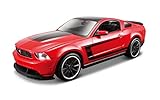
- These highly detailed kits come with everything you need to build them including the screwdriver
- Opening parts, Rolling Wheels
- Easy assembly, Pre-painted metal body
- When finished the vehicles are fully functional
- Rolling die-cast replica
For 1965, Ford describes changes to aerodynamics, airflow, materials, wheels, and suspension. Lunn’s team also developed the Mark II, adapting a 427-cubic-inch engine for the mid-engine car. The progression from early failures to a stronger contender depended on engineering changes and a clearer division of responsibility, not on an inevitable march to victory.
How the GT40 won Le Mans four years running
The 1966 Mark II effort
Ford’s account of the 1966 campaign describes the Le Mans Committee, Ford engineering, Shelby American, and Holman & Moody working together on the Mark II. Engine durability was central to the effort: Ford says the development program sought an engine capable of running for 48 hours on a dynamometer test simulating race conditions. In its 2019 historical account, Ford reports that a developed engine reached 6,400 rpm and 485 horsepower in this specific 1966 race-engine development context. Those figures are not production-car specifications.
Rank #4

- 1:25 scale, skill level 2, paint & glue required 169 parts Molded in white, clear and transparent red, with chrome-plated parts. Black vinyl tires Metal axle Built size: 7.125 inches long Ages 10+
Overall victories from 1966 to 1969
Ford records four consecutive Le Mans overall victories for the GT40, from 1966 through 1969. Ford describes the 1966 result as the first Le Mans win by an American-built car. The overall-win record should be kept distinct from later class victories by other Ford programs: winning a class is not the same result as winning the race overall.
Independent reader supportYour contribution helps us test, update, and keep practical guides available for everyone.From the 2016 Ford GT to an announced 2027 return
Ford’s retrospective says the 2016 Ford GT won in the GTLM class, while Mustang GT3 has since competed for class victories. These programs continue Ford’s presence in racing, but they are separate from the GT40’s 1960s overall Le Mans streak.
Free tools Windows power users keep installed
One-click scans. No signup required.
Best Value
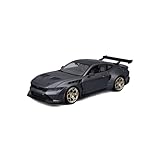
- Detailed Die-cast metal body with plastic parts
- Large Apx 9-1/2" replica
- Opening doors and engine compartment
- Full functioning steering
- Four-wheel suspension
In January 2025, Ford announced plans to return to the FIA World Endurance Championship in 2027 with a factory program. That is an announced future plan, not a completed return.
Quick Recap
Product prices and availability are accurate as of the date/time indicated and are subject to change. Any price and availability information displayed on Amazon at the time of purchase will apply.




