Recommended Free Tools
GM reportedly designed, built, and evaluated a 60-degree V4 for its J-platform compact cars in the 1980s, but the company chose a pushrod inline-four instead. The V4’s compact length was offset by its width and awkward accessory packaging. The account comes from secondary reporting; available SAE records document the production inline-fours, not the V4 prototype itself.
Did GM really build a V4 engine in the 1980s?
According to The Drive’s July 27, 2023 report, GM designed, built, and evaluated three engine layouts for the J platform: a pushrod inline-four, an overhead-cam inline-four, and a 60-degree V4. The report says the V4 concept was derived from GM’s existing 2.8-liter 60-degree V6 by removing two cylinders, with shared machining and parts among its potential advantages.
That is a reported prototype story, not a conclusion independently established by the retrieved primary documents. The available SAE abstracts describe production inline-four engines and do not verify the V4’s design, build, or evaluation. No V4-specific drawing, prototype record, or internal decision document is established by those sources.
Why did GM consider a V4 for the J platform?
GM was working within the dimensions of a compact-car platform whose key measurements were reportedly already fixed when the engine layouts were assessed. The V4’s proposed attraction was its short length and the possibility of drawing on components and manufacturing methods associated with the 2.8-liter V6. In a tightly packaged front-wheel-drive car, a shorter engine could appear useful—but length was only one constraint.
The Tool Desk
Outbyte PC Repair FREEClear out junk files and repair common Windows errorsFree Scan →Outbyte Driver Updater FREEScan for outdated or missing drivers - takes under a minuteDriver Scan →#1 Best Overall

- 【V8 Model Engine Kit That Runs】This V8 engine replica accurately restores every detail of the real engine, from the electroplated metallic sheen to the exhaust system and precise structural reproduction. The motor-driven design lets you explore the core of power as pistons move and valves operate—an ideal model engine kit for adults and mechanical enthusiasts. Should you encounter any problems assembling your model kit, please contact us by email. Our after‑sales team is always ready to offer support
- 【Realistic Mechanical Features】Movable parts show how engines work for educational fun; the breathing exhaust assembly replicates real pulsing exhaust motion for authentic mechanical experience
- 【Motor-Driven Mechanism with Four-Speed Gears】The integrated tiny motor activates realistic engine movement. Simulate shifting gears to watch the engine’s working principle in action
- 【Fully Flip-Open Hood】The adjustable hinged hood exposes the entire inner engine structure, ideal for displaying the model’s elaborate craftsmanship
- 【STEM Mechanical Build Set】Perfect for both teens and adults to study mechanical structures, motion transmission and engineering logic through entertaining creative model assembly
The period targets reported by The Drive, attributed to contemporary GM documents, were 29 mpg for the J-Car fleet and 0–60 mph in 16 seconds for automatic models or 14 seconds for manuals. These are targets, not independently verified test results or achieved fuel-economy figures.
The wider setting was a period of substantial passenger-car downsizing and successive engine introductions at GM, as described in a U.S. Department of Transportation report’s GM section. That context helps explain the pressure to balance compact packaging, economy, and cost; it does not independently substantiate the V4 account or its specifications. U.S. Department of Transportation report hosted by ROSA P.
Rank #2

- REAL WORKING ENGINE MECHANISM: Experience how a V8 engine works through visible gears, moving pistons, and a synchronized mechanical system that brings engineering concepts to life in a clear and engaging way
- PRECISION ENGINEERING BUILD: Designed with detailed components and a structured assembly process, this kit focuses on delivering a precise and rewarding mechanical building experience
- DISPLAY-WORTHY MECHANICAL MODEL: More than a building kit, this engine model serves as a compact mechanical display piece, adding an industrial aesthetic to any desk or workspace
- MOTOR-DRIVEN MOTION SYSTEM: Powered by a built-in motor, this V8 engine model simulates realistic movement, allowing you to observe how gears and internal components interact in motion
- THOUGHTFUL GIFT FOR BUILDERS AND ENGINE ENTHUSIASTS: A meaningful gift for adults, teens, and anyone interested in engineering, mechanics, or hands-on building projects
Why did GM reportedly reject the V4?
The reported trade-off was that the V4 was the shortest layout but also the widest, and its front-mounted accessories ate into the length advantage. The Drive says GM ultimately selected the pushrod inline-four for packaging and cost reasons, including the room available for an inlet manifold. In other words, a short block did not guarantee the best fit once the surrounding engine hardware and intake space were considered.
| Reported layout | Length and width | Packaging and manufacturing considerations |
|---|---|---|
| Pushrod inline-four | Comparative measurements not stated in The Drive report. | Reportedly selected for packaging and cost, including available inlet-manifold space. The report does not provide a detailed cost calculation. |
| Overhead-cam inline-four | Comparative measurements not stated in The Drive report. | Evaluated as one of the three layouts; the report does not establish its detailed cost, accessory placement, or tuning flexibility. |
| 60-degree V4 | Reportedly the shortest and widest of the layouts. | Front accessory placement reportedly compromised its length advantage. Shared machining and parts with GM’s 2.8-liter V6 were part of its appeal, but the report says packaging and cost favored the pushrod inline-four. |
The comparison is qualitative: the report does not supply engine dimensions, a cost breakdown, or a full engineering decision matrix. It supports the broad packaging explanation, not a precise numerical ranking beyond the V4 being shortest and widest.
Rank #3
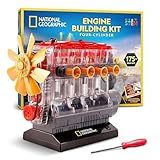
- BUILD YOUR OWN ENGINE – Assemble a clear 4-cylinder engine model kit with 175+ durable pieces. A fun DIY engineering toy engine that shows how pistons, valves, and gears really move.
- WORKING MODEL ENGINE – Install 3 AA batteries (not included), press start, and see this visible engine model kit come to life as pistons, valves, and gears move just like a real car engine.
- COMPLETE STEM ACTIVITY KIT – This kids engine build kit includes everything needed: 175+ parts, tools, illustrated instructions, and a Learning Guide for an engaging STEM toy experience.
- FUN & EDUCATIONAL – Encourages problem-solving skills and curiosity while teaching kids about mechanics and engineering. Perfect model engine kit for young builders and hobby kits for boys and girls.
- GREAT STEM GIFT – An exciting engine building kit for kids who love cars, building toys, and model kits. Inspires creativity and discovery through hands-on STEM play!
What the production-engine record establishes
The J-Car inline-four
A 1982 SAE abstract by James Walker of GM’s Chevrolet Engineering Center describes a new inline-four designed for the 1982 front-wheel-drive J-Car line. It says packaging, performance, and economy shaped the engine’s design. This is primary-source confirmation of the production inline-four context—not independent confirmation that a V4 prototype was among the alternatives. SAE paper 820111, “The GM 1.8 Liter L-4 Gasoline Engine Designed by Chevrolet”.
The later Quad 4
A separate 1987 SAE abstract identifies the 2.3-liter, 16-valve Quad 4 as an engine GM planned to introduce for the 1988 model year. It is a four-cylinder production-engine milestone, not evidence that the earlier reported V4 entered production or directly continued into the Quad 4. SAE paper 870353, “General Motors 2.3L Quad 4 Engine”.
Rank #4

- V10 Mechanical Engine Model: This building set showcases intricate gear-driven operation replicating the core mechanical systems of a high-performance V10 engine through interlocking gear mechanisms
- Multi-Speed Transmission: Features multiple gear ratios that can be shifted to demonstrate different rotational speeds and power transfer efficiency
- Advanced Gear System Assembly: With 1834 components this complex kit focuses on precision gear alignment and mechanical synchronization for technical building enthusiasts
- Comprehensive Technical Guide: Includes a detailed instruction manual with exploded diagrams and sequential steps for accurate assembly of the gear train and drive mechanisms
- Dimensions: The completed model measures 16.4 inches (41.6 cm) long 8.3 inches (21.0 cm) wide and 7.3 inches (18.5 cm) high
What remains unconfirmed about the abandoned project
The V4-specific account rests on The Drive’s 2023 secondary reporting. The SAE abstracts corroborate the J-Car inline-four and the later Quad 4, but do not discuss the experimental V4. Without the original GM drawings, prototype build records, or internal selection documents, the precise design details and rejection rationale remain reported rather than independently verified.
Quick Recap
Best Value

- 1:4 SCALE MODL WITH MOVING PARTS; Clear Engine Casing So You Can See All the Parts Move, LED Lights Simulate Spark Plugs Firing; Fan Spins, Crank Turns, Just like Original
- 100 PAGE COLLECTOR'S BOOK; Full Color Photos, History and Facts about the Ford Mustang, Clear Instructions for Building
- NO GLUE REQUIRED; Builds in a Couple Hours with the Included Tools.
- ELECTRONIC SOUND MODULE: Electric Display Base Plays Sounds Recorded From Actual 1965 Ford Mustang
Product prices and availability are accurate as of the date/time indicated and are subject to change. Any price and availability information displayed on Amazon at the time of purchase will apply.
What’s actually slowing this PC down?
Pick the symptom - the matching free tool is one click away.




