The Firebird Formula 400 was Pontiac’s performance-oriented Firebird for buyers who wanted a strong engine and purposeful details without the Trans Am’s more conspicuous identity. But “Formula 400” was not one fixed package across the decade: equipment, engine choices and transmission pairings varied by model year. Its quieter character came from the way Formula combined performance hardware with a less overt visual treatment—not from a single, unchanging specification.
What was a Firebird Formula 400?
Formula was a Firebird model line, not simply a name for one engine. Pontiac’s 1972 buyer’s guide, for example, lists Formula versions with a 350 two-barrel, a 400 four-barrel and a 455 H.O. four-barrel. It also describes Formula-specific identification, a fiberglass hood with dual scoops, and additional handling and exhaust equipment. Those choices make the Formula best understood as a performance-minded Firebird with several possible powertrains, rather than a car whose badge guaranteed the same engine and equipment every year. Pontiac’s 1972 buyer’s guide
A 1970 AMA specifications publication is another period reference for the model: its catalog record identifies a 27-page Pontiac Firebird form, revised in 1970, and its indexed terms include Formula 400 and 400 V8. The catalog information establishes that the technical reference exists, but does not by itself verify detailed engine ratings. Google Books’ bibliographic record
How was the Formula 400 different from a Trans Am?
The clearest distinction supported by period material is visual: the Formula had its own hood and engine identification, while “low-profile” is a useful description of its comparatively restrained character, not a Pontiac marketing term established by these sources. The 1973 brochure describes a fiberglass hood with forward-facing dual scoops and Formula engine emblems on the front fenders. Its indexed description says the scoops were functional with the 455 H.O. That qualification matters: the hood’s appearance alone does not establish that the scoops served the same function on every Formula. Pontiac’s 1973 Firebird brochure
Free tools Windows power users keep installed
One-click scans. No signup required.
#1 Best Overall
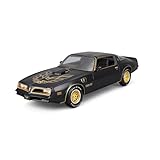
- Large Approx. 9.5” replicas
- Die-cast metal body with plastic parts, with opening doors and engine compartment on some models
- Full functioning steering Four- wheel suspension Adjustable seat backs on some models Detailed chassis with separate exhaust system
- Mounted on display stand for collectors
- Detailed die-cast precision model
There is not enough evidence here to make a complete, year-by-year Formula-versus-Trans Am equipment comparison. For a specific car, compare the two models using that year’s documentation: exterior treatment and badging, standard and optional equipment, and the available engine-and-transmission combinations. A broad claim that one model always had a particular advantage would obscure the changes Pontiac made over the decade.
Did every Formula have a 400?
No. “Formula” covered multiple engine choices, and the number in “Formula 400” matters. In 1972, Pontiac listed Formula 350, Formula 400 and Formula 455 H.O. identities. In 1974, the engine-code information distinguishes a 400 two-barrel L65 from a 400 four-barrel L78 and notes transmission restrictions for some applications. A year and engine code are therefore more informative than the Formula name alone when identifying a car or checking its original configuration. 1974 Firebird engine-code information
Rank #2

- [Product Size] 4.9×1.9×1.4 inches(1:36 scale). Package weight: Approx. 0.37 pounds. Suitable for playing.
- [Good Quality] Detailed interior and exterior trim, using high grade alloy die-cast into form.
- [Great Diecast Toy Car] Made of non-toxic paint spray, doesn’t contain harmful substances, protecting the safety of children greatly.
- [Funny Pull Back Car Model] Left and right doors can be opened. Place the car on the ground, press down on the body and pull it back, the car will move forward.
- [Awesome Toy for Kids] Sturdy body, fine workmanship. Suitable for collections, birthdays, Christmas and decorations. Great for kids, boys, girls and adults.
The decade’s engine story also changed. Hagerty’s April 2025 historical overview says the 455 disappeared after 1976 and identifies 1979 as the final year for Pontiac 400 V-8s in Firebirds. That does not mean every 1979 Formula had a 400, or that a Formula 400 had the same specification from one year to the next. Hagerty’s 1970 Firebird valuation report, published April 21, 2025
What made it a low-profile muscle car?
The Formula’s appeal was the combination: Firebird performance choices and equipment paired with distinct but less flamboyant cues than the Trans Am is commonly associated with. Pontiac’s brochures identify the Formula through its hood and fender emblems, while the 1972 guide shows that buyers could select different engines within the model. The result was a performance Firebird that did not rely on one dramatic appearance or one universal engine to define it.
What’s actually slowing this PC down?
Pick the symptom - the matching free tool is one click away.
Rank #3

- Package Dimensions: 23.368 cms (L) x 17.018 cms (W) x 8.382 cms (H)
- Product Type: Hobbies
- Package Quantity: 1
- Country Of Origin: China
That description should not be mistaken for a claim that every Formula was subtle, mechanically identical, or less capable than a Trans Am. The documented engine range included a 455 H.O. in 1972, and the 1973 brochure specifically associates functional hood scoops with the 455 H.O. Formula identity could encompass serious performance equipment; its “low-profile” quality is relative, not a measure of power.
Independent reader supportYour contribution helps us test, update, and keep practical guides available for everyone.How to identify a Formula 400 accurately
For an individual car, use documentation for its model year rather than assuming the decade’s specifications apply uniformly.
Rank #4

- Revell Model Kit #14535, Skill Level 5, Contains 144-Parts, Recommended for ages 13 and up
- Detailed 5.7-liter V-8 engine with tuned-port fuel injection. Positional front wheels.
- T-Top body with removable clear roof panels. All-new and expanded decal sheet.
- Molded in white and clear with soft black tires.
- Illustrated assembly instructions. Requires paint and glue. (not included)
- Establish the model year. Formula equipment and powertrain availability changed over time; Pontiac’s 1972 and 1973 brochures illustrate different year-specific descriptions.
- Verify the engine code. The 1974 information differentiates the L65 400 two-barrel and L78 400 four-barrel, among other applications. Do not infer the engine from a Formula badge alone.
- Check the transmission pairing. The 1974 engine-code material lists restrictions for some engine applications, so confirm the combination against the relevant year’s documentation.
- Interpret appearance in context. The 1973 brochure documents the fiberglass dual-scoop hood and Formula fender identification, but does not support treating every scoop as functional on every engine.
Available sources support representative model-year details, not a complete annual horsepower series or verified production totals for Formula 400s. Avoid comparing horsepower figures without confirming the model year and whether a cited rating is gross or net.
Quick Recap
Best Value

- Pre-lettered Goodyear GT Radial tires
- 3 Firebird hood and color stripe options
- 1/25 scale, skill 2, paint and cement required
- Molded in pearl blue
- T-top roof
Product prices and availability are accurate as of the date/time indicated and are subject to change. Any price and availability information displayed on Amazon at the time of purchase will apply.
Do these 3 things before closing this tab:
1Fix the driver behind crashes, sound loss and screen glitches2Repair Windows errors before they cause bigger problems3Scan for outdated or missing drivers - takes under a minute



