The Red Bull RB21 currently holds Formula 1’s fastest official average-speed lap: Max Verstappen’s 1:18.792 qualifying lap at Monza on September 6, 2025, recorded at 264.681 km/h (164.46 mph). But that does not automatically make it the fastest complete Grand Prix car ever.
For an all-round ranking, the 2023 Red Bull RB19 has the strongest case. It won 21 of 22 races, combined extraordinary qualifying speed with exceptional race pace and tyre management, and was far more dominant over a season than the RB21. The Mercedes W11, McLaren MP4/4 and Ferrari F2004 also have compelling claims, depending on how “fastest” is defined.
This ranking combines peak qualifying pace, performance relative to rivals, race performance, technical capability, reliability and usability. Cross-era comparisons are necessarily editorial rather than scientifically exact: a 1955 car cannot be directly lap-tested against a 2025 car under identical conditions.
Fastest F1 cars by category
| Category | Car | Driver or drivers | Best evidence |
|---|---|---|---|
| Fastest official average-speed lap | Red Bull RB21 | Max Verstappen | 1:18.792 at Monza in 2025; 264.681 km/h |
| Previous average-speed record | Mercedes W11 | Lewis Hamilton | 1:18.887 at Monza in 2020; 264.362 km/h |
| Highest official Grand Prix top speed | McLaren MP4-20 | Juan Pablo Montoya | 372.6 km/h at Monza in 2005 |
| Most dominant season | Red Bull RB19 | Max Verstappen and Sergio Pérez | 21 wins from 22 races; 15 poles |
| Greatest qualifying dominance | McLaren MP4/4 | Ayrton Senna and Alain Prost | 15 poles from 16 races |
| Most dominant active-suspension car | Williams FW14B | Nigel Mansell and Riccardo Patrese | 10 wins from 16 races |
| Most influential early ground-effect car | Lotus 79 | Mario Andretti and Ronnie Peterson | Mature Venturi-tunnel and diffuser design |
Those are different achievements. The MP4-20 holds the Grand Prix top-speed record, but a straight-line speed trap says little about cornering, tyre use or reliability. The RB21 owns the fastest official average-speed lap, while the RB19 was much more dominant across a full season.
#1 Best Overall
- Ferrari Die-Cast Race Vehicle in 1/43 scale
- Authentic Race Car and Driver's Helmet Details
- Acrylic Box with Decorative Sleeve
- 2025 Season Car
How this ranking defines “fastest”
There is no single number that can fairly rank every F1 car ever built. A car optimized for Monza may be spectacular on the straights but less effective at Monaco. A qualifying setup may use a low fuel load and an aggressive engine mode that cannot be sustained for two hours. Older cars also raced on different tyres, layouts, fuel rules, engine regulations and safety standards.
The ranking therefore uses a transparent composite:
- 30% peak qualifying pace: fastest laps, average lap speed and pole performance.
- 25% pace relative to the field: qualifying margins, fastest-lap frequency and average advantage over the next-best car.
- 20% race performance: wins, podiums, race pace and the ability to sustain performance over a Grand Prix distance.
- 15% technical capability: aerodynamics, power-unit performance, tyre use, suspension, weight and regulatory sophistication.
- 10% reliability and usability: whether both drivers could exploit the car and whether speed translated into results.
This is a ranking of each car’s fastest competitive specification actually raced, rather than a one-off test vehicle, a land-speed car or an unofficial demonstration machine. Where a car evolved substantially, such as the Williams FW10 and FW10B, the peak season specification is considered.
The 15 fastest F1 cars ever, ranked
1. Red Bull RB19 — 2023
Why it ranks first: The RB19 is the strongest candidate for the fastest complete F1 package over a full season. Red Bull won 21 of 22 Grands Prix, took 15 poles, scored 30 podiums and finished with 860 constructors’ points.
Quick wins for a faster PC:
Fix the driver behind crashes, sound loss and screen glitchesFind Drivers →Clear out junk files and repair common Windows errorsFree Scan →Scan for outdated or missing drivers - takes under a minuteDriver Scan →Its advantage was not limited to one type of circuit. The RB19 was fast through high-speed corners, efficient on the straights, gentle on its tyres and unusually effective in race trim. It also had a broad operating window, allowing the team to extract performance without the car becoming unusable whenever conditions or circuit characteristics changed.
Technically, the RB19 was a highly refined version of Red Bull’s ground-effect concept. Its aerodynamic efficiency generated strong downforce without imposing an excessive drag penalty, while its floor and suspension package helped preserve tyre performance during long stints.
The qualification: The RB19 does not hold the fastest official single-lap record. Its claim is repeatable, sustained superiority rather than one exceptional low-drag qualifying lap. The 21-win total also reflects Verstappen’s extraordinary 2023 season, so it should not be treated as a pure measurement of the chassis alone.
Red Bull’s RB19 season and technical overview
2. Mercedes W11 — 2020
The W11 was the benchmark for outright F1 speed from September 2020 until the RB21 surpassed its Monza record five years later. Lewis Hamilton’s 1:18.887 qualifying lap at Monza averaged 264.362 km/h, an astonishing figure for a full Grand Prix lap.
PC Slower Than It Used to Be?
A free scan shows the junk files, broken settings and background clutter dragging Windows down - then fixes them in one click.Free scan · Windows 10 & 11Outdated Drivers Are Slowing You Down
One free scan finds every outdated or missing driver and matches the right update for your exact hardware.Free scan · exact hardware matchMercedes also produced 13 wins, 15 poles and 25 podiums in the shortened 17-race 2020 season. The car combined enormous aerodynamic load with excellent straight-line performance and the power of Mercedes’ hybrid unit. It was especially devastating in qualifying and on fast, flowing circuits.
The W11 remains one of the best candidates for the fastest all-round Grand Prix car ever built. It is ranked below the RB19 because the latter’s season-long statistical dominance was even more extreme, and because the W11 no longer owns the peak average-speed record.
Important distinction: losing the lap record does not make the W11 suddenly ordinary. The RB21’s Monza lap and the W11’s Monza lap were set under different regulations, tyre conditions, setups and track circumstances. A record on one circuit cannot erase the W11’s broader body of evidence.
Mercedes’ report on Hamilton’s 2020 Monza record · Mercedes’ 2020 season statistics
3. McLaren MP4/4 — 1988
The MP4/4 was not merely quick; it operated in a different performance class from almost every rival. McLaren won 15 of 16 races, took 15 poles and led 1,003 of the season’s 1,031 laps. Senna and Prost won repeatedly in the same car, strengthening the argument that the car—not just one exceptional driver—was responsible for the advantage.
At Imola, McLaren reported a qualifying advantage of approximately 3.3 seconds over the next-best car. That sort of gap is difficult to imagine in modern F1, where aerodynamic and power-unit performance is constrained by tightly converged regulations.
The car’s low, compact carbon-fibre chassis was an excellent platform for Honda’s turbocharged V6. Its packaging, aerodynamics, reliability and power delivery were perfectly matched to the restrictive 1988 turbo rules, which limited boost and fuel capacity while leaving McLaren with a highly effective overall package.
It ranks below the RB19 and W11 because absolute lap-speed comparisons favor later generations, but its dominance relative to its contemporaries gives it one of the strongest “fastest ever” arguments in the sport’s history.
Do these 3 things before closing this tab:
1Clear out junk files and repair common Windows errors2Fix the driver behind crashes, sound loss and screen glitches3Repair Windows errors before they cause bigger problemsMcLaren’s MP4/4 technical history · McLaren’s constructors’ championship statistics
4. Ferrari F2004 — 2004
The Ferrari F2004 won 15 of 18 races, took 12 poles and scored 262 constructors’ points as Ferrari won both championships. Michael Schumacher won 13 races, including seven of the first 12, while Rubens Barrichello helped turn Ferrari’s speed into a dominant team campaign.
Ferrari paired a powerful and reliable V10—Ferrari quotes approximately 865 bhp—with highly developed aerodynamics, a refined chassis and excellent Bridgestone tyre management. The F2004 was quick in qualifying, highly effective over race distances and dependable enough to convert its advantage into championships.
Its position below the MP4/4 reflects the size of McLaren’s advantage in 1988 and the extraordinary peak speeds achieved by later high-downforce cars. It remains, however, one of the most complete naturally aspirated F1 cars ever built.
Recommended Free Tools
Engine output figures from this period are estimates or manufacturer figures rather than standardized, independently comparable dyno measurements. Horsepower is therefore only one part of the F2004’s case.
Rank #2
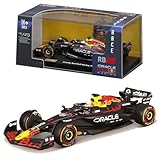
- Officially Licensed Replica – Authentic styling and branding from the original manufacturer
- Die-Cast Metal Construction – Durable metal body with detailed plastic components
- Highly Detailed Design – Realistic exterior styling and interior details
- Free-Rolling Wheels – Smooth movement for display or play
- Perfect for Collectors & Kids – Great gift for automotive fans
Ferrari’s 2004 season and F2004 statistics
5. Williams FW14B — 1992
The FW14B was arguably the most advanced car of its era. Williams won 10 of 16 races, and Formula 1’s historical analysis says the Williams set the fastest individual lap at every 1992 Grand Prix weekend except Hungary. The same analysis estimated that it was roughly 1.5% faster than the second-best McLaren on average—an enormous advantage by F1 standards.
Its combination of active suspension, traction control, excellent aerodynamics, Renault V10 power and strong mechanical design made it especially formidable in fast corners. The active suspension kept the car’s aerodynamic platform remarkably stable, allowing Williams to generate consistent downforce without the compromises imposed by conventional springs and dampers.
There was a driver-fit element. Nigel Mansell was particularly comfortable with the active-suspension system and extracted more from it than Riccardo Patrese. That does not undermine the car’s achievement, but it is a reminder that the fastest car and the fastest driver-car combination are not always identical.
Free tools Windows power users keep installed
One-click scans. No signup required.
Formula 1’s analysis of the FW14B · Formula 1 on the FW14B’s driver-car combination
6. Red Bull RB21 — 2025
The RB21 is the answer if the question is narrowly phrased as: Which F1 car has recorded the fastest official average-speed lap? Max Verstappen’s lap at Monza in 2025 took 1:18.792 and averaged 264.681 km/h (164.46 mph), edging Hamilton’s W11 record of 264.362 km/h.
That achievement required more than a large engine or a low-drag rear wing. The time was set over a complete qualifying lap, so the car had to carry speed through Monza’s chicanes and high-speed corners as well as reach an exceptional terminal velocity on the straights.
It is ranked sixth overall because one record-setting qualifying configuration does not establish season-long superiority. The RB21 was difficult to extract consistently, and the 2025 McLaren MCL39 was generally the more complete package over the season. The correct description is therefore the fastest F1 car ever recorded over one official qualifying lap by average speed, not unqualifiedly the fastest F1 car ever.
FIA 2025 Italian Grand Prix qualifying classification · Formula 1 onboard report of the RB21 record
7. McLaren MCL39 — 2025
The MCL39 was the most complete package of the 2025 season. McLaren won both championships, secured the constructors’ title after 18 Grands Prix and had won 12 of those 18 races at that point.
Its strength was balance rather than one spectacular headline number. The MCL39 combined strong qualifying pace with excellent tyre management and competitive performance at slow, medium- and high-speed circuits. That versatility made it more effective over a championship than a car that was unbeatable only at a particular type of track.
It sits below the RB21 in this ranking because the Red Bull set the all-time official average-speed record, but above several historically dominant cars because the MCL39 delivered a modern championship-winning package across a complete season. Its field advantage was not as overwhelming as the RB19’s or MP4/4’s.
McLaren’s technical look at the MCL39 · MCL39 technical specification · McLaren’s 2025 championship account
8. Mercedes W07 Hybrid — 2016
Mercedes won 19 of 21 races in 2016, with Lewis Hamilton winning 10 and Nico Rosberg nine. That paired-driver record is powerful evidence of the W07’s quality: both Mercedes drivers could win regularly, rather than one driver carrying an otherwise inconsistent car.
The W07 was the final and perhaps most complete expression of Mercedes’ first-generation hybrid dominance. It combined a formidable power unit with efficient aerodynamics, excellent tyre use and a mature chassis platform.
Its lower position is not a criticism of its dominance. The W07 ranks behind cars with stronger evidence of absolute peak speed, especially the 2017–2025 machines that benefited from regulations designed to produce much higher cornering performance.
The Tool Desk
Outbyte Driver Updater FREEFix the driver behind crashes, sound loss and screen glitchesFind Drivers →Outbyte PC Repair FREERepair Windows errors before they cause bigger problemsFix Now →Formula 1’s 2016 season review
9. McLaren MP4-20 — 2005
If “fastest” means highest straight-line speed recorded in a Grand Prix, the MP4-20 is the car to beat. Juan Pablo Montoya reached 372.6 km/h (231.5 mph) at Monza in 2005, a record listed by the FIA and Guinness World Records.
The MP4-20 was not merely a speed-trap specialist. It won 10 races in 2005 and had extraordinary qualifying and race pace. Its aerodynamic package and Mercedes V10 made it one of the fastest cars of the high-revving V10 era.
Reliability prevented it from becoming the season’s most successful car. Mechanical failures cost McLaren valuable points, and Renault’s R25 proved more effective over the championship. The MP4-20 is the clearest example of why a top-speed record cannot establish all-round superiority.
FIA background on the Monza top-speed record · Guinness World Records entry · Formula 1’s 2005 Italian Grand Prix results
What’s actually slowing this PC down?
Pick the symptom - the matching free tool is one click away.
10. Red Bull RB7 — 2011
The RB7 took 12 wins and 18 poles from 19 races, making it one of the most dominant qualifying cars in F1 history. Sebastian Vettel’s one-lap performances were often untouchable, while the car remained highly competitive over race distances.
Its defining technical feature was the exhaust-blown diffuser. By directing exhaust gases toward the diffuser, Red Bull maintained aerodynamic load through corners even when the driver was not fully on the throttle. The system was extremely effective but was subsequently restricted and ultimately outlawed.
Rank #3

- Mercedes Die-Cast Formula Vehicle in 1/43 scale
- Authentic Race Car and Driver's Helmet Details
- Acrylic Box with Decorative Sleeve
- #63 George Russell
The RB7 ranks below the RB19 because the later car combined qualifying speed, race pace, reliability, tyre management and adaptability more completely. The RB7’s advantage was nevertheless extraordinary, particularly when measured against its 2011 field.
Formula 1’s technical and statistical overview of the RB7
11. Ferrari SF71H — 2018
Kimi Räikkönen’s 2018 Monza qualifying lap in the SF71H averaged 263.587 km/h, making it the fastest official F1 lap in history until Hamilton’s W11 record in 2020 and Verstappen’s RB21 record in 2025.
The SF71H was also a genuine championship contender. It represented the peak of Ferrari’s late V6-hybrid development and had the power, aerodynamic efficiency and race pace to challenge Mercedes across the season.
Its record-setting lap demonstrates exceptional peak speed, but the SF71H was not dominant enough over a full campaign to rank alongside the RB19, W11, MP4/4 or F2004. It is a strong one-lap car, not the strongest all-round season package.
Formula 1’s report on Räikkönen’s 2018 Monza record
What’s actually slowing this PC down?
Pick the symptom - the matching free tool is one click away.
12. Red Bull RB18 — 2022
The RB18 mastered the first year of Formula 1’s modern ground-effect regulations. Red Bull won 17 of 22 races, Max Verstappen won 15 and the team took both championships.
Its greatest strength was not a headline top-speed record. Instead, the RB18 combined aerodynamic efficiency, tyre management and strong race pace while Red Bull learned how to exploit a difficult new ruleset. The car’s ability to generate performance without destroying its tyres was central to its success.
The RB19 was a major evolution of the same basic philosophy and was faster, more reliable and dramatically more dominant. That is why the RB18 ranks below its successor despite an outstanding 2022 record.
Formula 1’s Red Bull year-by-year record
13. Lotus 79 — 1978
The Lotus 79 was the mature expression of ground-effect aerodynamics. Its Venturi tunnels and diffuser accelerated airflow beneath the car, creating substantial downforce with comparatively little drag. That gave Lotus a major advantage in corners without sacrificing as much straight-line speed as conventional wing-based solutions.
Recommended Free Tools
The design transformed F1 engineering and helped Lotus dominate the 1978 championship. It belongs on this list because it changed what designers believed a racing car could do, not because its absolute lap times can be placed on the same scale as those of modern carbon-fibre, slick-tyre and hybrid-era cars.
Historical performance data from the 1970s are less standardized, and the car’s position is therefore more dependent on technical significance and performance relative to its rivals than on directly comparable timing data.
Formula 1’s history of Lotus and ground effect
14. Mercedes W196 — 1955
The Mercedes W196 was the benchmark of the early 2.5-litre era. Juan Manuel Fangio won the 1955 Drivers’ Championship, while Mercedes placed Fangio first and Stirling Moss second in the standings.
Its streamlined bodywork, sophisticated straight-eight engine and advanced chassis made it exceptionally fast for its period. The W196 demonstrated how much performance could be extracted through the coordinated development of engine, aerodynamics, suspension and tyres—even before the later revolutions in monocoque construction and ground effect.
It is difficult to assign the W196 a more precise position. The 1955 championship had fewer races, different tyre technology, very different safety conditions and less standardized timing data than modern F1. It is included as a period-defining benchmark, not as a claim that its lap speed was close to that of a 2025 car.
Formula 1’s 1955 drivers’ standings · 1955 Dutch Grand Prix results
15. Williams FW10/FW10B — 1985
Keke Rosberg’s 1985 qualifying lap at Silverstone averaged 259.01 km/h (160.94 mph), the fastest full-lap average-speed record at the time. It stood for nearly two decades.
The late-season FW10B upgrade transformed Williams into a formidable race-winning package, particularly at high-speed circuits. Its turbocharged Honda power and aerodynamic efficiency made it one of the quickest cars of the mid-1980s.
Free tools Windows power users keep installed
One-click scans. No signup required.
The record needs a major qualification: it was set on the much faster historic Silverstone layout, not the modern circuit. The FW10 also was not as dominant over an entire season as the MP4/4, FW14B or RB7. Because the car changed during 1985, this entry refers to the fastest competitive FW10 specification raced that season, including the FW10B development.
Motor Sport’s historical review of F1 speed records
Independent reader supportYour contribution helps us test, update, and keep practical guides available for everyone.Why the RB21 is not automatically No. 1
The RB21’s Monza lap is the factual answer to the narrowest version of the question. It is the fastest official average-speed lap currently recorded in Formula 1. But “fastest car” can mean performance over one qualifying lap, over a race distance, relative to the opposition or across an entire season.
Rank #4

- FERRARI F1 TOY CAR – Boys and girls ages 10 and up and Ferrari fans can build, display and race the LEGO Speed Champions Ferrari SF-24 F1 Race Car and driver set
- 1 DRIVER MINIFIGURE – This vehicle set includes a driver minifigure wearing a special Ferrari outfit and a winged helmet for kids to place inside the cockpit and role-play thrilling race action
- AUTHENTIC DETAILS – F1 race car with design details from the real-life 2024 version, including a rear wing, a halo bar, sponsor stickers and wider rear tires imprinted with “Pirelli”
- F1 FUN FOR THE WHOLE FAMILY – Race for the checkered flag alongside the whole family with other building sets (sold separately) in the LEGO F1 range
- BUILD & DISPLAY – After kids have enjoyed playing out racing stories with the Ferrari F1 toy, they can display it on a shelf or bedside table
The RB21’s record was set in a low-drag qualifying configuration at a circuit famous for long straights and fast corners. That is a valid and remarkable achievement, but it does not prove that the RB21 was superior to the RB19 at every circuit, in every weather condition or over every race stint. The 2025 McLaren MCL39 was generally the more complete package across the season, while the RB19’s 21 wins from 22 races provide much stronger evidence of sustained superiority.
Quick wins for a faster PC:
Scan for outdated or missing drivers - takes under a minuteDriver Scan →Clear out junk files and repair common Windows errorsFree Scan →Why qualifying is usually the best measurement of peak speed
Qualifying removes much of the fuel-load variation found in race data and gives drivers a chance to use fresh tyres and maximum performance modes. That makes an official qualifying lap the best conventional measure of a car’s peak circuit speed.
It is still not a laboratory test. A qualifying result can be affected by:
- driver quality and confidence;
- track evolution during the session;
- a tow or slipstream from another car;
- wind direction and speed;
- track temperature;
- tyre preparation;
- engine modes and energy deployment;
- traffic, yellow flags or red flags;
- setup compromises between qualifying and the race; and
- whether a team deliberately prioritizes race pace over one-lap performance.
That is why the RB21’s record is important evidence, but not sufficient evidence by itself to place the car above every other entry.
Why race wins can mislead
Race wins are useful, but they are not a pure car measurement. Results also depend on driver ability, reliability, strategy, weather, safety cars, team orders, rival failures, the points system, the number of races and the competitiveness of the second driver.
The Tool Desk
Outbyte Driver Updater FREEScan for outdated or missing drivers - takes under a minuteDriver Scan →Outbyte PC Repair FREERepair Windows errors before they cause bigger problemsFix Now →The RB19 illustrates both sides of the issue. Its 21 wins from 22 races are unparalleled in modern statistical terms, but Verstappen won 19 of Red Bull’s 21 victories and was an exceptional performer throughout 2023. The evidence for the car is stronger because Pérez also won twice and Red Bull was consistently competitive, but the driver cannot be removed from the result.
Paired-driver evidence is particularly useful. Senna and Prost repeatedly won in the MP4/4. Hamilton and Rosberg won 19 of 21 races in the W07. Schumacher and Barrichello combined for Ferrari’s 15 wins in 2004. By contrast, Mansell was much more comfortable with the FW14B’s active suspension than Patrese, so that car’s results combine outstanding technology with an especially strong driver-car fit.
Why modern cars are not automatically fastest at every circuit
Formula 1 regulations frequently reduce performance in one area while increasing it in another. Turbo boost limits, fuel-flow limits, grooved tyres, minimum-weight increases, aerodynamic restrictions, floor and diffuser changes, engine-mode restrictions and tyre regulations have all altered the speed equation.
The 2022 ground-effect rules changed how downforce was generated. The 2026 regulations introduce active aerodynamic modes, a greater electrical contribution and new power-unit rules. However, as of August 9, 2026, the season is still in progress and the 2026 Italian Grand Prix has not yet taken place. The 2026 cars therefore should not be ranked definitively, and the RB21 retains the all-time official Monza average-speed record unless a later 2026 session surpasses it.
A newer car can be faster in some corners but slower on a complete lap if it carries more drag, uses a less favorable tyre or operates under a less powerful engine formula. A lap record only means something when the exact circuit configuration, session type and conditions are identified.
Important record-keeping qualifications
Official qualifying versus practice
Not every famous speed claim comes from an official pole-position lap. Juan Pablo Montoya’s 2004 Williams FW26, for example, set an extremely high average-speed lap during a pre-qualifying session, but it was not the official qualifying lap that determined pole. It should not be placed on an identical footing with Hamilton’s 2020 W11 or Verstappen’s 2025 RB21 records without labeling the difference.
Top speed versus average lap speed
A speed trap records the car’s velocity at one point on a circuit. Average lap speed measures the entire lap. The MP4-20’s 372.6 km/h Monza top speed is therefore a straight-line record, while the RB21’s 264.681 km/h is an average over a complete official qualifying lap. They answer different questions.
Circuit layouts change
Silverstone’s 1985 layout was substantially faster than the modern circuit. Monza has changed its chicanes, kerbs and surface conditions, while Hockenheim, Imola, Spa and other circuits have also been revised. Lap times should never be compared without checking the precise circuit configuration and session.
PC Slower Than It Used to Be?
A free scan shows the junk files, broken settings and background clutter dragging Windows down - then fixes them in one click.Free scan · Windows 10 & 11Outdated Drivers Are Slowing You Down
One free scan finds every outdated or missing driver and matches the right update for your exact hardware.Free scan · exact hardware matchCars evolve during a season
A “car” is a season package, not necessarily one unchanging chassis. This list uses the fastest competitive specification actually raced. That is why the Williams entry is described as the FW10/FW10B and why the mature Lotus 79, rather than every early Lotus 78/79 configuration, is considered.
Honorable mentions
- Brawn BGP 001, 2009: Its double diffuser produced exceptional early-season pace and delivered both championships, although rivals reduced the advantage as the year progressed.
- Lotus 49, 1967: Its stressed-engine layout and Cosworth DFV created a revolutionary and exceptionally fast period package.
- Lotus 78, 1977–78: The pioneering ground-effect car laid the foundation for the more fully developed Lotus 79.
- Alfa Romeo 159, 1951: A hugely powerful supercharged Alfa Romeo and the last great car of that technical era.
- Mercedes W10, 2019: A highly complete Mercedes package whose season-long quality can be understated by headline statistics.
- Red Bull RB16B, 2021: Fast enough to defeat Mercedes in an exceptionally close championship fight.
- McLaren MCL38, 2024: The foundation for the MCL39 and a major late-season performance benchmark.
- McLaren M23, 1973–78: One of F1’s most successful long-lived designs, winning 16 Grands Prix across six seasons, although it was not a single-season peak-speed candidate.
Why this ranking differs from simpler “fastest F1 car” lists
A defensible list must not combine team-stated top speeds, official qualifying laps, practice-session performances, race wins and even salt-flat speed runs as though they were the same measurement. An F1 car modified for a land-speed attempt is not automatically a faster Grand Prix car, and a practice lap is not an official qualifying record.
The ranking also needs to account for cars that changed during a season, distinguish the SF71H’s actual 2018 season from a broad “2017-present” label, and include the 2025 RB21 and MCL39. Most importantly, it must separate the MP4-20’s straight-line record from the RB19’s season-long dominance and the RB21’s average-speed lap record.
Those distinctions are why there is a clear factual winner in some categories but no single objectively provable winner in every category.
Frequently Asked Questions
What is the fastest F1 car ever by official average lap speed?
As of August 9, 2026, it is the 2025 Red Bull RB21. Max Verstappen averaged 264.681 km/h around Monza during qualifying on September 6, 2025, with a lap time of 1:18.792.
What F1 car has the highest official top speed in a Grand Prix?
The McLaren MP4-20 holds the official Grand Prix top-speed record. Juan Pablo Montoya reached 372.6 km/h at Monza in 2005. That is a straight-line record, not proof that the MP4-20 was the fastest complete circuit car.
Is the Red Bull RB19 faster than the RB21?
The RB21 is faster by the narrow measure of official average-speed lap record. The RB19 has a stronger claim as the fastest complete season package because it won 21 of 22 races in 2023 and was more consistently dominant.
Can F1 cars from different eras be compared fairly?
Only approximately. Regulations, tyres, fuel loads, circuit layouts, timing standards, engine technology and safety requirements changed significantly. Relative performance against contemporary rivals is usually more meaningful than directly comparing absolute lap times.
The Bottom Line
Final answer: the Red Bull RB21 is Formula 1’s fastest car by the current official average-speed lap record, while the Red Bull RB19 is the best choice for the fastest complete Grand Prix car overall. The Mercedes W11 remains an exceptional all-round candidate, the McLaren MP4/4 has perhaps the greatest qualifying dominance, and the McLaren MP4-20 owns the highest official Grand Prix top-speed record. “Fastest” only becomes meaningful once the measurement is specified.
Quick Recap
Product prices and availability are accurate as of the date/time indicated and are subject to change. Any price and availability information displayed on Amazon at the time of purchase will apply.