Short answer: Tesla’s Cybercab has progressed from a 2024 unveiling to pilot production, limited production and public-road testing in 2026—but it is not yet a mass-produced consumer car or a widely deployed robotaxi. Tesla’s current Robotaxi service is a separate, broader program, and the company’s timetable for volume Cybercab production became less certain during the summer of 2026.
Unveiled on October 10, 2024, Cybercab is a purpose-built, two-seat autonomous vehicle presented without a steering wheel or pedals. The harder milestone now is not revealing the design; it is scaling a safe, legally compliant and economically viable no-controls fleet.
What Tesla’s Cybercab is—and what it is not
The Tesla Cybercab has moved beyond a concept-car reveal, but it is not yet a mass-produced consumer car or a widely available autonomous taxi. As of August 12, 2026, Tesla has begun pilot and limited production activity and has tested production-version Cybercabs on public roads in Austin. However, Tesla’s 2026 volume-production timetable became less certain during the summer, and the company’s current Robotaxi service should not automatically be described as a Cybercab fleet.
Cybercab is Tesla’s purpose-built robotaxi: a compact, two-seat vehicle designed around autonomous operation rather than a conventional Tesla with a driver-assistance system added to it. Tesla presented it without a steering wheel or pedals, with gull-wing-style doors and a planned role in a dedicated Robotaxi network.
PC Slower Than It Used to Be?
A free scan shows the junk files, broken settings and background clutter dragging Windows down - then fixes them in one click.Free scan · Windows 10 & 11Outdated Drivers Are Slowing You Down
One free scan finds every outdated or missing driver and matches the right update for your exact hardware.Free scan · exact hardware match#1 Best Overall

- 【LARGE STORAGE CAPACITY】Free up space in your vehicle with this roof rack cargo basket that can hold up to 200 LBS. Overall dimensions include: 46 in (L) x 36 in (W) x 5 in (H)
- 【BUILT TO LAST】The GarveeLife Universal Roof Rack Basket integrates powder-coated steel and electrophoretic technology to resist rust, corrosion, and extreme weather. Engineered for heavy-duty performance, it safeguards cargo during cross-country trips, camping, or long-term outdoor storage—built tough to outlast every adventure
- 【EASY INSTALLATION & COMPATIBILITY】Easily installed on the car roof with four universal U-bolts within minutes. Compatible with many types of vehicle crossbars,including Cars, SUVs, Pickups, and RVs(please make sure your car has a crossbar)
- 【SECURE TRANSPORTATION】Featuring Bottom metal bars and side rails, your items are securely supported during travel. And features a steel wind deflector fairing to protect cargo from wind damage and reduce wind resistance. Equipped with two reflective stickers on the rear, providing extra safety for nighttime driving
The central question has therefore changed. In 2024, the question was whether Tesla would build the vehicle it showed on stage. In 2026, the question is whether Tesla can safely, legally and economically scale a no-controls vehicle into a dependable fleet.
The October 2024 reveal
Tesla unveiled Cybercab at its We, Robot event on October 10, 2024. The presentation showed a small two-seat vehicle with no conventional driver controls. Tesla positioned it as a vehicle designed from the ground up for autonomy, rather than as a privately owned car that would normally be driven by a human.
Tesla’s investor materials grouped Cybercab with the larger Robovan as vehicles developed specifically for autonomous transportation. The event’s design exercise was important because removing the steering wheel and pedals changes the vehicle’s interior, controls, passenger experience and regulatory requirements. It also makes clear that Tesla was proposing a fleet product, not simply another consumer model in the company’s lineup. (Tesla’s October 2024 investor materials)
The reveal did not establish a retail price, a customer-delivery schedule, a final production specification or proof that the vehicle could operate autonomously in every location and weather condition. Those distinctions matter: a dramatic prototype presentation is not the same thing as a certified, high-volume commercial vehicle.
Free tools Windows power users keep installed
One-click scans. No signup required.
Cybercab production status: reveal vehicle to limited production
Tesla originally targeted volume production in 2026. That target appeared in the company’s 2024 investor communication and was still described as on schedule in a January 2026 filing. The subsequent updates, however, show a project that is progressing but not yet at mature fleet scale.
| Date | What happened | Why it matters |
|---|---|---|
| October 10, 2024 | Tesla unveiled the two-seat, no-steering-wheel, no-pedal Cybercab. | The company introduced a purpose-built autonomous vehicle rather than a conventional consumer Tesla. |
| October 2024 | Tesla’s investor materials described Cybercab as designed from the ground up for autonomy and targeted volume production in 2026. | This was a production ambition, not evidence of customer availability. |
| January 2026 | Tesla’s filing still described Cybercab as on schedule for volume production beginning in 2026. | The original schedule remained the company’s stated plan early in the year. (January 2026 filing) |
| First quarter of 2026 | Tesla’s Form 10-Q said pilot production had begun. | Cybercab had entered production engineering and pilot-build work, but pilot production is not high-volume manufacturing. (Tesla’s Q1 2026 Form 10-Q) |
| Second quarter of 2026 | Reporting indicated that Cybercab production began in Texas, alongside public-road testing of production-version vehicles in Austin. | The vehicle had progressed from a stage presentation to physical production and road testing. (Axios report) |
| July 22, 2026 | Reporting on Tesla’s Q2 shareholder update said the company no longer maintained the same firm commitment to volume production during 2026 and was focused on increasing battery output, including 4680 cells, before scaling Cybercab. | Production had started, but the timetable for meaningful volume had become less definite. (TechCrunch’s report on the Q2 update) |
The most accurate summary is that Cybercab production exists, but mass availability does not. A pilot line can produce vehicles for validation, engineering changes and testing without supporting a large commercial fleet. Tesla’s battery-production work is another practical constraint: a robotaxi program requires not only a finished vehicle design but also enough cells, service capacity, charging infrastructure and replacement parts to keep vehicles operating continuously.
Rank #2

- ✅ ✅ The WEIZE roof cargo rack measures 64" x 39" x 5" and includes a cargo bag, cargo net, and tie-down straps. Please ensure these dimensions are compatible with your vehicle. If you need a smaller size, please search for ASIN B0DSVWNJTP.
- ✅ EXTRA LARGE STORAGE CAPACITY - Free up space in your vehicle with this roof rack cargo basket that can hold up to 200 lbs. Overall dimensions: 64"(L) x 39"(W) x 5"(H).
- ✅ RIGID CONSTRUCTION - Heavy duty steel construction with black powder coating resists weather elements and corrosion, offering many years of long-lasting use.
- ✅ EXTRA SECURITY - Bottom metal bars and side rails keep your items secure during traveling. Features a steel wind fairing to protect cargo from wind damage and reduce wind resistance. The included waterproof bag, cargo net and rachet straps provide more strength and protection when stretched over larger cargo items.
- ✅ EASY INSTALLATION - Our roof cargo carrier fits crossbars with a maximum thickness of 1.35" and a maximum width of 4.6". The welded frame comes in four sections, easily mounting onto most car's crossbars with four universal U-bolts. We highly recommend double-checking the dimensions and specifications before placing your order to avoid any inconvenience.
Is Tesla’s current Robotaxi service using Cybercabs?
Not necessarily—and readers should keep the vehicle and the service separate.
Tesla operates a limited Robotaxi service through a dedicated app. Its current Robotaxi website says Cybercab will offer rides in customers’ areas in the future. That wording indicates that the live service and the purpose-built Cybercab fleet are not synonymous today. The current program has used Tesla vehicles other than Cybercab, so an expansion of Robotaxi service should not be treated as proof that Cybercabs make up the fleet.
The Tool Desk
Outbyte PC Repair FREERepair Windows errors before they cause bigger problemsFix Now →Outbyte Driver Updater FREEScan for outdated or missing drivers - takes under a minuteDriver Scan →Tesla expanded Robotaxi service to Orlando and Tampa in July 2026, according to Reuters reporting carried by Yahoo Finance. That was an expansion of the broader Robotaxi program—not confirmation of a nationwide commercial launch of the no-controls Cybercab. (Tesla Robotaxi; Reuters report via Yahoo Finance)
A useful way to understand the distinction is:
| Term | Meaning | What should not be assumed |
|---|---|---|
| Cybercab | The purpose-built two-seat autonomous vehicle Tesla unveiled and is now producing and testing in limited quantities. | That it is available for ordinary consumers to buy or that it already forms most of Tesla’s Robotaxi fleet. |
| Tesla Robotaxi | The ride service and operating program accessed through Tesla’s Robotaxi app. | That every ride is provided by a Cybercab. |
| FSD Supervised | Tesla’s consumer driver-assistance system, which requires an attentive human driver. | That it is equivalent to a fully autonomous Cybercab. |
How autonomous is Cybercab?
Cybercab is intended to operate without a human driver. Its lack of a steering wheel and pedals reflects that intended operating model. But the design goal alone does not answer the harder questions: where the system can drive, how it handles unusual situations, how passengers request help, what happens after a crash or breakdown, and whether remote assistance is needed.
Cybercab should also not be conflated with FSD Supervised in privately owned Teslas. Tesla’s own investor materials state that FSD Supervised requires active driver supervision and does not make the vehicle autonomous. A production Cybercab is intended for a different operating model, but Tesla has not publicly supplied a complete, independently validated technical description establishing that the production system has achieved a universally accepted Level 4 or Level 5 capability. (Tesla investor materials on FSD Supervised)
Tesla’s first-responder guidance gives a glimpse of the operational structure required around an autonomous vehicle. It discusses how emergency personnel can interact with a Cybercab and how Tesla support may become involved when a vehicle or passenger needs assistance. That is an important part of the product: a robotaxi network is not only a self-driving computer. It is also a dispatch, communications, emergency-response and remote-support system. (Tesla’s Robotaxi first-responder materials)
Rank #3

- 【840D CHAMPION QUALITY MATERIAL】 Made with heavy-duty 840D abrasion-resistant PVC fabric, this ultra-durable car roof cargo carrier stands up to any rough treatment or harsh weather. Better still, the triple-reinforced welded seams make it hard to tear or rip for years to come.
- 【MORE THAN WATERPROOF】 Featuring waterproof zipper wrapped with 6 inches widened velcro zipper flaps, our vehicle cargo carriers will exceed your expectations with the waterproof effet. The reinforced seams will make it possible "zero leakage" even in downpours.
- 【EASY INSTALLATION】 Our roof rack cargo carrier comes with an anti-slip mat and 8 thickened adjustable straps that will keep the cargo bag in place. The smooth zipper, adjustable straps, door hooks and robust buckles allows you to effortlessly secure it to any car.
- 【SECURE FIT & LARGE CAPACITY】 Our 21 cubic feet rooftop cargo bag is compatible with vehicles with our without roof rack, the large capacity can keep the shape nicely, even when holding many luggage cases, blanket, tents, sleeping bags and more.
- 【PACKAGE LIST】You will receive 1x roof top carrier bag, 1x storage bag, 1x anti-slip mat, 6x padded door hooks, 2x extra luggage straps, 1x luggage lock.
The unresolved regulatory issue
Removing the driver controls creates a regulatory problem in addition to the engineering problem. The National Highway Traffic Safety Administration says that no fully automated vehicle is currently available for sale in the United States and that vehicles currently sold to consumers require the driver’s full attention. NHTSA separately recognizes that automated vehicles can operate in limited testing, research and pilot programs on public roads. That distinction leaves room for testing or restricted service without meaning that a no-controls vehicle has blanket approval for ordinary sale across the country. (NHTSA automated-vehicle safety guidance)
NHTSA also asked Tesla for detailed information about its Robotaxi plans. The request covers subjects including planned vehicle numbers, launch dates, locations, human supervision, teleoperation or remote assistance, system architecture, the operational design domain and intervention data. It also asks about the relationship between Robotaxi technology and FSD Supervised. The request demonstrates that important deployment and safety details remain under regulatory scrutiny; it does not show that Tesla has received blanket federal approval or completed every regulatory step. (NHTSA information request to Tesla)
The federal rules may evolve. In June 2026, NHTSA began rulemaking intended to remove the manual brake-pedal requirement for vehicles designed to be driven exclusively by automated driving systems, while preserving braking-performance requirements. That could be relevant to Cybercab, but beginning a rulemaking is not the same as finalizing a rule or authorizing Tesla’s specific vehicle. (NHTSA brake-pedal rulemaking announcement)
There is also a useful precedent, but it should not be overstated. In August 2025, NHTSA granted Zoox a demonstration exemption for purpose-built automated vehicles. That shows that vehicles without conventional driver controls may require specific regulatory treatment. It does not establish that Tesla has received the same exemption or that Cybercab has identical legal status. (NHTSA announcement on the Zoox demonstration exemption)
Why Cybercab matters to Tesla
Cybercab is a bet on a different business model from selling an electric car to one owner. Tesla’s filings describe Robotaxi as an autonomous ride-hailing platform and Cybercab as a purpose-built vehicle that may join that fleet over time. Instead of generating revenue primarily when a customer buys a car, the model is intended to combine fleet ownership or operation, passenger trips and software-enabled transportation services. (Tesla’s 2025 annual filing)
A purpose-built robotaxi could, in theory, reduce hardware associated with human driving, use its passenger cabin more intensively than a privately owned car and be optimized for centralized maintenance and fleet operations. Those are strategic possibilities, not demonstrated financial results. They depend on high utilization, acceptable insurance and maintenance costs, reliable charging, efficient dispatching, regulatory permission and autonomous performance that is safe enough for sustained commercial use.
Rank #4
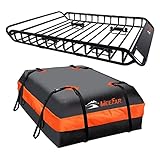
- DURABLE BUILD - Tubular steel in black epoxy powder coating to promote high strength and a lightweight design. and covered in a rust free coating. It is rated for 200 lbs
- OVERALL DIMENSIONS - 51"(L) x 36"(W) x 5"(H), 200 lbs Capacity (Please also consider the maxium weight limit of the vehicle roof)
- AERODYNAMIC - Features a wind shield that helps protect cargo from wind damage and keeps the vehicle more aerodynamic.
- EASY ASSEMBLY- Easy to assemble and install on your vehicles cross bars, mounting with four universal U-bolts. you will need cross bars to use this roof basket.
- ACCESSORY INCLUDED - Waterproof rooftop bag (15 Cubic feet), Cargo net with attachment hooks. Ratchet Straps.
The risks are correspondingly large:
- Manufacturing scale: Tesla must move from pilot builds to a repeatable production system capable of supplying a fleet.
- Battery supply: The company’s focus on 4680-cell output shows that battery availability can affect the Cybercab timetable.
- Operational limits: A vehicle may work in a defined city, route type or weather range without being ready for every road and condition.
- Safety performance: Public confidence and regulatory acceptance will depend on real-world intervention, collision and failure data—not only demonstrations.
- Remote assistance: Tesla must explain how passengers and vehicles receive help, while making clear the boundary between remote assistance and remote driving.
- Regulatory approval: A no-controls vehicle may require regulatory exemptions or revised rules in addition to ordinary vehicle compliance.
- Fleet economics: The proposed advantages remain theoretical until Tesla demonstrates the cost, uptime and utilization of an operating fleet.
Can you buy a Tesla Cybercab?
There is no evidence in the current production updates that Cybercab is available as a normal consumer vehicle. Tesla has not established a broad customer-order process, retail price or delivery schedule for the vehicle itself. It should be treated as a fleet and development product, not as a new Tesla model available through the company’s ordinary online configurator.
There is, however, a small official collectible. The Tesla Shop listed an official Tesla Cybercab Wind-up Racer, a 1:43-scale die-cast model with a wind-up mechanism and matte-gold finish. The listed price was $35 at the time of research, and Tesla said purchase eligibility required Tesla vehicle ownership. Merchandise availability and price can change, so this should not be confused with the Cybercab vehicle itself.
What’s actually slowing this PC down?
Pick the symptom - the matching free tool is one click away.
Readers searching for a Tesla Cybercab diecast model on a third-party marketplace should verify the seller, scale, licensing and whether the item is an official Tesla product. Tesla’s Shop listing confirms that the collectible concept exists; it does not prove that the official item is sold through Amazon or that every similarly named marketplace listing is Tesla-authorized.
The bottom line on Tesla Cybercab
Tesla’s Cybercab is no longer only a stage prop: pilot production began in the first quarter of 2026, production followed in the second quarter, and production-version vehicles have been tested on public roads. But that progress should not be mistaken for a scaled autonomous fleet. Tesla’s volume-production language became less firm in July, the Robotaxi service remains distinct from the future Cybercab deployment, and the vehicle’s safety, operating limits, remote-support model and regulatory status remain central unanswered questions.
The fairest description as of August 12, 2026 is: an active, limited-production autonomous-vehicle program with a functioning but limited Robotaxi service—not a widely available consumer car and not yet a fully scaled national robotaxi network.
Frequently Asked Questions
Can consumers buy the Tesla Cybercab?
No. As of August 12, 2026, Cybercab is not established as a normal consumer vehicle with a public retail-order process, confirmed price or broad delivery schedule. Tesla has begun limited production and testing, but the vehicle is intended primarily for the company’s Robotaxi program.
Quick wins for a faster PC:
Scan for outdated or missing drivers - takes under a minuteDriver Scan →Clear out junk files and repair common Windows errorsFree Scan →Best Value

- [840D CHAMPION QUALITY MATERIAL] Made with heavy-duty 840D abrasion-resistant PVC fabric, this ultra-durable car roof cargo carrier stands up to any rough treatment or harsh weather. Better still, the triple-reinforced welded seams make it hard to tear or rip for years to come.
- [MORE THAN WATERPROOF] Featuring waterproof zipper wrapped with 6 inches widened velcro zipper flaps, our vehicle cargo carriers will exceed your expectations with the waterproof effet. The reinforced seams will make it possible "zero leakage" even in downpours.
- [EASY INSTALLATION] Our roof rack cargo carrier comes with an anti-slip mat and 8 thickened adjustable straps that will keep the cargo bag in place. The smooth zipper, adjustable straps, door hooks and robust buckles allows you to effortlessly secure it to any car.
- [SECURE FIT & LARGE CAPACITY] Our 15 cubic feet rooftop cargo bag is compatible with vehicles with our without roof rack, the large capacity can keep the shape nicely, even when holding many luggage cases, blanket, tents, sleeping bags and more.
- [PACKAGE LIST] You will receive 1x roof top carrier bag, 1x storage bag, 1x anti-slip mat, 6x door hooks, 2x extra luggage straps, 1x luggage lock.
Is Tesla’s current Robotaxi service made up of Cybercabs?
Not based on Tesla’s current public Robotaxi information. Tesla says Cybercab will offer rides in customers’ areas in the future, while the current limited Robotaxi service has used Tesla vehicles other than the purpose-built Cybercab. Service expansion should therefore not be treated as proof of a large Cybercab fleet.
Is the Cybercab fully autonomous?
Cybercab was designed and presented as a vehicle without a steering wheel or pedals, intended to operate without a human driver. That does not by itself prove a universally accepted Level 4 or Level 5 capability. Tesla has not provided a complete independently validated technical description resolving every question about operating limits, safety performance and remote assistance.
Is Cybercab the same as Tesla FSD?
No. Tesla says FSD Supervised requires active driver supervision and does not make a consumer Tesla autonomous. Cybercab is intended for a different, driverless operating model, even though the relationship between the two systems remains part of regulatory scrutiny.
When will Tesla Cybercab production begin?
Tesla unveiled Cybercab on October 10, 2024. Pilot production began during the first quarter of 2026, and reporting indicated that production and public-road testing followed in the second quarter. However, Tesla’s previously stated 2026 volume-production timetable became less certain in July 2026.
Recommended Free Tools
The Bottom Line
Bottom line: Cybercab has advanced from its October 2024 unveiling to limited production and road testing, but Tesla has not yet demonstrated high-volume deployment. The vehicle, the current Robotaxi service and consumer FSD Supervised remain three different things, while production scale, battery supply, safety validation and regulation are still unresolved.
Quick Recap
Product prices and availability are accurate as of the date/time indicated and are subject to change. Any price and availability information displayed on Amazon at the time of purchase will apply.




