Recommended Free Tools
Use your vehicle’s maintenance schedule or oil-life monitor, and change the oil when the first applicable time or mileage limit arrives. Synthetic oil alone does not justify extending the interval. The exact schedule depends on your vehicle’s model year, engine, market, and driving conditions.
Which comes first: time or mileage?
Follow the schedule for your specific vehicle. If it gives both a calendar limit and a mileage limit, whichever one you reach first is the deadline. A car driven only a little can still need an oil change when its time limit arrives.
For vehicles with an oil-life monitor, follow the monitor as directed by the owner’s manual. Mobil likewise advises owners to follow the vehicle maker’s recommendations, particularly while the vehicle is under warranty: Mobil’s synthetic-oil guidance.
How to find the right interval for your vehicle
- Check the owner’s manual for the exact vehicle. Match the model year, engine, and market; do not assume another version of the same model uses the same schedule.
- Look for an oil-life monitor procedure. If equipped, the manual explains whether to use the monitor and what to do when it signals service.
- Check whether the manual defines severe service. It may provide a different schedule for particular operating conditions.
- Use oil that meets the specified requirements. Confirm both viscosity and service classification in the manual; a grade mentioned on an oil product page is not a universal fit.
What if you hardly drive?
Low mileage does not automatically cancel a time limit in the maintenance schedule. For example, the 2002 Honda Civic Coupe manual says, “Service at the indicated distance or time, whichever comes first.” Its normal schedule lists a milestone of 10,000 miles/16,000 km/1 year; those figures apply to that model’s schedule, not to other vehicles. The manual also gives a separate schedule for severe conditions. See the 2002 Honda Civic Coupe Owner’s Manual.
Windows Errors? Fix Them Before They Spread
Repair common Windows errors and clear accumulated junk for a smoother, more stable PC - no reinstall needed.Free scan · no reinstallOutdated Drivers Are Slowing You Down
One free scan finds every outdated or missing driver and matches the right update for your exact hardware.Free scan · exact hardware match#1 Best Overall
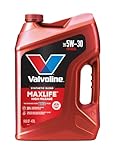
- Formulated for engines with 75,000 miles or more, Valvoline MaxLife High Mileage synthetic blend is formulated with seal conditioners to help prevent oil leaks and reduce oil consumption
- Delivers 20% better wear protection and 15% better sludge defense than industry standards to help prevent engine breakdown
- Extra detergents safeguard against friction, corrosion and deposits to keep high-mileage engines clean
- Advanced friction-fighting additives help maximize performance and improve fuel efficiency
- Provides performance benefits for high mileage, new and re-built engines alike
Does synthetic oil last longer between changes?
Synthetic oil can support longer intervals than conventional oil in some circumstances, but that does not set a safe interval for every car. Mobil says the interval depends on factors including the oil brand, driving style, and conditions, and directs drivers to their owner’s manuals. Its FAQ mentions intervals ranging from 3,000 to 20,000 miles on some new cars; this is a broad range described by Mobil, not a recommendation for any particular vehicle. See Mobil’s oil-change FAQ.
Do not treat oil-product protection claims as replacements for your vehicle’s schedule. Mobil advertises 25,000 miles or one year, whichever comes first, for its specific Mobil 1 Extended Performance High Mileage 0W-20 product. The claim is product-specific, and the listed 0W-20 grade should not be assumed to suit your vehicle. Confirm the oil specification and service interval in your manual. See Mobil 1 Extended Performance High Mileage product information.
Rank #2

- 6X better wear protection on critical engine parts than industry standards**
- 1.3X better sludge protection than industry standards*
- 3X Stronger against viscosity breakdown than leading full synthetic^
- Protection for 10,000 miles between oil changes
- Meets or exceeds the following specifications: API SP/SN PLUS/SN | ILSAC GF-6 | GM dexos1 Gen 3 | Meets Ford WSS-M2C947-B1 | Meets Ford WSS-M2C962-A1 |
When severe driving conditions change the decision
Frequent towing or hauling, dusty or dirty operation, racing or commercial use, and excessive idling are examples Mobil identifies as conditions that may affect service timing. Check your owner’s manual for its own definition of severe use and the corresponding schedule; classifications and intervals are vehicle-specific. Mobil’s full-synthetic limited warranty also sets product-warranty conditions, including an oil change every six months, while directing warranty-covered vehicle owners to the vehicle’s oil-life sensor or owner’s-manual interval. That is a condition of Mobil’s warranty, not a universal oil-change rule. See Mobil’s Full Synthetic limited warranty.
Quick Recap
Best Value

- Designed for vehicles with 75,000 miles or more, Valvoline MaxLife Full Synthetic High Mileage Motor Oil helps maximize engine life and performance for the many miles still ahead
- Formulated with seal conditioners to help prevent oil leaks, reduce oil consumption, and improve fuel economy
- Delivers 50% stronger wear protection than industry standards for superior defense against friction and wear
- Provides 20% stronger sludge defense than industry standards to protect against harmful buildup and deposits
- Offers 2.5X better heat protection than industry standards to safeguard engines in extreme conditions
Rank #4

- 3X Stronger than the leading full synthetic*
- 10X Better high stress performance**
- 20,000 miles between oil changes***
- Viscosity breakdown as measured in Kurt Orbahn test on 5W-30 grade
- As measured in Seq IX test under high load/torque conditions vs. API SQ test limits
Rank #3

- 3X Stronger than the leading full synthetic*
- 10X Better high stress performance**
- 20,000 miles between oil changes***
- Viscosity breakdown as measured in Kurt Orbahn test on 5W-30 grade
- As measured in Seq IX test under high load/torque conditions vs. API SQ test limits
What not to use as your interval
- A generic mileage rule: schedules vary by vehicle, and an oil maker’s stated range is not your car’s service interval.
- A synthetic-oil label by itself: the word “synthetic” does not override the owner’s manual or oil-life monitor.
- Another vehicle’s schedule: even a manufacturer’s example applies only to the model and conditions it names.
- A product protection claim: check your vehicle’s required viscosity and service classification, then follow its maintenance guidance.
Product prices and availability are accurate as of the date/time indicated and are subject to change. Any price and availability information displayed on Amazon at the time of purchase will apply.
The Tool Desk
Outbyte Driver Updater FREEScan for outdated or missing drivers - takes under a minuteDriver Scan →Outbyte PC Repair FREERepair Windows errors before they cause bigger problemsFix Now →