What’s actually slowing this PC down?
Pick the symptom - the matching free tool is one click away.
A compact riding mower is often the better fit for a smaller or obstacle-filled lawn where turning and access matter most. A lawn tractor is often the more versatile choice for a larger, open property or for work beyond mowing, such as towing an approved cart or using a compatible seasonal attachment. Those are category tendencies, not guarantees: compare the specific machines, your property layout and the operator’s manual before choosing.
What is the difference between a riding mower and a lawn tractor?
“Riding mower” is a broad label for a mower the operator rides, and some sources use it interchangeably with “lawn tractor.” The distinction is therefore not perfectly standardized. In this comparison, a riding mower means a compact, primarily mowing-focused machine; a lawn tractor means a tractor-style ride-on mower that may support additional approved tasks. Check the configuration and capabilities of the model rather than relying on its name alone. Briggs & Stratton’s comparison discusses the categories, while Purdue Extension’s tractor guidance addresses broader tractor uses.
As an Amazon Associate I earn from qualifying purchases.
Deck position and turning affect access
Many compact riding mower designs place the cutting deck forward, while lawn tractor decks are often mounted centrally. A forward or low deck may reach beneath some low obstacles, but access depends on the machine’s actual dimensions and clearance. Tractor steering and geometry also affect how much room it needs to turn. Measure tight gates, storage openings and turning areas, then compare them with the model specifications. Briggs & Stratton and Husqvarna’s UK guidance describe these general design differences.
Which machine suits your property?
Choose a compact riding mower when access matters most
A compact rider can make sense when the lawn is smaller, broken up by trees or beds, or difficult to navigate with a wider machine. Its potential advantage is maneuverability, not a guaranteed faster cut: tight obstacles can still require careful turns, and the actual turning circle and deck layout vary by model.
#1 Best Overall

- PEAK POWER TECHNOLOGY: Combines power of up to six EGO 56V ARC Lithium batteries to deliver up to 20,000 watts of power, equivalent to a 21-horsepower gas engine.
- LONG RUNTIME: Cordless tractor cuts up to 1.5 acres on a single charge with six included 6.0Ah batteries.
- CUSTOMIZE YOUR RIDE: Digital LCD display includes three blade settings, three drive speeds, and cruise control. Mows at up to 6 MPH.
- TWELVE CUTTING HEIGHT POSITIONS: Easily adjust the cutting deck on the electric riding mower to get the grass height you want, anywhere from 1.5 to 4.5 inches.
- REAR TOW HITCH: Haul loads around your property with Power Beyond Belief.
Consider a lawn tractor for open lawns and additional tasks
A wider deck can be useful on an open lawn where you can mow in longer, straighter passes. Manufacturer guidance describes lawn tractors as suitable for medium-to-large open lawns, but that is not a universal acreage threshold. Property shape, obstacles, deck width, turning room and storage access all affect whether a tractor is practical. Husqvarna’s guidance is for the UK market; equipment and attachment availability can differ elsewhere.
A lawn tractor may also be the stronger fit if you want one machine to help with more than mowing. Virginia Cooperative Extension lists uses such as towing and operating equipment for tasks including tilling, sweeping, seeding, spreading, spraying and aerating. Husqvarna’s UK guidance also describes uses such as sweeping leaves, moving snow, spreading fertilizer and towing a trailer. These examples do not mean every tractor can do every job: confirm that an implement is approved for the specific model and check its limits. Virginia Cooperative Extension’s tractor guide and Husqvarna’s UK page provide the cited use guidance.
Rank #2

- 24HP/726cc FR730 engine
- 54 inch FAB Deck
Compare specific models before deciding
Once you have narrowed the category, compare the machines you can actually buy and service in your area. A model’s specifications can erase or reverse broad differences between categories.
Free tools Windows power users keep installed
One-click scans. No signup required.
- Property geometry: Consider the area to mow, narrow gates, trees, beds, ponds, low structures, turning space at boundaries and storage space.
- Turning and access: Check the turning circle, deck position, clearance beneath low obstacles and whether you can turn without driving over beds or other sensitive areas.
- Mowing setup: Compare deck width, cut-height range, discharge, mulching or collection options, and access for cleaning and service. Verify each detail in the model specifications.
- Terrain: Consult the operator’s manual for slope instructions and limits, traction and stability guidance. Consider surface irregularities and ground conditions; category alone does not establish that a machine is safe on a particular slope.
- Other jobs: If you need to tow or use implements, check the machine’s towing capacity and the approved attachments for that exact model. Do not assume a cart, sweeper, blade or seeder will fit.
- Ownership logistics: Compare purchase cost, routine maintenance, local parts and service, storage and transport. No current comparative prices or independent performance tests are established here, so use current local quotes and model documentation.
How to make the choice
- Map the route. Measure the narrowest gate and storage opening, identify low obstacles and note where the machine must turn.
- Decide whether mowing is the only job. If you need towing or seasonal tasks, identify the specific implements first, then verify model-level approval and limits.
- Match the deck and dimensions to the lawn. Compare deck width and machine size with the available turning space and obstacles; a wider deck is not automatically an advantage in a cramped layout.
- Check terrain guidance. Read the current operator’s manual for the model’s slope instructions and operating limits before using it on a grade.
- Compare ownership support. Check local servicing, parts availability, storage and transport alongside the purchase price.
What about hills?
Do not choose between these categories on the assumption that one is always safe on slopes. Virginia Cooperative Extension advises operating a tractor slowly up and down a slope. That is general safety guidance, not permission to mow any particular grade. Follow the current operator’s manual for the exact machine, respect its slope limits and avoid risky turns on inclines. Virginia Cooperative Extension’s tractor safety guide provides the cited general guidance.
Quick Recap
Rank #4

- Cleaner, more even cuts than gas with constant 17K ft/min blade speed
- Out-cut traditional gas-powered mowers and conquer 2.5 acres with an industry-leading 8mph mowing speed
- 4X quieter than gas with LED Lights for early morning and late evening mowing
- Industry's only rear storage bin with universal front and rear attachment capability
- Removable battery isn't limited to just the mower—it's compatible with over 75 other Greenworks 60v tools
Rank #3
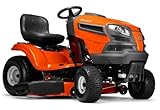
- Briggs & Stratton 19 HP 540cc Engine
- Pedal-Operated Transmission: Keep both hands on the wheel for more control
- 42-Inch Twin Blade Stamped Mower Deck
Product prices and availability are accurate as of the date/time indicated and are subject to change. Any price and availability information displayed on Amazon at the time of purchase will apply.




