Recommended Free Tools
The Porsche most likely meant by “the ultra-rare 1970s Porsche” is the 911 Carrera RS 2.7, introduced in 1972 and associated with the 1973 model year. Porsche planned it as a road-approved homologation special, initially targeting 500 cars; the company says it ultimately built 1,580. That is a limited production run, not a count of surviving cars or proof of current collector demand.
What is the rare 1970s Porsche collectors are chasing?
The 911 Carrera RS 2.7 was a road-going sports car developed to qualify a 911 for competition. Porsche’s then Head of Testing for series production cars, Peter Falk, recalled: “The 911 Carrera RS 2.7 was intended as a homologation special. It was to be a very light, fast sports car.” Porsche’s 2022 anniversary account describes how that competition purpose shaped the car’s development.
Development began in May 1972 with a team of about 15 engineers, joined by production staff. Porsche presented the car at the Paris Motor Show on October 5, 1972. The company initially planned 500 road-approved examples to homologate the RS for Group 4 Special GT competition. All 500 had sold by the end of November 1972, so Porsche expanded production.
How many Porsche 911 Carrera RS 2.7s were made?
Porsche reports that it built 1,580 RS 2.7s. That manufacturer-reported figure is total production, not the number still on the road or available to buy. Porsche says that after the 1,000th example, the car was homologated for Group 3 as well as Group 4.
#1 Best Overall
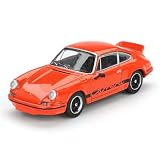
- Brand new box, Comes in a blister pack.
- Real rubber tires, Authentic detail.
- Detailed interior, Exterior.
- Authentic Paint & Graphics
- Die-cast metal body and chassis
The initial 500-car plan explains the RS’s homologation origins; it is not the final production total. Porsche’s account also says 1,308 buyers chose the Touring package, but that figure alone does not reconcile every variant or establish a complete production breakdown. See Porsche’s account of the RS variants for its description of those configurations.
What made the RS 2.7 distinctive?
Porsche describes the RS 2.7 as the first series-production car with spoilers at both the front and rear. Its raised rear spoiler became known as the “duck tail.” Weight reduction and aerodynamic performance were central development priorities, alongside the engine and chassis. The spoiler was therefore more than a styling signature: it reflected the car’s competition-minded engineering.
Rank #2

- Brand new box.
- Real rubber tires.
- Detailed interior, exterior.
- Officially licensed product.
- Made of diecast with some plastic parts.
The RS’s road approval mattered as much as its performance. Porsche needed a production car to meet homologation requirements before the related competition program could proceed. The company’s history of the RS 2.7 also places its aerodynamic work in that homologation context.
RS 2.7 Touring, Sport/Lightweight, and RSR 2.8: what is the difference?
These names describe related but distinct things. Touring and Sport/Lightweight refer to RS 2.7 configurations; the RSR 2.8 is a racing derivative, not another name for the road-going RS.
The Tool Desk
Outbyte PC Repair FREERepair Windows errors before they cause bigger problemsFix Now →Outbyte Driver Updater FREEFix the driver behind crashes, sound loss and screen glitchesFind Drivers →Rank #3
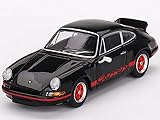
- Brand new box. Authentic detail. Real rubber tires. True-to-scale detail. Detailed wheel design. Detailed under-chassis. Soft rubber side mirrors. Detailed interior, exterior. Comes in a blister pack. Officially licensed product. Die-cast metal body and chassis. Manufacturer's original unopened packaging. Dimensions approximately L-2.75 inches long.
| Model or configuration | What it describes | How to distinguish it |
|---|---|---|
| 911 Carrera RS 2.7 Touring | A road-going RS 2.7 package | The Touring package was selected by 1,308 buyers in Porsche’s account; that figure is not a complete breakdown of every variant. |
| 911 Carrera RS 2.7 Sport/Lightweight | A more focused, lighter RS 2.7 configuration | It prioritizes reduced weight over the Touring configuration’s emphasis on road equipment. |
| 911 Carrera RSR 2.8 | A racing derivative related to the RS 2.7 | It is a competition car, not interchangeable with the road-approved RS 2.7. |
Porsche’s anniversary account places the RSR’s racing debut at the Tour de Corse in November 1972 and says the company expanded the 911’s racing program in 1973. The RS 2.7 supplied the road-car homologation basis; the RSR belonged to the racing side of that story.
Independent reader supportYour contribution helps us test, update, and keep practical guides available for everyone.What does “ultra-rare” mean in this case?
The term is best understood as shorthand for a historically significant car built in limited numbers: Porsche reports 1,580 examples, far fewer than a mass-market production run. The available production figure does not establish how many cars survive, how many are currently offered for sale, or whether collector demand has risen over time. No current price or market-availability figure follows from the production history alone.
Quick Recap
Best Value

- Brand new box, Comes in a blister pack.
- Real rubber tires, Authentic detail.
- Detailed interior, Exterior.
- Authentic Paint & Graphics
- Die-cast metal body and chassis
Rank #4
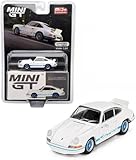
- Brand new box, Comes in a blister pack.
- Real rubber tires, Authentic detail.
- Detailed interior, Exterior.
- Authentic Paint & Graphics
- Die-cast metal body and chassis
Product prices and availability are accurate as of the date/time indicated and are subject to change. Any price and availability information displayed on Amazon at the time of purchase will apply.