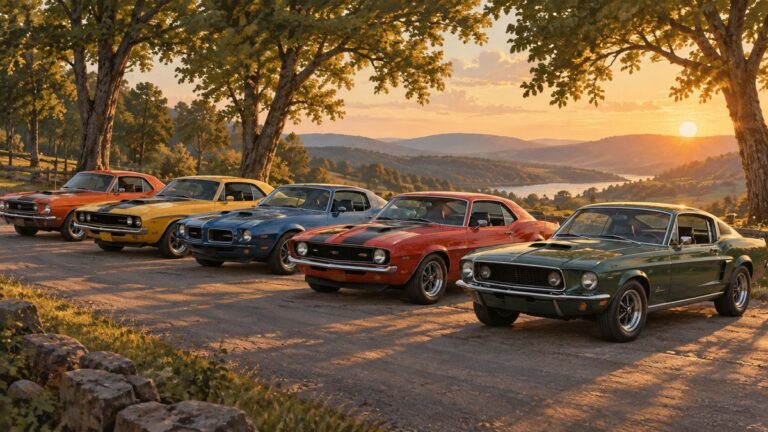
No: a pony car does not have to be American-made. The label is rooted in the Ford Mustang’s U.S. debut, but Brad Brownell’s working definition emphasizes a car’s shape, V8 power and visual attitude—not its passport. Six cars from Australia, Japan, Germany, Italy and Britain show how that formula can travel, even though some are closer to grand tourers than conventional pony cars.
What makes a car a pony car?
There is no binding industry definition in the source material here. Brownell uses a personal standard: a stylish two-door with a long hood and short deck, a V8, and enough visual appeal to be more than a small car with a large engine. As he puts it, “It doesn’t have to be the biggest or most powerful engine, but it has to be a V8.”
That distinction separates his pony-car idea from a muscle car, which he describes as a smaller car given a larger engine primarily for speed. The formula is therefore about styling and attitude as well as power—and it is a useful lens, not a universal rule.
Why the Mustang sets the reference point
Ford launched the Mustang on April 17, 1964. Jalopnik reports that more than one million were sold in under 24 months, an early success that helped establish the shape and identity later associated with pony cars. Those launch and sales details are reported by Jalopnik; they are not independently verified here against Ford’s historical records.
#1 Best Overall

- 1:25 scale Easy snap-together assembly 30 super-detailed parts Molded in light blue, pink, and purple with clear plastic, chrome parts & a pre-painted rear bumper Black vinyl tires Metal screws & axles Colorful decal and sticker options with My Little Pony graphics Built size: ~ 7.25 inches long Skill level 2, Ages 10+ Eye-catching My Little Pony packaging
Six international cars that fit the formula to different degrees
These examples vary in brand nationality, market identity, powertrain provenance and original positioning. A car’s place of assembly, the nationality of its marque and the origin of its engine are not necessarily the same thing.
| Car and country | Relevant character and history | Fit with Brownell’s definition |
|---|---|---|
| Holden Monaro — Australia | The Monaro began in 1968. The article reports that Holden first sought a compact V8, then used a Chevrolet small block; later versions were imported to the United States as the Pontiac GTO. | A strong stylistic and V8 analogy, though the American-market GTO identity complicates the national label. |
| Toyota Soarer — Japan | The fourth-generation V8 version was sold in the United States as the Lexus SC400. | Its two-door form and V8 support the comparison, while its upscale, grand-touring character stretches the category. |
| Mercedes 450SLC/500SLC 5.0 — Germany | The article describes a limited homologation coupe related to the 107-series SL, with a 5.0-liter engine and production from 1977 to 1981. | A powerful two-door with visual presence, but its SL lineage and limited homologation role make it unlike a straightforward pony car. |
| Iso Grifo — Italy | The article reports a 1965 launch, styling by Giugiaro, chassis engineering by Bizzarrini and Chevrolet Corvette V8 options. | It shares the long-hood, V8 appeal, but Brownell considers it closer to a European grand tourer. |
| Jensen Interceptor — Britain | Introduced in 1966, it is described as a four-seat grand tourer with Chrysler V8 power. | Its styling and V8 make the analogy understandable; its grand-touring identity places it near the category’s edge. |
| MG XPower SV — Britain | The article traces its development through the De Tomaso Biguà and Qvale Mangusta project and reports a modified Ford Modular V8. | Brownell explicitly regards it as a stretch for the pony-car concept. |
Where the category boundary gets fuzzy
Shared styling does not mean shared market identity
The Soarer illustrates the difference between a car that resembles the formula and one conceived as a pony car. Its V8 version reached U.S. buyers under the Lexus SC400 name, but the article characterizes it as an upscale grand tourer. The Monaro’s later U.S. identity also changed: it was imported as a Pontiac GTO, not sold there under its Holden name.
Rank #2

- This plastic model requires assembly and painting. Adhesives, tools, paints, etc., sold separately
- 1/24 scale unpainted plastic assembly kit
- Size when assembled: total length 6.5 inches (166 mm), total width 2.6 inches (65
- Represents the form of Jiugiaro design
- Grill and wheels are plated parts
V8 power is only one part of the comparison
The Grifo and Interceptor pair V8s with the proportions and presence that invite comparison, yet both are described as grand tourers. The XPower SV is further from the archetype in Brownell’s judgment. These differences are why “international pony-car-like car” is more precise than claiming all six are universally recognized as pony cars.
Independent reader supportYour contribution helps us test, update, and keep practical guides available for everyone.So, do pony cars have to be American-made?
No. The Mustang established the best-known reference point, but Brownell’s definition allows room for cars from other countries when their styling, V8 power and attitude echo the formula. The Monaro, Soarer, Mercedes, Grifo, Interceptor and XPower SV make that case in different ways; some are persuasive analogues, while others are grand tourers or deliberate edge cases.
The Tool Desk
Outbyte PC Repair FREEClear out junk files and repair common Windows errorsFree Scan →Outbyte Driver Updater FREEFix the driver behind crashes, sound loss and screen glitchesFind Drivers →Quick Recap
Best Value

- A PERENNIAL CLASSIC FOR EXPERIENCED MODELERS: AMT’s 1/25 scale 1967 Shelby GT-350 is the perfect project for muscle car builders. Add it to your collection today!
- FEATURE PACKED: The 1967 Shelby GT-350 is a historical muscle car that stands alone! Fully paintable, it features authentically detailed water-slide decals. Build it up right with a Ford 289 V8 engine and all the Shelby touches—custom rear lower pan, chrome wheels, custom taillights and front grille, bucket seats, and more. Wrapped up nicely in retro-styled packaging!
- QUICK SPECS: 1/25 Scale, 123 Parts, 7 inches long once assembled. Parts molded in white, clear and transparent red, with black vinyl tires. Some parts are chrome plated. Plastic model kit paint and cement required (Testors or Tamiya brands recommended). Paint guide included in kit. Skill Level 2. For ages 10+
- THE PERFECT PRESENT: Don't know what to get dad for his birthday? Or maybe you have an avid hobbyist or collector in your life. This model kit makes an ideal gift for any occasion!
Rank #4

- Revell Model Kit #14512, Skill Level 4, Contains 129-Parts, Recommended for ages 12 and up
- All new tooling. Highly detailed Boss 351-specific "Cleveland" V-8.
- Engine compartment features many separate details. Interior includes separate door panels.
- Extensive decal sheet includes Boss 351 graphics in silver and black.
- Molded in white and clear with chrome plated parts and soft black tires. Requires paint and glue. (not included)
Rank #3

- Revell Model Kit #14545, Skill Level 4, Contains 122-Parts, Recommended for ages 12 and up
- Pontiac 400 c.i. Ram Air engine plus optional race engine parts and interior.
- Stock or Torque Thrust wheels and optional racing seat and roll bar.
- Authentic stock and drag racing decals.
- Molded in white and clear with chrome plated parts and soft black tires. Requires paint and glue.(not included)
Product prices and availability are accurate as of the date/time indicated and are subject to change. Any price and availability information displayed on Amazon at the time of purchase will apply.