The Tool Desk
Outbyte PC Repair FREERepair Windows errors before they cause bigger problemsFix Now →Outbyte Driver Updater FREEFix the driver behind crashes, sound loss and screen glitchesFind Drivers →The Michelin Man—officially Bibendum—began with a pile of bicycle tires and became one of motoring’s most durable symbols. André and Édouard Michelin imagined the figure in 1894; illustrator Marius Rossillon, known as O’Galop, turned it into public advertising in 1898. His name comes from the Latin “Nunc est bibendum” (“Now is the time to drink”), a reference to an advertisement showing the tire character swallowing nails and broken glass.
Who invented the Michelin Man?
There was no single inventor. André and Édouard Michelin supplied the original idea, while Marius Rossillon (O’Galop) created the illustrated character.
As an Amazon Associate I earn from qualifying purchases.
The 1894 tire-stack observation
At the 1894 Lyon Universal Exhibition, the Michelin brothers saw a stack of bicycle tires in front of their stand. Michelin’s account records André’s reaction: “Add some arms and you’d say it was a man.” That visual joke supplied the character’s basic silhouette.
O’Galop’s 1898 advertisement
The brothers asked O’Galop to develop the idea. Bibendum first appeared publicly in 1898, including at the first Paris Motor Show. The early figure was recognizably made from a stack of tires, but had a more flamboyant period style than the discreet mascot used today.
#1 Best Overall

- Brand new box.
- Real rubber tires.
- Has opening doors.
- Detailed interior, exterior.
- Made of diecast with some plastic parts.
Why is he called Bibendum?
Bibendum is taken from the Latin phrase “Nunc est bibendum!”, usually translated as “Now is the time to drink.” The wording became the headline of the first major Bibendum advertisement.
In the image, Bibendum raises a goblet filled with nails and broken glass. The joke was that a Michelin tire could “drink” road hazards rather than be defeated by them. Michelin’s historical wording summarized the promise as “The Michelin tyre drinks obstacles” (also rendered in Michelin Canada’s history as “The Michelin Tire drinks the obstacle”). It converted an unfamiliar pneumatic technology into an instantly understandable claim about toughness.
Why was the Michelin Man made white?
The earliest Bibendum drawings used the pale, light-colored appearance of the tire stacks Michelin displayed. That explains the character’s visual starting point more reliably than a modern assumption that he was designed as a white human figure. The historical material establishes the light-colored tire construction; it does not give one definitive official sentence assigning the color to a particular rubber additive or manufacturing formula.
His body is therefore best understood as a stylized stack of tires. The pale color made the layered construction readable in posters and later print, while the rounded form made a technical product look friendly rather than mechanical.
Rank #2
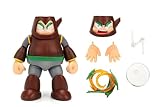
- Officially Licensed - Captures Wood Man’s iconic nature-inspired design, officially licensed by CAPCOM
- High Articulation - Features premium articulation for dynamic action poses and battle stances.
- Premium Accessories - Includes (2) interchangeable heads sculpts, (2) sets of hands, (1) Leaf Shield effect piece and (1) effects stand
- Collector’s Packaging - Premium packaging with a removable sleeve showcasing exclusive Mega Man artwork.
- Jada Toys - Known for crafting high-quality, nostalgia-packed collectibles for gamers and collectors alike.
How Bibendum made tire technology understandable
In the late nineteenth century, roads, vehicles and driving habits were still developing. Michelin was selling pneumatic tires to people who had to imagine why the technology mattered. Bibendum gave the company a continuing spokesman who could demonstrate durability, welcome motorists and explain engineering ideas without filling an advertisement with technical copy.
A character that could travel between media
Michelin used Bibendum in posters, motor shows, public appearances, travel guidance and sporting or mobility settings. He could be a motorist when the audience needed a fellow driver, a cyclist when the product context was bicycles, or an adventurer when Michelin wanted to dramatize performance. Michelin’s own histories describe roles including magician, diver and cyclist, followed much later by digital animation.
Turning radial construction into a story
At the 1952 Paris Motor Show, Michelin staged a symbolic “wedding” between steel and textiles to explain its radial-tire innovation. Instead of asking visitors to visualize tire construction from a diagram alone, the company presented the technical change as a human relationship. The same strategy underpinned the original goblet image: a difficult engineering benefit became a scene people could remember.
Do these 3 things before closing this tab:
1Fix the driver behind crashes, sound loss and screen glitches2Repair Windows errors before they cause bigger problems3Scan for outdated or missing drivers - takes under a minuteA timeline of Bibendum and Michelin’s mobility business
| Year | Development | Why it mattered |
|---|---|---|
| 1889 | André and Édouard Michelin founded the tire company, according to Michelin Canada. | Established the business that would turn a tire silhouette into a long-term brand identity. |
| 1891 | Michelin created a removable bicycle tire, according to Michelin Canada. | Helped place the company in the practical world of everyday mobility before mass motoring. |
| 1894 | The brothers noticed a human shape in a stack of bicycle tires at the Lyon Universal Exhibition. | Provided the visual seed for Bibendum. |
| 1898 | O’Galop’s Bibendum appeared publicly, including at the first Paris Motor Show. | Introduced the mascot as a national motoring and advertising figure. |
| 1900 | Michelin published the first MICHELIN Guide. | Extended the company from tires into practical travel information. |
| 1934 | Bibendum appeared in a comic-style section of the Guide. | Made the travel publication more visual and personable. |
| 1952 | The Paris Motor Show “wedding” communicated radial-tire construction. | Used narrative and symbolism to explain engineering. |
| 2000 | Michelin Canada reported that a Financial Times jury recognized Bibendum as the best logo of the twentieth century. | This is Michelin’s account of the recognition, not an independently audited marketing statistic. |
| 2017 | Michelin described a ninth major redesign. | Recast Bibendum as an everyday, discreet, considerate and reassuring partner. |
| 2018 | L’Aventure Michelin in Clermont-Ferrand held a 120th-birthday Bibendum exhibition. | Confirmed the character’s place as part of Michelin’s industrial and cultural heritage. |
How Bibendum changed without losing his identity
Early versions could smoke a cigar, wear a moustache or appear as a convivial gentleman. Those details reflected the visual conventions of their time, but the tire-stack body remained the constant.
Rank #3

- Officially Licensed: Captures Bubble Man's classic design, authentically licensed by CAPCOM
- High Articulation: Features premium articulation for dynamic action poses and battle stances
- Premium Accessories: Includes (2) interchangeable head sculpts, (2) sets of hands, (1) Arm canon blaster, (1) Bubble Lead effect piece and (1) effects stand
- Collector's Packaging: Premium packaging with a removable sleeve showcasing exclusive Mega Man artwork
- Jada Toys Quality: Known for crafting high-quality, nostalgia-packed collectibles for gamers and collectors alike
Period roles and adventures
- 1908: an aviation-themed “dragonfly” connected Bibendum with new forms of travel.
- 1914: a magician persona emphasized spectacle and visual surprise.
- 1930: a diver placed the mascot in another adventure setting.
- Later decades: cyclist, motorist and other roles matched changing audiences and media.
- 2017: the redesign emphasized a less showy, more considerate companion for everyday mobility.
These revisions changed clothing, expression, posture and setting rather than abandoning the core silhouette. That balance let Michelin update its advertising language while preserving immediate recognition across generations and languages.
Independent reader supportYour contribution helps us test, update, and keep practical guides available for everyone.How the Michelin Man is connected to the MICHELIN Guide
The first MICHELIN Guide appeared in 1900, when Michelin distributed practical information to motorists. It helped drivers plan journeys by supplying travel guidance at a time when routes, cars and roadside services were still developing.
The Guide later became famous for restaurant evaluation, but Bibendum remained part of its identity. He appeared throughout the publication and in a comic-style section in 1934. The Bib Gourmand category for good-value restaurants is also named after him.
What’s actually slowing this PC down?
Pick the symptom - the matching free tool is one click away.
This is more than a naming coincidence. Tires, route planning, lodging and dining formed a single mobility ecosystem: Michelin could help someone travel, choose where to stop and decide what to eat. A current Guide book is therefore regional and edition-specific; its listings and coverage depend on the market and year, while Bib Gourmand remains the value-oriented distinction tied to the mascot’s name.
Rank #4

- Chainsaw Man Figure from Taito!
- Base Stand included
- Official Licensed Product
- Chainsaw Man
What Bibendum had to do with motoring
Bibendum was not merely a tire logo placed beside a product. He performed several jobs for Michelin:
- Explaining durability: the nails-and-glass goblet made resistance to puncturing visible.
- Humanizing engineering: a face and body gave pneumatic and radial construction a personality.
- Welcoming new drivers: a reassuring figure reduced the distance between an industrial company and the public.
- Making events memorable: motor-show displays, including the 1952 “wedding,” turned technical demonstrations into stories.
- Linking mobility services: the same character appeared in advertising, travel information, guides and later digital media.
Michelin Canada describes Bibendum as communicating quality, performance and reliability across languages and generations. The company’s histories also connect the mascot’s world to the Éclair vehicle, the first Guide and later innovations such as the Micheline railcar.
Why Bibendum remains recognizable
His staying power comes from a rare combination: the character directly depicts the product, his visual form is simple enough to reproduce, and his personality can change with the medium. A poster can show a confident figure holding a goblet; a motor show can stage a live spectacle; a Guide can use comic panels; a digital campaign can animate the same tire-stack body.
The result is a mascot that carries a technical promise—reliable mobility—without being trapped in one era’s technology or advertising style. Michelin can modernize his behavior and tone while retaining the outline people associate with tires.
The short answer
André and Édouard Michelin conceived the Michelin Man after seeing stacked bicycle tires in 1894. O’Galop drew Bibendum for public advertising in 1898. His Latin-derived name refers to a tire that can “drink” nails and broken glass, his pale body reflects the light-colored tire stacks of the original design, and his appearances in motor shows, the MICHELIN Guide and later digital media helped Michelin turn engineering into a recognizable story about dependable travel.
Quick Recap
Product prices and availability are accurate as of the date/time indicated and are subject to change. Any price and availability information displayed on Amazon at the time of purchase will apply.




