An MOT and a motorcycle service are different jobs. In England, Scotland and Wales, an MOT is a legally defined inspection of specified safety and roadworthiness items. A service is maintenance performed to the schedule for your motorcycle’s exact make, model and year. Passing an MOT does not prove that scheduled maintenance is up to date, and completing a service does not produce an MOT certificate.
The distinction matters because each process can leave important gaps in the other. The MOT test can identify a defective brake, tyre, lamp or control, but it is not a general mechanical-health assessment. A service can include oil, chain, brake-fluid or valve work when the manufacturer calls for it, but it is not the statutory test used to establish whether the motorcycle meets MOT standards.
As an Amazon Associate I earn from qualifying purchases.
Motorcycle MOT versus service at a glance
| Question | Motorcycle MOT | Motorcycle service |
|---|---|---|
| Primary purpose | Checks specified items against legal test standards. | Maintains one particular motorcycle according to its manufacturer’s schedule. |
| Who defines the scope? | The Driver and Vehicle Standards Agency (DVSA) inspection guidance and manual for the relevant UK jurisdiction. | The motorcycle manufacturer, with intervals and tasks that can vary by model, mileage, time and use. |
| Typical coverage | Lights, steering, suspension, wheels, tyres, frame, braking, exhaust, fuel system, seat, alignment, controls, identity marks and other listed items. | Scheduled inspections, adjustments, lubrication, fluid or filter changes, component replacements and other work specified for the motorcycle. |
| Result | An MOT pass or fail, with defects classified as minor, major or dangerous where applicable. | A record of maintenance tasks completed; it is not an MOT result. |
| What it proves | That the inspected items met the test standards at the time of inspection. | That the agreed or scheduled maintenance work was carried out; it does not certify statutory roadworthiness. |
The legal guidance discussed here covers England, Scotland and Wales, with separate guidance for Northern Ireland. Do not assume that the same test or maintenance rules apply in another country.
Crashes, No Sound, or Screen Glitches?
Random freezes, missing sound and display glitches usually trace back to one bad driver. Find and replace yours safely.Free scan · under a minuteWindows Errors? Fix Them Before They Spread
Repair common Windows errors and clear accumulated junk for a smoother, more stable PC - no reinstall needed.Free scan · no reinstallWhat a motorcycle MOT includes
The MOT is a standardised inspection rather than a general examination of every part of the motorcycle. The tester follows the DVSA’s inspection procedures and defect standards. The motorcycle must meet the applicable requirements for the items within that defined scope on the day it is tested.
#1 Best Overall

- For best performance, follow the manufacturer's recommendations in your vehicle owner’s manual
Lighting, signalling and visibility items
The inspection includes the motorcycle’s lights. Depending on the motorcycle and equipment fitted, this covers the lamps and their operation, condition and security as assessed under the test procedure. The tester also checks the horn. These checks concern the equipment presented for inspection; they do not amount to a diagnosis of the motorcycle’s electrical system as a whole.
Steering, suspension and alignment
Steering and suspension are listed inspection areas. The tester examines the relevant components for defects against the manual’s standards. Wheel alignment is also within the MOT scope. A pass means the observed condition satisfied the test requirements; it does not establish that every bearing, seal or internal component will remain sound for the rest of the test certificate’s life.
Wheels, tyres and braking
Wheels and tyres are checked, as are the braking components and their operation under the prescribed procedure. These are safety-critical MOT areas. The test can identify a defect that requires attention even when the motorcycle starts, runs and feels normal during an ordinary ride.
Do these 3 things before closing this tab:
1Fix the driver behind crashes, sound loss and screen glitches2Clear out junk files and repair common Windows errors3Scan for outdated or missing drivers - takes under a minuteFrame, structure and external equipment
The frame is part of the inspection, along with the seat and, where fitted, a sidecar. The tester considers the condition and security of the relevant structures and fittings using the legal defect standards. A sidecar is therefore not outside the test simply because it is an attachment; it has specific relevance when fitted to the motorcycle.
Exhaust, fuel system and controls
The exhaust and fuel system are included. The manual also lists the drive chain and sprocket, throttle, clutch lever and footrests. These checks cover the specified condition and operation of those items, not a complete assessment of the engine, transmission or all controls not named in the inspection requirements.
Registration, identity and plates
Registration plates and vehicle-identification details are among the listed MOT items. The tester checks them against the applicable requirements, so a motorcycle can have a mechanical system in good order and still encounter a test defect in an identification or plate-related area.
Rank #2

- No fling-off and O-Ring Safe
- Dirt-resistant dry lubricant
- Contains Teflon and Moly for wear protection
- Water resistant and Non-staining
How MOT results and defects work
The DVSA distinguishes between minor, major and dangerous defects. A motorcycle with only minor defects can pass. A major or dangerous defect causes a fail. The result therefore communicates the outcome of the defined test and the severity of any recorded defects; it is not a rating of the motorcycle’s overall condition.
What a pass means
A pass means the items examined met the MOT standards at the time and under the conditions of that test. It is useful evidence about those inspected areas on that date. It is not evidence that the manufacturer’s service schedule has been followed, that no non-MOT fault exists, or that a component cannot deteriorate immediately afterward.
What a fail means
A major or dangerous defect means the motorcycle has failed the test. The repair decision should follow the defect description and the manufacturer’s instructions for the motorcycle. A minor defect may be recorded on a pass and should still be dealt with promptly, because the MOT result does not turn a known defect into a maintenance recommendation that can safely be ignored.
What a motorcycle service includes
There is no single service checklist for every motorcycle. The controlling document is the manufacturer’s maintenance schedule for the exact model and year. Schedules commonly use more than one trigger: elapsed time, mileage and, in some cases, operating conditions. A low-mileage motorcycle can still require time-based work, while a heavily used motorcycle may reach a mileage interval quickly.
Scheduled inspections
Some service entries are inspections. The technician may examine a component and record its condition without replacing it. An inspection is not automatically a replacement, adjustment or repair. The schedule and the findings determine what happens next.
Adjustments and lubrication
Other entries call for adjustment or lubrication. Drive-chain maintenance is a recurring example in Honda’s CBR600RR schedule. The exact procedure, lubricant, adjustment limits and interval belong to that model’s schedule, so they should not be presented as a universal promise for every motorcycle.
Rank #3
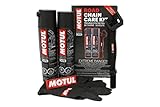
- All-in-one package to clean and maintain your chain
- Includes chain clean, chain lube road, chain brush, motul gloves and decal
- C1 Chain Clean is perfect for removing residue, sand, dirt, and oil.
- C2 Chain Lube Road is a product of MOTUL's racing history, protecting your chain while reducing drag.
- MOTUL gloves and chain brush help remove deposits without creating a mess.
Fluid, filter and component replacement
Scheduled replacement work can include engine oil and an oil filter, brake fluid or other service items. Honda’s CBR600RR schedule, for example, includes recurring engine-oil-filter and brake-fluid tasks. That example demonstrates why the owner’s manual matters; it does not establish that every motorcycle receives those items at every service.
Severe-use adjustments
Manufacturers may shorten intervals for demanding conditions. Royal Enfield states that its schedule is based on average riding conditions and advises more frequent maintenance in severe conditions. Frequent short trips, dusty or wet environments, heavy loads, prolonged high-speed use or other demanding patterns may therefore change the appropriate interval when the manufacturer identifies them as severe. Use the schedule’s own definition rather than inventing a mileage reduction.
The work a service can cover that an MOT does not
A service is the place to address maintenance items that are outside the MOT’s defined inspection. Depending on the motorcycle and interval, that can include engine oil and filter work, brake-fluid replacement, valve-clearance checks, chain lubrication or adjustment and other manufacturer-specified tasks. Whether an item is inspected, adjusted or replaced depends on the schedule and the motorcycle’s condition.
The Tool Desk
Outbyte PC Repair FREEClear out junk files and repair common Windows errorsFree Scan →Outbyte Driver Updater FREEScan for outdated or missing drivers - takes under a minuteDriver Scan →The MOT does not check the motorcycle’s general mechanical condition. The DVSA specifically states that the test does not cover the condition of the engine, clutch or gearbox. Consequently, an MOT pass cannot be used as evidence that the engine is healthy, the clutch has adequate remaining life, the gearbox is operating correctly or the service schedule is current.
The work an MOT can reveal that a routine service may not certify
A service record does not substitute for the legal inspection. A workshop may service a motorcycle carefully and still not issue an MOT certificate unless an MOT test was separately carried out by an authorised tester. Conversely, an MOT tester may identify a tyre, lamp, plate, frame, chain, sprocket or control defect that was not part of the service appointment or was not due under the maintenance schedule.
The two processes can overlap in practical checks, but overlap does not merge their legal outcomes. A technician might look at a chain during a service, while the MOT tester assesses the drive chain and sprocket against the MOT manual. The service record and MOT result remain separate documents with separate purposes.
Rank #4

- PREMIUM LUBRICATION: Muc-Off Motorcycle All-Weather Chain Lube is a premium synthetic formulation that ensures first-class performance.
How to decide whether you need an MOT, a service or both
Choose the MOT when the legal test is due
Book the MOT when you need the statutory inspection for continued lawful use. The test should be treated as a point-in-time check of the listed items, not as a substitute for planned maintenance. If the motorcycle has a current MOT but the service interval has arrived, the service is still due.
Recommended Free Tools
Choose a service when the manufacturer interval is due
Use the owner’s manual or official maintenance schedule for the exact motorcycle. Check both mileage and elapsed time, then consider whether the manufacturer specifies shorter intervals for severe use. A service may be due even if the MOT certificate is recent, because the two calendars are independent.
Book both when both schedules converge
It is often efficient to arrange an MOT and a scheduled service in the same period, but ask the workshop to identify which work is the MOT test and which work is scheduled maintenance. This prevents an MOT pass from being mistaken for completion of the service and makes the invoice and records easier to understand.
Preparing a motorcycle for its MOT
A short owner check cannot guarantee a pass, but it can catch obvious issues before the appointment. Use the MOT’s listed areas as a practical checklist:
- Operate the lights and horn and look for obvious damage or insecure fittings.
- Check the visible condition of the tyres and wheels.
- Look for leaks or damage around the braking and suspension areas.
- Inspect the frame and seat for visible damage or insecure fittings.
- Look at the exhaust and fuel-system area for obvious defects or leaks.
- Check the registration plate and vehicle-identification markings are present and legible.
- Inspect the drive chain and sprocket, and confirm that the throttle, clutch lever and footrests operate normally.
- If a sidecar is fitted, include it in the visual check rather than treating it as separate from the motorcycle.
These checks are preparation, not a replacement for the formal inspection. Do not adjust a component to an unfamiliar setting merely to prepare for the test; use the owner’s manual or a qualified technician when a repair or adjustment is needed.
Free tools Windows power users keep installed
One-click scans. No signup required.
Preparing for a scheduled service
- Identify the exact motorcycle. Record the make, model, model year and mileage. Similar-looking variants can have different schedules.
- Read the maintenance schedule. Mark both time-based and mileage-based tasks that are due. Note any manufacturer definition of severe or special operating conditions.
- Bring the maintenance history. Previous service records help the technician establish what has already been replaced or inspected and avoid treating an overdue task as completed.
- Describe symptoms separately. Tell the workshop about starting problems, noises, clutch feel, gear-selection issues, fluid loss or handling changes. A scheduled service is not automatically a diagnosis of every symptom.
- Ask for the work to be itemised. The record should distinguish inspections, adjustments, lubrication, replacements and additional repairs, and should identify any task deferred or not due.
- Confirm the next interval. Record the mileage and date for the next scheduled maintenance point, including any shorter interval recommended for the way the motorcycle is used.
Common misunderstandings, corrected
“The MOT is a full health check.”
It is not. The MOT is limited to specified inspection items and does not check general mechanical condition, including the engine, clutch or gearbox.
Best Value

- Precision Brush Applicator for Clean Application: Designed with an integrated brush tip for accurate and controlled application, helping ensure even coverage on the chain while reducing mess, overspray, and product waste.
- Long-Lasting Lubrication and Protection: Provides durable lubrication that adheres to the chain surface, helping reduce wear, friction, and elongation while maintaining smooth drivetrain operation over extended use.
- Compatible with Modern Chain Types: Suitable for use on O-ring, X-ring, and Z-ring chains, helping preserve seal integrity while delivering effective lubrication and protection.
- Reduces Friction and Wear: Helps minimize metal-to-metal contact between chain links and sprockets, supporting smoother power transfer and extending the lifespan of drivetrain components.
- Ideal for Street and Performance Riding: Well suited for daily riding, sport use, and touring applications where consistent lubrication, clean application, and reliable protection are required.
“A fresh service guarantees an MOT pass.”
It does not. A service follows the manufacturer’s maintenance plan; the MOT applies legal standards to its own list of items. A motorcycle can be serviced and still fail an MOT because of a defect found during the statutory test.
“An MOT pass means the service is up to date.”
It does not. The MOT result says nothing about whether an oil-filter, brake-fluid, valve, chain or other scheduled task is due or completed.
“Every motorcycle service includes an oil change and fluid replacement.”
Not necessarily. The manufacturer’s schedule determines which items are due, and some entries are inspections rather than replacements. The interval may also differ between models and use conditions.
“The same rules apply everywhere.”
The cited DVSA motorcycle guidance applies to England, Scotland and Wales, with guidance for Northern Ireland. Requirements in other jurisdictions should be checked with that jurisdiction’s authority.
Keeping records that answer both questions
Keep the MOT result separately from the service invoice or maintenance log. The MOT record should show the test outcome and any defects. The service record should show the motorcycle identified, mileage and date, scheduled tasks completed, measurements or adjustments where relevant, parts or fluids replaced, and work that was recommended but declined or deferred. Separate records make it clear whether a later problem concerns a statutory test item, a scheduled maintenance task or an unrelated mechanical fault.
If you sell the motorcycle, this distinction also prevents an ambiguous statement such as “recently checked” from being treated as both an MOT claim and a service claim. State which event occurred and when.
Where chain maintenance fits
Drive-chain maintenance is a useful example of the boundary between the two processes. The chain and sprocket are MOT inspection items, while a manufacturer schedule may require recurring cleaning, lubrication, inspection or adjustment. If you maintain the chain yourself, follow the owner’s manual for the correct procedure and chain type, and keep a record of what you did. Chain lubricant is not automatically required for every motorcycle service or every MOT; its use depends on the motorcycle and maintenance instructions.
Quick wins for a faster PC:
Scan for outdated or missing drivers - takes under a minuteDriver Scan →Clear out junk files and repair common Windows errorsFree Scan →Fix the driver behind crashes, sound loss and screen glitchesFind Drivers →Bottom line for owners
Use the MOT to answer: “Did this motorcycle meet the defined legal inspection standards today?” Use the service schedule to answer: “Have the maintenance tasks due for this exact motorcycle and its operating conditions been completed?” You need both systems because neither result establishes what the other is designed to establish.
Quick Recap
Product prices and availability are accurate as of the date/time indicated and are subject to change. Any price and availability information displayed on Amazon at the time of purchase will apply.




