Quick wins for a faster PC:
Clear out junk files and repair common Windows errorsFree Scan →Scan for outdated or missing drivers - takes under a minuteDriver Scan →Repair Windows errors before they cause bigger problemsFix Now →Mechanical (solid) lifters maintain a specified valve lash that must be checked and adjusted; hydraulic lifters use engine oil and an internal plunger to take up clearance automatically during normal operation. Hydraulics generally mean less routine adjustment and quieter operation, while mechanical lifters can suit some higher-rpm combinations when the camshaft and valvetrain are designed for them. Neither type is universally better: the right choice and setup depend on the engine and camshaft.
How mechanical and hydraulic lifters work
Mechanical (solid) lifters
A mechanical lifter has no oil-operated plunger to remove clearance. It transfers motion from the camshaft through the valvetrain while maintaining a specified gap, called valve lash. That clearance must be set and periodically checked to the engine and camshaft manufacturer’s specifications. The U.S. Navy’s Automotive Maintenance and Repair manual describes the mechanical lifter’s fixed contact position and the need for valve clearance.
Hydraulic lifters
A hydraulic lifter fills an internal chamber with engine oil. Oil pressure moves its plunger to take up play; when the cam loads the lifter, a check valve closes so the lifter acts as a solid unit during valve opening. The design compensates for changes in valvetrain clearance as parts warm and wear, reducing the need for routine lash adjustment. Eaton describes hydraulic lash adjusters as compensating for valvetrain clearance changes in its Hydraulic Lash Adjusters technical material.
Hydraulic does not mean installation requires no measurement. MAHLE Aftermarket North America advises: “Although hydraulic lifters require no adjustment during normal service, it is important to check the lifter pre-load when lifters are installed.” Follow the relevant camshaft and engine instructions for that check.
#1 Best Overall
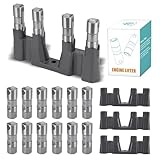
- 【OEM Part Number】12499225 12564012 12576400 12648846 17089852 17109057 17120090 17120735 17121905 17122490 5233745 5234660 5234670 5234890 5235498 8171224900 25341990 12699845
- 【Fitment】Compatible with Camaro and Firebird 1999-2002, For Camaro 2010-2013, For Corvette 1999-2013, For Pontiac GTO 2004-2006, For Cadillac CTS-V 2004-2007, For Pontiac G8 2008-2009, For Tahoe, For Yukon, For Escalade 2000-2013, For Hummer H2 2003-2009, For Silverado and Sierra (4.8L, 5.3L, 6.0L) 1999-2013; Fit For GM LS1, LS2, LS3, LS6, LS7, LS9 LSX engines (4.8L, 5.3L, 5.7L, 6.0L, 6.2L)
- 【Strict Quality Control】Hydraulic roller valve lifter manufactured in TS16949 certified facilities, undergone material validation and functional testing to ensure its performance.
- 【Better Performance】The Hydraulic Roller Lifters are made of high-quality metal materials, which are wear-resistant and durable, not easy to damage, and have long service life. Precise valve timing and lift control greatly Improve fuel economy and enhance engine performance.
- 【Warranty】This hydraulic roller valve lifter kit provides a 1-year replacement or 50000km promise. If you have any problems with the AULINK product, please feel free to contact us via Amazon message.
Key differences at a glance
| Consideration | Mechanical lifter | Hydraulic lifter |
|---|---|---|
| How clearance is handled | Maintains specified mechanical lash. | Oil pressure and an internal plunger take up clearance in normal operation. |
| Setup and service | Set and periodically check lash using the application-specific procedure. | Check preload during installation; routine lash adjustment is generally not required. |
| Noise and routine maintenance | Requires lash maintenance; the design comparison generally favors hydraulics for quieter operation and less routine adjustment. | Generally quieter and involves less routine adjustment. |
| Engine-speed suitability | Can suit some higher-rpm combinations when matched to the cam and valvetrain; no universal rpm cutoff applies. | Suitability depends on the specific engine, camshaft and valvetrain design. |
These are general design differences, not a diagnosis of a particular engine. A ticking sound alone does not establish that a lifter is faulty; assess the engine and its other possible causes in context.
Mechanical or hydraulic: which should you use?
Choose based on the engine and camshaft
For many ordinary applications, hydraulic lifters are attractive because they reduce routine lash adjustment and are generally quieter. Mechanical lifters may be appropriate for a performance combination designed around them, including some higher-rpm applications. That does not make “mechanical” a universal performance upgrade: the camshaft profile, engine, and complete valvetrain have to work together. Manufacturers such as COMP Cams and Crane Cams describe these distinctions in the context of specific cam and component combinations, rather than a universal rpm threshold.
Rank #2

- .842” diameter; 94g weight; 1.99” seat height
- Patented orifice metering valve precisely meters oil to the rocker arms
- Continuous contact between metering valve and hardened pushrod seat is maintained, eliminating excessive oiling at high engine speeds
- Contain a longer piston than conventional hydraulic lifters, which provides more load bearing surface and increases lifter longevity
- Lightweight check valve disc allows for quicker response and maintains added control at all engine speeds and loads
Do not convert by type name alone
Do not assume a hydraulic lifter can replace a mechanical one, or vice versa, simply because the parts look similar. Match the lifter to the exact engine, camshaft and valvetrain layout, then use that application’s specified lash or preload procedure. MAHLE’s Camshaft Installation Tips emphasize checking hydraulic preload during installation; COMP Cams’ Master Reference Guide also treats lash and preload as application-specific setup requirements. No generic lash or preload figure is appropriate for every engine.
Independent reader supportYour contribution helps us test, update, and keep practical guides available for everyone.Hydraulic versus mechanical is separate from roller versus flat tappet
“Hydraulic” and “mechanical” describe how the lifter handles clearance. “Roller” and “flat tappet” describe how it contacts the camshaft. These are separate characteristics: a roller lifter can be hydraulic or mechanical. Identify both aspects when checking a part or reading a camshaft specification; the U.S. Navy manual notes that roller lifters may be either type.
The Tool Desk
Outbyte PC Repair FREEClear out junk files and repair common Windows errorsFree Scan →Outbyte Driver Updater FREEFix the driver behind crashes, sound loss and screen glitchesFind Drivers →Quick Recap
Best Value

- Brand New (2) Pack of Genuine Kohler Hydraulic Valve Lifters... We are an Authorized Kohler Dealer... (2) Pack Hydraulic Valve Lifters Genuine Kohler Part # 25-351-11-S Fits Specific Kohler CH18-CH25, CH620-CH980, CV620-CV980, ECH630-ECH749, ECV630-ECV980 & LH685-LH775 Model Engines Genuine OEM Kohler Part If you need assistance locating correct part, Please email Model, Spec and Serial numbers of your engine and we will gladly look up correct parts
Rank #4

- 【OEM Part Number】H817, 2131638, 17085566, 3799644, 3869997, 36817, 97385, 12371044, HL66, LIF3101, 148007, 1564178, 213-1685, 97385, 5231475, 5232280, 5232450, 5232660, 5232670, 5232700, 5232720, JB817, T12343, HA817, H817, VT817, A817, VL37, 71817, HL20, HT817R, 298184, VL66RH, HL1817HP, JX817, HL1817, 817D, HA817D, 17085566, AE82042NG441P
- 【Fitment】For Buick Century 1977-1980,Regal 1977-1979,skylark 1977-1979;For Chevrolet C10/C10 suburban 1975-1986,caprice 1975-1987,Corvette 1975-1979 1986,G10/G20/G30 1975-1995,Impala 1975-1985,K10 1975-1986,Malibu 1975-1982,Monte carlo 1975-1982 1985-1986 1988,Monza 1976-1979;For GMC P3500 1980 1984-1985 1987 1989 1993,R1500 Suburban 1987-1988,R2500 1987 1989,R2500 Suburban 1988,R3500 1987-1989,jimmy 1975-1978 1982-1983 1987,K1500 1980-1982 1984 1986 1990-1991 1993 1995,K1500 Suburban 1983 1985 1986 1993,K2500 1979-1991 1993-1995,K2500 Suburban 1980 1982 1984 1985 1992,K3500 1979-1986 1989-1995,C1500 1979-1995,C1500 Suburban 1979-1986 1995
- 【Strict Quality Control】Hydraulic roller valve lifter manufactured in TS16949 certified facilities, undergone material validation and functional testing to ensure its performance.
- 【Better Performance】The Hydraulic Roller Lifters are made of high-quality metal materials, which are wear-resistant and durable, not easy to damage, and have long service life. Precise valve timing and lift control greatly Improve fuel economy and enhance engine performance.
- 【Warranty】This hydraulic roller valve lifter kit provides a 1-year replacement or 50000km promise. If you have any problems with the AULINK product, please feel free to contact us via Amazon message.
Rank #3

- 【Precision Engineered for Safe Lifter Removal】 Professionally hydraulic valve lifter remover is designed specifically for removing seized or stuck hydraulic valve lifters during engine teardown, rebuilds, or maintenance, eliminating the risk of damaging the engine block or lifter bores. Replacement for OE part # W84004
- 【Durable Construction for Demanding Environments】 Constructed from high-quality steel with a corrosion-resistant coating, hydraulic valve lifter remover withstands repeated stress in shop environments, resists oil and moisture degradation, and ensures long-term durability for both professional and serious DIY use
- 【Intelligent Internal Grip & Extraction System】 Hydraulic valve lifter remover operates by inserting through the pushrod hole, where its expanding collet mechanism securely grips the lifter from inside, allowing safe extraction without spreading force to the bore; the integrated slide hammer delivers controlled impact to free even the most stubborn lifters with minimal effort
- 【Simple Three-Step Operation for Reliable Results】 Simply insert the hydraulic valve lifter remover into the lifter, tighten the handle to expand the collet for a secure grip, then operate the built-in slide hammer to apply steady pulling force; once freed, loosen the handle to release the lifter
- 【 Warm Tips】 Integrating a precision bearing within its expansion mechanism, hydraulic valve lifter remover ensures smooth operation and secure lifter grip. For optimal performance, users should maintain the tool horizontally when disengaging the collet, work on a clean, level surface, and conduct pre-use condition checks. In confined engine spaces, providing additional support during extraction ensures complete control throughout the removal process
What to verify before installation or replacement
- Confirm the exact engine and camshaft application for the lifter.
- Identify whether the cam and lifters are hydraulic or mechanical, and whether the cam-contact style is roller or flat tappet.
- For a mechanical setup, obtain the specified running lash and adjustment procedure.
- For a hydraulic setup, check installation preload as directed by the manufacturer.
- Follow the engine and camshaft manufacturers’ instructions rather than a generic number or assumed interchange.
Product prices and availability are accurate as of the date/time indicated and are subject to change. Any price and availability information displayed on Amazon at the time of purchase will apply.




