Mazda’s rotary engine did not disappear because it was a bad idea. It disappeared from Mazda’s sports cars because the same design that delivered compact size, low mass, smoothness and impressive power density also made combustion efficiency, sealing, lubrication, fuel economy and emissions unusually difficult.
The rotary later returned in a different job. The MX-30 e-Skyactiv R-EV uses a rotary engine as a generator in a series plug-in hybrid, while an electric motor drives the wheels. That distinction explains Mazda’s rotary story: it lost the case for mainstream direct-drive propulsion, but it retained a useful advantage in compact generator packaging.
What makes a rotary engine different?
A rotary engine produces rotary motion directly from combustion. A conventional piston engine moves pistons up and down, uses connecting rods to transfer that motion to a crankshaft, and relies on valves in a cylinder head to control the gas flow. A Mazda Wankel engine instead uses a roughly triangular rotor that orbits inside a stationary, epitrochoidal housing while turning an eccentric shaft.
The rotor’s three convex sides divide the housing into three moving combustion chambers. As the rotor moves, each chamber passes fixed intake, ignition and exhaust points. The four stages of the cycle—intake, compression, combustion and expansion, then exhaust—happen sequentially in each chamber, while the other chambers are at different stages of their own cycles.
#1 Best Overall
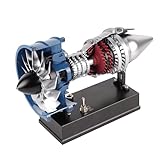
- Realistic & Authentic: The lifelike & visually stunning model provides a realistic depiction of a full-sized engine with main components including a first-stage fan, high-pressure rotor assembly, combustion chamber, high-pressure turbine assembly, low-pressure turbine assembly, and exhaust nozzle.
- High-Quality Construction: Made of high-quality metal, the meticulous model, full of detail and features, undergoes precision casting and CNC machining, along with sandblasting and anodized coloring treatment on the surface, ensuring durability and accuracy the same as the real model.
- Dynamic Display: Featuring a semi-transparent magnetic casing, this model offers a clear view of the engine's internal mechanics in motion when powered by the electric motor. The quick-release magnetic cover allows for effortless assembly and disassembly, making it ideal for demonstrations while protecting delicate components. Equipped with a sturdy mounting bracket and throttle control lever, this kit delivers an immersive hands-on experience with aviation engineering.
- DIY Assembly: Consists of 170+PCS (including screws & nuts) and comes with tools and paper-based English instructions. You will personally experience the entire assembly process, from small parts to the final completed model, constructing an awe-inspiring turbofan engine model.
- STEM Education: As an educational tool, this model unravels the internal workings of a turbofan engine, imparts knowledge about aerospace engineering, and stimulates interest, creativity, and awe for industrial technological achievements
That arrangement gives the rotary its defining mechanical character: few moving parts, compact dimensions, low mass, smooth power delivery and no conventional valve train. It also creates the problems that eventually made a rotary difficult to justify as the primary engine in a modern sports car.
| Question | Short answer |
|---|---|
| What moves? | A triangular rotor follows an orbital path around an eccentric shaft. |
| How many chambers does one rotor have? | Three, one along each rotor flank. They are not the same thing as three piston-engine cylinders. |
| How are the valves operated? | There are no conventional poppet valves; fixed intake and exhaust ports are uncovered as the rotor passes them. |
| Why is it smooth? | The engine does not repeatedly reverse the direction of pistons, connecting rods and other heavy reciprocating parts. |
| Why is it challenging? | It must maintain compression across moving seals while controlling heat, lubrication, combustion and emissions. |
How a Mazda rotary engine works
1. Intake
As a chamber expands, it draws an air-fuel mixture through the intake port. The port is fixed in the housing or side plate rather than opened and closed by a valve. Port location and shape determine when the chamber begins and ends its intake event, making port design a major part of the engine’s character.
2. Compression
The rotor continues orbiting, reducing the volume of the chamber and compressing the mixture. The combustion space is long and narrow at important points in the cycle, unlike the relatively compact chamber found in many piston engines. That shape helps explain both the rotary’s distinctive combustion behavior and its efficiency difficulties.
3. Ignition and expansion
Spark plugs ignite the compressed mixture. Mazda road-car rotaries use spark ignition, and the flame must travel through an unusually shaped chamber as the rotor continues moving. Expanding gases push against the rotor’s flank. Through the rotor’s offset relationship with the eccentric shaft, that pressure becomes shaft rotation.
Quick wins for a faster PC:
Fix the driver behind crashes, sound loss and screen glitchesFind Drivers →Clear out junk files and repair common Windows errorsFree Scan →4. Exhaust
The chamber moves past the exhaust port and expels the burned gases. Each flank repeats the process, so the engine delivers a continuous sequence of combustion events rather than the separated piston strokes most drivers know.
A two-rotor engine therefore has six moving chambers in the broad geometric sense—three associated with each rotor—but calling it a “six-cylinder engine” would be misleading. Rotary displacement nomenclature and piston-engine displacement comparisons are not interchangeable, and the number of chambers does not map directly to a conventional cylinder count.
The major parts inside a rotary
- Rotor: The roughly triangular moving element. Its three flanks form the boundaries of the three working chambers.
- Rotor housing: The stationary epitrochoidal surface around which the rotor travels. Its shape is central to the engine’s geometry.
- Eccentric shaft: The output shaft with offset journals. It converts the rotor’s orbital motion into usable rotation.
- Apex seals: Seals fitted at the rotor’s three corners. They maintain separation between adjacent chambers as the tips sweep across the housing.
- Side seals and corner seals: Additional seals that limit leakage across the rotor’s side faces and around its corners.
- Intake and exhaust ports: Fixed openings that replace the valve-controlled gas exchange of a piston engine.
- Spark plugs: Mazda’s production road-car rotaries use spark ignition. Spark location, ignition control and chamber shape strongly affect combustion quality.
- Oil-injection and lubrication system: Oil must reach the sealing surfaces, especially the rotor-to-housing interface. Some oil entering the combustion process is therefore part of the architecture rather than automatically evidence of a failed engine.
The seals are the engineering center of gravity. An apex seal has to preserve compression while sliding against a hot, complex surface at high speed. The contact can experience demanding boundary or mixed-lubrication conditions, and friction, wear, leakage and oil flow all influence durability, emissions and power.
That does not mean apex seals are the sole explanation for every rotary problem. Sealing works as part of a larger system involving housing finish, thermal expansion, lubrication, ignition, cooling, fuel mixture and maintenance. Treating “apex-seal failure” as a complete explanation oversimplifies the engine.
Do these 3 things before closing this tab:
1Clear out junk files and repair common Windows errors2Fix the driver behind crashes, sound loss and screen glitches3Repair Windows errors before they cause bigger problemsWhy Mazda pursued the rotary
Mazda began working with NSU/Wankel technology in 1961 and introduced the Cosmo Sport, its first rotary-powered production vehicle, in 1967. The company then applied rotary engines to a surprisingly broad range of vehicles, including the Familia/R100, Luce/RX-4, Capella/RX-2, Savanna/RX-3, Cosmo/RX-5, RX-7 and RX-8.
The appeal was not just novelty. A rotary power unit could be shorter and lighter than a comparable piston engine, helping designers lower the hood, improve packaging and place mass toward the center of the car. It also had low vibration and noise, a strong power-to-weight potential and a willingness to rev that suited performance vehicles.
The first-generation RX-7, introduced in March 1978, made those advantages visible. Its 12A two-rotor engine was installed in a front-midship layout, helping the car achieve the low, balanced sports-car proportions that became central to the RX-7 identity. Later RX-7 generations adopted more developed 13B engines, including turbocharged versions.
Rank #2

- EXPOSED DOHC V8 ARCHITECTURE: This model presents a V8 layout with two angled cylinder banks, four exposed overhead camshafts, dual timing-chain drives, a central intake section, and outward-facing exhaust headers. The open arrangement makes the major mechanical structures easy to identify before and during operation.
- PRECISION METAL CONSTRUCTION: Built from precision-cast and machined components in anodized aluminum and stainless steel. Defined surfaces, exposed fasteners, timing assemblies, and front pulleys reflect key structures found in modern V8 engine architecture while giving the completed model a detailed industrial finish.
- 500+ COMPONENT ASSEMBLY: Build the model from more than 500 labeled components, including precision metal parts, screws, and assembly hardware. Custom foam trays help organize and protect the parts, while the included tool set and full-color manual guide the approximately five-hour assembly process.
- MOTORIZED FOUR-STROKE MOTION: An electric motor concealed inside the starter housing drives the crankshaft, connecting rods, pistons, and valvetrain through a four-stroke mechanical sequence. Viewing openings reveal the internal movement, while the exposed camshafts, timing chains, and belt-driven pulleys show how motion is transferred across the assembled engine.
- MECHANICAL DISPLAY FOR HOME OR OFFICE: Measuring approximately 7.80 × 6.69 × 7.09 inches when assembled, the DM118 combines visible mechanical motion with detailed metal construction. Intended for ages 14 and above, it is suited to model builders, automotive enthusiasts, engineering fans, and hobbyists for display in a home, office, study, studio, or workshop. A metal gift box is included.
There was also a powerful motorsport argument. Mazda’s four-rotor R26B powered the 787B to overall victory at the 1991 24 Hours of Le Mans. That win gave the rotary an achievement few production-engine technologies could match and cemented Mazda’s association with the design.
Free tools Windows power users keep installed
One-click scans. No signup required.
The engineering bill: why rotary engines struggled
The same geometry that makes a rotary compact also makes combustion, sealing and emissions control difficult. The result is not that every rotary is inefficient in every operating condition. Rather, production automotive rotaries historically struggled to match modern piston engines across the broad range of speeds, loads and temperatures encountered in ordinary driving.
Combustion-chamber shape
A rotary chamber can have a high surface-area-to-volume relationship and a long flame path. More of the burning mixture is close to cool chamber surfaces, where heat can be lost and combustion can be quenched. Recesses and crevice regions can also retain unburned fuel that later exits in the exhaust.
These effects contribute particularly to hydrocarbon emissions. Poor combustion efficiency, port overlap and leakage past the seals can leave unburned hydrocarbons in the exhaust stream. Carbon monoxide and nitrogen-oxide emissions also have to be controlled, adding to the calibration and after-treatment challenge.
Port overlap
Port timing can allow the intake and exhaust processes to overlap. That may help breathing and power, but it can also let part of the fresh mixture escape before it has burned. This was one reason port arrangement became so important as emissions limits tightened.
Windows Errors? Fix Them Before They Spread
Repair common Windows errors and clear accumulated junk for a smoother, more stable PC - no reinstall needed.Free scan · no reinstallCrashes, No Sound, or Screen Glitches?
Random freezes, missing sound and display glitches usually trace back to one bad driver. Find and replace yours safely.Free scan · under a minuteSealing and leakage
The rotor tips and side seals must maintain compression against a housing that is hot, curved and continuously moving relative to them. Any loss of sealing reduces combustion pressure and can increase unburned fuel, while friction and wear affect durability. The challenge is especially severe because the seal must both move freely and press hard enough to prevent leakage.
Lubrication and oil consumption
A piston engine generally tries to keep lubricating oil out of the combustion chamber. A rotary must deliberately lubricate sealing surfaces, often through an oil-injection strategy. That protects the interface but means oil consumption and oil-derived emissions are inherent considerations in the design.
Oil use is therefore not a simple yes-or-no reliability diagnosis. Rotary engines can consume oil by design, but the expected amount depends on the engine generation, calibration, condition and lubrication system. An abnormal change still deserves investigation; it is inaccurate to claim that every rotary consumes oil at the same rate or that any oil use proves imminent failure.
Fuel economy across real driving
Rotaries can produce impressive power for their physical size, and a narrowly optimized operating point may show the design in a better light. A road car, however, must accelerate, idle, cruise, climb hills, sit in traffic and operate through many temperatures and loads. The rotary’s combustion and sealing compromises make it difficult to deliver piston-engine fuel economy throughout that complete duty cycle.
Recommended Free Tools
This was the central trade-off: compactness, low weight and power density on one side; efficiency, oil control and emissions performance on the other.
RENESIS: Mazda’s last major sports-car rotary
Mazda did not simply accept those disadvantages. Decades of development brought changes to rotor and housing materials, seal design, cooling, ignition, intake systems, exhaust treatment, port geometry and combustion control.
Rank #3

- Realistic V8 Engine Model Kit – Get your mechanical models moving with the NEXTJOY V8 engine kit! 1394PCS high-quality ABS building blocks provide a challenging and rewarding assembly experience.
- Visual and Auditory Feast - Featuring real mechanical structures, including movable pistons, valves, turbochargers, and exhaust systems. Connect via Bluetooth and use the app to control engine speed for more driving fun!
- Dynamic Lights & Spray Effects - This V8 engine is equipped with cool LED lights and realistic water spray functions, creating a realistic engine simulation effect. These interactive controls add extra realism to your model.
- Collectible Home & Office Decor –More than just a building toy, this premium mechanical model kit becomes an impressive display piece for your desk, shelf, or man cave decor.
- Educational Gift for Car & Engineering Fans – Ideal birthday or holiday gift for adults, teens, and kids who enjoy automotive models, engine replicas, and creative STEM projects.
The most important late-generation road-car example was the RENESIS engine used in the RX-8. Mazda began RENESIS production in January 2003 and launched the RX-8 that year. Compared with earlier peripheral-port arrangements, RENESIS used side intake and side exhaust ports. The side-exhaust layout reduced port overlap and helped limit unburned hydrocarbons, while improved combustion stability and intake control supported better drivability and fuel economy.
RENESIS was naturally aspirated, lighter and more compact than the earlier turbocharged 13B-REW. It showed that Mazda could make a rotary substantially cleaner and more usable than its predecessors, and it helped the RX-8 meet the applicable standards in its launch markets.
The Tool Desk
Outbyte Driver Updater FREEFix the driver behind crashes, sound loss and screen glitchesFind Drivers →Outbyte PC Repair FREEClear out junk files and repair common Windows errorsFree Scan →But RENESIS did not erase the underlying compromises. The chamber still had its combustion geometry, the seals still needed lubrication across a demanding interface, and the engine still had to compete with increasingly efficient piston engines and other powertrain types. It was an improvement to the formula, not a solution that made the formula universally competitive.
Why the rotary left Mazda’s sports cars
The rotary’s decline was caused by several pressures acting together, not by a single dramatic engineering failure.
- Emissions compliance became harder. Hydrocarbon control is difficult when chamber geometry, port timing, seal leakage and oil lubrication all affect the exhaust. As standards tightened, the calibration and after-treatment burden increased.
- Fuel consumption was difficult to justify. Buyers could obtain strong performance from increasingly efficient piston engines without accepting the rotary’s traditional economy penalty.
- Sealing and durability required careful control. The apex-seal and housing interface demanded precise materials, surface finishes, lubrication and thermal management. The seals were important, but they were one part of a broader system rather than the only possible failure point.
- Oil consumption challenged conventional expectations. A lubrication strategy that is normal for a rotary can look alarming to a driver accustomed to a piston engine that should keep its oil almost entirely out of the combustion chamber.
- The business case was limited. Mazda carried much of the development, manufacturing and compliance burden for a relatively specialized engine family. It was harder to spread those costs across the volume of a large global engine portfolio.
- The market moved elsewhere. Mazda’s product strategy increasingly included conventional gasoline and diesel engines, hybrids and battery-electric vehicles, while the market for a dedicated rotary sports car narrowed.
The concrete endpoint was the RX-8. Mazda ended RX-8 production in June 2012. That date is better understood as the end of the rotary’s previous role in Mazda’s mainstream production lineup, not proof that the company stopped researching the technology altogether.
What an RX-7 or RX-8 owner should understand
A rotary’s unusual architecture makes generic piston-engine advice incomplete. Cooling, ignition, fuel delivery, compression, oil metering and sealing are interconnected. A car that appears to have a “rotary problem” may need a system-level diagnosis rather than a reflexive assumption about one component.
Maintenance information should also match the exact generation. RX-7 engines, RX-8 RENESIS engines and racing rotaries are not interchangeable service subjects. Readers who want to see the systems in service context can use a Mazda RX-7 rotary repair manual; choose the correct model-year range, because the available print coverage includes different RX-7 generations and discusses engine, cooling and lubrication, fuel, exhaust and emissions, ignition, electrical systems and wiring diagrams together.
A manual like that is not a Mazda factory service manual, and it is not a substitute for model-specific diagnostic equipment or specialist knowledge. Its value is that it keeps the rotary-related systems in the context of the actual car rather than treating the engine as an abstract design.
Independent reader supportYour contribution helps us test, update, and keep practical guides available for everyone.Why Mazda brought the rotary back as a generator
Mazda resumed production of rotary-engine vehicles in June 2023 with the MX-30 e-Skyactiv R-EV. This was a return to rotary technology, but not a return to the RX-7 formula.
The MX-30 e-Skyactiv R-EV is a series plug-in hybrid. Its electric motor drives the wheels; the rotary engine serves as a generator. In other words, the rotary is not mechanically driving the wheels through a conventional transmission as it did in the RX-7 and RX-8.
What’s actually slowing this PC down?
Pick the symptom - the matching free tool is one click away.
For the European launch model, Mazda specified a 17.8-kWh lithium-ion battery, a 50-liter fuel tank and an 85-km battery-electric driving range. That range is a launch specification for the cited European version, not a universal figure for every market or later model year. Availability and specifications vary by market.
Rank #4

- REAL WORKING ENGINE MECHANISM: Experience how a V8 engine works through visible gears, moving pistons, and a synchronized mechanical system that brings engineering concepts to life in a clear and engaging way
- PRECISION ENGINEERING BUILD: Designed with detailed components and a structured assembly process, this kit focuses on delivering a precise and rewarding mechanical building experience
- DISPLAY-WORTHY MECHANICAL MODEL: More than a building kit, this engine model serves as a compact mechanical display piece, adding an industrial aesthetic to any desk or workspace
- MOTOR-DRIVEN MOTION SYSTEM: Powered by a built-in motor, this V8 engine model simulates realistic movement, allowing you to observe how gears and internal components interact in motion
- THOUGHTFUL GIFT FOR BUILDERS AND ENGINE ENTHUSIASTS: A meaningful gift for adults, teens, and anyone interested in engineering, mechanics, or hands-on building projects
Why the generator role changes the trade-off
A direct-drive engine must be ready to operate over a wide range of rpm and load because the driver controls the vehicle’s speed and acceleration directly through it. A generator can potentially be calibrated to spend more of its running time in a narrower, more controlled operating range. That may make combustion, noise and emissions management easier.
This is an engineering inference from the series-hybrid layout and Mazda’s compact power-unit design, not a claim that the R-EV automatically matches a piston hybrid’s measured fuel economy in every situation. The rotary’s compactness is simply more valuable when the primary traction source is electric and the engine-generator unit can be packaged alongside the motor, battery and generator.
The MX-30 therefore demonstrates a changed use case. Mazda did not prove that the old direct-drive sports-car problem disappeared; it found a role in which the rotary’s small size and low mass could matter more than its disadvantages at every road speed and load.
Is the rotary engine dead?
No—but its role has changed. Mazda’s history shows a progression from production sedans and sports cars to the RX-7 and RX-8, then to a long pause in rotary-powered vehicles, followed by the generator-based MX-30 e-Skyactiv R-EV.
The rotary did not fail because it had no technical merit. It lost the argument for mainstream direct propulsion because its strengths were outweighed by fuel economy, emissions, sealing, lubrication, durability, cost and market pressures. In a generator role, the same compactness that once helped create a low sports-car nose can help package a range-extending power unit.
That is why the most accurate description is not “Mazda abandoned the rotary forever.” Mazda moved it out of the role where its disadvantages were most visible and into one where its compact packaging could still be useful.
Frequently Asked Questions
How does a Mazda rotary engine work?
A rotary engine uses a roughly triangular rotor that orbits inside an epitrochoidal housing. Its three flanks form three moving combustion chambers. As each chamber moves past fixed intake, ignition and exhaust ports, it completes intake, compression, combustion and exhaust. The rotor’s orbital motion turns an eccentric shaft directly, without pistons, connecting rods or a conventional valve train.
Is a two-rotor engine the same as a four-cylinder engine?
No. One rotor has three working chambers, but those chambers are not equivalent to three conventional cylinders. Rotary displacement labels also should not be compared directly with piston-engine displacement without qualification. A two-rotor engine is often discussed alongside four-cylinder piston engines for certain performance or firing-frequency comparisons, but it is not literally a four-cylinder engine.
Why are apex seals important in a rotary engine?
Apex seals are important because they help preserve compression between the rotor’s chambers. However, they are not the sole cause of every rotary failure. Durability also depends on housing condition, side and corner seals, lubrication, cooling, ignition, fuel mixture, thermal control and maintenance. The entire sealing and combustion system matters.
Do rotary engines burn oil by design?
Oil consumption is architecturally significant because the rotary needs lubrication at the rotor-to-housing sealing surfaces, and some oil may enter the combustion process. That does not mean every rotary consumes oil at the same rate or that any oil use proves a failure. The engine generation, condition and lubrication system all matter.
When did Mazda stop making rotary cars, and why did it bring the engine back?
The RX-8 ended production in June 2012. Mazda resumed production of rotary-engine vehicles in June 2023 with the MX-30 e-Skyactiv R-EV. That vehicle uses the rotary as a generator in a series plug-in hybrid; an electric motor drives the wheels. It was not a new direct-drive rotary sports car.
The Tool Desk
Outbyte PC Repair FREEClear out junk files and repair common Windows errorsFree Scan →Outbyte Driver Updater FREEScan for outdated or missing drivers - takes under a minuteDriver Scan →The Bottom Line
Bottom line: Mazda’s rotary engine went away from sports cars because its compact, smooth, high-power design could not economically match piston engines on broad real-world efficiency, emissions, sealing and oil-control demands. The MX-30 e-Skyactiv R-EV shows that Mazda still sees value in the rotary—but as a compact generator supporting electric drive, not as the direct-drive heart of a new RX-7.
Quick Recap
Product prices and availability are accurate as of the date/time indicated and are subject to change. Any price and availability information displayed on Amazon at the time of purchase will apply.