Honda factory-installed K20 engines in selected Accord, Civic, Civic Type R, Civic Si, Integra, CR-V, Stream, Step WGN, Edix, FR-V, Avancier, and UR-V models. The family includes both naturally aspirated K20A/K20B/K20Z engines and turbocharged K20C variants, so the exact model, market, trim, year, and engine suffix matter.
The complete factory Honda K20 model list
Honda installed K20-family engines in far more than the Civic Type R. Depending on market, trim, body code, and model year, the family appeared in performance cars, ordinary Civics and Accords, compact MPVs, SUVs, and China-market crossovers.
The main distinction is between the earlier naturally aspirated K20A, K20B, and K20Z engines and the later turbocharged K20C engines. A model name alone does not identify the engine: a Civic, Accord, or CR-V may have used different engine families in different countries and years.
| Honda model or derivative | K20-family engines | Principal markets and period |
|---|---|---|
| Accord | K20A variants; K20C4 turbo | Japan, Europe, other export markets, and North America; various years, including 2018–2022 Accord 2.0T |
| Accord Euro R | High-output naturally aspirated K20A | Japan, CL7 generation, approximately 2002–2008 |
| Civic | K20A, K20B, K20Z, and K20C2 depending on market and trim | Selected seventh-, eighth-, ninth-, and tenth-generation cars |
| Civic Si | K20Z3 | North America, 2006–2011 |
| Civic Type R | K20A, K20Z4, and K20C1 | EP3, FD2, FN2, FK2, FK8, and FL5 generations |
| Integra | K20A variants | Japan and selected right-hand-drive/export markets; DC5 generation |
| CR-V | K20A4/K20A5-family engines and related market variants | Primarily second-generation 2.0-liter petrol models |
| Stream | K20A and K20A1-family engines | First generation, Japan and export markets |
| Step WGN | K20A/K20A6-family engines | Early second-generation models, Japan |
| Edix | K20A | Japan, especially 20X and 20X 4WD trims, approximately 2004–2009 |
| FR-V | K20A9 | Europe, approximately 2004–2009 |
| Avancier | K20C3 | China-market turbocharged models |
| UR-V | K20C3 | China-market turbocharged models |
This is a list of factory-installed engines in Honda-branded production vehicles. It excludes engine swaps, racing-only engines, and Acura models unless specifically noted below.
What’s actually slowing this PC down?
Pick the symptom - the matching free tool is one click away.
#1 Best Overall
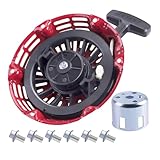
- Recoil Pull Start With Steel rod ratchet replaces Compatible with Honda 28400-ZE1-003ZF 28400-ZH8-013YA
- Recoil Starter Fit Honda Generator GX120 GX160 GX200 Engine
- Fit For 4 / 5.5 / 6.5hp Engine
- High Quality metal Material, Center To Center Hole Is 160mm, Red Color
- Package include: 1 x recoil starter, 1 x starter cup, 6 x mounting bolts, We Provide Carefree Return, And 90 Days Money Back Guarrantee! Lifetime Warranty Against Manufacturer Defect!
What the Honda K20 engine family is
The K-series is Honda’s 1,998-cm3, inline-four, DOHC engine family. Honda introduced its new-generation 2.0-liter DOHC i-VTEC engine in the first-generation Stream in 2000, making the Stream the original mainstream production debut for this generation of Honda 2.0-liter engines. Honda’s contemporary announcement describes the engine’s DOHC i-VTEC technology and its Stream application, while Honda’s historical material identifies the K engine as a principal mass-production design.
“K20” is therefore an engine-family designation, not one universal specification. The characters after K20 matter:
- K20A: used in numerous naturally aspirated Japanese-market and export applications, including high-output Type R, Euro R, Integra, Edix, Stream, and other versions.
- K20B: appears in selected Civic applications, depending on market and configuration.
- K20Z: includes naturally aspirated engines such as the North American Civic Si’s K20Z3 and the European FN2 Civic Type R’s K20Z4.
- K20C1: the direct-injection turbocharged engine used in later Civic Type R generations.
- K20C2: a naturally aspirated 2.0-liter engine used in selected tenth-generation Civic trims.
- K20C3: a turbocharged K20-family engine associated with the China-market Avancier and UR-V.
- K20C4: the turbocharged 2.0-liter engine used in North American Accord 2.0T models.
Those descriptions are useful for orientation, but they are not a parts-compatibility guide. Even two engines with the same K20 prefix can have different cylinder heads, intake and exhaust systems, turbo hardware, oiling arrangements, wiring, engine management, emissions equipment, mounts, and transmissions.
Performance Hondas with K20 engines
Honda Accord Euro R: CL7 K20A
The Japanese-market CL7 Accord Euro R is one of the best-known naturally aspirated K20 applications. It used a dedicated high-output K20A with a six-speed manual transmission. Honda’s official Euro R archive identifies the engine code and describes the performance-oriented intake- and exhaust-side VTEC/VTC arrangement.
Do these 3 things before closing this tab:
1Clear out junk files and repair common Windows errors2Scan for outdated or missing drivers - takes under a minute3Repair Windows errors before they cause bigger problemsThat engine should not be treated as representative of every Accord K20. Other Japanese, European, and export Accords used lower-output K20A-family engines, while the North American Accord 2.0T used a turbocharged K20C4. The shared K20 prefix does not make these engines equivalent.
Honda Integra Type R: DC5 K20A
The fourth-generation Honda Integra, commonly known by its DC5 chassis code, brought the K20A to the Integra range. The regular Japanese-market Integra included K20A-powered versions such as the iS and Type S in selected configurations. The DC5 Integra Type R used a high-output naturally aspirated K20A paired with a six-speed manual transmission.
Honda’s archived 2006 Integra specifications identify K20A as the engine type, and Honda’s Type R documentation records the DC5 Type R’s 2.0-liter K20A application. Engine suffixes, output, drivetrain, and emissions equipment still depend on the exact market and trim.
Honda Civic Type R: six factory K20 generations
The Civic Type R has used both naturally aspirated and turbocharged K20 engines. The factory Honda-branded applications are:
The Tool Desk
Outbyte PC Repair FREEClear out junk files and repair common Windows errorsFree Scan →Outbyte Driver Updater FREEFix the driver behind crashes, sound loss and screen glitchesFind Drivers →- EP3 Civic Type R: naturally aspirated K20A-family engine in Japanese and European-market versions.
- FD2 Civic Type R: naturally aspirated, high-output K20A, sold in Japan.
- FN2 Civic Type R: naturally aspirated K20Z4, sold primarily in Europe and related markets.
- FK2 Civic Type R: turbocharged K20C1, sold in Europe and related markets.
- FK8 Civic Type R: turbocharged K20C1, sold globally, including North America.
- FL5 Civic Type R: turbocharged K20C1, sold globally, including North America.
Honda’s Type R material records the naturally aspirated K20A engines in the DC5 Integra Type R and earlier Civic Type R applications. Honda’s later Type R information documents the 2.0-liter direct-injection turbo configuration, and the FK2-era K20C development was described at 310 horsepower. Exact output, calibration, emissions equipment, and ancillary parts vary by generation and market. Honda’s current North American vehicle-identification data also lists K20C1 for the Civic Hatchback Type R.
Rank #2

- Compatibility: Gx160 gx200 carburetor is compatible with Honda GX120 GX140 GX 140 GX160 GX 160 GX168 GX 168 GX200 GX 200 5HP 5.5HP 6.5HP Engine
- Carburetor replacement model: Gx160 gx200 carburetor replaces the part number 16100-ZH8-W51, 16100-ZH8-W61, 16100-ZE1-814, 16100-ZE1-825. Recoil starter replaces 28400-ZE1-003ZF, 28400-ZH8-013YA, ignition coil replaces 30500-ZE1-033, 30500-ZE1-063, air filter replaces 17210-ZE1-505
- Specification: Mounting hole center to center: 42mm, Core hole: 19mm, Choke hole: 24mm. High quality gx160 gx200 carburetor kit, easy to install
- Replacement for honda carburetor: Gx160 gx200 carburetor replacement for honda gx160 carburetor, for honda gx140 carburetor, for honda gx200 carburetor kit, for oem honda gx120 carburetor, carburetor for gx120 gx140 gx168 gx200
- Quality Assurance: Package includes 1 x carburetor, 1 x recoil starter, 1 x air filter, 3 x gasket, 1 x fuel line, 1 x switch, 1 x joint fuel filter, 1 x spark plug, 1 x ignition coil, 1 x insulator. 100% satisfaction guarantee. If you have any questions, please feel free to contact us by email. We will solve it for you in the first time
The important dividing line is that the EP3, FD2, and FN2 engines are naturally aspirated, whereas the FK2, FK8, and FL5 use turbocharged K20C1 engines. A naturally aspirated K20A or K20Z4 replacement is not a bolt-in substitute for a K20C1.
Honda Civic Si: K20Z3 in North America
The 2006–2011 North American Civic Si used the naturally aspirated K20Z3. It is a genuine factory Honda K20 application, but it is not the same engine as the high-output K20A versions used in Japanese Type R cars.
The later tenth-generation Civic Si moved to a 1.5-liter turbocharged engine rather than a K20. Consequently, “Civic Si” is not enough information when ordering parts or shopping for a donor vehicle: the model year and market are essential.
Regular Hondas that used K20 engines
Honda Civic
The Civic has one of the broadest ranges of K20 applications. Selected Japanese, European, and North American Civics used naturally aspirated K20A, K20B, and K20Z variants. In North America, the eighth-generation Civic Si used K20Z3, while selected tenth-generation Civic LX and EX configurations used the naturally aspirated K20C2.
A 2016 U.S. vehicle-identification reference lists K20C2 for specified Civic LX and EX configurations, and Honda’s 2016 Civic information confirms the availability of a 2.0-liter DOHC i-VTEC four-cylinder in the sedan. K20C2 availability changed with body style, trim, and model year; many later tenth-generation Civics increasingly used 1.5-liter turbocharged engines instead.
For a Civic, check the VIN, model year, body style, trim, market, and factory engine information. “Eighth-generation Civic” or “tenth-generation Civic” is too broad to establish parts fitment.
Honda CR-V: mainly the second-generation 2.0-liter petrol models
The second-generation CR-V used naturally aspirated 2.0-liter K20 engines in several markets. European application references commonly identify K20A4 and K20A5-family engines, with the exact suffix depending on market and vehicle specification. Honda’s archive covers the second-generation CR-V’s multiple model-year phases from 2001 through 2006.
Outdated Drivers Are Slowing You Down
One free scan finds every outdated or missing driver and matches the right update for your exact hardware.Free scan · exact hardware matchWindows Errors? Fix Them Before They Spread
Repair common Windows errors and clear accumulated junk for a smoother, more stable PC - no reinstall needed.Free scan · no reinstallThe third-generation and later CR-V generally moved to R20- and K24-family engines, depending on geography. Therefore, “second-generation CR-V, 2.0 petrol” is a much stronger K20 description than simply “CR-V.” Diesel versions and engines from other markets should not be assumed to be K20-powered.
Honda Stream: the K20’s first mainstream production home
Honda announced the new-generation 2.0-liter DOHC i-VTEC engine in 2000 for the first-generation Stream. Early 2.0-liter Stream variants used K20A-family engines, including K20A1 and related market-specific versions. The most relevant chassis and market references include RN3, RN4, and RN5 configurations.
Rank #3

- √ Recoil Starter Fits Honda GC135,GC160,GCV135,GCV160 Engine Motor Lawn Mower Pressure Washer Parts
- √ GC160 Pull Starter Fits for Honda EN2000,EN2500 Generator Engine Motor Parts, Compatible with Honda 5.5 hp HRR2169VKA / HRX217HXA /HRR2167VKA Engine Motor Troy-Bilt Lawn mower Pressure Washer
- √Replaces Honda Models: 28400-ZL8-013ZA/ 28400-ZL8-023ZA/ 284400-ZM0-003
- √ We offer you three months warranty,you can buy it with confidence
- High quality aftermarket Part
Honda’s archived Stream specifications identify K20A among the available engine types. Later Stream versions shifted to other engines, including R18 applications, so not every Stream is a K20.
Honda Step WGN: early RF-series models
Early and mid-2000s second-generation Step WGN models used naturally aspirated K20A-family engines, particularly in the RF3–RF8 range and related market variants. Application references identify K20A and K20A6 versions, while Honda’s archive describes the generation’s DOHC i-VTEC configuration.
Later Step WGN generations changed engine families. Honda introduced a 1.5-liter VTEC Turbo for the 2015 Step WGN, so only the earlier 2.0-liter petrol versions belong on a K20 list.
Honda Edix: K20A in the 20X models
The Japan-market Edix was a six-seat compact MPV available with a K20A in its 2.0-liter 20X and 20X 4WD trims. Honda’s archived specification sheet identifies the K20A engine type, 1,998 cm3 displacement, and DOHC i-VTEC configuration.
The Edix is particularly easy to overlook because it was not sold under that name in every market. Its closest European-market counterpart was the FR-V, but the engine suffix and calibration were not necessarily identical.
Honda FR-V: European K20A9
The European Honda FR-V used a 2.0-liter K20A9 petrol engine in selected trims from approximately 2004 onward. Specialist OE application data identifies the FR-V 2.0 with that engine code.
Recommended Free Tools
Although the FR-V was marketed as the Edix in Japan, do not assume that an Edix K20A part automatically fits an FR-V K20A9. Market-specific electronics, emissions hardware, accessories, and transmission combinations can change the correct replacement part.
Modern turbocharged K20C applications
North American Honda Accord 2.0T: K20C4
The 2018–2022 North American Accord 2.0T used the turbocharged K20C4. Honda’s 2020 Accord technical material identifies the 2.0T powertrain as a turbocharged 2.0-liter VTEC engine.
This is a fundamentally different application from the naturally aspirated K20A in the Accord Euro R. The C4’s turbocharger, direct-injection system, engine controls, intake and exhaust plumbing, cooling requirements, and transmission integration make it a separate service and parts category.
Rank #4

- This is a Honda GX390 GX340 tune up kit.It contains plenty of parts,including Honda GX 390 GX 340 carburetor,pull start recoil starter assembly,air filter,ignition coil,spark plug,fuel line,clips,air breather hose, insulator,gaskets set and mounting bolts and nuts for ignition coil,carb, muffler and other parts as shown.The pull starter assembly is made of strong pull cord,recoil spring and recoil pulley which are durable. The carb was originally designed by Japan.It is a perfect rebuild kit and service kit for your Honda GX 390 GX 340 13.0 hp 11.0 hp engine motor.Save your money,energy and time
- This tune up kit fits Honda GX340 11hp GX390 13hp GX420 16hp 340cc 390cc 420cc engines.
- ThisHonda GX390 GX340 engine kit fits many power equipments with Honda GX 340 GX 390 GX 420 11 hp 13 hp 16 hp 340 cc 390 cc 420 cc engines, including pressure washer,power washer,water pump,compressor and others.
- The quality of these parts are very good. All these parts are used on massive production by many small engine manufacturers. It is an excellent maintenance kit for your Honda 390 340 420 engine motor.
- Quality matches the original Honda GX390 GX340 engine parts
Civic Type R: K20C1
The FK2, FK8, and FL5 Civic Type R use the turbocharged K20C1. Honda’s Type R development material describes the K20C as a 2.0-liter direct-injection turbo engine, while North American vehicle-identification data lists K20C1 for the Civic Type R.
Although the engine code is shared across these Type R generations, a K20C1 from an FK2, FK8, or FL5 should still be checked by complete engine number, market, emissions specification, electronics, and intended chassis before purchase. “K20C1” narrows the search; it does not guarantee that every ancillary component transfers.
China-market Honda Avancier and UR-V: K20C3
Honda-branded Avancier and UR-V SUVs sold in China were offered with turbocharged 2.0-liter K20C-family engines commonly identified as K20C3. These are legitimate production applications, but they are geographically limited and are not the same calibration as the Civic Type R’s K20C1.
The Avancier and UR-V entries have less direct factory documentation in the available evidence than the Type R, Accord Euro R, Edix, Stream, and Civic applications. Treat K20C3 identification as a China-market application that should be confirmed against local factory documentation, the vehicle VIN, and the engine’s identification marking before making a parts or swap decision.
Honda models often confused with K20 applications
Acura models: related, but not part of the Honda-branded list
Acura is Honda’s premium brand, but this article is limited to Honda-badged production vehicles. The following Acura applications are therefore excluded from the main list even though they used Honda-developed K20-family engines:
- Acura RSX: K20A2, K20A3, and K20Z1 in North America.
- Acura TSX
- Acura RDX
- Acura TLX
- Acura Integra Type S
An Acura K20 may be relevant to a Honda project, but its inclusion would change the scope from “Honda models” to all Honda-developed or Honda-powered vehicles.
Not every Honda 2.0-liter engine is a K20
Displacement is not engine identity. Honda also used 2.0-liter engines from the F20, R20, and K24 families, among others. A 2.0-liter badge, DOHC label, i-VTEC branding, or a “Honda 2.0” search result is not sufficient proof that a vehicle has a K20.
The same warning applies to popular swap terminology. A vehicle advertised as “K-swapped” is not evidence of a factory K20 application; it may contain a different K-series engine, a modified engine, or an engine installed from another Honda or Acura model.
Independent reader supportYour contribution helps us test, update, and keep practical guides available for everyone.How to identify the correct K20 before buying parts
- Confirm the badge and market. Record the exact model, body style, drivetrain, model year, country of sale, and trim. A Japanese Edix, European FR-V, North American Civic, and Chinese Avancier require different lookup paths.
- Verify the factory engine code. Use the VIN with a manufacturer or reliable vehicle-identification database, then cross-check it against the under-hood label, engine stamping, service information, or build documentation.
- Record the complete suffix. “K20” is not enough. Write down K20A, K20A4, K20A9, K20Z3, K20C1, K20C2, K20C3, K20C4, or the exact code shown for the vehicle.
- Check the transmission and drivetrain. Manual and automatic applications can use different mounts, sensors, flywheels, clutch components, wiring, and control modules. Four-wheel-drive versions can also have different packaging and ancillary parts.
- Match emissions and electronics. Intake manifolds, exhaust manifolds, catalytic converters, oxygen sensors, engine-control modules, immobilizer systems, and wiring can vary by country and model year.
- Verify the part number, not only the description. A listing that says “fits K20” may cover only one suffix or chassis. Ask the seller or manufacturer to confirm the exact engine code and VIN before ordering.
For owners carrying out diagnosis or teardown work, a Honda K20 engine repair manual is most useful when it matches the specific engine code and vehicle market. A generic K-series guide cannot replace the wiring diagrams, torque specifications, service procedures, and emissions information for the exact application.
Quick wins for a faster PC:
Scan for outdated or missing drivers - takes under a minuteDriver Scan →Repair Windows errors before they cause bigger problemsFix Now →Best Value

- Replacement for Honda Engines GX340 GX390 GX610 GX620 (Metal Pawl) 11 , 13 , 18 and 20 HP Honda Engines.
- Replaces OEM Honda 28400-ZE3-W01 28400-ZE3-W01ZA.
- Length center to center hole is 200mm,Please check fitment and picture carefully before purchase.
- Package includes 1x recoil, 6x screws in a 1PZ Brand Box.
- Please confirm the model before purchase. For any questions, feel free to contact us—we’re always here to help.
The same rule applies to service parts. If a timing-chain job calls for a K20 timing chain kit, match the kit to the complete engine code, chassis, model year, and VIN. Do not assume that a kit advertised for one K20A, K20Z, or K20C will fit all engines carrying the K20 prefix.
Are K20 engines interchangeable?
No—not as complete, drop-in engines. The K20A, K20Z, K20C1, K20C2, K20C3, and K20C4 belong to the same broad family, but they are not interchangeable simply because they share 2.0-liter displacement and a K20 prefix.
The most consequential differences include:
- Induction: naturally aspirated K20A and K20Z engines differ fundamentally from turbocharged K20C1, K20C3, and K20C4 engines.
- Fuel and engine management: direct-injection turbo applications require different fuel-system, sensor, ECU, and wiring arrangements.
- Mounting and packaging: the engine mounts, accessory layout, oil pan, cooling plumbing, and chassis clearances vary between vehicles.
- Transmission integration: flywheel, clutch, automatic-transmission interface, driveshaft, and electronic-control requirements depend on the donor and recipient chassis.
- Emissions equipment: catalytic converters, oxygen sensors, evaporative systems, and regional compliance hardware can make a mechanically similar engine unsuitable for a road-legal installation.
A K20 swap is a separate engineering project involving mounts, wiring, ECU and immobilizer integration, fuel and cooling systems, exhaust fabrication, and often transmission and driveshaft work. It should not be confused with identifying a factory K20 vehicle or replacing like-for-like components.
Bottom line
The most recognizable factory Honda K20 vehicles are the Accord Euro R, DC5 Integra Type R, EP3 and FD2 Civic Type R, FN2 Civic Type R, FK2/FK8/FL5 Civic Type R, eighth-generation Civic Si, second-generation CR-V, first-generation Stream, early second-generation Step WGN, Edix, FR-V, selected Civic and Accord trims, and the China-market Avancier and UR-V.
Free tools Windows power users keep installed
One-click scans. No signup required.
For accuracy, split them into two groups: naturally aspirated K20A/K20B/K20Z applications and turbocharged K20C applications. Then verify the complete engine code, market, trim, drivetrain, model year, and VIN before ordering parts or planning a swap.
Frequently Asked Questions
Is every 2.0-liter Honda engine a K20?
No. Honda used several unrelated 2.0-liter engine families, including F20, R20, and K24 engines. Displacement, i-VTEC branding, and a 2.0 badge do not prove that a vehicle has a K20.
Are all K20 engines interchangeable?
No. K20A, K20Z, K20C1, K20C2, K20C3, and K20C4 differ in induction, fuel system, electronics, mounts, emissions equipment, and ancillary hardware. Confirm the complete engine code, chassis, model year, market, and VIN.
Which Civic Si has a K20 engine?
The North American 2006–2011 Civic Si used the naturally aspirated K20Z3. The later tenth-generation Civic Si used a 1.5-liter turbocharged engine instead, so the Civic Si name alone does not identify a K20.
Why are the Acura RSX and other Acura models not included?
The main list covers Honda-badged vehicles. The Acura RSX, TSX, RDX, TLX, and Integra Type S are excluded even though some used Honda-developed K20-family engines.
How can I identify which K20 engine is in my Honda?
Use the VIN with reliable manufacturer or vehicle-identification data, then cross-check the engine stamping or label and the vehicle’s factory service information. Record the full suffix—such as K20A9, K20Z3, K20C1, or K20C4—rather than searching only for K20.
The Bottom Line
The answer is not one model but a family of factory applications. Honda used K20 engines in selected Accord, Civic, Civic Si, Civic Type R, Integra, CR-V, Stream, Step WGN, Edix, FR-V, Avancier, and UR-V models. Because K20A, K20Z, K20C1, K20C2, K20C3, and K20C4 differ substantially, always verify the exact engine code and VIN before buying parts.
Quick Recap
Product prices and availability are accurate as of the date/time indicated and are subject to change. Any price and availability information displayed on Amazon at the time of purchase will apply.
What’s actually slowing this PC down?
Pick the symptom - the matching free tool is one click away.




