Do these 3 things before closing this tab:
1Clear out junk files and repair common Windows errors2Fix the driver behind crashes, sound loss and screen glitches3Repair Windows errors before they cause bigger problemsSince 1978, Mazda’s sports-car story has centered on two distinct ideas: rotary-powered performance in the RX-7 and RX-8, and lightweight, rear-wheel-drive roadster fun in the MX-5. The 1992 AZ-1 adds a more unusual branch: a tiny, turbocharged kei-class coupe with gull-wing doors. These cars are not direct substitutes, but together they show how Mazda interpreted the sports car across roughly five decades.
Which Mazda models count as sports cars?
Mazda has not published one formal definition that classifies every sporty model in its history. This overview focuses on the production cars central to the company’s modern sports-car story: the RX-7, MX-5, RX-8 and AZ-1. The AZ-1 is included as an edge case because it is a kei microcar as well as a sports-oriented coupe, not a conventional rival to the RX-7 or MX-5.
The timeline begins with the RX-7’s 1978 introduction and runs through the present-day end of the 50-year period. It covers the major model lines and generations rather than every regional derivative, motorsport special or concept car.
Mazda RX-7 generations: the rotary sports-car lineage
The RX-7 established Mazda’s modern rotary sports-car identity. Mazda says the first Savanna RX-7 was developed under the theme “pursuit of driving pleasure.” The Savanna had already built a motorsports reputation: Mazda records its 100th Japanese motorsports victory in 1976, before the RX-7’s launch. Mazda’s rotary heritage history describes the first-generation car’s 12A two-rotor engine and front-midship layout.
Free tools Windows power users keep installed
One-click scans. No signup required.
#1 Best Overall

- Plastic Model Kit-Assembly Required
- Glue and Paint sold separately
- Manufacturer Item #: 24110
First generation: Savanna RX-7 (1978)
Introduced in March 1978, the Savanna RX-7 put a compact rotary engine in a front-midship arrangement. That combination became the foundation of Mazda’s best-known coupe sports-car line. The car’s significance is not just that it used a rotary; it connected Mazda’s rotary-engine work with a dedicated sports-car model.
Second generation: FC (1985)
The 1985 second-generation RX-7, commonly identified as the FC, continued with a 13B rotary in a front-midship layout. Mazda characterizes it as a pure sports car intended to balance driving dynamics and comfort. That description marks a refinement of the original idea rather than a departure from it.
Rank #2
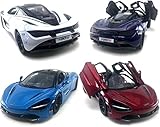
- Realistic Replica: This 1:36 scale die-cast metal model car is a detailed miniature replica of the iconic McLaren 720s supercar.
- Opening Doors: The model features opening doors that allow you to admire the intricate interior detailing.
- Pull-Back Action: Engaging the pull-back mechanism enables this toy car to zip across smooth surfaces.
- Vibrant Color: Showcasing a rich white hue, this miniature captures the sleek and stylish design of the full-size McLaren.
- Compact Size: Measuring approximately 5 inches in length, this model is perfectly sized for display or playtime.
Third generation: FD (1991)
The 1991 FD brought a twin-turbocharged 13B rotary, a front-midship layout and, in Mazda’s historical account, 50:50 weight distribution. Those are Mazda’s stated design features; they should be distinguished from broader enthusiast judgments about the FD’s handling or performance.
Mazda’s rotary heritage timeline identifies the FC and FD launch years and documents the RX-7’s evolution. Taken together, the three generations show how the same basic brief—a rotary-powered sports coupe—changed over time.
Quick wins for a faster PC:
Clear out junk files and repair common Windows errorsFree Scan →Fix the driver behind crashes, sound loss and screen glitchesFind Drivers →Rank #3
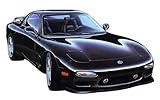
- Plastic model kit-assembly required
- Glue and paint sold separately
- Manufacturer item #: 24116
Mazda MX-5: a lightweight roadster with different names
The MX-5 took a different route from the RX-7. It is a compact, two-seat, open-top roadster whose identity rests on low weight, rear-wheel drive and a direct connection between driver and car—not on rotary power. Mazda’s development history describes its guiding concept, “Jinba Ittai,” as “rider and horse as one.” Mazda’s MX-5 development account explains the roadster’s design intent.
Mazda launched the car in the United States in spring 1989 and in Japan in September of that year. In Japan it was sold as the Eunos Roadster; MX-5 and Miata are names used in other markets. The different badges refer to the same roadster line, not separate sports-car models.
Rank #4

- 【Safe material, non-toxic and harmless 】The body is made of zinc alloy, sturdy and durable, the outer paint is electrostatic spraying, anti-rust, anti-corrosion, anti-collision, anti-painting, long service life. The windows are made of acrylic, non-toxic and odorless. Rubber tires are strong and durable. Provide safe guarding for you and your family.
- 【Product Size】This toy car is 1/32 scale. Well-made and realistic, it can also be used as a decoration in addition to being a toy for children to play with. Suitable for people who like car models as a collection.
- 【Play Function】The doors of this toy car can be opened, and the sound and light effects can be triggered by pressing the body and opening the doors. The roof of the car is also removable. The toy car also comes with a little tongue part that can be inserted in the front of the car after taking it out of the trunk. Press on the lights to lift them up and with the little tongue, a cute little face appears. This toy car has a strong pull back function, put the toy car on the ground and pull back hard, then let go, the toy car can run forward by itself.
- 【Learning Implications 】Children can learn more about cars while playing with toy cars. The color, temperature and material of the toy car can also give children intuitive feelings and help them understand the world.
- 【Quality after-sales service】We will provide quality pre-sales and after-sales service for the toy cars purchased in our store. You can contact us if you have any questions.
The MX-5’s long production history is reflected in two dated milestones from Mazda: 531,890 units produced from April 1989 through the end of October 1999, and production passing 800,000 units in January 2007. These figures describe those specific historical periods, not current totals. Mazda recorded both milestones in its MX-5 history.
Independent reader supportYour contribution helps us test, update, and keep practical guides available for everyone.Mazda RX-8: rotary power in a four-seat format
Launched in 2003, the RX-8 carried Mazda’s rotary-engine story into a different body style. Mazda describes it as a four-door, four-seat sports car powered by the RENESIS rotary engine. That makes it a distinct proposition from the two-seat RX-7 coupe: the RX-8 retained rotary power but made room for four occupants and rear doors. Mazda’s rotary heritage history and model history document its place in the rotary line.
Best Value
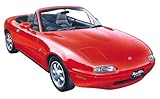
- 1/24 Mazda Eunos Roadster
- Great for Gift
- Assembly, painting is required plastic model. Separately, necessary tools, paint and the like.
- 1/24 Mazda Eunos Roadster
- High Quality model
Mazda AZ-1: the kei-class sports-car outlier
The AZ-1, introduced in 1992, is a two-seat micro-mini coupe with gull-wing doors. Mazda’s timeline describes a turbocharged 660 cc mid-engine and a lightweight design with a low center of gravity. Its unusual proportions and layout make it memorable, but its kei microcar character matters: it belongs in a broad account of Mazda’s sports-oriented models, while remaining a different class of vehicle from the RX-7 and MX-5. See Mazda’s historical timeline.
How Mazda’s sports cars differ
| Model | Body and seating | Powertrain identity | Core concept |
|---|---|---|---|
| RX-7 | Sports coupe; two-seat configuration is not specified in the cited Mazda history | 12A or 13B rotary, depending on generation; FD used a twin-turbo 13B | Rotary sports car with a front-midship layout |
| MX-5 / Roadster / Miata | Two-seat open roadster | Lightweight balance and driver connection define the story; engine specifics are not covered here | Rear-wheel drive, low weight and open-top driving |
| RX-8 | Four-door, four-seat sports car | RENESIS rotary | Rotary sports-car character in a more practical body format |
| AZ-1 | Two-seat micro-mini coupe | Turbocharged 660 cc mid-engine | Lightweight kei-class design with gull-wing doors |
The RX-7 and RX-8 are the rotary branches; the MX-5 is the roadster branch; and the AZ-1 is a small, specialized outlier. That distinction is more useful than treating all four as interchangeable choices. Specific maintenance needs, current market availability and parts compatibility depend on model year and market; Mazda’s historical descriptions do not establish those details.
Quick Recap
Product prices and availability are accurate as of the date/time indicated and are subject to change. Any price and availability information displayed on Amazon at the time of purchase will apply.




