The Mazda RX-7 FD was the third and final generation of the RX-7. Mazda introduced it in 1991 and says RX-7 production ended in 2002. Its defining formula was a compact two-rotor rotary engine, sequential twin turbochargers, and a light, carefully balanced sports-car chassis. Mazda’s sources establish that timeline, but do not verify that the RX-7 was the longest-running rotary-powered sports car.
When did the Mazda RX-7 FD come out, and when did production end?
Mazda dates the FD’s introduction to 1991. In its later historical account, the company says RX-7 production ended in 2002. Those dates describe the generation’s launch and the end of RX-7 production, respectively—not a claim that every market received the car at the same time.
Mazda’s March 25, 2002 announcement of the final Spirit R series said it envisioned FD-3S production ending in August of that year. That was the company’s anticipated end date in the announcement; Mazda’s later retrospective records 2002 as the year production ended. Mazda’s 1990–1999 history and its RX-7 retrospective provide the broader timeline.
What engine does the FD RX-7 have?
The FD uses a two-rotor 13B rotary engine with sequential twin turbochargers. Mazda’s technical material identifies the engine as the 13B-REW and lists its displacement as 654 cc × 2. “Twin turbo” means two turbochargers; Mazda describes their operation as sequential rather than simply treating them as a pair that always work identically.
Quick wins for a faster PC:
Scan for outdated or missing drivers - takes under a minuteDriver Scan →Repair Windows errors before they cause bigger problemsFix Now →Fix the driver behind crashes, sound loss and screen glitchesFind Drivers →#1 Best Overall

- AUTHENTIC REPLICA: Highly detailed 1:18 scale diecast model of the Mazda RX-7 FD, featuring stunning candy red exterior paint and gold-finished wheels
- PREMIUM DESIGN: Die-cast metal construction with opening doors, hood, and detailed interior components for authentic collector-grade quality
- DISPLAY FEATURES: Comes in a collector's display box with clear window, perfect for showcasing this precision-crafted model
- DIMENSIONS: Large 1:18 scale provides impressive detail, making it an ideal size for display or collection purposes
- COLLECTOR'S ITEM: Part of the prestigious Pink Slips series, featuring authentic sports car styling and premium craftsmanship
Power figures vary by specification and should not be collapsed into a single number for every FD. Mazda’s technical material lists 255 PS for the launch specification and says maximum output was later boosted to 280 PS. It notes updates in 1996 and 1998, but those figures alone do not provide a complete market-by-market or trim-by-trim power chart. Mazda’s 2007 rotary-engine technical material is the source for the engine designation, displacement and stated output figures.
What makes the FD RX-7 different?
A compact sports-car brief
Mazda describes the development aim as “the best rotary engine pure sports car.” Its retrospective says the team reduced the car’s dimensions relative to its predecessor, raised power and removed over 100 kilograms through a weight-reduction effort. That weight figure is Mazda’s account of the development programme, not an independently measured comparison of every version.
Rank #2
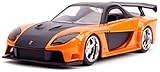
- Authentically licensed product from the Fast & Furious Saga.
- As seen in Fast & Furious Tokyo Drift, Han's Mazda RX-7 has been taken directly from the big screen and brought to you in a 1:32 scale die - cast model
- Crafted from durable materials such as 100% die - cast metal and premium rubber tires.
- Our superior casting method allows us to capture the feature rich details of the Han's Mazda RX-7, regardless of size!
- This premium die - cast model is a must have for any Fast & Furious collection
Front-midship layout and balanced chassis
Mazda says the FD placed its engine in a traditional front-midship layout and achieved 50:50 weight distribution. The chassis used aluminum double-wishbone suspension at all four wheels. Together, those choices show how the FD’s identity extended beyond its rotary engine: Mazda paired a compact powertrain with a balance- and handling-focused platform. These specifications are manufacturer descriptions in Mazda’s corporate history.
Mazda also reports that the generation received RJC New Car of the Year recognition. That is a period accolade cited by the manufacturer, rather than a measure of how every market or later buyer evaluated the car.
Windows Errors? Fix Them Before They Spread
Repair common Windows errors and clear accumulated junk for a smoother, more stable PC - no reinstall needed.Free scan · no reinstallCrashes, No Sound, or Screen Glitches?
Random freezes, missing sound and display glitches usually trace back to one bad driver. Find and replace yours safely.Free scan · under a minuteRank #3

- Contents: The Savanna RX-7 sports car equipped with a rotary engine known as Mazda's original technology in 1978, and the 3rd generation RX-7 was released in the late 1991 with Hot Wheels motif. The car name has been changed from the 2nd generation Savannah RX-7 to RX-7. The exterior has been modified to an organic form that uses a lot of curves and curves, and was produced until 2003 by changing the shape of the foot and improving the engine power. Often called "Effdi" from the model FD3S. The FD3S is the last RX-7 and the last rotary engine vehicle with turbo, so it is still very popular today. This release is inspired by drift specifications, and features a guard pipe installed instead of the front spoiler that is easy to hit with
- Country of Origin: Malaysia; Recommended Age: 3 years and up
- Perfect Gift: Perfect as a birthday gift, Christmas gift, or anniversary gift for kindergarten or school entrance celebrations
What was the final RX-7 FD edition?
Mazda announced Spirit R on March 25, 2002, as the RX-7’s final limited-production series. The announcement said it would go on sale in Japan on April 22 and described three configurations:
| Spirit R type | Seating | Transmission |
|---|---|---|
| Type A | Two seats | Five-speed manual |
| Type B | Four seats | Five-speed manual |
| Type C | Four seats | Four-speed automatic |
These descriptions and the Japan sale date come from Mazda’s Spirit R announcement. The release frames Spirit R as a closing series, with the FD-3S production end then envisioned for August 2002.
Rank #4
- Brand new box, Comes in a blister pack.
- Real rubber tires, Authentic detail.
- Detailed interior, Exterior.
- Authentic Paint & Graphics
- Die-cast metal body and chassis
How should the RX-7’s racing record be understood?
Mazda credits the RX-7 with 100 victories in North American IMSA competition across the model’s history. The company does not assign that total to the FD generation alone, so it should not be presented as an FD-only win record. Mazda’s account places the achievement in the longer RX-7 story rather than isolating a single generation.
Was the RX-7 the longest-running rotary-powered sports car?
The FD’s 1991–2002 production span is documented by Mazda, as is the RX-7’s place in the company’s rotary sports-car history. The available Mazda material does not compare the RX-7 or FD with every other rotary-powered sports car, so it does not establish the “longest-running” superlative as a verified record.
Recommended Free Tools
Quick Recap
Product prices and availability are accurate as of the date/time indicated and are subject to change. Any price and availability information displayed on Amazon at the time of purchase will apply.




