What’s actually slowing this PC down?
Pick the symptom - the matching free tool is one click away.
The three production Miura versions follow a clear progression. The P400 is the original 1966 design; the P400 S adds power, small styling changes and a more comfortable cabin; and the P400 SV goes further with wider rear tires and arches, a stronger chassis, revised suspension and independent gearbox lubrication. The SV is therefore more than a higher-output S: it is the most substantially revised version and the most powerful in Lamborghini’s published figures.
All three use the same basic idea that made the Miura revolutionary: a four-litre, transversely mounted mid-engine V12 in a layout whose engine and gearbox were joined in a distinctive casting. The differences below show what changed, how to identify each version, and why production totals reported by different authorities do not always agree.

As an Amazon Associate I earn from qualifying purchases.
Miura P400, P400 S and P400 SV at a glance
| Version | Production period | Lamborghini-published output | Cabin and appearance | Chassis, tires and lubrication |
|---|---|---|---|---|
| P400 | 1966–1968 | 350 CV at 7,000 rpm | Original styling and original interior specification | Base chassis and suspension arrangement; earlier cars retain the headlamp “eyelashes” associated with the first Miuras |
| P400 S | 1969–1971 | 370 CV at 7,700 rpm | Slightly revised aesthetics and a more comfortable interior | Evolution of the original mechanical package rather than the SV’s later chassis redesign |
| P400 SV | 1971–1973 | 385 CV at 7,850 rpm | Wider rear bodywork; Lamborghini says the headlamp eyelashes were removed | Larger rear tires, widened rear arches, stronger chassis, revised suspension and independent gearbox lubrication |
The power figures are Lamborghini’s published CV ratings. They should not be relabeled as SAE or DIN horsepower without a separate source establishing the applicable test standard.
Quick wins for a faster PC:
Fix the driver behind crashes, sound loss and screen glitchesFind Drivers →Clear out junk files and repair common Windows errorsFree Scan →What the “P400” name means
Lamborghini says the Miura debuted at the Geneva Motor Show in March 1966. In the model name, “P” refers to the engine position and “400” denotes the four-litre displacement. The car’s V12 sits transversely behind the passenger compartment, and the engine and gearbox use a unique shared casting. That packaging is common to the family, so the badge alone does not tell you whether a car is a P400, S or SV.
#1 Best Overall

- Includes decal
- Type: vintage and modern cars / period: 1970/80 / country: Italy
- Skill: 2
- Model Size: 18.3 cm/Box Size: 34 x 24 x 6 cm
- Glue and colours not included
The three versions are best understood as successive factory specifications, not three unrelated models. The P400 established the architecture; the S refined performance and daily accommodation; and the SV altered the suspension, rear-end geometry and lubrication arrangement in addition to increasing output.
P400: the original Miura specification
Engine and identity
The first production cars are the P400s built during the 1966–1968 period. Lamborghini lists the original version at 350 CV at 7,000 rpm. Its significance is not only the number: it is the specification that introduced the transverse mid-mounted V12 and the compact engine/gearbox casting to the road-car market.
Because the P400 is the starting point for the family, originality matters more than any single cosmetic detail. A car with a later engine, altered suspension or replacement body panels can look like an early Miura while no longer representing its delivered specification. Factory records, chassis documentation and a physical inspection are more reliable than a visual label.
Free tools Windows power users keep installed
One-click scans. No signup required.
Exterior and interior
The earliest cars carry the original treatment of the nose and lamps. Lamborghini’s description of the SV specifically notes that its headlamp eyelashes were removed, so the presence of eyelashes is a useful clue toward an earlier car, while their absence supports an SV identification. It is not conclusive by itself: trim can be changed during restoration.
The P400 cabin is the baseline against which Lamborghini describes the S as more comfortable. The company does not characterize the original interior with a separate modern comfort package; therefore, claims that every early car has a particular seat, switch or trim combination should be checked against the individual car’s build records.
Rank #2
P400 S: more power and a more usable cabin
What changed mechanically
The P400 S, produced from 1969 to 1971, raised the published engine rating to 370 CV at 7,700 rpm. Lamborghini presents this as a development of the original rather than the wholesale chassis intervention that arrived with the SV.
That distinction matters when a seller describes an S as “an SV with less power.” The S received the output increase and other refinements, but Lamborghini’s defining list for the SV adds larger rear tires, wider arches, a stronger chassis, revised suspension and independent gearbox lubrication. Those items are not established as standard P400 S features by the company’s history.
Appearance and interior
Lamborghini describes the S as having slightly different aesthetics and a more comfortable interior than the original. The wording is deliberately broad: it identifies a factory direction rather than a single visual component that can authenticate every car. Restorations, replacement upholstery and period modifications can erase or imitate small S-era details, so use the car’s documentation alongside its appearance.
The S is consequently the middle ground in the range’s development. It preserves the core P400 concept while making the car less austere and adding engine output, without the SV’s documented rear-track and suspension changes.
P400 SV: the chassis redesign
Why the SV is more than a powerful S
Introduced in 1971, the P400 SV is the final production evolution covered here. Lamborghini lists 385 CV at 7,850 rpm, the highest published output of the three versions. More important for identification is the collection of chassis changes delivered with that power increase:
Rank #3
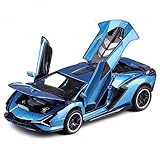
- Material:This model car is made of zinc alloy body,rubber tires and plastic parts.With Detailed interior and exterior trim, It is very sturdy.Car gets multiple processing, grinding sharp corners to prevent cuts child.
- Sound and light:Car doors,hood and trunk can be opened, accompanied with lights&sounds.Press the car body and open the doors can trigger the lights and real sounds.
- Pull back Cars:Place the car on the ground,just pull it back ,the model car will drive forward.Your kids can use it to play a chasing game with their friends.
- Size:Lamborghini Sian FKP37 is 1 /32 scale,Approx.6.3 * 2.7 * 1.6 inches.The size is similar with adult hands.It is very suitable for little boys and girls to grip.
- Gift:Fine workmanship,exquisite box with a display base,ideal birthday gift and holiday gift for kids boys and men who like collect model car.
- Larger rear tires.
- Widened rear wheel arches to accommodate them.
- A stronger chassis.
- Revised suspension.
- Independent gearbox lubrication.
These changes alter the car’s rear-end proportions and its underlying mechanical specification. That is why calling the SV merely “the most powerful S” misses the defining difference. Power is one part of the revision; tire, body, structure, suspension and lubrication changes are the rest.
Recommended Free Tools
Exterior cues
The widened rear arches are the most obvious body clue when viewing an unmodified car. The larger rear tires sit beneath them, giving the SV a visibly broader rear stance than the earlier versions. Lamborghini also states that the SV lost the headlamp eyelashes used on the earlier cars.
Neither cue proves authenticity alone. Bodywork can be converted, arches can be replaced and lamps can be changed during restoration. A credible SV identification should connect the visible features to chassis records, component numbers and an inspection of the suspension and lubrication systems.
Lubrication documentation and the chassis-number question
Lamborghini’s official history confirms independent gearbox lubrication on the SV but does not publish a chassis-number changeover for that feature. A collector guide describes later SVs as having separated engine and gearbox sumps and proposes a chassis threshold, but that detail is not confirmed by Lamborghini’s reviewed history. For a particular car, treat the arrangement and any claimed cutoff as questions for chassis-specific documentation and an experienced Miura specialist, not as a universal rule.
Power ratings: how to read the numbers
| Version | Published output | Published engine speed |
|---|---|---|
| P400 | 350 CV | 7,000 rpm |
| P400 S | 370 CV | 7,700 rpm |
| P400 SV | 385 CV | 7,850 rpm |
“CV” is the unit Lamborghini uses in its history. It is commonly associated with metric horsepower, but the manufacturer’s page does not identify these figures as SAE or DIN test results. Keeping the original unit avoids implying a conversion or a test method that the source does not establish. The rpm figures are part of each published rating; they are not interchangeable peak-power measurements taken under a single modern comparative test.
Rank #4

- ICONIC MODEL: Hot Wheels '71 Lamborghini Miura SV die-cast car in a sleek black finish with gold accents
- SERIES DETAILS: Part of the HW 70s vs 90s series, numbered 6/10, and is car 78 out of 250 in the mainline collection
- DIE-CAST CONSTRUCTION: Crafted with quality die-cast metal for durability and an authentic, detailed look
- COLLECTIBLE: A must-have for Hot Wheels enthusiasts and fans of classic Lamborghini models from the 1970s
- AGE RECOMMENDATION: Recommended for children ages 3 and up, suitable as a gift for young car fans and adult collectors alike
Production totals: why published counts disagree
Lamborghini’s own English-language Miura history gives the following production record:
| Version | Lamborghini’s stated production | Period |
|---|---|---|
| P400 | 265 | 1966–1968 |
| P400 S | 338 | 1969–1971 |
| P400 SV | 150 | 1971–1973 |
Those are the manufacturer’s figures, not an uncontested industry-wide count. Specialist references report different totals for some versions:
| Source | P400 | P400 S | P400 SV | How to use the figures |
|---|---|---|---|---|
| Automobili Lamborghini official history | 265 | 338 | 150 | Manufacturer’s own production account |
| LamboCARS model table | 275 | 338 | 150 | Secondary specialist reference; differs on P400 |
| Registro Italiano Miura | 274 | 338 | 147 | Registry total; the registry says it does not replace Automobili Lamborghini for certification |
| Collector buyer guide | Approximately 275 | 338 | 150 | Approximate secondary summary, not a manufacturer count |
The disagreement is material rather than a rounding difference. It can reflect different definitions of completed cars, records counted, or cars assigned to a variant. Use Lamborghini’s numbers when you need the company’s published account, and identify the specialist or registry source when quoting an alternative. Do not present a single combined total as definitive without stating which set of counts was added.
Independent reader supportYour contribution helps us test, update, and keep practical guides available for everyone.How to tell a P400, P400 S and P400 SV
Use a layered identification process instead of relying on one badge or body detail:
Crashes, No Sound, or Screen Glitches?
Random freezes, missing sound and display glitches usually trace back to one bad driver. Find and replace yours safely.Free scan · under a minuteWindows Errors? Fix Them Before They Spread
Repair common Windows errors and clear accumulated junk for a smoother, more stable PC - no reinstall needed.Free scan · no reinstall- Start with provenance. Obtain the chassis number, engine and gearbox information, invoices and restoration history. These establish what the car was delivered as and what may have changed.
- Place the car in the production timeline. A documented 1966–1968 car fits the P400 period, a 1969–1971 car fits the S period, and a 1971–1973 car fits the SV period. The overlapping year means that a 1971 car needs especially careful documentation.
- Inspect the rear bodywork and tires. Wider arches and larger rear tires support an SV specification. Measure and document the actual components rather than assuming that an arch conversion is factory-original.
- Check the headlamp treatment. Eyelashes point toward the earlier versions; their removal is consistent with the SV. Treat this as a clue, not proof, because lamps and trim are replaceable.
- Examine the chassis and suspension. The SV should show the stronger chassis and revised suspension described by Lamborghini. A specialist should verify the parts and mounting details against the car’s records.
- Verify the lubrication arrangement. Confirm the independent gearbox lubrication claimed for the SV and document the actual configuration on the car. Do not assign a chassis-number cutoff from an unverified secondary claim.
- Reconcile the engine documentation. The factory output rating helps classify the intended variant, but a present-day engine may have been rebuilt or replaced. Matching numbers and period records are more probative than a dyno result alone.
This sequence separates “what the car looks like now” from “what Lamborghini delivered.” That distinction is essential for a historically correct P400, S or SV.
Best Value

- Brand new box
- Real rubber tires.
- Detailed interior, exterior.
- Die-cast metal body and chassis,
- Dimensions approximately L-3 inches long.
Performance claims: what can and cannot be compared
The published power progression establishes the SV as the most powerful version in Lamborghini’s figures, followed by the S and then the P400. It does not establish a complete ranking for acceleration or top speed. The reviewed official history does not provide directly comparable figures for all three cars, and secondary sources do not constitute one consistent three-way test protocol.
For that reason, avoid quoting a single precise 0–60 time or top speed as though it were a factory comparison. Tire specification, gearing, test method, restoration condition and driver technique can all affect a period car’s result. Use the documented output and chassis changes to explain the engineering progression, and treat any additional performance number as a separately sourced estimate.
Which Miura variant fits a collector’s objective?
Choose a P400 when the original specification is the priority
The P400 is the correct focus for a collector interested in the first production form of the Miura, the earliest styling and the initial 350-CV specification. Its value as a reference car depends heavily on originality and documentation because later parts can make an early chassis resemble an S or SV.
The Tool Desk
Outbyte PC Repair FREEClear out junk files and repair common Windows errorsFree Scan →Outbyte Driver Updater FREEFix the driver behind crashes, sound loss and screen glitchesFind Drivers →Choose a P400 S for the intermediate factory evolution
The S suits a buyer who wants the original architecture with Lamborghini’s documented output increase, slightly revised appearance and more comfortable interior. Confirm that those features belong to the car’s history rather than a later restoration brief.
Choose a P400 SV for the final factory specification
The SV is the logical target when the priority is the highest Lamborghini-published output and the later chassis package: larger rear tires, wider arches, stronger structure, revised suspension and independent gearbox lubrication. Because the visible and mechanical differences are desirable, they are also the features most likely to be imitated on another variant; provenance remains decisive.
Buying and authenticity checklist
A prospective owner should commission a Miura-knowledgeable inspection before treating a car as a particular variant. The following checks address the differences that matter most:
- Record the chassis, engine and gearbox numbers and compare them with factory or registry documentation.
- Determine whether the body panels, rear arches, wheels and tires are original, period replacements or later conversions.
- Inspect the suspension components and chassis structure for the SV specification when an SV is claimed.
- Document the gearbox lubrication arrangement rather than relying on a seller’s description.
- Check restoration photographs and invoices for changes to headlamp trim, interior parts and engine components.
- Separate the manufacturer’s production count from registry or specialist counts when evaluating rarity claims.
- Have an independent specialist assess originality, matching numbers and mechanical condition before purchase.
These checks do not replace certification, but they prevent a cosmetic feature or an unverified production statistic from carrying more weight than the car’s records.
Bottom line: the real difference between P400, S and SV
The P400 is the foundation, the P400 S is the comfort-and-output update, and the P400 SV is the chassis-and-rear-end redesign that also delivers the highest published power. If you remember one identification rule, make it this: an SV claim should be supported by its wider rear stance, larger rear tires, revised suspension, stronger chassis and independent gearbox lubrication—not by an engine number or missing headlamp eyelashes alone.
Quick Recap
Product prices and availability are accurate as of the date/time indicated and are subject to change. Any price and availability information displayed on Amazon at the time of purchase will apply.




