The familiar “276-hp limit” was a voluntary Japanese auto-industry restraint on published domestic passenger-car power ratings—not a law that physically capped engine output. Its headline figure was 280 metric horsepower (PS), which converts to about 276 mechanical horsepower. The Japan Automobile Manufacturers Association (JAMA) reported ending the restraint in June 2004.
What was the JDM Gentleman’s Agreement?
It was an industry convention under which Japanese automakers held official power ratings for domestic-market passenger cars to 280 PS. In mechanical horsepower, 280 PS is approximately 276 hp, which explains why English-language accounts commonly call it the “276-hp limit.” The two numbers are different units for essentially the same published rating, not competing limits.
The restraint concerned catalogued or announced power figures. It was not a statutory ceiling imposed by law, nor proof that every engine rated at 280 PS produced precisely that amount in every condition. Contemporary reporting described it as voluntary self-restraint by automakers. Response.jp reported in July 2004 that JAMA notified the transport ministry of the decision to end the passenger-car restraint; Car and Driver’s 2005 account likewise described the familiar 276-hp figure.
Why were Japanese cars limited to 276 hp?
JAMA chair Itaru Koeda said the restraint began around 1989 amid concern about traffic accidents and the belief that more power could lead to excessive speed. That is the rationale he reported, not evidence that a particular horsepower threshold was scientifically established as a cause of crashes.
#1 Best Overall
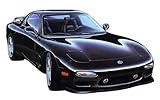
- Plastic model kit-assembly required
- Glue and paint sold separately
- Manufacturer item #: 24116
When explaining the decision to end the restraint in 2004, Koeda cited improvements in vehicle safety measures and said no relationship between maximum horsepower and accidents had been found. This is an English translation of his reported statement, not an original English quotation. Response.jp’s July 21, 2004 report attributes both the approximate 1989 starting point and the explanation to Koeda.
When did the agreement end?
JAMA reported terminating the passenger-car restraint to the transport ministry on June 30, 2004. Contemporary July reporting said the ministry accepted the notification. Because Koeda described the origin as “around 1989,” it is more accurate to give that as the approximate start than to assert a specific signed-agreement date.
Rank #2
![Hot Wheels Pearl & Chrome '92 Honda Civic EG [Blue] 2/6-1:64 Scale Diecast Toy Vehicle](https://m.media-amazon.com/images/I/51t5mPrTt0L._SL160_.jpg)
- 1992 Honda Civic EG in a Beautiful Blue Finish!
- Number 2/6 in the Pearl & Chrome Set! Celebrating Hot Wheels 58th Anniversary!
- 1:64 Scale Diecast Toy Car!
Honda’s redesigned Legend made the change visible later that year. Announced on October 7, 2004, it had a 3.5-liter V6 rated at 300 PS (221 kW), above the former 280-PS passenger-car figure. Response.jp reported the Legend’s rating and identified it as a milestone after the restraint ended.
Did cars rated at 276 hp really make more power?
Some period accounts reported that particular Japanese performance cars were underrated, including the Mitsubishi Lancer Evolution, Subaru Impreza WRX and Nissan 300ZX. Those reports help explain the enduring suspicion around the number, but they do not establish one reliable “real” output for every model—or a universal amount by which every car exceeded its rating. Car and Driver discussed examples, while MOBY’s retrospective account cautions against treating factory ratings and dyno readings as interchangeable.
Rank #3

- 1: 24 scale
- Glue and Paint sold separately
- Plastic Model Kit-Assembly Required
- TAM24123
- A factory power rating generally describes engine output; a chassis dynamometer measures power at the wheels after drivetrain losses.
- Results can vary with the car’s condition and the test and correction methods used.
- Japanese domestic and export versions may differ, so a figure from one market does not automatically describe another specification.
Without a defined vehicle specification, measurement method and test conditions, claims that a particular car “really made” a precise higher number should remain attributed claims, not a blanket correction to its published rating.
Independent reader supportYour contribution helps us test, update, and keep practical guides available for everyone.Was the 280-PS limit the same as the kei-car limit?
No. The 280-PS convention concerned Japanese-market passenger cars. A separate 64-PS restraint for kei cars was reported as still in place in July 2004, when JAMA’s passenger-car restraint had ended. The two figures applied to different vehicle categories and should not be combined. Response.jp’s July 2004 report covered both the passenger-car notification and the separate kei-car figure.
Quick Recap
Best Value

- COLLECTION CONTENT: Set includes 5 die-cast Hot Wheels vehicles featuring popular Japanese car models, with designs randomly selected from JDM collection
- AUTHENTIC DETAILS: Each vehicle showcases precise detailing, realistic paint schemes, and iconic Japanese automotive styling
- DISPLAY-WORTHY: Premium die-cast construction with eye-catching designs makes these cars perfect for both play and collection display
- VEHICLE VARIETY: Random assortment may include sports cars, tuners, classic models, and modern Japanese performance vehicles
- COMPATIBILITY: Works with Hot Wheels track sets and can be integrated into existing Hot Wheels collections for enhanced play value
Rank #4

- Tamiya Nissan Skyline
- GT-R R34 V-Spec Model Set
- Scale 1:24
- Plastic model kit
Product prices and availability are accurate as of the date/time indicated and are subject to change. Any price and availability information displayed on Amazon at the time of purchase will apply.




