The 2012–2013 Ford Mustang Boss 302 can be a rewarding first muscle car for a driver who already knows how to handle a manual transmission, respects a high-performance car, and can budget for specialist maintenance. It is not an easygoing default for a novice: Ford built it for track capability as well as public-road use, and it came with summer-only performance tires. The right answer depends less on the badge than on your experience, intended use, and the condition of the specific car.
What makes the Boss 302 different from a regular Mustang?
The modern Boss returned for the 2012 model year, reviving a name tied to Ford’s Trans-Am history. Ford’s 2012 owner supplement says Boss 302s driven by Parnelli Jones and George Follmer helped Ford win the 1970 manufacturer’s championship (Ford’s 2012 Mustang Boss 302 Supplement).
This is not merely a Mustang GT with appearance add-ons. Ford lists a high-performance V8 with forged pistons and rods, unique steering and chassis tuning, manually adjustable dampers, Brembo four-piston front brakes, and summer-only performance tires. Ford described the car as extensively re-engineered for track performance and paired it with a close-ratio six-speed manual in its launch announcement (Ford’s 2012 Boss 302 launch announcement).
Ford Performance’s engine-history document lists 2012–2013 output as 444 horsepower and 380 lb-ft of torque. Ford’s original 2010 launch release announced 440 horsepower and 380 lb-ft for the 2012 model. Because the two Ford sources differ, it is more accurate to note both figures and their sources than to present them as one definitive number. The later engine-history document describes upgraded pistons and rods, CNC-machined high-flow cylinder heads, a high-rpm intake design, oil cooling, and revised oil-pan baffling (Ford Performance’s engine-history document).
Quick wins for a faster PC:
Clear out junk files and repair common Windows errorsFree Scan →Scan for outdated or missing drivers - takes under a minuteDriver Scan →Repair Windows errors before they cause bigger problemsFix Now →#1 Best Overall

- 1: 25 scale/ 109 parts
- Detailed 302 cu. In. V-8 engine
- Front and rear spoilers
- Tampo printed tires
- Molded in white, transparent red and clear with chrome plated parts and soft black tires
Is a Boss 302 suitable as your first muscle car?
It may suit an experienced manual driver
If you are already comfortable with a manual transmission and want an engaging, factory-engineered performance car, the Boss can be usable on the street. Ford Mustang chief engineer Dave Pericak described its whole-car approach in the launch announcement: “The Boss 302 isn’t something a Mustang GT owner can buy all the parts for out of a catalog or that a tuner can get by adding a chip. This is a front-to-back re-engineered Mustang with every system designed to make a good driver great and a great driver even better.” That is an engineering aim, not a promise that the car makes an inexperienced driver safe.
A novice should think carefully before buying
The high-output V8, manual gearbox, track-oriented chassis, and summer-only tires call for deliberate inputs and sound judgment about weather and road conditions. A novice driver may be better served by a less powerful, lower-cost car with more forgiving tires and handling while building experience. This is a practical recommendation based on the Boss’s equipment and intended use, not a claim that a particular model has a measured crash risk.
Rank #2
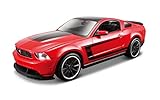
- These highly detailed kits come with everything you need to build them including the screwdriver
- Opening parts, Rolling Wheels
- Easy assembly, Pre-painted metal body
- When finished the vehicles are fully functional
- Rolling die-cast replica
How do the 2012, 2013, and Laguna Seca versions differ?
Choose based on the individual car’s condition, service history, equipment, comfort, and whether you expect mostly street or track use. Ford’s 2013 announcement describes heritage graphics, standard SYNC, and removable grille covers that can be taken out for additional track cooling. Ford described the Laguna Seca package as adding a firmer chassis, greater body stiffness, and aerodynamic changes; the 2013 announcement also identifies a rear-seat delete and race-ready suspension (Ford’s 2013 Boss 302 announcement).
The Laguna Seca’s more track-focused equipment may be appealing if that is your priority, but it is not automatically the better first-car choice. Consider whether its setup and reduced practicality match your actual use, and compare specific cars rather than assuming model year or package guarantees condition.
Rank #3

- High-Quality Materials:The 1969 Ford Mustang Boss 429 die-cast car is made of zinc alloy,plastic parts and rubber tires,making it safe for children to play with.It features detailed interior and exterior trim, and is very sturdy.
- Function:No batteries are required, but the vehicle has a powerful pull back feature. Simply pull it back, then release your hand, and the car will go for a long distance. The doors may be opened to view the whole inside of the vehicle. So appealing to children and collectors alike.
- Size:1/36 scale vehicle model with beautiful English packaging,ideal for toddlers to play with and carry. Car collectors will appreciate the perfect small size, which allows them to collect a complete set of cars without taking up too much space.
- Grow From Play:Help children learn more about car ,expand their knowledge ,increase the hand-eye coordination and the reaction speed of the children in the play.
- Ideal Christmas Festival Gift:All of TOKAXI die-cast model cars are attractively packaged in English, making them the perfect Christmas, Birthday, Children's Day, New Year gift for kids, party favors, home decorations, or travel toys for boys and girls.gifts for boys girls.
The Boss 302S and 302R are different propositions: Ford identifies them as purpose-built racing cars, and says the 302R is not street legal. They are not equivalent street-car alternatives to a road-going Boss 302 (Ford Performance’s Boss 302S/302R information).
What should you check before buying a used Boss 302?
Factory specifications cannot establish the condition of an individual used car. Arrange a pre-purchase inspection with a mechanic familiar with S197 Mustangs and review the car’s records and use history. No model-specific defect checklist or reliability ranking is established by the cited Ford materials.
Rank #4

- Approximately 7-1/2" Long
- Scaled replicas of cars and trucks
- Die-cast metal body with plastic details
- Opening doors on all- some with opening hoods and trunks
- Detailed chassis
- Review service records and ask about track use, modifications, and repairs.
- Have a qualified mechanic inspect the car, including its chassis, brakes, tires, and any modifications.
- Check tire condition and whether the summer-only performance tires are appropriate for your local climate and intended use.
- Test-drive only within your skill level; do not use a public road to explore the car’s limits.
- Verify the asking price, insurance cost, and likely upkeep for the specific car before committing. Current market values, insurance costs, and comparative ownership costs are not established here.
What maintenance and track-use details matter?
Ford’s 2012 supplement says a new vehicle should be driven for at least 100 miles before extended wide-open-throttle maneuvers and for 1,000 miles before performance or competition conditions. That guidance is for break-in of a new vehicle; it is not a used-car inspection result or a complete maintenance schedule. For a used car, consult the manual for its exact model year and have a qualified mechanic assess its condition.
Ford Performance identifies 5W-50 full-synthetic oil and an engine oil cooler in the Boss 302 engine package. Confirm the required specification and capacity in the correct manual for the car. Ford lists oil cooler part M-6642-MB as original equipment on 2012–2013 Boss 302 models and says it fits 2011–2014 Mustang GTs with the 5.0L 4V Ti-VCT engine; that fitment information does not mean every owner needs a replacement or that the part is currently available (Ford Performance’s M-6642-MB listing).
Recommended Free Tools
Best Value

- Contents: Boss 302 is based on the 2nd generation Mustang, a special model manufactured to gain the qualification of the SCCA Trans Am Series, which appeared in 1969. Although the Mustang sports grade main engine was V8 351 cu.in. (5,751 cc), the BOSS 302 is equipped with a V8 engine that generates 290 horsepower from 302 cu.in. (4,948 cc) displacement, and is equipped with a front and rear spoiler. On Hot Wheels, the BOSS 302 features include "C" lettering on the side and a black-out engine hood
- Country of Origin: Thailand, Recommended Age: 3 years and up
- Perfect Gift: Perfect as a birthday gift, Christmas gift, or anniversary gift for kindergarten or school entrance celebrations
Ford’s TracKey announcement describes a second engine calibration and launch-control feature for track use. Mustang powertrain engineer Jeff Seaman cautioned: “It’s not for use on the street – for example, the deceleration is set up to preserve the brakes, and the throttle response is very aggressive. A skilled driver on a closed course will really appreciate the benefits.” Treat that calibration as a closed-course feature, not a street-driving upgrade (Ford’s TracKey announcement).
Quick Recap
Product prices and availability are accurate as of the date/time indicated and are subject to change. Any price and availability information displayed on Amazon at the time of purchase will apply.