The Tool Desk
Outbyte PC Repair FREEClear out junk files and repair common Windows errorsFree Scan →Outbyte Driver Updater FREEScan for outdated or missing drivers - takes under a minuteDriver Scan →No—SP80 has not yet broken the outright sailing speed record. The Swiss experimental kiteboat has published a major peak-speed milestone, but record certification requires an average over a defined course. Its next announced attempt is planned for Walvis Bay, Namibia, beginning in September 2026; the cited project and record-authority material does not confirm a completed record by September 30, 2026.
What SP80 is building
SP80 is an experimental Swiss sailboat project developed by EPFL students and alumni. It is not a production boat or a consumer kiteboard. The project combines a very narrow, lightweight hull platform with a large airborne kite and an underwater foil designed to keep the craft controlled at extreme speed.
Its long-term objective is 80 knots—about 150 km/h—using wind power alone. SP80 describes the project as a test bed whose technology could eventually inform maritime transport, competitive sailing and hydroelectric power generation.
“Starting with a dream, we built a boat capable of sailing at 80 knots (150kph) solely powered by the wind,” SP80 says.
Do these 3 things before closing this tab:
1Clear out junk files and repair common Windows errors2Fix the driver behind crashes, sound loss and screen glitches3Repair Windows errors before they cause bigger problemsSpecial offer. See more information about Outbyte and uninstall instructions. Please review EULA and Privacy policy.#1 Best Overall
 PLAYSTEAM Voyager 280 RC Controlled Wind Powered Sailboat in Red - 17.5" Tall
- Control your own RC sailboat - 2-channels with two servos for control of the water rudder and sail angle
- Powered by the wind! Does not need (or include) a motor for forward movement. Captain your sailboat and learn about wind powered control.
- No assembly required. Perfect for the pool or pond.
- Requires: 4 AA batteries and wind. 17.5” tall (14” above the waterline) and 11” long.
- Choose from three different colors – blue or red.
How a kite can pull a boat without lifting it out of the water
The kite replaces a conventional mast and sail
A conventional high-speed sailcraft transfers aerodynamic force through a mast, boom and hull. SP80 instead flies a high-performance kite above the water. The kite generates a forward component of force while also creating a substantial upward load.
That upward load is the central engineering problem: uncontrolled lift could make the boat skip, pitch or leave the water. The design therefore has to turn the kite’s force into forward motion while keeping the hull and foil aligned with the surface.
Rank #2

- Control your own RC sailboat - 2-channels with two servos for control of the water rudder and sail angle.
- Powered by the wind! Does not need (or include) a motor for forward movement. Captain your sailboat and learn about wind powered control.
- No assembly required. Perfect for the pool or pond.
- Requires: 4 AA batteries and wind. 26.5” tall (21” above the waterline) and 15.75” long.
- If there are problems such as Mainsail is not attached, missing parts, broken parts, please contact us in time, we will replace you with new products for free, and we are happy to solve any product problems for you until you are satisfied.
The underwater foil supplies the opposing force
SP80 uses an underwater foil to counter the kite’s tendency to lift the boat. The foil produces downward and lateral forces, while the narrow hull and control system are intended to reduce drag and preserve stability. In effect, the kite and foil form opposing parts of one force-management system: the kite pulls from above and the foil reacts below the waterline.
Two pilots divide the workload
Two people sit in tandem. One steers the boat while the other controls the kite. Separating those jobs lets the crew manage course, foil behavior and kite power at the same time—an important requirement when small control errors can produce large changes in load at record speeds.
Quick wins for a faster PC:
Fix the driver behind crashes, sound loss and screen glitchesFind Drivers →Clear out junk files and repair common Windows errorsFree Scan →Scan for outdated or missing drivers - takes under a minuteDriver Scan →Rank #3
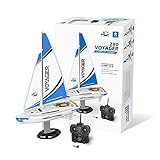
- Control your own RC sailboat - 2-channels with two servos for control of the water rudder and sail angle
- Powered by the wind! Does not need (or include) a motor for forward movement. Captain your sailboat and learn about wind powered control.
- No assembly required. Perfect for the pool or pond.
- Requires: 4 AA batteries and wind. 17.5” tall (14” above the waterline) and 11” long.
- Choose from three different colors – blue or red.
How fast is the SP80 kiteboat?
| Measure | SP80 published figure | What it means |
|---|---|---|
| Long-term target | 80 knots (about 150 km/h) | Project goal, not a certified result |
| Peak speed | 58.2 knots (about 107 km/h) | Highest instantaneous speed reported by SP80 |
| 500 m average | 48.6 knots (about 90 km/h) | Published average over a 500 m run |
| Outright 500 m world record | 65.37 knots (75.23 mph; 121.06 km/h) | Certified record set by Paul Larsen aboard Vestas Sailrocket 2 |
SP80’s official project material describes the 58.2-knot peak as the second-fastest top speed recorded by a sailboat. That is a peak-speed comparison, not a claim that SP80 has taken the certified outright record.
Why the 58.2-knot run is not yet a world record
The World Sailing Speed Record Council records sailing speed records using a specified course and elapsed-time average. A peak reading can show how fast a craft accelerated momentarily, but it does not establish the average required for certification.
Rank #4

- Length 400mm, width 100mm, height 672mm, scale 1:30
- Includes detachable electric motor for fun sailing indoors or when there is no wind
- 3-channel control. Transmitter controls the sail angle, the water rudder and the motor
- Equipped with 2 9-gram servos, 3.7V 150mAh Li-Po battery, Battery charger is built into the transmitter.
- The motor is used to control the sailboat forward and backward, avoiding the sailboat being trapped when encountering a complex environment, or the boat cannot be driven back to the shore without wind or loss of control.
The distinction is visible in the council’s 2013 announcement for Alexandre Caizergues in the KiteSail category: the result used a 501 m course, a 17.20-second elapsed time and a 56.62-knot average. The official record is therefore tied to a measured distance and timed run, rather than the highest number displayed by an onboard instrument.
SP80 compared with Vestas Sailrocket 2
| Comparison point | SP80 | Vestas Sailrocket 2 |
|---|---|---|
| Published speed discussed here | 58.2-knot peak; 48.6-knot 500 m average | 65.37-knot certified 500 m average |
| Propulsion architecture | Airborne high-performance kite | Conventional sail-powered sailcraft architecture |
| Stability approach | Narrow hull plus an opposing underwater foil that manages the kite’s lift | Different hull, sail and foil arrangement; the cited material does not provide a like-for-like technical specification |
| Record status | Development project with a planned campaign in Namibia | Holder of the cited outright 500 m sailing speed record |
| How the speed is expressed | Peak and 500 m average figures are both reported; only a qualifying average can support certification | Record is reported as a certified average over the defined course |
Development history and the planned Namibia attempt
Concept validation
The project grew out of EPFL student and alumni work. SP80 says it tested the concept at full scale with kite-surfing experiments and developed a program to predict stability and velocity before committing to its record craft.
Recommended Free Tools
Best Value

- Length 400mm, width 100mm, height 672mm, scale 1:30
- Includes detachable electric motor for fun sailing indoors or when there is no wind
- 3-channel control. Transmitter controls the sail angle, the water rudder and the motor
- Equipped with 2 9-gram servos, 3.7V 150mAh Li-Po battery, Battery charger is built into the transmitter.
- The motor is used to control the sailboat forward and backward, avoiding the sailboat being trapped when encountering a complex environment, or the boat cannot be driven back to the shore without wind or loss of control.
May 2025 milestone
SP80 reports reaching its 58.2-knot peak in May 2025, alongside the 48.6-knot average over 500 m.
Weather delay and the next campaign
Weather prevented the first official campaign planned for spring 2025. SP80 subsequently announced a new objective: begin a record attempt in Walvis Bay, Namibia, in September 2026. The announcement identifies the location and start period, but the cited sources do not report a final certified result from that campaign.
What would count as a successful record attempt?
- Run the craft on the designated course. The attempt must use the course geometry and distance required by the applicable sailing-speed record rules.
- Produce the qualifying average. The deciding figure is elapsed time averaged over the measured course, not the boat’s highest instantaneous speed.
- Document the run for the governing authority. Timing and course data must support the result under the World Sailing Speed Record Council’s certification framework.
- Separate milestones from the official result. A new peak speed could be an important engineering achievement while still falling short of a ratified outright record.
Why the project matters even before a record
SP80’s kite-and-foil layout explores a different way to manage the trade-off between aerodynamic power, hydrodynamic drag and stability. The project says lessons from the record program are intended for wider applications, including maritime transport, racing technology and hydroelectric power generation.
That broader ambition also explains why SP80 works with EPFL and seeks scientific, technical and financial partners. Until a specific program is identified, those partnership categories should be understood as prospective rather than as established commercial products.
Quick Recap
Product prices and availability are accurate as of the date/time indicated and are subject to change. Any price and availability information displayed on Amazon at the time of purchase will apply.




