Do these 3 things before closing this tab:
1Repair Windows errors before they cause bigger problems2Fix the driver behind crashes, sound loss and screen glitches3Clear out junk files and repair common Windows errorsFor most homeowners, a two-post lift is the more practical starting point—provided the exact model fits the garage, slab, vehicles and electrical service. It mounts on the existing floor and gives direct wheel-free access. An in-ground lift leaves a completely open, flush floor when lowered, but it requires floor-integrated construction, detailed engineering and often excavation. The in-ground equipment described by manufacturers is primarily heavy-duty commercial gear, so it should be treated as a purpose-built construction project rather than a routine residential upgrade.
Neither design is automatically safer or cheaper in every home. The correct choice depends on a model-specific installation manual, a site assessment and itemized local quotes.
As an Amazon Associate I earn from qualifying purchases.
What is the difference between a two-post and an in-ground lift?
Two-post lifts are surface-mounted
A two-post lift has two upright columns anchored to the garage floor. Swing arms extend from the columns to the vehicle’s approved lifting points. An electric motor drives a hydraulic pump or screw-type mechanism, depending on the design. The Automotive Lift Institute (ALI) describes surface-mounted lifts as typically bolted to the floor and says they are the most widely used lift type today.
Once the arms are positioned correctly and the vehicle is raised, the wheels hang free. That makes suspension, brake, tire, steering and underbody work easier than working with a jack and stands. The columns and arms remain in the bay, however, so the garage loses some unobstructed floor and maneuvering space.
#1 Best Overall
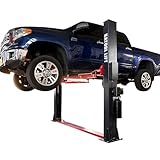
- Powerful 4.0HP Motor & 12,000 lbs Lifting Capacity – This CE Approved and Certified 2 post car lift. Perfect for heavy duty use in home garages, auto repair shops, and 4S stores
- Wide Lifting Range for Low & High Vehicles – Max lifting height 70.86", minimum height only 4.25" It is safe and secure, easy to operate, has a strong structure
- Single-Point Lock Release for One-Person Operation – Release all locks from one side for quicker, safer solo use. Sturdy construction with dual hydraulic chain-drive cylinders and rubber pad door opening protection – prevents scratches and dents while lifting
- Top-Level Hydraulic System with 220V/60Hz/1PH – Symmetric arms and base plate design deliver stable, balanced lifting. Includes rubber pad door protection, screw-on pads, and extension support adaptor sets (+100mm) for extra reach and versatility
- Buyer will be responsible for unloading, equipment required: forklift, if you can't unload it, we can ship it to the local terminal for pick up. In addition, if item was damaged, please take photos and contact us, and mark "damaged" on the receipt.
In-ground lifts are built into the floor
An in-ground lift places the lifting mechanism below the finished floor. When retracted, the equipment can leave a flush surface with no columns standing in the work area. The cited in-ground products are designed for heavy-duty fleets and large vehicles; their existence does not prove that a particular unit is suitable for an ordinary residential garage.
Traditional in-ground construction can involve a pit, excavation, drainage, structural concrete and access for future service. Some newer designs use a recessed cassette or other below-floor structure, but the same principle applies: the building must be designed around the lift rather than simply receiving a pair of bolted columns.
Two-post vs. in-ground: the practical trade-offs
| Decision factor | Two-post lift | In-ground lift |
|---|---|---|
| Floor and access | Columns and arms occupy the bay. Correctly positioned arms provide wheel-free access. | Retracts below the floor for a clear, flush work area; cited heavy-duty products also provide wheel-free access. |
| Construction | Needs a suitable concrete slab, accurately placed anchors and overhead clearance. | Requires floor-integrated construction; a pit or recess may require excavation and substantial civil work. |
| Typical application evidence | A familiar category for garages, but each model still has its own limits. | The products identified are aimed at commercial heavy-duty fleets; residential suitability must be established project by project. |
| Critical purchase checks | Current manual, capacity, approved lift points, arm reach, ceiling obstructions, concrete, anchors, power and certification. | Vehicle class, pit or foundation design, drainage, covers, utilities, controls, service access and local construction rules. |
| Residential cost evidence | No comparable residential purchase-and-installation total was established. | No comparable residential purchase-and-installation total was established. |
Will a two-post car lift work in my garage?
Only a model-specific check can answer that question. Measure the complete installation envelope rather than just the nominal garage dimensions.
Check ceiling height and every overhead obstruction
Measure from the finished floor to the lowest obstruction across the entire area the vehicle and lift will occupy. Include garage-door tracks, the opener, torsion springs, joists, lights, ducts and storage racks. Also consider the height of the tallest vehicle you intend to raise, the lift’s maximum rise and the height of the vehicle’s roof or hatch when the suspension unloads.
BendPak’s general FAQ guidance says most standard two-post lifts need at least 12 feet of ceiling, but that is not a universal requirement. A TP12KSC-DX manual, dated July 2018-A, recommends a minimum ceiling height of 170 inches (14 feet 2 inches) for that specific model. Use the current manual for the exact lift; never substitute a broad FAQ figure for engineering data.
Verify the concrete slab
The slab must be thick and strong enough for the column loads, in good condition and suitable for the specified anchors. BendPak gives broad, model-dependent guidance of a 4-to-6-inch reinforced slab rated at 3,000-plus PSI and fully cured. The TP12KSC-DX manual instead specifies a minimum 4-1/2-inch thickness and 3,500-PSI concrete for that model.
Rank #2

- Powerful and Economical 2 Post Car Lift: Capable of lifting up to 10,000 lbs, this two-post carlift is suitable for a variety of vehicles including cars, trucks, SUVs, and vans. Equipped with a robust 3 HP motor for efficient operation. Requires N32/N46 hydraulic oil for smooth performance.
- Durable Hydraulic Post Lift Construction:The pass-through width is 103.07 inches, and the dimensions are 137.64 inches in width and 146.46 inches in height. High-quality materials in each hydraulic cylinder ensure heavy-duty use and long-lasting reliability.Point Release: The convenient double point release system allows for quick and easy lowering of the lift.
- Secure Car Lift System with Safety Locks:Features a 2-point safety lock release for secure positioning during lifts. Automatic arm restraints for added security. A relief valve in the power pump prevents overloading. Protective rubber door guards prevent pinching. An up-limit switch safeguards the cylinders by limiting their stroke. Cylinder limit switches enhance safety.
- Functional Design:Load Capacity: Handles 10000 LB with ease. Temperature Range: Operates from -5°C to +40°C.Altitude Tolerance: Functions well up to 200m above sea level.
- Space-Efficient Design: The compact two-post design saves floor space, making it ideal for even the most confined workshops.
Those numbers illustrate why lift specifications cannot be generalized. A slab can be thick enough yet still be unsuitable because of cracking, poor concrete, inadequate reinforcement, a joint in the wrong location or an edge too close to an anchor. Before drilling, identify embedded water, gas, electrical lines and post-tensioning cables. If the slab’s construction is unknown, have a qualified concrete or structural professional assess it.
Recommended Free Tools
Confirm vehicle capacity and geometry
Check the lift’s rated capacity against the vehicle’s actual curb weight and the manufacturer’s load-distribution limits. Confirm that the arm reach, pad height and adapter options can contact the vehicle’s approved lifting points without touching fuel lines, battery packs, rocker panels or other vulnerable parts.
Do not assume that a lift rated for a certain weight will fit every vehicle below that weight. Compare the vehicle service information with the lift manual, including wheelbase, width, ground clearance, high-roof height and the location of the center of gravity. Vans, electric vehicles, unibody cars and modified trucks can require different adapters or procedures.
Check power, access and local rules
Confirm the required voltage, phase, circuit rating, disconnect and outlet location. The AMGO installation manual states that wiring should be completed by a licensed or certified electrician and that the equipment is for indoor use. Follow the exact electrical diagram supplied with the lift and the requirements enforced by your local authority.
Plan how the vehicle will enter and leave the bay, where doors will swing, and whether a second vehicle or storage items will interfere with the columns. A lift that technically fits may still be unusable if the driver cannot align the vehicle or if a raised door strikes the ceiling.
Free tools Windows power users keep installed
One-click scans. No signup required.
Check certification for the exact model
Certification is not automatically shared by every model from one manufacturer. BendPak states that many, but not all, of its lifts are ALI certified. Verify the current certification status of the exact make and model, then keep its installation, inspection and maintenance documents with the equipment.
Rank #3

- This 2-post lift is CE approved and fully certified, meeting strict European safety and quality standards. You can trust in its structural integrity and reliable performance for every vehicle you raise. Built to comply, built to last—safety you can count on
- Exceeding standard safety margins, this commercial-grade lift is built to a 115% dynamic load specification and has successfully undergone 150% static load testing. This means every column, cable, and cylinder is proven to handle extreme weights with zero compromise on stability. Choose a lift that's tested to perform when it matters most
- Designed for shop safety and efficiency, this lift features manual safety releases on both sides and heavy-duty symmetric arms for stable, even lifting. Dual hydraulic chain-drive cylinders deliver consistent power, while the integrated rubber door pads protect against accidental impacts. A complete package of safety, strength, and vehicle protection
- Powered by a top-level hydraulic system, this lift is available in 220V/60Hz/1Ph or optional 110V/60Hz/1Ph to fit your shop's electrical setup. It comes complete with extension support adaptor sets of +30mm and +120mm for enhanced vehicle compatibility. Premium hydraulics with versatile fitment for a wide range of vehicles
- Buyer will be responsible for unloading, equipment required: forklift, if you can't unload it, we can ship it to the local terminal for pick up. In addition, if item was damaged, please take photos and contact us, and mark "damaged" on the receipt
How thick does the concrete need to be for a two-post lift?
There is no single thickness that applies to every two-post lift. The model manual controls. As examples, BendPak’s general guidance is 4–6 inches of reinforced, cured concrete at 3,000 PSI or more, while the TP12KSC-DX manual calls for at least 4-1/2 inches of 3,500-PSI concrete. These are different requirements for different scopes, not competing universal rules.
| Specification | General BendPak FAQ guidance | TP12KSC-DX manual (July 2018-A) |
|---|---|---|
| Concrete thickness | 4–6 inches, model dependent | 4-1/2 inches minimum |
| Concrete strength | 3,000+ PSI, cured | 3,500 PSI |
| Ceiling guidance | At least 12 feet for most standard two-post lifts | 170 inches (14 feet 2 inches) recommended minimum |
Ask the installer to document the slab’s thickness, compressive strength, reinforcement, anchor locations and distance from joints or edges. If the existing floor does not comply, options may include a correctly engineered thickened pad or replacement slab; do not improvise with random shims, undersized anchors or unapproved epoxy repairs.
How to plan a two-post lift installation
- Select the exact model first. Download its current installation manual and record capacity, rise, overall height, column spacing, arm reach, concrete requirements, anchor type and electrical specifications.
- Map the garage. Draw the bay, walls, doors, tracks, opener, lights, shelving and vehicles to scale. Mark the lowest overhead obstruction and the required approach path.
- Inspect the slab. Confirm thickness and concrete strength, locate reinforcement and utilities, and check for cracks, joints, post-tensioning and edge distances. Obtain professional testing when records are unavailable.
- Verify the vehicles. Compare every intended vehicle with the lift’s approved lifting points, capacity, wheelbase, width and adapter requirements.
- Confirm electrical and code requirements. Have a qualified electrician plan the circuit, disconnect and controls. Obtain any permit or inspection required locally.
- Set out the columns precisely. Follow the manual’s dimensions and keep anchors away from joints, edges and embedded services. Do not drill until the layout has been checked.
- Install and torque the anchors as specified. Use only the supplied or approved hardware, drilling diameter and embedment. Record torque values and curing times where applicable.
- Commission the lift. Check synchronization, locks, arm restraints, adapters, hydraulic connections and emergency lowering. Run the manufacturer’s no-load and loaded checks before regular use.
- Document maintenance. Keep inspection dates, lubrication, cable or chain checks, hydraulic-fluid service and repairs in a log, and follow the manufacturer’s inspection intervals and applicable standards.
Does an in-ground car lift need excavation?
Often, yes—but the exact method depends on the design. A traditional pit-style installation requires removing floor material and constructing a reinforced, drained enclosure below grade. A recessed modular system may reduce the excavation, but it still needs a structural opening, utilities coordination and access for service.
Quick wins for a faster PC:
Clear out junk files and repair common Windows errorsFree Scan →Fix the driver behind crashes, sound loss and screen glitchesFind Drivers →Questions an in-ground proposal must answer
- What vehicle weights, dimensions and duty cycles is the lift designed for?
- What pit, cassette or foundation dimensions and reinforcement are required?
- How will groundwater, wash water and hydraulic leaks be contained and drained?
- How will the floor be reinstated, covered or made safe when the lift is lowered?
- Where will hydraulic power units, controls and electrical disconnects be located?
- How will technicians reach cylinders, hoses, valves and other components for maintenance?
- What permits, structural review, utility locates and inspections does the local authority require?
Get a site-specific design and itemized quotation before committing. Include excavation or recess construction, demolition and disposal, structural concrete, drainage, covers, electrical work, equipment delivery, installation, testing and future maintenance access. Heavy-duty commercial specifications cannot be treated as a residential design without an engineer and installer confirming the adaptation.
Independent reader supportYour contribution helps us test, update, and keep practical guides available for everyone.Which lift is safer?
The available material does not establish that either architecture is inherently safer in every home. Safety depends on a compatible vehicle and lift, correct installation, trained operation, functioning locks and restraints, regular inspection and compliance with the manual and applicable standards.
With a two-post lift, the operator must place each arm pad at the vehicle’s approved lifting point, raise the vehicle slightly, stop and verify stability, then engage the mechanical locks before working underneath. Keep people clear during raising and lowering, do not exceed capacity, and never rely on hydraulic pressure alone to hold a vehicle.
Rank #4

- This 2-post lift delivers a full 12,000 lbs of reliable lifting force, effortlessly handling many types of vehicles. Its high-torque motor provides rapid, consistent raises and lowers, slashing service times and keeping your workflow moving. Whether you run a busy professional shop or a passionate home garage, this lift adapts to every vehicle you bring in. Rugged steel construction ensures long-term durability, even under daily, demanding use
- Reliability isn't just a feature — it's the foundation of this 2-post lift's design. Every weld, cylinder, and lock mechanism is crafted from heavy-duty materials to handle continuous use without faltering. Combined with its generous capacity and built-in safety redundancies, this lift gives you the confidence to work under any vehicle, day after day. It's not just equipment; it's a partner you can trust for the long haul
- Designed with the technician's body in mind, this 2‑post lift reaches a full 70.87 inches high — enough for most adults to stand upright underneath with ease. This ergonomic clearance transforms tedious undercarriage work into a comfortably paced, strain‑free experience. From transmission drops to brake line inspections, you'll work faster and more accurately when you're not fighting for space. It's the kind of thoughtful design that makes a real difference in your daily routine
- Designed for effortless operation, this 2-post lift features a convenient single-side locking release that puts full control at your fingertips. No more running back and forth to disengage both columns — one simple motion safely unlocks both sides simultaneously. This intuitive design not only speeds up your workflow but also reduces the risk of operator error. Professional-grade safety has never been this simple
- Buyer will be responsible for unloading, equipment required: forklift, if you can't unload it, we can ship it to the local terminal for pick up. After you ordered, our service will contact you to comfirm unloading details. In addition, if item was damaged, please take photos and contact us, and mark "damaged" on the receipt
An in-ground lift removes surface columns but introduces below-floor hazards and maintenance obligations. Covers must support the expected loads when closed, drainage must work, and the pit or recess must remain protected from water, debris and unauthorized access. A flush floor is not a safety feature by itself.
The Tool Desk
Outbyte Driver Updater FREEScan for outdated or missing drivers - takes under a minuteDriver Scan →Outbyte PC Repair FREEClear out junk files and repair common Windows errorsFree Scan →What does each type cost?
No sourced study provides an apples-to-apples residential total cost, lifetime maintenance comparison or failure-rate comparison between in-ground and two-post lifts. Equipment prices vary by capacity and configuration; installation costs depend on the slab, electrical work, access, excavation, drainage, permits and local labor.
Request separate line items for equipment, freight, concrete work, anchors, excavation, structural engineering, electrical work, installation, inspection, covers, drainage and scheduled maintenance. Compare quotes only after each contractor has used the same vehicle requirements and site measurements. A claim that one type is always cheaper is not supported by the available evidence.
When a two-post lift is usually the better home-garage choice
- Your garage already has a compliant slab and enough clear height.
- You want wheel-free access for routine service on cars or light trucks.
- You can dedicate a bay to columns and swing arms.
- You want to avoid excavation, drainage and floor reconstruction.
- The exact model’s manual, certification status and electrical requirements are acceptable to your installer and local authority.
When an in-ground project may make sense
- A flush, unobstructed floor is more valuable than a simple installation.
- You are constructing or substantially rebuilding the garage floor.
- An engineer and qualified installer can design the pit or recess for your vehicles, soil and groundwater conditions.
- You accept the additional planning, civil work, service access and maintenance obligations.
- The selected product is explicitly suitable for your vehicle class and residential environment, rather than merely being a heavy-duty commercial unit.
Common mistakes to avoid
- Using the 12-foot general ceiling figure as permission to install any two-post model.
- Assuming a 4-inch slab is adequate without checking concrete strength, reinforcement and the exact manual.
- Drilling into a post-tensioned slab or embedded utility.
- Choosing by rated capacity alone while ignoring arm reach, lifting points and center of gravity.
- Relying on a manufacturer’s broad certification statement instead of checking the exact model.
- Budgeting only for the lift and forgetting electrical, concrete, excavation, drainage, permits and service access.
- Building an in-ground pit without a plan for water, covers and future maintenance.
- Operating before locks, restraints, anchors and emergency-lowering functions have been tested.
Bottom line for a home garage
A correctly specified two-post lift is generally the more practical starting point for a homeowner because it uses a surface-mounted installation and provides direct wheel-free access without excavating the floor. That recommendation is conditional: the slab, ceiling, vehicle fit, electrical supply, certification and local requirements must all pass the exact model’s checks.
An in-ground lift is the better physical layout only when a flush floor justifies a purpose-designed construction project and a qualified team can resolve excavation, foundation, drainage, controls and maintenance access. Obtain model-specific plans and itemized local quotes before deciding; the available evidence does not support a universal safety or cost winner.
Quick Recap
Product prices and availability are accurate as of the date/time indicated and are subject to change. Any price and availability information displayed on Amazon at the time of purchase will apply.




