Vehicle speed is distance traveled divided by elapsed time. Radar measures motion from reflected radio waves, lidar calculates it from repeated distance readings, GPS receivers estimate it from satellite signals, and a measured course gives average speed from distance and time. These methods serve different purposes and have different limits: no single accuracy figure applies to every device or setup.
What does a vehicle speed measurement represent?
Speed is the rate at which distance changes over time. A device may estimate that rate from a moving vehicle’s signal, compare successive distance readings, or time travel over a known course. A dashboard speedometer is a driver display; a traffic study may need repeatable measurements; enforcement requires an appropriate instrument, controlled procedures, and qualified operation.
When comparing readings, identify what each number represents: an instantaneous display, an instrument’s measurement of a target, or an average over a course. Differences can reflect measurement method and setup rather than a simple failure of one device.
How the main measurement methods work
Radar: speed from reflected radio waves
Down-the-road radar detects microwave signals reflected from a vehicle and uses the Doppler shift—the change in frequency associated with relative motion—to determine speed. Across-the-road radar directs a beam across the roadway and processes Doppler shifts as vehicles pass through it; NIST’s 2008 performance specification describes this method.
#1 Best Overall

- 【Dynamic GPS Positioning】- This bike computer with higher sensitivity, higher accuracy, faster positioning. The GPS signal tracks your route, it will display ride time, riding distance, total riding time, total riding mileage, clock, current altitude.
- 【Automatic Backlight】The glare-free backlit screen introduces FSTN technology, which is highly visible in sunlight. You can read your data more easily and clearly no matter day or night. High-quality tempered glass, do not worry about nails scratches the screen.
- 【IPX6 Waterproof and Large Battery Capacity】- Wireless and waterproof design. Cable clutter on the handlebar is past now. It can work anytime in the rain. 𝟏𝟐𝟎𝟎 𝐦𝐀𝐡 super large capacity, the sustained working time is more than 𝟓𝟓 𝐡𝐨𝐮𝐫𝐬.
- 【Automatic Wireless Bike Computer】This cycling computer will automatically enter sleep mode after 10 minutes of inactivity, it will display your last cycling data when you turn it on.
- ♥Professional 7/24 SERVICE ♥All CYCPLUS products we sold are covered with a two-year warranty. Please feel free to contact us if you have any problems, and we're more than happy to help.
Radar needs suitable geometry and correct association of a reading with its target. In the United States, NIST describes down-the-road (DTR) radar as “the most widely used vehicle speed measurement technology.” Its use for enforcement depends on the applicable device requirements and operator procedures, not just the presence of a radar reading. NIST: Down-the-Road Radar
Lidar: speed from successive range readings
A lidar speed device takes repeated measurements of the distance to a target. It derives speed from how that range changes over time. Because it measures a selected target, correct aiming and target association matter.
Rank #2
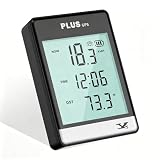
- [3.26-INCH LARGE SCREEN] The biggest display in its class at 3.26" — read speed, distance, and time at a glance without squinting. Anti-glare LCD with auto backlight ensures clear visibility in bright sun or night rides.
- [GPS+BDS DUAL POSITIONING] Tracks speed, distance, and riding time via satellite — no wheel sensor or calibration needed. Works out of the box for road, mountain, and hybrid bikes.
- [IPX6 WATERPROOF] Handles rain, splashes, and wet roads — ride confidently in changing weather. Suitable for daily commutes, weekend trails, and long-distance touring.
- [16-HOUR BATTERY + 2-YEAR WARRANTY] Rechargeable battery lasts up to 16 hours for multi-day rides. Battery indicator shows remaining power. Backed by 2-year manufacturer warranty for peace of mind.
- [UNIVERSAL HANDLEBAR MOUNT] Fits 15-48mm handlebars on road, mountain, and hybrid bikes. Lightweight 3.2oz design — installs in seconds with included mount. No tools required.
NHTSA’s 2013 field procedure describes handheld or tripod testing, runs toward and away from the device, and comparison with independently measured speed. Its example geometry places a device 4 m off the road centerline at least 100 m from the measurement region, keeping the cosine effect below 0.1%. That is a test-procedure example, not a universal setup rule for every device or jurisdiction. NHTSA: Lidar Field Test Procedure (2013)
GPS: speed estimated from satellite signals
A GPS receiver estimates movement using satellite-derived measurements. GPS.gov reports a government-provided signal-in-space user range-rate error of ≤0.006 m/sec over any 3-second interval, with 95% probability. This is not a guarantee of accuracy for a particular phone, navigation unit, or GPS speed display: satellite geometry, signal blockage, atmospheric conditions, and receiver design and quality also affect the user’s result. GPS.gov: GPS Accuracy
Recommended Free Tools
Rank #3

- 8 LANGUAGES FOR FAMILIAR OPERATION – Choose from English, German, Chinese, Polish, French, Korean, Spanish and Italian for easier setup and everyday use.
- NO WHEEL SENSOR NEEDED – Built-in GPS tracks current speed, average speed, maximum speed, trip distance, ride time and total mileage without installing a magnet or speed sensor on the wheel.
- 2.4-INCH DISPLAY WITH GREEN BACKLIGHT – Ride information is arranged clearly on the LCD screen, while the automatic green backlight supports easier viewing in darker riding conditions.
- EXTRA INFORMATION FOR DIFFERENT ROUTES – In addition to essential cycling data, the computer displays temperature, current altitude, gradient and accumulated ascent for hills and changing terrain.
- 50G BODY WITH UP TO 28H RUNTIME – The compact design combines low weight, long battery life and IPX7 waterproof protection for commuting, road cycling and MTB use. Standard mounting accessories and USB-C cable are included.
A GPS display can provide an independent comparison for a driver, but the cited signal-in-space figure does not establish that every GPS device is more accurate than every vehicle speedometer.
Known distance and elapsed time: average speed
For a measured course, average speed is the distance traveled divided by the elapsed time. This method is useful as a controlled reference or validation approach, but it reports an average over the course rather than a continuously updated instantaneous reading.
Rank #4

- 【Head Up Display】HUD display car driving speed in real time. Attention pls: there are many copies of this model, they have the same design as us. However, the chipsets are completed different. Our VJOYCAR Chipset is real 10 Hz high refresh rate, it can display the speed in real time. From our client feedback, it's easy to many clients say our speed update the speed very fast. You are welcome to test. If you are not satisfied, pls contact with us for refund.
- 【GPS Speedometer】Collects the speed data from GPS satellites, no relation with car engine, no destroy to car circuit board or OBD port, and can be widely used on SUV ATV Pick-up Truck Scooter Golf Cart Bus Boat Train Bike Motorcycle...all vehicles. Its speed will be 1%-5% different from car dashboard which speed is from car tire rotation speed, but its speed is the same logis as speeding radar.
- 【Install】Easy install and use, no buttons, no need any setting, no need read manual, its package include one USB cable, just need connect the USB with our GPS speedometer, then connect to your car. If your car has a USB port, pls plug the USB cable to USB port; if your car doesn't have a USB port, then give it a car adaptor. Plug and Play.
- 【On/Off automatically】 When detect car ACC is on, it will be on and display the driving speed in big fonts; When car ACC is off, it will be off automatically because it doesn't have internal battery. When it's off, no power consumption at all.
- 【Warranty】First time usage, it takes 10-30 seconds to get GPS signal, and it can't work indoor/Underground parking lot/Tunnel. Client service is 7days-24hours, you are welcome to contact with us, thanks.
In its 2013 lidar procedure, NHTSA describes using a measured course of at least 402 m (1,320 ft) to establish a target vehicle speedometer correction factor, then comparing that corrected speed with certified radar and the test device. This is a controlled device-evaluation procedure, not a recommendation to conduct roadside tests without suitable equipment and controls. NHTSA: Lidar Field Test Procedure (2013)
Vehicle speedometer: an onboard driver display
A vehicle speedometer reports speed using the vehicle’s systems and calibration. Its display is not itself a laboratory reference for the actual speed of a particular vehicle. NHTSA’s cited interpretation of US Federal Motor Vehicle Safety Standard No. 101 addresses display units: the display must be labeled in mph, with km/h allowed alongside it. That interpretation concerns US display labeling, not real-world accuracy. NHTSA: FMVSS No. 101 speedometer display interpretation
Quick wins for a faster PC:
Scan for outdated or missing drivers - takes under a minuteDriver Scan →Repair Windows errors before they cause bigger problemsFix Now →Fix the driver behind crashes, sound loss and screen glitchesFind Drivers →Best Value

- BUILT-IN GPS RIDE TRACKING – Displays current speed, average speed, maximum speed, riding distance, ride time and total mileage without requiring a wheel sensor or spoke magnet. Suitable for commuting, leisure riding and everyday outdoor cycling.
- USEFUL DATA FOR HILLS AND ROUTES – View temperature, current altitude, gradient and accumulated ascent to better understand elevation changes, hills and longer cycling routes.
- 2.4-INCH EASY-READ SCREEN – The clear LCD display presents essential riding information in a simple layout, helping riders check speed, distance and ride time at a glance.
- GREEN AUTO BACKLIGHT AND AUTO START STOP – The green automatic backlight improves visibility in low-light conditions and during night rides. Auto Start and Stop helps simplify everyday ride recording.
- 50G LIGHTWEIGHT DESIGN WITH STANDARD MOUNT – The rechargeable battery provides up to 28 hours of runtime, while the IPX7 waterproof design supports riding in rainy conditions. Includes a standard mount, rubber pad, mounting rings, USB-C cable and user manual.
How the methods differ in practice
| Method | What it measures | Typical purpose | Key requirements or limitations |
|---|---|---|---|
| Radar | Speed derived from reflected radio signals and Doppler shift | Traffic measurement and, where permitted, enforcement | Suitable geometry, correct target association, applicable performance requirements, and operator checks |
| Lidar | Speed derived from repeated range measurements | Target speed measurement and, where permitted, enforcement | Line of sight, accurate aiming and target association, suitable equipment, and qualified operation |
| GPS receiver | Movement estimated from satellite-derived measurements | Driver-facing display or independent comparison | Receiver quality, satellite geometry, signal blockage, and atmospheric conditions affect user-level accuracy |
| Measured course and elapsed time | Average speed over a known distance | Controlled reference or device validation | Known course length and accurately measured elapsed time; not an instantaneous reading |
| Vehicle speedometer | Onboard estimate displayed to the driver | Normal driving | Vehicle-specific system and calibration; display rules depend on jurisdiction |
What affects accuracy?
Accuracy depends on the instrument and the conditions in which it is used. A useful accuracy claim identifies the device, setup, reference method, operating conditions, and whether the figure describes a system-level signal specification or a particular end-user device.
- Radar: Geometry, target selection, and correct association of a reading with a vehicle matter.
- Lidar: Line of sight, aiming, distance measurement, and target association affect the result.
- GPS: Signal blockage, satellite geometry, atmospheric conditions, and receiver design and quality contribute to user-level accuracy.
- Course timing: Distance and elapsed-time measurements determine the average, so the quality of both reference measurements matters.
- Speedometers: A display reading reflects the vehicle’s own system; regulatory display requirements do not establish the accuracy of an individual vehicle.
How enforcement devices are checked
For enforcement use in the United States, the instrument’s reading is only one part of an assurance process. NIST identifies conformance with performance requirements, periodic laboratory calibration, and routine operator checks as reliability measures for radar. NHTSA training material likewise emphasizes that a device must be suitable for measuring vehicle speed, in proper working condition at the time of measurement, and operated by a qualified person. NIST: Down-the-Road Radar NHTSA: Speed-Measuring Device Training
NHTSA’s 2013 lidar field procedure illustrates a controlled evaluation: it calls for approaching and receding target runs at approximately 32 km/h, 80 km/h, and 112 km/h (20 mph, 50 mph, and 70 mph), while recording test distance, elapsed time, speedometer and radar readings, device readings, and anomalies. These are device-evaluation procedures, not general roadside instructions. NHTSA: Lidar Field Test Procedure (2013)
Standards and program status can change. NIST’s DTR radar program references IEEE Standard 2450-2019. A US Department of Transportation notice published in 2024 described a transition away from the NHTSA-managed DTR radar Conforming Products List toward an industry-based verification program. For current procurement or compliance decisions, check the applicable specification and current verified-products listing. NIST: Down-the-Road Radar US DOT: 2024 DTR Radar Verification Program Notice
Outdated Drivers Are Slowing You Down
One free scan finds every outdated or missing driver and matches the right update for your exact hardware.Free scan · exact hardware matchWindows Errors? Fix Them Before They Spread
Repair common Windows errors and clear accumulated junk for a smoother, more stable PC - no reinstall needed.Free scan · no reinstallWhether a particular measurement is admissible in court, and what operator certification or procedure is required, depends on the jurisdiction. Check current local rules rather than assuming one national evidentiary standard.
Quick Recap
Which method should you rely on?
- For everyday driving: Use the vehicle speedometer as the built-in driver display; a GPS display can offer an independent comparison, but its receiver-level accuracy varies.
- For a controlled average-speed check: Use a measured distance and elapsed time with suitable measurement controls.
- For traffic studies or enforcement: Choose an instrument designed and verified for the purpose, follow its applicable procedures, and use qualified operators.
- For evaluating an accuracy claim: Ask what instrument and setup were used, what reference it was compared against, and what conditions and jurisdiction apply.
Product prices and availability are accurate as of the date/time indicated and are subject to change. Any price and availability information displayed on Amazon at the time of purchase will apply.




