What’s actually slowing this PC down?
Pick the symptom - the matching free tool is one click away.
Start with the complete VIN, not the engine’s appearance. In the 1970 Charger R/T registry decoding scheme, XS29 identifies the R/T body combination, the engine character U indicates a factory 440 four-barrel and V indicates a 440 Six Pack. Then match that VIN to the car’s broadcast sheet, compare its engine and transmission sales codes, and use the fender tag, period Dodge equipment guide and surviving paperwork as corroboration. None of those documents, by itself, proves that the components currently installed are original.
What establishes a 1970 Charger’s R/T and 440 identity?
A credible identification is a chain of matching evidence. The vehicle identification number establishes how the car was coded at production; a broadcast sheet links the assembly-line instructions to that VIN; the fender tag and period equipment information should show a compatible combination; and a window sticker, order form or dealer record can provide an additional check. The strongest conclusion comes when all of those records describe the same car and the same drivetrain.


As an Amazon Associate I earn from qualifying purchases.
The principal decoding information comes from the 1970 Dodge Charger Registry, a specialist historical resource. Its decoder is useful for interpreting the number, but it is not a factory-issued authentication certificate. Chrysler’s period Dodge dealership guide is an archival reproduction, and its surviving option lists are not complete for every point in the model year. Treat both resources as evidence to compare, not as substitutes for examining the vehicle and its records.
Quick wins for a faster PC:
Repair Windows errors before they cause bigger problemsFix Now →Scan for outdated or missing drivers - takes under a minuteDriver Scan →Clear out junk files and repair common Windows errorsFree Scan →| Evidence | What it can establish | What it cannot establish by itself |
|---|---|---|
| Complete VIN | Whether the number follows the 1970 R/T and engine-character pattern | That today’s engine, transmission or other parts are the ones installed at the factory |
| Broadcast sheet with matching VIN | Assembly-line engine, transmission and other build instructions | That a loose or damaged sheet belongs to this car, or that the car still has those parts |
| Fender tag and period code guide | Whether options and equipment form a consistent factory pattern | That an omitted item was never available; model-year lists are incomplete |
| Window sticker, order or dealer paperwork | An independent comparison for paint, roof, trim and ordered equipment | Physical originality of surviving components |
| Current component inspection | Condition, date/features and possible signs of replacement or alteration | The original factory specification without matching documentation |
Decode the complete VIN first
Record every character before interpreting any other evidence. The registry describes a 1970 Charger R/T VIN in six sections: the XS car line, the 29 body type (called “Sport Top” in the registry’s terminology), a one-character engine code, the model-year digit 0, the assembly-plant character G, and the sequential production number.
#1 Best Overall
| VIN section | 1970 R/T value or meaning | How to use it |
|---|---|---|
| Car line | XS | Required first section for the R/T line in the registry decoder. |
| Body type | 29 | The registry labels this R/T body combination “Sport Top.” |
| Engine character | R, U or V in the cited R/T scheme | R = 426 Hemi; U = 440 four-barrel; V = 440 Six Pack. |
| Model year | 0 | Indicates the 1970 model year in this sequence. |
| Assembly plant | G | The plant character identified by the registry for this 1970 R/T sequence. |
| Sequential number | Vehicle-specific running number | Use it as part of the complete identifier when matching records. |
A number that follows the pattern is a first check, not a final verdict. Compare the complete VIN exactly with the number on every surviving record. A partial number, a transcription error or a sheet that belongs to another vehicle can produce a convincing but false match. If the engine character is U, the factory claim is a 440 four-barrel; if it is V, the factory claim is a 440 Six Pack. An R points to a 426 Hemi rather than either 440 configuration.
Why the whole number matters
Checking only “XS29” can establish that the body and car-line portions fit the R/T scheme, but it cannot connect a document to one specific vehicle. The model-year, plant and sequential sections are essential for matching the VIN on a broadcast sheet, window sticker or dealer document. Preserve the sequence exactly as found, including any characters that are difficult to read, and have ambiguous marks checked against the physical stamping and paperwork rather than silently correcting them.
Use the broadcast sheet as the assembly-line cross-check
The factory production broadcast sheet was used by the assembly line. According to the registry, surviving sheets may turn up under the rear seat, under the front seats, beneath the carpet or taped to the back of the glove box. Finding one is valuable, but its location does not prove that it belongs to the car.
Match the sheet to the vehicle before decoding it
- Photograph the sheet as found. Keep the original position and condition documented before unfolding, cleaning or attempting to flatten it.
- Locate the sheet’s VIN information. Compare it character-for-character with the vehicle’s complete VIN, including the sequential number.
- Assess legibility. Water damage, fading, tears and missing corners can make a code appear to be something else. Do not treat an uncertain character as a confirmed one.
- Only then interpret the sales codes. Use the engine and transmission fields together with the VIN engine character and the rest of the car’s documentation.
The registry specifically warns that a sheet found inside a car can belong to another car or be too damaged to read. A loose sheet with no matching VIN is therefore a lead, not proof. Even a perfectly matching sheet establishes the factory build instruction; it does not demonstrate that the current drivetrain has never been replaced.
Engine and transmission sales codes
| Broadcast-sheet code | Factory configuration represented | Interpretation |
|---|---|---|
| E86 | 440 four-barrel | Supports a VIN engine character U when the sheet’s VIN matches the car. |
| E87 | 440 Six Pack | Supports a VIN engine character V when the sheet’s VIN matches the car. |
| D21 | Four-speed transmission | Use as the sheet’s transmission specification, not as proof of the transmission currently installed. |
| D32 | Automatic transmission | Compare with the VIN, tag and surviving paperwork for a consistent record. |
For example, a matching sheet marked E86 supports a factory 440 four-barrel claim, while E87 supports a factory 440 Six Pack claim. A car may now have a different engine or transmission, so record the discrepancy rather than changing the interpretation of the historical document. The combination of a matching VIN, the expected engine code and a compatible transmission field is materially stronger than any one code viewed in isolation.
Rank #2

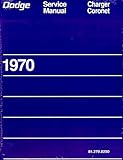
- Dodge Charger & Coronet Service Manual." The manual set is a page-for-page reproduction of the book that Dodge mechanics used to service cars. You will find detailed service procedures for front suspension, rear axle, body and sheet metal, brakes, clutch, cooling, electrical, engine, exhaust, frame, fuel system, lubrication, shock Charger, Coronet, Super Bee, R/T, Coronet Deluxe, Coronet 440, and Coronet 500 R/T series.
Cross-check the fender tag against period Dodge information
The fender tag supplies another set of production codes. The registry’s tag material includes the R/T-related A47 Special Edition application and axle and equipment codes. Chrysler’s 1970 Dodge dealership guide covers the Charger’s assembly plant, paint and trim, R/T-only performance stripes, tire, engine and transmission availability, axle availability and factory-installed options.
Compare the tag’s complete pattern with the guide and with the broadcast sheet. Look for a coherent combination of body, trim, engine, transmission, axle and R/T equipment rather than relying on one attractive code. An apparently missing option is not automatically evidence of a clone: the archival guide warns that surviving lists are not complete because options were introduced during the model year.
How to use an apparent conflict
- VIN says U, sheet says E86, tag is compatible: the documents reinforce a factory 440 four-barrel configuration, subject to the sheet’s VIN actually matching the car.
- VIN says V, sheet says E87, but the car has a four-barrel engine today: the records support a factory Six Pack specification; the present engine may be a replacement or later change.
- VIN and sheet agree, tag appears to omit an item: check the guide’s model-year qualification and whether the tag is complete and legible before declaring a contradiction.
- Sheet has the right codes but no matching VIN: do not use it as authentication. It may have been installed in the car from another vehicle.
- VIN does not follow the XS29 R/T pattern: stop treating the car as a documented 1970 R/T until the number is rechecked and any discrepancy is resolved.
Check window stickers and other surviving records
A window sticker, original order or dealer paperwork can add an independent comparison layer. The Charger Registry provides a window-sticker decoder for paint, roof and trim information. Reconcile those details with the fender tag and broadcast sheet; do not rely on the car’s present color, roof covering or upholstery as a substitute for a document.
Paperwork is most useful when it identifies the same VIN and repeats several independent details. A document that shows a paint or trim combination inconsistent with the tag may reflect a later change, a misread code or a document from another vehicle. Preserve the original document and record any uncertainty rather than editing it to fit the car.
Distinguish factory identity from present-day originality
VINs and factory paperwork describe how the vehicle was represented or built. They do not prove that the current engine block, carburetion, transmission, axle, stripes, interior or other components remain original. The cited decoding materials do not provide forensic tests for tampering, component date verification or a guarantee that a car has never been re-bodied.
For a purchase, make any stronger originality or authenticity conclusion conditional on an in-person examination by a qualified specialist who can inspect the vehicle and all documentation together. Ask that the inspection record separate three questions:
Crashes, No Sound, or Screen Glitches?
Random freezes, missing sound and display glitches usually trace back to one bad driver. Find and replace yours safely.Free scan · under a minuteWindows Errors? Fix Them Before They Spread
Repair common Windows errors and clear accumulated junk for a smoother, more stable PC - no reinstall needed.Free scan · no reinstall- Identity: Does the complete VIN identify a 1970 Charger R/T configuration?
- Factory specification: Do the VIN, matching broadcast sheet, fender tag and other records agree on the original 440 and transmission?
- Surviving originality: Are the components currently on the car consistent with that documented specification, and are there signs of replacement or alteration?
A car can be a genuine R/T that has received a replacement engine. Conversely, a car can display a correct-looking 440 while lacking documentation that it left the factory as an R/T. Keep those conclusions separate in any appraisal, advertisement or purchase contract.
Independent reader supportYour contribution helps us test, update, and keep practical guides available for everyone.A practical inspection sequence for a buyer
- Write down the complete VIN. Divide it into XS, 29, engine character, 0, G and sequential number, then verify that the characters are readable and internally consistent.
- Classify the documented engine. R indicates a 426 Hemi, U a 440 four-barrel and V a 440 Six Pack in the registry’s 1970 R/T scheme. Do not infer the engine from hood badges, air cleaners or paint.
- Find and preserve any broadcast sheet. Photograph it before handling it and note whether it came from under a seat, carpet or the glove-box back.
- Match its VIN. Reject a sheet as proof if its VIN cannot be matched or if critical characters are unreadable.
- Read the engine and transmission fields. E86 should describe a 440 four-barrel, E87 a 440 Six Pack, D21 a four-speed and D32 an automatic.
- Record every legible fender-tag code. Include the R/T-related A47 application and axle and equipment information where present, then compare the full pattern with the period Dodge guide.
- Compare paint, roof and trim records. Use the window-sticker decoder and any original order or dealer paperwork only after confirming that the VIN belongs to this car.
- Inspect the present drivetrain separately. Note what is installed now and whether it agrees with the documented factory configuration; do not rewrite the historical conclusion to match a replacement component.
- Document unresolved conflicts. A missing or incomplete record lowers certainty, but the guide’s incomplete option lists mean that one omission is not automatically disqualifying.
- Obtain an in-person specialist assessment before purchase. The documents establish a historical specification; a physical examination is needed for any conclusion about current originality or alteration.
How registry production figures should influence expectations
The 1970 Dodge Charger Registry reports 9,509 Charger R/Ts, including 8,574 E86 440 four-barrel examples and 684 E87 440 Six Pack examples. It lists E86 as 91.5% and E87 as 7.3% of R/T production. These are registry-published figures on an undated page accessed in 2026, not a factory production record independently verified here.
The counts provide context for a seller’s rarity claim, but they do not authenticate an individual VIN. A car should not be accepted as a Six Pack, four-barrel or R/T merely because its claimed configuration is uncommon or because a registry percentage appears in an advertisement. The individual vehicle’s matching records remain decisive.
Common mistakes that create false confidence
Accepting a correct-looking 440 as proof of an R/T
The engine visible today may have been installed after production. Establish the factory configuration from the VIN and matching records before judging the current engine’s originality.
Using a broadcast sheet without checking its VIN
Sheets can be found in the car yet belong to another vehicle, and damaged sheets can be misread. A physical location is not an identity check.
Treating one fender-tag code as conclusive
R/T-related and equipment codes must fit the entire vehicle history. The period guide’s lists are not exhaustive for the whole model year, so neither one omission nor one attractive code should decide the case.
Assuming appearance proves factory trim
Paint, roof coverings, stripes and interior parts can be changed. Use the window-sticker decoder and original paperwork as documentary comparisons, not as confirmation based on appearance alone.
Calling registry counts factory totals
The published numbers are attributed to the registry and are useful context, but they are not presented as primary Chrysler production records.
Recommended Free Tools
What a well-supported conclusion looks like
The most defensible statement is precise: for example, “The complete VIN follows the 1970 Charger R/T XS29 pattern and carries U; the broadcast sheet bears the same VIN and lists E86, with tag and period equipment information consistent with a factory 440 four-barrel.” If the current engine is different, say so separately. If a sheet cannot be matched, describe it as unverified evidence rather than proof.
For a 440 Six Pack claim, the equivalent documentation chain is a matching VIN with engine character V, a matching broadcast sheet with E87, and a fender-tag and period-equipment pattern that does not conflict. For either 440 configuration, the final question about originality belongs to a physical inspection, not to decoding alone.
Quick Recap
Product prices and availability are accurate as of the date/time indicated and are subject to change. Any price and availability information displayed on Amazon at the time of purchase will apply.




