What’s actually slowing this PC down?
Pick the symptom - the matching free tool is one click away.
The most reliable way to use less diesel in a Mercedes-Benz E-Class on a long journey is to combine the correct tyre pressures and light load with smooth acceleration, a legal and steady cruising speed, early anticipation of traffic, and the car’s recommended gear-selection and economy settings. Check your owner’s manual and the tyre-pressure placard for your exact model year, engine, body style, transmission, wheel and tyre combination, and market: E-Class controls and specifications are not identical across generations.
Measure the result from fuel used over comparable refills or trips. The dashboard ECO display can coach your driving, but it is not a fuel-consumption meter.
As an Amazon Associate I earn from qualifying purchases.
Why consumption differs between E-Class diesels
“Mercedes-Benz E-Class diesel” covers several generations, engines, transmissions, body styles and drive systems. A saloon with rear-wheel drive, a wagon carrying luggage and an all-wheel-drive car can use different amounts of fuel even on the same route. Weather, gradients, traffic, tyre choice, payload and accessory use also matter.
Mercedes-Benz owner manuals identify driving style, load, tyre pressure, cold starts, route choice and electrical consumers as factors that influence consumption. These are controllable before and during a journey; none provides a guaranteed saving on every trip.
#1 Best Overall

- HIGH ACCURACY: Every ETENWOLF's pencil tire gauge is calibrated to ANSI B40.1 Grade B, it is accurate to 2% of span in the middle 50% of range and 3% of span in the lower and upper 25% of range. Each ETENWOLF pencil tire pressure gauge is manually calibrated and has its unique calibration number printed on the pencil
- WIDER RANGE: ETENWOLF's tire gauge offers 2 pressure ranges: 10-50PSI, 20-120PSI for all types of vehicles
- ALL METAL: ETENWOLF tire gauges are made of all solid metal, zinc alloy head and stainless steel body, they are durable and can be used for many years unless you lose them
- DEFLATION: You can also use ETENWOLF's tire gauge to deflate tires when the tire pressure is overinflated
- 16 CAPS IN 2 CASES: ETENWOLF even offers 16 valve stem caps, so you won't worry about losing tire caps anymore
Motorway cruising is not the same as short-trip use
A long, uninterrupted motorway run usually gives a diesel a more stable operating temperature and fewer acceleration and braking events than urban traffic. Stop-start driving, hills, congestion and repeated cold starts increase fuel demand. Compare like with like when judging an improvement: a steady motorway trip should not be compared directly with a short, cold, urban journey.
WLTP figures are configuration-specific
Mercedes-Benz launch information for the 2023 E-Class T-Modell E 220 d lists combined WLTP consumption of 5.7–5.0 l/100 km. That is a manufacturer test-cycle range for that named vehicle, not a prediction for every diesel E-Class or a promise of motorway consumption. Mercedes-Benz notes that actual use depends on driving style and other non-technical factors.
Prepare the car before leaving
A few checks before departure prevent avoidable drag and weight. Complete them when the tyres are cold, and use the values printed for your vehicle rather than a generic internet pressure.
- Read the tyre-pressure placard and manual. Set each tyre to the vehicle-specific pressure for the actual load and wheel/tyre specification. If the car has separate normal-load and full-load values, use the one that matches the passengers and luggage. Reset the tyre-pressure monitoring system only after pressures are correct and the manual’s procedure has been followed.
- Remove unnecessary weight. Empty the boot of tools, sports equipment, packaging and other items that do not need to travel. Keep heavy luggage low and secure; do not remove safety equipment or carry less than is needed for the journey.
- Inspect for obvious problems. A warning lamp, dragging brake, damaged tyre or abnormal noise deserves attention before a long trip. Do not try to compensate for a mechanical fault by changing your driving style.
- Plan a route that avoids needless stop-start running. A route that is slightly longer but flows steadily can use less fuel than a shorter route with repeated queues and junctions. Balance fuel use against travel time, tolls, weather, road quality and safety.
- Allow the car to warm up by driving gently. Avoid extended idling to warm the engine. Start, check that visibility is adequate, and use moderate throttle until the engine and drivetrain reach normal operating conditions.
Tyre pressure: use the exact specification
Under-inflation increases rolling resistance, but there is no single “best” pressure for all E-Class models. The correct value changes with axle load, tyre size and sometimes speed or load category. Over-inflating beyond the placard is not a safe fuel-saving shortcut: it can affect ride, grip and tyre wear. A basic pressure gauge can be useful on a trip, provided you follow the placard and verify readings when the tyres are cold.
Load and external drag
Weight matters most during acceleration and on gradients. Roof boxes, racks and open windows at higher speeds add aerodynamic drag; remove roof equipment when it is not needed and stow it according to its manufacturer’s instructions. Keep luggage inside the vehicle where possible, while preserving the driver’s view and access to safety equipment.
Rank #2

- Professional Tire Pressure Gauge for Cars - This heavy duty mechanical tire pressure gauge is calibrated to ANSI B40.1 Grade B (2%) international accuracy standard so you get a precise, accurate pressure reading every time you use it. Makes great car accessories, car stuff, tire deflator, car stuff for men, cool car gadgets, car gifts for men, him, dad.
- Recommended by mechanics - It features a steel and brass construction with an extended 5mm chuck tip, so you get a great seal with no air leakage. This automotive tool is also surrounded by a rubber cover, so it is protected from drops and is easy to grip.
- No batteries required - This top-rated, professional tire monitoring system is easy to use and is reliable in all weather conditions. A perfect accessory for your car, motorcycle, truck, bike, SUV, RV or ATV - it will not let you down.
- Easy to read dial with a 45 degree angled and fully swivelling chuck. Our built in relief valve allows you to press the bleed button whilst the gauge is still on the tire valve, releasing air until you reach the exact target required.
- Car accessories for men and women - Give as the perfect gifts for men, car accessories gifts for men, gifts for dad, car gifts, car gifts for men, car stuff for men, gifts for car guys, car guy gifts for men, gifts for car lovers, cool car gifts, car lovers gifts for men.
How can I reduce fuel consumption on a long journey?
Use the following driving sequence as a practical routine. It is intended to reduce unnecessary energy changes without asking you to compromise control, visibility or legal speed.
1. Accelerate progressively
Apply the throttle smoothly, especially as speed rises. Moderate acceleration gives the transmission time to select an appropriate gear and avoids the high fuel demand associated with repeated sporty throttle inputs. You do not need to accelerate so slowly that you obstruct traffic; the aim is a steady build-up to the required speed.
The Tool Desk
Outbyte Driver Updater FREEFix the driver behind crashes, sound loss and screen glitchesFind Drivers →Outbyte PC Repair FREEClear out junk files and repair common Windows errorsFree Scan →2. Settle at a legal, reasonable speed
Once at cruising speed, hold it where traffic, weather and the posted limit allow. Aerodynamic resistance rises sharply with speed, so an unnecessarily fast motorway pace can cost more fuel than small changes in engine technique. Do not treat a fuel-saving target as permission to drive below a safe or lawful speed.
3. Look far ahead
Scan for junctions, roundabouts, lane closures, traffic lights, gradients and queues. Anticipation lets you lift off earlier and avoid a late brake followed by another acceleration. Keep a safe following distance so that you can respond progressively rather than repeatedly alternating between throttle and brake.
4. Coast only when it remains safe and controlled
When traffic conditions permit, easing off the accelerator early can reduce unnecessary braking. Keep the vehicle in a mode that preserves predictable control, maintain steering and braking readiness, and follow the road’s rules. Never coast in neutral, switch off the engine, or allow a fuel-saving technique to reduce your ability to control the car.
Rank #3

- Accurate, Dependable Readings: Factory‑calibrated to ±1 PSI, so you can confidently match your vehicle’s recommended PSI (check the door jamb sticker). Ideal for monthly checks and road trips — consistent results every time, cold or warm.
- Bright Backlit Display & Nozzle Light: The illuminated nozzle helps you find the valve stem in the dark, while the backlit LCD makes readings crystal clear in dim garages or at night. No more squinting or holding a flashlight.
- 4 Measurement Units, One Button: Quickly switch among PSI, Bar, Kgf/cm², and KPA with a single press. No complex settings — just press and cycle to your preferred unit. Perfect for drivers who need multiple scales.
- Broad Compatibility for Everyday Vehicles: 0–150 PSI covers cars, SUVs, motorcycles, and spare tires (often 60 PSI). Fits standard Schrader valves; just press on for a reading.
- Auto‑Off to Extend Battery Life: The gauge automatically powers down after 30 seconds of inactivity, so the included 2*AAA batteries last longer. Always ready for your monthly checks without surprise dead batteries.
5. Follow the shift recommendations
If the instrument cluster displays a suggested upshift, use it as guidance for economical driving when the road and traffic situation allow. A recommended higher gear is not an instruction to labour the engine: select a lower gear when climbing, overtaking, manoeuvring or maintaining control requires it.
Do these 3 things before closing this tab:
1Fix the driver behind crashes, sound loss and screen glitches2Clear out junk files and repair common Windows errors3Scan for outdated or missing drivers - takes under a minute6. Select an economy-oriented drive program if fitted
Some E-Class versions provide a drive program labelled E or another economy-oriented setting. Mercedes-Benz describes the program and controls in the vehicle-specific manual. If your car has it, select it when appropriate for a relaxed journey; do not assume that every E-Class has the same program, button or transmission behaviour.
7. Use climate and electrical equipment sensibly
Air conditioning, heated seats, demisting, lighting and other electrical consumers draw energy. Use them according to comfort, visibility and safety needs. Do not turn off demisting, exterior lights or climate functions needed to keep the driver alert and the windows clear for a small theoretical saving.
Does the ECO display show actual fuel consumption?
No. The ECO display is behavioural feedback, not a direct measurement of diesel used. The 2014 E-Class Wagon manual states: “The ECO display does not indicate the actual fuel consumption.” It evaluates aspects of your driving such as acceleration, anticipation and consistency.
On a steady long journey, the same manual says: “On long journeys at a constant speed, e.g. on the highway, only the bar for Constant will change.” That means a stable “Constant” indication is the relevant feedback during an uninterrupted cruise; it does not convert the bar into a l/100 km or mpg reading.
Crashes, No Sound, or Screen Glitches?
Random freezes, missing sound and display glitches usually trace back to one bad driver. Find and replace yours safely.Free scan · under a minutePC Slower Than It Used to Be?
A free scan shows the junk files, broken settings and background clutter dragging Windows down - then fixes them in one click.Free scan · Windows 10 & 11Rank #4

- PROCESS LEVEL ACCURACY: This heavy duty tire pressure gauge is calibrated manually to ANSI B40.1 Grade A (±1% of span)
- PRESSURE RANGE 0-75 PSI: ETENWOLF’s tire gauge can measure pressure of pickup, motorcycle, truck, bike, SUV, RV or ATV
- EASY TO READ IN THE DARKNESS: The large glow dial helps you clearly read the pressure at night or in low light
- EASY TO USE: 360 degree swivel chuck allows you to measure and take a reading from a tire valve at any angle
- ACCURACY IN EXTREME WEATHER: PSI gauge works normally even in extreme cold or hot weather
How to use the display correctly
- Use it to notice whether your inputs are smooth and consistent, not to claim a specific fuel saving.
- Interpret changes in the context of traffic, hills, wind, payload and weather.
- Judge actual consumption from refilled fuel and distance, using comparable journeys.
How do I get better mpg in my Mercedes E-Class diesel?
“Better mpg” is best treated as a repeatable measurement rather than a single dashboard score. The following method separates a genuine change from differences in route or conditions.
- Fill the tank to the same practical point each time. Do not overfill beyond the fuel system’s safe shut-off.
- Record the odometer or trip distance and the litres added. Keep the same distance units and fuel-use units for each comparison.
- Repeat the measurement over more than one refill when possible. One fill can be distorted by pump shut-off, temperature, traffic, wind or a different route.
- Compare journeys with similar speed, payload, weather, tyre pressures and traffic. Note whether a diesel particulate-filter regeneration or unusual congestion occurred.
- Change one behaviour at a time where practical, such as cruising speed or route, so you can identify what actually made a difference.
Manufacturer WLTP values are useful for comparing specified configurations under a standardised test cycle, but they are not observed trip results. Your refuelling records answer a different question: what this particular car used under your conditions.
Diesel particulate-filter guidance: check your own manual
Diesel particulate-filter (DPF) behaviour depends on the vehicle and its use pattern. Frequent short trips can prevent automatic cleaning from completing on some cars. A 2012 E-Class Saloon manual gives specific guidance for the vehicles covered by that document: a motorway or rural-road drive lasting about 20 minutes at least every 500 km. That is model-specific maintenance guidance, not a universal fuel-saving target or an instruction to drive at a particular speed.
Do not apply the 20-minute/500-km schedule automatically to a later or different E-Class. Consult the manual for your exact engine and emissions system. If a DPF warning appears, follow the prescribed procedure; if the warning persists, seek qualified service rather than repeatedly attempting high-speed runs.
Configuration context: published WLTP ranges
The figures below are manufacturer-published combined WLTP values from 2023 launch or road-trip material. They identify the configuration and the status of the figure; they do not represent guaranteed real-world motorway consumption.
Best Value
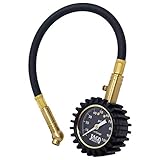
- Mechanic Recommended - performance tested, certified, & calibrated accurate within ANSI Standards (±1.5%) at our ANSI accredited calibration facility, ensuring precise tire pressure readings without relying on batteries
- Feels rugged in the hand & built to last from solid brass shielded by our durable shock-resistant gear-style protective guard; features our signature HybridFlex leak-proof air hose providing a soft feel with superior strength & flexibility
- Robust design is equipped with a built-in air bleeder valve to reduce pressure in overinflated tires, and the handy 360-degree swivel chuck allows for easy access to the tire valve from any angle
- Larger, 2" glow dial features easy-to-read 100 PSI single increment scale that glows in the dark, providing accurate readings that "lock" in place until the pressure reset button on the brass neck is pressed
- 100% Lifetime Warranty by JACO when you order today, so click buy with confidence and enjoy longer-lasting tires, improved gas mileage, and a smoother car driving experience with the help of properly inflated tires.
| Vehicle configuration | Combined WLTP consumption | Qualification |
|---|---|---|
| E-Class T-Modell E 220 d | 5.7–5.0 l/100 km | Mercedes-Benz 2023 launch information; model- and test-cycle-specific |
| E 220 d | 5.7–5.0 l/100 km | Mercedes-Benz Media road-trip release dated 18 September 2023; provisional archived figure |
| E 220 d 4MATIC All-Terrain | 6.0–5.3 l/100 km | Mercedes-Benz Media road-trip release dated 18 September 2023; provisional archived figure for the named all-wheel-drive configuration |
Rear-wheel drive versus 4MATIC, body style, optional equipment, wheel and tyre size, ambient conditions and driving style can all change actual use. Do not use the table to predict what an older E-Class, a different engine or a loaded car will achieve.
What to check when consumption suddenly rises
A gradual difference between two similar trips is often explained by speed, wind, temperature, traffic or payload. A sudden or persistent increase deserves a structured check.
- Tyres: verify all four pressures against the placard, look for damage and check whether a pressure warning has been ignored.
- Load and drag: remove forgotten cargo, roof equipment and racks that are no longer required.
- Journey conditions: record whether the latest trip included cold starts, severe weather, long queues, steep gradients or a higher cruising speed.
- Driving behaviour: look for repeated hard acceleration, late braking and frequent speed changes. Use a larger following gap and earlier lift-off where safe.
- Warnings and symptoms: investigate engine, emissions, brake, transmission or tyre warnings, poor performance, unusual smells, smoke or a vehicle that pulls to one side.
- DPF use pattern: if the car is used mostly for short trips, read the exact DPF section in the manual and follow its warning procedure.
Do not add fuel additives or replace parts solely because a trip used more diesel than expected; the factors above should be checked first, and the cited Mercedes-Benz guidance does not establish a need for any particular additive or replacement component.
Recommended Free Tools
A repeatable long-journey checklist
- Confirm the correct cold tyre pressures for the planned load.
- Remove unnecessary luggage and external carriers.
- Check fuel, engine oil, coolant, washer fluid, lights and visibility before departure.
- Plan a route with predictable flow and safe rest stops.
- Accelerate progressively and use the shift recommendations when appropriate.
- Maintain a legal, steady speed instead of chasing a high average speed.
- Anticipate traffic and gradients; leave a safe gap and avoid needless braking.
- Use the E or equivalent economy program if your exact vehicle provides one.
- Operate climate, lighting and demisting equipment for safety and comfort.
- Use the ECO display as coaching, then verify fuel use from distance and litres at refill.
Bottom line for an E-Class diesel trip
Start with the exact tyre-pressure and load settings, then drive smoothly at a steady legal pace while anticipating traffic. Use the transmission’s recommendations and any fitted economy program, but keep safety and control ahead of a small theoretical saving. Treat the ECO display as behavioural feedback, not a consumption readout, and use your own comparable refuelling records to judge the result. For DPF requirements, follow the manual for your specific E-Class rather than applying advice from another generation.
Quick Recap
Product prices and availability are accurate as of the date/time indicated and are subject to change. Any price and availability information displayed on Amazon at the time of purchase will apply.




