What’s actually slowing this PC down?
Pick the symptom - the matching free tool is one click away.
A classic pickup that has barely moved can be less roadworthy than one driven regularly. Before you try to start it, inspect for leaks, rodent damage, blocked intake or exhaust, cracked belts and hoses, seized brakes, unsafe tyres and corroded wiring. Replace or service time-aged parts, change old oil, treat petrol older than about six months as suspect, prime the lubrication system where the design permits, and make the first drive a short local test. Any fuel leak, sinking brake pedal, severe tyre cracking, damaged wiring, overheating or abnormal engine knock is a stop-and-repair fault, not something to drive through.
Why low mileage does not make a stored pickup safe
Odometer readings describe use, not elapsed time. A truck can accumulate years of deterioration while parked: brake fluid absorbs moisture, petrol loses volatility and forms deposits, batteries discharge and sulphate, and rubber compounds in tyres, belts, hoses and seals harden or crack. Wiring insulation can become brittle or be damaged by rodents. Tyres also age while stationary; a vehicle that has covered only a few hundred miles may still have dangerously old rubber.
As an Amazon Associate I earn from qualifying purchases.
Richard Kitchen of Hagerty UK captures the central mistake: “Don’t fall into the trap of thinking because it hasn’t been used, it doesn’t need attention.” Treat the storage period as part of the maintenance history. A recommissioning plan should be based on both the mileage and the time since each component was serviced.
| Component or symptom | Why storage matters | What to do before road use |
|---|---|---|
| Brake fluid | It absorbs moisture over time, lowering corrosion protection and potentially reducing boiling resistance. | Check level and condition; replace or flush when age or history is unknown, then bleed and test the system. |
| Petrol and fuel system | Modern petrol can degrade, leave varnish and clog filters or carburettor passages. Hagerty UK suggests fuel older than roughly six months may need draining or dilution with fresh fuel. | Check age, smell and colour; drain contaminated fuel when necessary, dilute marginal fuel with fresh petrol, inspect filters and repair every leak. |
| Battery and cables | A battery left connected can discharge or suffer permanent damage. Terminals, earth straps and insulation can corrode. | Inspect, slow-charge with a quality charger or 12-volt maintainer, test its ability to hold charge and replace it if it fails. |
| Belts, hoses and seals | Rubber ages without mileage. Cracks, hardening and flattened seals can produce leaks or sudden failure after the first heat cycle. | Inspect by sight and touch where safe; replace suspect parts before driving and recheck after warm-up. |
| Tyres | Storage can create flat spots, sidewall cracking and hardening even when tread remains. | Read the date code, inspect the complete tyre and set cold pressure to the vehicle manufacturer’s specification. Replace unsafe or excessively old tyres. |
| Brakes, bearings and suspension | Surface rust may develop, while calipers, wheel cylinders, cables, bushes or bearings can seize or deteriorate. | Check for free movement, corrosion and play. Repair any component that does not operate smoothly before a road test. |
| Wiring and intake/exhaust | Rodents may chew insulation or build nests. Debris can block airflow or create a fire or carbon-monoxide hazard. | Search the engine bay, air cleaner, cabin, tailpipe and other openings; remove obstructions and repair damaged wiring. |
Set a no-go threshold before you start
Cosmetic defects can wait; safety-critical defects cannot. Do not crank or drive until you have a plan for any of the following:
#1 Best Overall
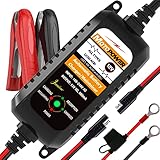
- Charger, Maintainer & Desulfator - An all-weather battery charger, battery maintainer, trickle charger, and battery desulfator. Perfect for charging and maintaining all 12-volt lead-acid, flooded or sealed maintenance free batteries (AGM and gel cell).
- Automatic Desulfation & Optimization - Automatic detection of battery sulfation problem. Applying with pulse current technology to desulfate the batteries effectively. Optimize the battery performance during charging without any manual operation.
- Energy Saving & Spark Free - Zero output in standby mode. No battery drain when connecting with the battery. Spark proof during lead connection for safety.
- Multi-level Safety Protection & Timer Set Up - Overcharge, short circuit and reverse polarity protected. Charge the battery up to 14.4V and Maintain the battery at 13.6V for long time to avoid gasing and to extend the battery life. 24-hour Timer is set up in the program to terminate the charge and enter the maintaining mode once the voltage is above 14V to ensure safety.
- Easy Operation -Just plug-in, connect to the battery and start charging or maintaining your battery. The desulfation is working automatically during the charing. No manual operation.
- A visible fuel, brake-fluid, coolant or major oil leak.
- A brake pedal that feels spongy, sinks under steady pressure or fails to release the brakes.
- Tyres with deep sidewall cracks, bulges, exposed cords, severe flat spots or an age that makes their condition doubtful.
- Chewed or exposed wiring, a damaged battery case, loose high-current cables or a missing earth strap.
- A blocked air cleaner, intake, exhaust or tailpipe.
- Seized steering, a loose steering joint, a wheel that will not turn freely or a handbrake that will not hold and release.
- A belt or hose that is cracked, swollen, oil-soaked or visibly frayed.
If the engine starts but produces a knock, loud tapping, immediate overheating or a significant leak, switch it off and investigate. Nathan Chadwick of Hagerty UK advises not assuming such noises will “clear themselves.”
The 10-step recommissioning workflow
-
Document the baseline
Write down the current odometer reading, how long the pickup was stored, the last known service date, fuel type, battery age, tyre date codes and every known defect. Photograph fluid stains, damaged wiring and the engine bay before cleaning. These records prevent a newly discovered problem from being mistaken for a new failure and establish a maintenance baseline.
- Record whether storage was indoors, outdoors, damp or exposed to temperature swings.
- Note whether the tank was full, partly filled or empty and whether a stabilizer was used.
- Keep the photographs and measurements with the truck’s service records.
-
Inspect the exterior, underside and engine bay
Look underneath for fresh or old stains from engine oil, coolant, brake fluid and fuel. Trace each stain to its source rather than wiping it away. Examine the frame, suspension mounts, steering linkage, exhaust hangers, fasteners and brake discs for corrosion or structural damage.
Special offer. See more information about Outbyte and uninstall instructions. Please review EULA and Privacy policy.Open the bonnet and air cleaner, inspect the cabin and check every visible wiring loom for nests, droppings, chewed insulation and packed material. Look inside the tailpipe and other openings. Remove covers, rags, leaves and animal debris from the intake and exhaust before turning the engine.
-
Assess tyres and wheels before rolling
Inspect tread and both sidewalls for cracks, bulges, cuts, exposed cords, hardening and flat spots. Find the tyre date code and record it; the code is more useful than tread depth for a stored vehicle. Set cold pressures to the pickup manufacturer’s specification, not the maximum pressure moulded into the sidewall.
NHTSA’s TireWise guidance specifically warns that ageing occurs through service, storage and environmental conditions and includes collector cars and low-mileage vehicles. AAA’s maintenance guidance reports that replacement commonly falls between six and ten years regardless of remaining tread. That is a common replacement window, not a guarantee that every tyre lasts ten years: severe cracking, heat exposure, incorrect storage or an unknown date warrants earlier replacement. Do not road-test an unsafe tyre merely because it still has tread.
Rank #2
Sale Schumacher Electric 1.5A Car Battery Charger & Maintainer, 6V/12V – SC1355
- PREVENT BATTERY FAILURE: Ensure reliable starts after storage with this 3-in-1 device that charges, maintains, and reconditions batteries for cars, motorcycles, ATVs, trucks, SUVs, and boats.
- MULTI-FUNCTION VALUE: Maximize battery life and performance with advanced desulfation mode, automatic voltage detection for 6V and 12V batteries, smart trickle charging , and multi-stage charging algorithms.
- REVIVE DEAD BATTERIES: Delivers 1.5A immediate charging power to keep standard, AGM, and deep-cycle batteries healthy, making it the perfect garage upgrade for seasonal or infrequently used vehicles.
- EASY OPERATION: Experience peace of mind with smart trickle charging that safely maintains battery health over time without overcharging, plus reverse hook-up protection for safety.
- COMPLETE PACKAGE: Includes (1) SC1355 Battery Charger and Maintainer, (1) Quick-Connect Battery Clamps, (1) Quick-Connect Ring Connectors, (1) User Manual
-
Recover the electrical system
Assume a battery left connected may be discharged or damaged. Inspect the case for swelling or cracks, clean corrosion from terminals, and check the positive cable, negative cable and engine-to-body earth strap. Replace damaged insulation rather than wrapping over a fault that could short or ignite fuel vapour.
Do these 3 things before closing this tab:
1Repair Windows errors before they cause bigger problems2Fix the driver behind crashes, sound loss and screen glitches3Clear out junk files and repair common Windows errorsSpecial offer. See more information about Outbyte and uninstall instructions. Please review EULA and Privacy policy.Use a quality charger on a slow setting or a 12-volt battery maintainer. If the battery will not hold charge, replace it; Chadwick notes that UK winters are particularly hard on batteries. Before moving the truck, test headlights, indicators, brake lights, horn, wipers, dashboard gauges and the charging circuit. A start is not a successful recommissioning if you cannot signal, stop or monitor the engine.
-
Check every fluid and decide what to replace
With the truck on level ground, check engine oil, coolant, brake fluid, clutch fluid where fitted, gearbox oil and differential oil where accessible. Look for water contamination, an acrid fuel smell, milky oil, sludge, low levels and leaks around seals or hoses.
If storage exceeded a year, change the engine oil and filter before starting. Replace or flush brake fluid when its age or condition is unknown because absorbed moisture promotes internal corrosion and reduces margin under heat. Inspect coolant concentration and condition; correct the level and repair leaks rather than relying on repeated top-ups.
Treat petrol older than approximately six months as degraded. Drain it when it smells stale or shows contamination, or dilute marginal fuel with fresh petrol as appropriate for the system. Inspect the tank, lines, pump, filter and carburettor or injection components for leaks and deposits. Do not add fresh fuel to a system that is visibly leaking.
The Tool Desk
Outbyte PC Repair FREEClear out junk files and repair common Windows errorsFree Scan →Outbyte Driver Updater FREEScan for outdated or missing drivers - takes under a minuteDriver Scan →Special offer. See more information about Outbyte and uninstall instructions. Please review EULA and Privacy policy. -
Prime the lubrication system
Where the design allows, disable ignition or fuel delivery and crank in short intervals until the oil-pressure gauge registers or the warning light goes out. This fills galleries and puts oil on bearings before combustion loads arrive. Follow the vehicle’s service information for the correct disabling method; do not defeat safety interlocks or create an ignition spark near spilled fuel.
Rank #3
 NOCO GENIUS2D 2A 12V Onboard Battery Charger, Trickle Charger & Maintainer
- MEET THE GENIUS2D — The all-new direct-mount onboard battery charger for an under-the-hood battery charging system and year-round battery maintenance.
- DO MORE WITH GENIUS — Designed for 12-volt lead-acid (AGM, Gel, SLA, VRLA) batteries, including flooded, maintenance-free, deep-cycle, marine and RV batteries.
- DIRECT MOUNT — Securely attaches near the battery using a durable snap-fit mounting bracket and installs easily into most surfaces with truss-head self-tapping screws for a hassle-free, reliable setup.
- ENJOY PRECISION CHARGING — An integrated thermal sensor dynamically adjusts the charge based on ambient temperature, preventing overcharging in hot weather and undercharging in cold, ensuring optimal battery performance.
- CHARGE DEAD BATTERIES — Charge batteries from as low as 1 volt, or use Force Mode to manually charge completely dead batteries down to zero volts. Perfect for recovering deeply discharged or neglected batteries.
On a carburetted pickup, confirm that throttle linkages move freely and that the accelerator pump is not leaking. Avoid repeatedly pumping the pedal, which can flood the engine or discharge fuel into the intake. Have a suitable fire extinguisher nearby and stop if you smell raw petrol.
-
Make the first start a controlled warm-up
Start without touching the throttle unless the engine’s normal cold-start procedure requires it. Some initial smoke, a brief uneven idle or loosened deposits can occur after storage, but the engine must show improving oil pressure and stable temperature.
Watch the oil-pressure gauge or warning light, coolant-temperature gauge and charging indication continuously. Check that the cooling fan operates as designed. Inspect around the oil filter, rocker cover, water pump, hoses, fuel connections and brake-fluid reservoir as seals re-wet and pressure builds. Shut down immediately for a knock, loud tapping, immediate overheating or a substantial leak.
Free tools Windows power users keep installed
One-click scans. No signup required.
Special offer. See more information about Outbyte and uninstall instructions. Please review EULA and Privacy policy.Do not leave an unattended freshly started truck running in a garage. Exhaust gases contain carbon monoxide; use proper ventilation and keep the tailpipe clear.
-
Prove the brakes, steering and controls while stationary
Press the brake pedal firmly and hold it. It should remain solid rather than feel spongy or sink. Confirm that the handbrake holds the truck and releases completely. Surface rust on discs or drums may clear with gentle use, but seized calipers, wheel cylinders, cables or contaminated linings require repair.
Turn the steering from lock to lock while stationary and listen for knocks. Check for excessive play at the wheel, steering joints, ball joints and bushes. Confirm that the throttle returns to idle, the clutch disengages, the gear lever selects each position and the wheels rotate freely without a dragging brake.
Rank #4
 Battery Tender Plus 12V 1.25 AMP Car & Motorcycle Battery Charger and Maintainer, Float Charge for Automotive, and ATVs - Smarter Than a Trickle Charger
- Adaptive Smart Charging: Our battery maintainer adapts to the needs of your 12V battery, ensuring optimal charging and extending battery life. Ideal for Automotive, Motorcycle, and Lawn Mowers.
- 4-Step Charging Program: This 12V battery charger safely charges and maintains your battery utilizing a 4-Step program to promote optimal battery health. Smarter than a trickle charger.
- Includes: 12V, 1.25 AMP battery charger, fused ring terminal and alligator clip accessory cables, 10-year manufacturer's warranty, and lifetime customer support.
- Quick Disconnect Harness: Easily connect and disconnect with our quick disconnect harness. This 12V battery charger makes maintaining your battery hassle-free, ideal for those who appreciate convenience and efficiency.
- Two-Color Charge Status: Solid state two-color LED light indicates the state of the charge and if the battery voltage drops too far under load, charging will resume full charger output power.
-
Take a short first road test
Choose a quiet local route, not a motorway. Keep the trip short enough that you can walk back or arrange recovery. Accelerate gently, shift through every gear, and check clutch take-up, gearbox operation, driveline vibration, steering response and brake pull. Keep scanning the temperature, oil-pressure and charging gauges.
Windows Errors? Fix Them Before They Spread
Repair common Windows errors and clear accumulated junk for a smoother, more stable PC - no reinstall needed.Free scan · no reinstallCrashes, No Sound, or Screen Glitches?
Random freezes, missing sound and display glitches usually trace back to one bad driver. Find and replace yours safely.Free scan · under a minuteSpecial offer. See more information about Outbyte and uninstall instructions. Please review EULA and Privacy policy.Use progressive braking in a safe area to verify straight-line stopping. Do not attempt high-speed handling, towing or a long journey until the truck has completed several uneventful heat cycles.
-
Return after 10 to 15 miles and recheck
Hagerty UK’s revival guidance suggests returning after about 10 to 15 miles for an inspection. Let the pickup cool safely, then check engine oil, coolant, fuel and brake-fluid levels. Look under the truck and around the engine for fresh leaks. Recheck wheel-nut torque and inspect for loose fasteners, shifted belts, rubbed hoses or new tyre damage.
A leak that appears only after pressure and heat is more informative than a dry stationary inspection. Record what changed, repair it and repeat a shorter test rather than extending the route.
-
Build mileage gradually and service again
Over the next few hundred miles, increase use gradually. Reinspect suspension bushes, seals, bearings, hoses, belts, brakes and tyres after movement and heat cycles. Dormant faults often appear only when components flex, warm and cool repeatedly.
Special offer. See more information about Outbyte and uninstall instructions. Please review EULA and Privacy policy.Perform a fresh service after this initial running period. Replace any filter contaminated by loosened deposits, verify fluid levels and establish recurring inspection dates. Keep the storage history, parts replaced, fluid changes and tyre dates together so the next owner or technician can make decisions from evidence rather than guesswork.
What to replace before driving, and what can wait
| Priority | Typical examples | Decision rule |
|---|---|---|
| Immediate, safety-critical | Unsafe tyres, leaking fuel lines, failed brakes, damaged steering parts, exposed wiring near fuel, seized wheels | Repair or replace before any road movement. |
| Immediate, mechanical protection | Engine oil and filter after more than a year in storage, contaminated fuel, cracked belts, split hoses, low or contaminated coolant | Service before starting or before allowing the engine to reach operating load. |
| Condition-dependent | Battery, brake fluid, clutch fluid, gearbox and differential oils, filters, seals and bearings | Use age, test results, contamination and leakage to decide; unknown history favors replacement or a professional inspection. |
| Can wait until safe running is proven | Paint, trim, upholstery, minor surface corrosion and nonessential accessories | Do not let cosmetic work delay brakes, tyres, steering, fuel or electrical safety repairs. |
Tools and supplies to have on hand
- 12-volt battery maintainer: safer for controlled recovery and ongoing storage than repeatedly jump-starting a weak battery.
- Gasoline fuel stabilizer: useful when fresh fuel will be stored, but it does not restore petrol that has already degraded or repair a leaking system.
- Cold tyre-pressure gauge: check pressures before the first movement and again after the initial inspection; use the vehicle specification.
- Approved jack stands, wheel chocks, a bright inspection lamp, absorbent pads and gloves.
- A suitable fire extinguisher, basic hand tools, replacement fuses and electrical cleaner.
- Fresh engine oil, the correct filter, coolant and brake fluid only after confirming the truck’s specifications.
When a professional inspection is the safer choice
Use an approved repair facility or a mechanic experienced with older vehicles when you cannot verify brake condition, the fuel system is leaking, the frame or suspension is corroded, the engine will not build oil pressure, or the truck has been stored in damp conditions for many years. A shop can inspect hidden brake lines, wheel cylinders, bearings, fuel-tank interiors and structural corrosion that are difficult to assess on the driveway. Arrange recovery rather than driving an unproven pickup to the facility.
Quick Recap
Common mistakes that turn storage recovery into a breakdown
- Charging the battery and immediately driving: this skips tyres, brakes, fuel leaks, wiring and lubrication checks.
- Trusting tread depth: age, sidewall cracking and hardening can make a high-tread tyre unsafe.
- Assuming old petrol is harmless: stale fuel can damage filters, pumps and carburettor or injection components.
- Revving to clear smoke or noise: extra load can turn a lubrication or cooling fault into engine damage.
- Using a long first trip: a short route keeps a developing fault close to home and makes the 10-to-15-mile recheck possible.
- Ignoring a brake pedal that changes after driving: heat and movement can reveal a failing seal, hose or wheel cylinder that was not obvious while parked.
- Cleaning before documenting: removing stains or nests first can erase clues about where a leak or rodent entry began.
Practical go/no-go checklist
- Baseline mileage, storage duration, service history, battery age and tyre date codes recorded.
- No active oil, coolant, brake-fluid or fuel leak.
- Intake, air cleaner and exhaust clear of nests and debris.
- Belts, hoses, wiring, earth straps and fuel lines free from dangerous damage.
- Tyres pass age and condition inspection and are inflated to the manufacturer’s cold specification.
- Battery charges and holds charge; required lights, horn, wipers and gauges operate.
- Engine oil and filter changed when storage exceeded a year; coolant and brake fluid verified.
- Fuel older than about six months assessed, drained or diluted as necessary.
- Oil pressure appears during priming or immediately after starting; temperature and charging remain normal.
- Brake pedal is firm, handbrake works, steering is free and every wheel releases.
- First road test completed on quiet roads, followed by a 10-to-15-mile fluid, leak and fastener check.
Product prices and availability are accurate as of the date/time indicated and are subject to change. Any price and availability information displayed on Amazon at the time of purchase will apply.




